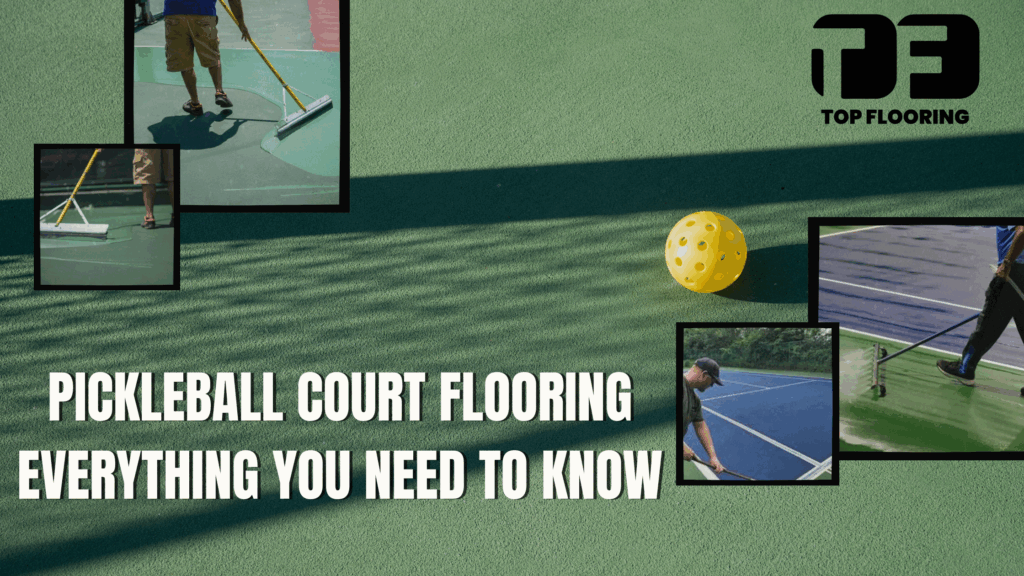
Whether planning a backyard pickleball court or a large-scale sports infrastructure project, one key element can make or break your court—the flooring. The right pickleball court flooring affects gameplay, safety, comfort, and player experience. That’s why choosing the right Pickleball court flooring and understanding the materials, installation process, and layout standards is crucial. From ball bounce and traction to resistance against weather conditions and injury risks, your pickleball court flooring guide plays a major role in long-term performance and maintenance.
In this complete guide, Top Flooring will cover everything you need to know—key materials like synthetic acrylic flooring, optimal pickleball court dimensions, and how it compares to a tennis court. Want a court surface that boosts performance, lasts for years, and thrives in Indian weather? Let’s break down everything you need to know about pickleball court flooring.
Why Synthetic Acrylic is Best for Pickleball Court Flooring?
When building a good pickleball court, acrylic flooring is the top choice for many sports facility developers, clubs and homeowners in India. But why is acrylic sports flooring so recommended?
First, acrylic coatings can withstand all weather conditions, so they are perfect for indoor and outdoor pickleball courts. Whether it’s scorching heat, heavy rain or humidity, synthetic acrylic flooring is long-lasting with minimum maintenance.
Second, the pickleball court surface material provides traction, consistent ball bounce, and more player comfort. These are the key factors in reducing injury risk and improving performance during intense play. Acrylic surfaces are UV resistant and slip resistant and can be customized with colors and logos for a premium look.
Another significant advantage is flexibility. Acrylic courts are easy to install and reconfigure, suitable for standard pickleball courts and Backyard pickleball court setups. We use only synthetic acrylic sports flooring—built for durability, safety and style. It’s the best choice for any modern pickleball court construction project.
What are the Advantages of Acrylic Pickleball Court Flooring?
Modern pickleball court surface needs more than a flat surface to meet international standards and play competitively. Here’s what defines High-Quality synthetic acrylic pickleball flooring:
- Good Traction: Acrylic sports flooring has grip and foot stability, prevents slips and falls, and allows players to move quickly during fast-paced pickleball games.
- Long-Lasting: Engineered with high-performance pickleball court material, acrylic surfaces resist cracks, fading, and wear. They can also be used for a long time, even under heavy play and frequent use, on both indoor and outdoor pickleball courts.
- Low Maintenance: Once installed, acrylic pickleball court surfaces require very little maintenance. They retain their color, grip, and playability for years, saving time and cost on frequent repairs or repainting.
- Weather Resistance: Acrylic coatings can withstand India’s climate—from scorching heat to heavy rains—making them ideal for outdoor pickleball court flooring applications without compromising on quality or safety over time.
- Comfort play: Designed with shock-absorbing properties, acrylic flooring reduces joint strain, enhances foot comfort, and helps players avoid fatigue—critical for long play and training sessions on high-quality pickleball courts.
All this is possible with acrylic courts built with advanced materials like synthetic acrylic sports flooring.
Which is the Best Flooring Material for Pickleball Court Construction?
At Top Flooring, we recommend acrylic sports flooring material for outdoor pickleball courts. Here’s why:
- Easy to Install and Reconfigure: Acrylic flooring systems are flexible and quick to install, perfect for small or custom spaces. Can be reconfigured for Backyard Pickleball Courts or multipurpose areas.
- Weather Resistant: Specially formulated to withstand all weather pickleball court flooring conditions, acrylic surfaces resist sun damage, fading and water exposure—ideal for India’s climate and perfect for outdoor pickleball court use year-round.
- Non-Slip Finish and Smooth Texture: The multilayered acrylic system provides a uniform, non-slip surface that promotes safe movement and accurate ball bounce, even during fast or aggressive play.
- Color Retention and Shock Absorption: Acrylic coatings give long-lasting color vibrancy and excellent surface grip and cushioning for visual appeal and player performance on Synthetic Pickleball Court Flooring Material.
Pickleball court flooring with acrylic coatings is designed for standard pickleball courts with non-volley zones and boundary lines.
What is the Ideal Pickleball Court Dimension?
Before you build your pickleball court, you need to know the standard pickleball court dimensions to lay it out and play correctly. A standard pickleball court is 20 feet wide by 44 feet long, half the size of a tennis court, so pickleball court flooring uses half the space of a tennis court. This is why pickleball is perfect for urban schools, residential complexes and backyard pickleball court flooring installation.
Key parts of the layout are the non-volley zone, also known as “The Kitchen”, which is 7 feet on each side of the net. This is where the gameplay strategy and player positioning happen. The court is also marked with baselines and sidelines to define the outer playing area and service boxes divided by a centerline to structure the serve-and-return.
These dimensions are the same for singles and doubles, so you can play different game on the same court. Combined with the right acrylic sports flooring, the dimensions of pickleball court will give player comfort, ball bounce, safety and a high-quality pickleball court. If you’re building a court, knowing these dimensions is step 1 to a successful and regulation-compliant build.
Pickleball Court vs. Tennis Court: What’s the Difference?
Understanding the key differences with this guide of pickleball court flooring vs. tennis courts is essential when planning a sports facility or a backyard setup.
| Feature | Pickleball Court | Tennis Court |
| Size | 20 ft x 44 ft | 36 ft x 78 ft |
| Net Height | 36” sideline, 34” center | 36” all across |
| Flooring | Synthetic acrylic flooring | acrylic flooring |
| Player Intensity | Lower-impact, more compact game | High-intensity lateral movement |
| Space Requirement | Smaller footprint | Requires larger space |
| Maintenance | Minimal maintenance with acrylic | Varies by surface type |
Pickleball involves lower-impact movements, which reduce injury risks, while tennis is more physically demanding with faster, more lateral movements. For those looking to build a high-quality pickleball court that is easily installed and reconfigured, pickleball offers a practical and space-efficient alternative to tennis.
Pickleball Court Flooring Material Comparison Table
| Material | Key Features | Pros | Cons | Best For |
|---|---|---|---|---|
| Synthetic Acrylic | Weather-resistant, seamless multi-layer coating | Excellent grip, UV-resistant, cost-effective, long-lasting | Can be hard on joints, needs professional installation | Outdoor & indoor courts |
| Cushioned Acrylic | Acrylic with added rubber or cushion layers | Shock-absorbing, better comfort, player-friendly | Slightly higher cost, installation time | Training centers, schools, long sessions |
| Modular PP Tiles | Interlocking plastic tiles (usually polypropylene) | Easy to install/move, cushioned, customizable | Can fade in sun, higher bounce inconsistency | Portable/backyard courts |
| Concrete/Asphalt Base | Solid base used under acrylic coatings | Durable, strong foundation, low material cost | Requires coating, hard on joints, cracks over time | Large-scale projects or base prep |
Which Pickleball Court Surface Should You Choose?
Use this short guide to help visitors select the right surface:
- Do you need a portable pickleball court solution?
➜ Choose: Modular PP Tiles - Do you want the most durable, weatherproof surface with low maintenance?
➜ Choose: Synthetic Acrylic Flooring - Is player comfort and injury prevention a top priority (e.g., kids, seniors, or training)?
➜ Choose: Cushioned Acrylic Flooring - Are you constructing from scratch and need a base layer?
➜ Choose: Concrete/Asphalt Base with acrylic topcoat
Factors That Influence Pickleball Court Cost
Though we won’t quote fixed prices, here are the significant factors that impact the pickleball court cost in India:
- Location & Land Prep: Uneven terrain or drainage issues require extra grading which adds to labor and material costs.
- Surface Area: A Larger court requires more material for flooring and coatings, which increases the overall cost.
- Add-ons: Fencing, lighting and seating add to the cost and the court’s functionality and safety.
- Material Choice: Premium acrylic materials offer better performance and durability at a higher initial cost.
- Construction Complexity: Custom elements like multi-sport designs or branding require extra time, special materials and labor, which adds to the cost.
Understanding these factors helps balance investment and outcome.
Why Choose Top Flooring?
At Top Flooring, we specialize in building high-quality pickleball courts using synthetic pickleball court flooring materials. Here’s what sets us apart:
- Proven track record of sports infrastructure projects across India.
- Certified acrylic sports flooring materials for better performance and durability.
- Skilled teams for smooth and efficient flooring installation.
- Turnkey services for clubs, schools, developers and communities covering design to installation.
- We don’t just install floors—we create pickleball courts that inspire active living and promote long-term engagement in sports.
Our commitment to quality and excellence ensures that every project delivers a high-quality pickleball court that provides the best experience for players. With this pickleball court flooring guide, you can be sure of a court that meets international standards and is built to last.
Conclusion
As pickleball grows in India, investing in the right court flooring is more important than ever. A well-built court with synthetic acrylic sports flooring will give you performance, comfort, longevity and low maintenance even in harsh weather. Whether you are planning a Backyard pickleball court, an institutional sports facility, or a full-scale sports infrastructure project, We have the expertise, materials, and execution you can trust.
Our high-quality pickleball court surfaces, with acrylic coatings and advanced material can be used in any environment. Don’t compromise on safety, style or performance. Choose Top Flooring for India’s no.1 in pickleball court construction and flooring innovation.
Still unsure which material is right for your court?
Contact our experts at Top Flooring for free consultation and recommendations based on your space, budget, and usage needs.
Frequently Asked Questions
Synthetic Acrylic Sports Flooring Material is best flooring for pickleball courts, it has excellent traction, weather resistance and long term durability for both indoor and outdoor pickleball courts.
A standard pickleball court is 20 feet by 44 feet but ideally you should have 30 feet by 60 feet to have space for movement and safe play zones.
Yes! At Top Flooring we offer custom backyard pickleball court solutions with minimal maintenance and easy installation for residential spaces.
Pickleball courts are smaller, require less space and use similar acrylic materials but the game has lower impact so the surface finish is slightly different focusing on comfort and grip.
Cost depends on site preparation, material choice, add-ons and court size but we provide transparent estimates based on your project requirements.
Pickleball courts are made of a concrete or asphalt base coated with synthetic acrylic layers for grip, bounce, and weather resistance. Line markings are added on top with durable acrylic paint.