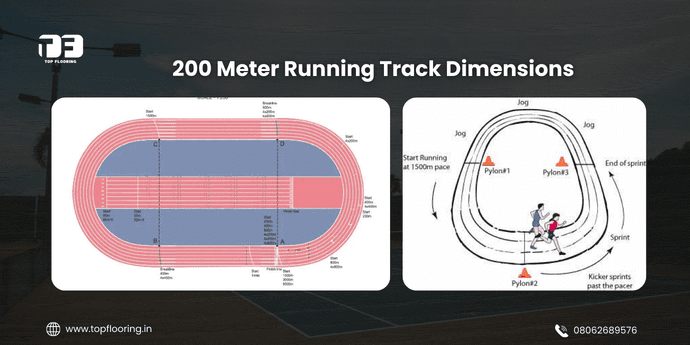
Running tracks are an essential part of athletic infrastructure in schools, universities, indoor arenas, and sports complexes. While the 400-meter track is the most widely known standard, the 200 meter running track is commonly used in indoor stadiums, training facilities, and compact sports complexes where space is limited. Understanding the 200 meter running track dimensions, lane markings, curve radius, and construction requirements is important for planners, architects, and sports facility developers.
A well-designed 200m track ensures fair competition, athlete safety, and optimal performance. From the track layout to lane width, curve measurements, and surface materials, every detail follows international athletics guidelines. This guide explains everything about 200 meter running track dimensions, including layout design, measurement standards, and construction considerations.
What Is a 200 Meter Running Track?
A 200 meter running track is a compact athletics track where the total distance around the inside lane measures 200 meters. Unlike the standard 400m outdoor track, the 200m track is typically built indoors or in facilities where space constraints make a full-size track impractical.
These tracks are often found in:
- Indoor athletics arenas
- School sports facilities
- University training centers
- Multi-sport complexes
- Professional indoor championships
Despite its smaller size, the 200m track follows strict measurement standards to ensure consistency in competitions and training. The track usually consists of two straight sections and two curved bends, similar to a 400m track but with tighter curves and shorter straights.
Standard 200 Meter Running Track Dimensions
The 200 meter running track dimensions are designed so that the total distance of the inside lane equals exactly 200 meters. The layout includes two straight sections and two semicircular curves.
Below is a simplified table showing the typical measurements used in a 200m athletics track.
| Feature | Standard Measurement |
| Total Track Length | 200 meters |
| Lane Width | 1.22 meters |
| Number of Lanes | 4 – 6 lanes (commonly) |
| Curve Radius (Lane 1) | Approximately 17–18 meters |
| Straight Length | Around 50–60 meters |
| Safety Zone | 1 meter minimum around track |
The first lane measurement is taken 30 cm from the inner edge of the track. For other lanes, measurements are taken 20 cm from the lane line.
Because the track is smaller, curve banking or elevation is sometimes used in indoor arenas to help athletes maintain speed while running through tight bends.
Layout of a 200 Meter Running Track
The layout of a 200 meter athletics track follows the same basic structure as a larger running track but is scaled down to fit indoor or smaller spaces.
A typical layout includes:
1. Two Straight Sections
The straights are where athletes achieve maximum speed. These sections are usually 50 to 60 meters long.
Straight sections are used for:
- Sprint acceleration
- Relay exchange zones
- Start and finish lines
2. Two Curved Bends
The curved sections form semicircles that connect the two straights. Because the track is compact, the curve radius is smaller than a 400m track, which makes the turns tighter.
Indoor tracks often include banked curves to help runners maintain balance and speed.
3. Start and Finish Areas
Depending on the event, start positions are staggered so that each runner covers the exact same distance around the track.
Lane Width in a 200 Meter Track
Lane width is one of the most important measurements in athletics track design. It ensures athletes have enough space to run comfortably while maintaining fairness in competition.
Standard Lane Width
The standard lane width used in athletics tracks is:
1.22 meters (4 feet)
This measurement is used across most professional and training facilities.
Number of Lanes
A 200 meter track typically includes:
- 4 lanes – used in compact training facilities
- 5 lanes – common in school or university arenas
- 6 lanes – used in professional indoor stadiums
More lanes require additional space and slightly alter the outer track diameter.
Lane Measurement Rule
Each lane has a different running distance due to the curve. To ensure fairness:
- Lane 1 is measured 30 cm from the inner curb
- Other lanes are measured 20 cm from the lane line
This method ensures that every lane equals exactly 200 meters when using staggered starting positions.
Radius of Curves in a 200 Meter Track
The curve radius is one of the most critical elements in running track design. Smaller tracks require tighter curves, which can affect athlete speed and balance.
Typical Curve Radius
For a 200 meter running track:
- Lane 1 radius: approximately 17–18 meters
This radius is significantly smaller than the 36.5 meters used in a standard 400m track.
Importance of Curve Radius
The radius determines:
- Running comfort
- Athlete safety
- Speed control
- Track geometry
If curves are too tight, athletes may struggle to maintain speed and balance. That is why many indoor tracks include banked curves.
Banked Track Design
In indoor arenas, the curve is sometimes tilted upward toward the outside lane. This design helps:
- Reduce centrifugal force
- Improve running efficiency
- Prevent slipping
Banking angles can range from 10 to 18 degrees, depending on the facility design.
Lane Markings on a 200 Meter Track
Accurate lane markings are essential for official competitions and training sessions. These markings guide athletes and ensure fair race conditions.
Standard Marking Lines
A typical 200 meter track includes:
- Lane boundary lines
- Start lines
- Finish line
- Relay exchange zones
- Hurdle markings
Line Width
All track lines typically measure:
5 cm (50 mm) wide.
Staggered Start Lines
Because outer lanes cover more distance on curves, races on a 200m track use staggered starting positions. Each lane begins at a slightly different point so that all runners complete the same distance.
Relay Exchange Zones
For relay races such as the 4×200 meter relay, designated exchange zones are marked clearly on the track to ensure proper baton passing.
Indoor vs Outdoor 200 Meter Running Track
Although most 200m tracks are built indoors, some facilities also construct outdoor versions for training or compact stadiums.
Indoor 200 Meter Track
Indoor tracks are commonly found in:
- Athletics arenas
- Universities
- Professional training facilities
Characteristics include:
- Banked curves
- Climate-controlled environment
- Synthetic surface materials
- Seating for spectators
Indoor tracks allow competitions to continue during winter and adverse weather conditions.
Outdoor 200 Meter Track
Outdoor versions are less common but may be used in:
- School sports grounds
- Small stadiums
- Training facilities
These tracks usually have flat curves instead of banked ones.
Materials Used in Running Track Construction
Modern athletics tracks are built using specialized materials designed for durability, performance, and safety.
Synthetic Running Track Surfaces
Synthetic surfaces are widely used because they provide:
- Excellent traction
- Shock absorption
- Weather resistance
- Long lifespan
Common materials include:
- Polyurethane track systems
- Synthetic rubber surfaces
- Acrylic sports flooring
Synthetic surfaces help athletes run faster while reducing the risk of injuries.

Base Layers of a Running Track
A typical running track structure includes several layers.
- Sub-base layer
Compacted soil or aggregate for stability. - Base layer
Asphalt or concrete for structural support. - Cushion layer
Rubber granules or flexible materials for shock absorption. - Top surface layer
Synthetic coating that provides grip and durability.
These layers ensure the track can withstand heavy usage and varying weather conditions.
Construction Guide for a 200 Meter Running Track
Building a 200 meter athletics track requires careful planning and precise engineering. Even small measurement errors can affect race fairness and athlete safety.
1. Site Selection
The first step is choosing a suitable location. Important factors include:
- Available land area
- Ground stability
- Drainage system
- Accessibility for athletes and spectators
Indoor tracks require additional structural planning to accommodate roof height and seating arrangements.
2. Track Design Planning
Architects and sports engineers create detailed layouts that include:
- Track geometry
- Lane configuration
- Curve radius
- Marking plans
Professional design ensures the track meets international athletics standards.
3. Base Construction
A strong base is critical for long-term durability.
The construction process includes:
- Excavation
- Sub-base compaction
- Asphalt or concrete base installation
Proper leveling ensures the track surface remains smooth and consistent.
4. Surface Installation
Once the base is prepared, the synthetic surface layers are applied. These layers provide:
- Cushioning
- Grip
- Weather resistance
Professional installation ensures uniform thickness and smooth finishing.
5. Track Marking
After the surface cures, official markings are painted. High-quality track paint is used to create durable lines that remain visible for years.
Advantages of a 200 Meter Running Track
A 200m track offers several advantages for sports facilities.
Space Efficiency
Compared to a 400m track, a 200m track requires significantly less space, making it ideal for indoor arenas and compact stadiums.
Year-Round Training
Indoor tracks allow athletes to train throughout the year regardless of weather conditions.
Multi-Sport Facility Integration
Many sports complexes integrate a 200m track with other facilities such as:
- Basketball courts
- Volleyball courts
- Gymnasiums
This maximizes the use of available space.
Ideal for Indoor Competitions
International indoor athletics championships frequently use 200m tracks because they fit within stadium structures.
Key Design Considerations for Schools and Sports Complexes
When planning a 200 meter running track, several design factors should be considered.
Safety Zones
Adequate safety areas must be provided around the track to prevent injuries during competitions.
Lighting Systems
Indoor facilities require high-quality lighting to ensure visibility during events.
Drainage (for outdoor tracks)
Outdoor tracks must include proper drainage systems to prevent water accumulation.
Surface Maintenance
Synthetic surfaces require regular cleaning and occasional resurfacing to maintain performance and durability.
Common Mistakes in Running Track Construction
Avoiding design errors is essential for building a high-quality athletics track.
Common mistakes include:
- Incorrect curve radius measurements
- Uneven base layers
- Poor drainage systems
- Inaccurate lane markings
- Using low-quality surface materials
Professional engineering and precise construction methods help prevent these issues.
Future Trends in Running Track Design
Athletics infrastructure continues to evolve with new technologies and materials.
Some emerging trends include:
- Eco-friendly track materials
- Advanced shock-absorption systems
- Smart training surfaces with performance sensors
- Improved UV-resistant coatings
These innovations help improve athlete performance while extending the lifespan of running tracks.
Conclusion
Understanding 200 meter running track dimensions is essential for designing a safe and efficient athletics facility. From lane width and curve radius to track layout and construction materials, every detail plays an important role in ensuring fair competition and athlete performance.
A properly designed 200m track typically includes 4–6 lanes, a lane width of 1.22 meters, and curve radii of approximately 17–18 meters. Whether built indoors or outdoors, modern tracks use synthetic sports surfaces that provide durability, grip, and comfort for athletes.
For schools, universities, and sports complexes with limited space, the 200 meter running track offers a practical solution for professional training and competitions. With proper planning, accurate measurements, and high-quality construction, a well-built track can serve athletes for many years while supporting the growth of athletics programs.
Frequently Asked Questions
A standard 200 meter running track measures 200 meters around the inside lane. The track typically consists of two straight sections and two curved bends. The lane width is usually 1.22 meters, and most 200m tracks include 4 to 6 lanes depending on the facility size.
The standard lane width for a 200 meter running track is 1.22 meters (4 feet). Lane measurements are taken 30 cm from the inner curb for lane 1 and 20 cm from the lane line for other lanes to ensure accurate race distances.
The typical curve radius for lane 1 in a 200 meter track is approximately 17 to 18 meters. Because the curves are tighter than those on a 400m track, many indoor tracks use banked curves to help athletes maintain speed and balance.
Most 200 meter running tracks have 4 to 6 lanes, depending on the available space and the facility design. Indoor competition tracks often include 6 lanes, while training tracks may have fewer lanes.
Modern 200 meter running tracks are commonly built using synthetic sports surfaces such as polyurethane, rubberized systems, or acrylic coatings. These materials provide better grip, shock absorption, durability, and weather resistance, making them suitable for professional training and competitions.