Everything you need to plan, build, or verify a professional badminton court court size in meters & feet, labeled court diagram, step-by-step marking guide, net height, ceiling clearance, flooring types, and shuttlecock specifications all aligned with Badminton World Federation (BWF) standards.
This guide is produced by a team with 15+ years of experience in sports court construction across India, having built and certified over 400 badminton courts for schools, commercial academies, government sports complexes, and professional facilities. All dimensions and standards are cross-referenced directly with the Badminton World Federation (BWF) Laws of Badminton (Appendix 1 Court) and the Sports Authority of India (SAI) infrastructure guidelines.
Quick Answer
A standard badminton court measures 13.4 m × 6.1 m (doubles) or 13.4 m × 5.18 m (singles). Net height: 1.55 m at posts, 1.524 m at center. All lines are 40 mm wide. Minimum ceiling: 9 m recreational, 12 m BWF tournament. Total space needed: 16–18 m × 7–9 m.
Table of contents
- Official BWF Badminton Court Dimensions
- Badminton Court Diagram with Measurements
- Step-by-Step Badminton Court Marking Guide
- Net Height & Post Specifications
- Ceiling Height – The Most Overlooked Specification in India
- Total Space Required for a Badminton Court in India
- Badminton Court Flooring Types in India
- Official Shuttlecock (Shuttle) Specifications
- Official Badminton Racket Specifications (BWF)
- Mistakes to Avoid When Building a Badminton Court in India
- Badminton vs Tennis vs Pickleball Court Size Comparison
- Conclusion
- Frequently Asked Questions
Badminton is one of the fastest racquet sports in the world, with shuttlecocks reaching speeds of over 400 km/h in professional play. At that pace, even a 10 cm deviation in court width or service line placement creates measurable differences in player positioning, shot selection, and game fairness.
For facility owners, architects, and sports managers in India, accurate court measurement is non-negotiable for four specific reasons:
- Tournament eligibility: Courts with non-BWF dimensions are disqualified from hosting state, national, or international events – even if the deviation seems minor.
- Player safety: Insufficient buffer zones around the court cause wall collisions and player injuries, increasing liability for facility operators.
- Long-term investment protection: Corrections after construction typically cost ₹40,000–₹1.5 lakh per court in India, depending on surface type.
- Training quality: Athletes training on incorrectly sized courts develop incorrect spatial judgment that hinders competitive performance.
Authority Reference
All dimensions in this guide are sourced directly from the Badminton World Federation (BWF) Laws of Badminton, Appendix 1 – Court, available at bwfbadminton.com. These are the identical standards applied at the Olympic Games, BWF World Championships, and the BAI (Badminton Association of India) National Championships.
Official BWF Badminton Court Dimensions
The following measurements apply to all standard badminton courts globally, including India. These are mandatory for any court seeking to host competitive play.
Court Size – Doubles & Singles
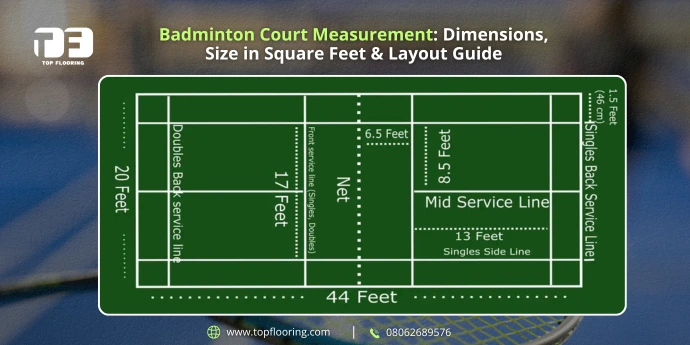
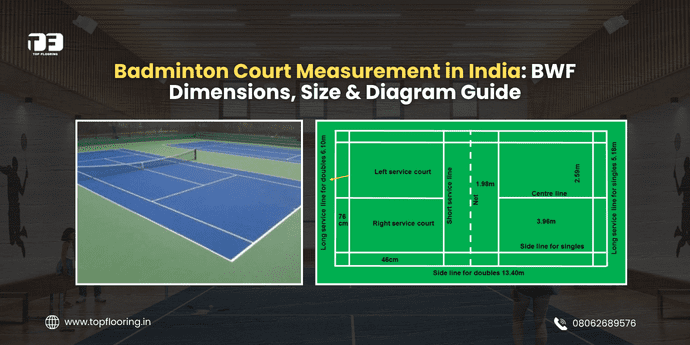
| Measurement | Meters | Feet / Inches | Centimeters |
| Court Length (both) | 13.4 m | 44 ft | 1340 cm |
| Doubles Width | 6.1 m | 20 ft | 610 cm |
| Singles Width | 5.18 m | 17 ft | 518 cm |
| Doubles Playing Area | 81.74 m² | 880 sq ft | – |
| Singles Playing Area | 69.41 m² | 747 sq ft | – |
| Court Diagonal (Doubles) | 14.723 m | 48.3 ft | – |
Net Measurements
| Net Measurement | Meters | Feet / Inches |
| Net Height at Posts | 1.55 m | 5 ft 1 in |
| Net Height at Center | 1.524 m | 5 ft 0 in |
| Net Width (Length) | 6.1 m | 20 ft |
| Net Depth | 0.76 m | 2.5 ft |
Line & Marking Dimensions
| Line / Marking | Dimension | Notes |
| All Line Widths | 40 mm (4 cm) | Mandatory – all lines including baselines, sidelines, service lines |
| Short Service Line | 1.98 m from net | Same for singles and doubles |
| Long Service Line (Doubles) | 0.76 m from baseline | Doubles only – not used in singles |
| Center Line | Full half-court length | Runs from short service line to baseline, divides left & right service courts |
| Singles Sideline | Inner sideline | 0.46 m inside the doubles sideline on each side |
| Doubles Sideline | Outer boundary | Defines full court width of 6.1 m |
Important Note
All line widths are included within the dimensions they define. For example, the 1.98 m short service line distance is measured to the near edge of the line. If a shuttlecock lands on any part of a line, it is considered “in.” Many court builders in India make the mistake of measuring to the outer edge – this creates a court that is 8 cm too long.
Badminton Court Diagram with Measurements
Below is a fully labeled badminton court diagram showing all BWF-standard dimensions, zones, and markings for both singles and doubles play. Use this as your visual reference during construction or marking.
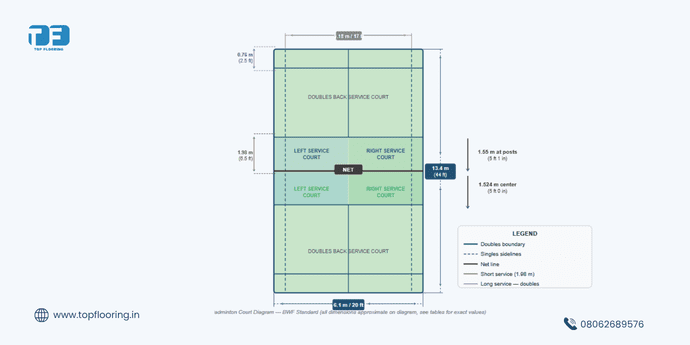
Step-by-Step Badminton Court Marking Guide
Accurate court marking is a separate skill from knowing the dimensions. Follow these steps in order for a correctly marked BWF compliant court:
Establish the baseline rectangle
Mark four corner points of the full doubles court: 13.4 m long × 6.1 m wide. Use a steel tape measure of at least 15 m for accuracy. String a chalk line between corner points to confirm straightness.
Verify with the diagonal (installer’s secret)
Measure both diagonals of the outer rectangle. Both must equal exactly 14.723 meters. If diagonals don’t match, your corners are not 90° – adjust until they do. This is the most reliable squaring method.
Mark the net line
At exactly 6.7 m from each baseline, mark the net line spanning the full 6.1 m width. The net posts sit at the outer doubles sidelines at this line.
Mark the short service lines
Measure 1.98 m from the net line toward each baseline and mark the short service line (parallel to the net, spanning the full court width of 6.1 m). This is the same on both sides.
Mark the doubles long service lines
Measure 0.76 m inward from each baseline. Mark a line parallel to the baseline spanning the full 6.1 m width. This applies only to doubles play.
Mark the center lines
From the midpoint of each short service line, draw a center line perpendicular to the net, running to the corresponding baseline. This divides each service court into left and right halves.
Mark the singles sidelines
Measure 0.46 m inward from each outer doubles sideline on both sides. Mark these inner sidelines running the full 13.4 m length of the court. These are used only during singles play.
Apply line paint
Use masking tape along each chalk line to create crisp 40 mm edges. Apply two coats of court-grade line marking paint for visibility and durability. White or yellow lines on green or blue surfaces are the BWF recommendation.
Pro Tip from Court Builders
For permanent synthetic acrylic surfaces, use a line marking machine calibrated to 40 mm to ensure consistent line width. For wooden sports floors, apply a primer coat before the line paint to prevent peeling at high-traffic intersection points like the T-junction of the center line and short service line.
Net Height & Post Specifications
The net is the most actively interacted-with fixture on a badminton court. Incorrect net height affects every rally, making it one of the most critical elements to get right.
| Specification | Measurement | Notes |
| Height at posts | 1.55 m (5 ft 1 in) | Posts positioned on the doubles sideline |
| Height at center | 1.524 m (5 ft) | Net must be tightly stretched – no sagging |
| Net depth (top to bottom) | 0.76 m (2.5 ft) | Must cover full post height |
| Net length | 6.1 m (20 ft) | Matches full doubles court width |
| Top tape width | 75 mm (7.5 cm) | White or yellow tape folded over the top cord |
| Mesh size | 15–20 mm | Must prevent shuttlecock from passing through |
Common Mistake
In India, many budget-installed courts use adjustable-height net posts without locking mechanisms. Under repeated play, the post height drops below 1.55 m, making net calls inconsistent. Always use fixed-height steel posts with floor anchors – the BWF prohibits posts that alter net height during play.
Ceiling Height – The Most Overlooked Specification in India
Ceiling height is the single most commonly ignored specification when building badminton courts in India. Yet it fundamentally determines whether standard badminton can actually be played. A high clear – one of the most basic shots in badminton – reaches heights of 8–9 meters at standard tempo. A low ceiling makes this shot physically impossible, destroying the fundamentals of the game.
| Court Type | Minimum Ceiling Height | Status |
| BWF International / National Tournament | 12 meters (39.4 ft) | Mandatory |
| State / District Competition | 9–10 meters | Recommended |
| Club / Academy Court | 9 meters (29.5 ft) | Standard |
| School / Training Court | 7.5 meters | Minimum acceptable |
| Absolute Minimum | 6 meters | Not recommended – limits gameplay severely |
Real Mistake Seen Across India
Many facility owners in India repurpose warehouses, garages, or low-ceilinged halls with 5–6 m clearances. The court markings physically fit, but standard defensive clears, smash returns, and high serves become impossible. Players trained in such facilities develop poor shot selection habits. Always verify ceiling clearance to a minimum of 7.5 m before committing to any indoor location.
Lighting Height Consideration
Lighting fixtures must be positioned along the long sides of the court – never directly overhead. Overhead lights create blindness during overhead shots like smashes and clears. For recreational courts, a minimum of 500 lux at floor level is required. For professional competition, 1000+ lux is standard, with no flickering and a Color Rendering Index (CRI) of 80+.
Total Space Required for a Badminton Court in India
The BWF playing area alone is never sufficient. Safe buffer zones are mandatory around every court for player run-off, line umpires, and emergency egress.
| Zone | Playing Area | With Safety Margins | For Multi-Court Facility |
| Single Court Length | 13.4 m | 16–18 m | 16 m + 1.5 m between courts |
| Single Court Width | 6.1 m | 7.5–9 m | 7.5 m per court |
| End Clearance (each end) | – | 1.3–2.0 m | 1.5 m minimum |
| Side Clearance (each side) | – | 0.7–1.5 m | 1.0 m between courts |
| Ceiling Height | – | 9 m min | 12 m for tournament |
Planning Formula for Multi-Court Facilities
To calculate total hall width for N courts: (6.1 × N) + (1.5 × (N-1)) + 2.0 meters. For 4 courts: (6.1 × 4) + (1.5 × 3) + 2.0 = 24.4 + 4.5 + 2.0 = 30.9 meters minimum hall width.
Badminton Court Flooring Types in India
Badminton court Flooring is the most physically demanding component of a badminton court. The wrong surface causes joint injuries, slips, and inconsistent shuttle bounce – all of which affect play quality and facility liability.
| Flooring Type | Cost (per sq ft) | Shock Absorption | Lifespan | BWF Approved |
| Synthetic Acrylic | ₹80–₹130 | Medium | 8–12 years | Yes |
| PU (Polyurethane) Cushion | ₹150–₹220 | High | 10–15 years | Yes |
| Wooden Sprung Floor | ₹200–₹350 | Very High | 15–25 years | Yes (BWF Preferred) |
| Vinyl / PVC Mat | ₹60–₹110 | Low–Medium | 5–8 years | Recreational only |
| Concrete / Ceramic | ₹30–₹60 | None | – | Not approved |
Never Use Concrete or Ceramic for Badminton
Concrete and ceramic tile floors have zero shock absorption. Repeated jumping, landing, and lateral movement on these surfaces causes knee, ankle, and hip joint stress within months of play. Orthopedic studies consistently link hard-surface court sports to early joint degeneration. Synthetic acrylic or PU cushion flooring is the minimum acceptable standard for any regular badminton play in India.
Official Shuttlecock (Shuttle) Specifications
The shuttlecock is the most aerodynamically complex piece of equipment in any racquet sport. BWF specifications exist to ensure consistent flight trajectory, speed, and durability across all playing conditions.
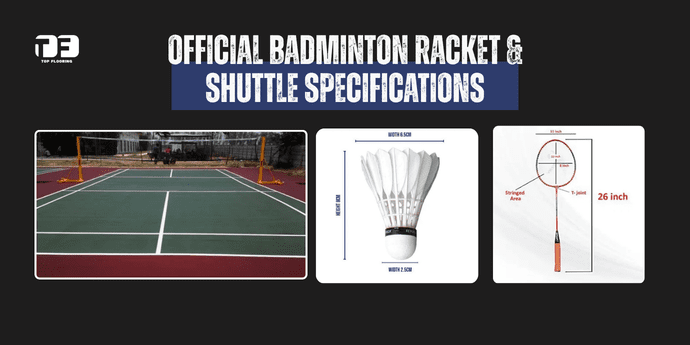
| Specification | Measurement |
| Weight | 4.74 to 5.50 grams |
| Number of feathers | 16 feathers (natural) or equivalent synthetic vanes |
| Feather length | 62 mm to 70 mm (from tip to top of base) |
| Feather spread (top diameter) | 58 mm to 68 mm |
| Cork base diameter | 25 mm to 28 mm |
| Cork base shape | Rounded hemisphere |
Shuttlecock Speed Selection for India
Speed selection matters as much as shuttle quality. The number on the shuttle (75–79) indicates the speed class, calibrated for temperature and altitude. Incorrect speed selection makes the shuttle fly too short or too long, making standard shots impossible.
| Speed Number | Suitable Conditions | Indian Cities |
| 75 | Hot & humid (>30°C, sea level) | Chennai, Mumbai, Kochi, Kolkata (summer) |
| 76 | Warm & moderate (25–30°C) | Hyderabad, Bengaluru, Pune, Ahmedabad |
| 77 | Temperate (20–25°C) | Delhi (winter), Jaipur, Lucknow |
| 78 | Cool (15–20°C) | Delhi (Dec–Jan), Chandigarh, Bhopal (winter) |
| 79 | Cold or high altitude (<15°C / >1000m) | Shimla, Dehradun, Darjeeling, Ooty |
How to Test Shuttle Speed
Hit a full underhand stroke from the baseline. The shuttle should land within the doubles long service zone (between the doubles long service line and the baseline) on the other side. If it falls short – use a faster speed number. If it overshoots – use a slower number.
Official Badminton Racket Specifications (BWF)
| Specification | Measurement |
| Maximum overall length | 680 mm (26.7 inches) |
| Maximum overall width | 230 mm (9.06 inches) |
| Stringed area – length | 280 mm maximum |
| Stringed area – width | 220 mm maximum |
| Typical playing weight | 70–95 grams (U notation: 3U = 85–89g, 4U = 80–84g) |
| String tension range | 18–30 lbs (typical); 24–28 lbs for advanced players |
| Frame material | Must be flat and even – no attached objects except handle grip |
Mistakes to Avoid When Building a Badminton Court in India
Mistake 1: Ignoring Ceiling Height
The most expensive mistake. Warehouses and multipurpose halls with 5–6 m ceilings look usable – but standard badminton requires at minimum 7.5 m and ideally 9 m. Verify height before site selection, not after construction begins.
Mistake 2: No Safety Buffer Zones
Courts built exactly to 13.4 m × 6.1 m with walls on all four sides create a dangerous environment. Players running for shots collide with walls, causing injuries and liability. Always plan for end clearance of minimum 1.3 m and side clearance of 0.7 m.
Mistake 3: Using Concrete or Ceramic Flooring
A budget decision that costs far more in player injuries and complaints. Concrete has zero shock absorption. It causes chronic knee and ankle problems within months of regular play. Synthetic acrylic is the minimum standard – the cost difference over a 10-year period is negligible compared to medical costs or lost bookings from injuries.
Mistake 4: Sagging or Incorrectly Tensioned Net
A net that droops below 1.524 m at center changes which shots clear the net – fundamentally altering gameplay and making training non-transferable to competition. Use tensioned steel posts with floor anchors and verify net height with a measuring rod before every competitive session.
Mistake 5: Lines Narrower Than 40 mm
Many painters use 25–30 mm line tape because it is cheaper and easier to handle. BWF mandates 40 mm lines. Narrower lines alter line-ball decisions, which affects fairness in match play and disqualifies the court from competitive hosting.
Mistake 6: Overhead Lighting
Lights positioned directly above the court blind players during overhead shots – the most critical shots in the game. Position all lighting along the long sides of the court at 45–60° angles to the playing surface, at a height of at least 8 m.
Mistake 7: Skipping the Diagonal Check
Many court builders measure the four sides correctly but skip the diagonal verification. A rectangle where both sides are correct but corners are not 90° creates a parallelogram – which looks right but has incorrect internal service court geometry. Always measure both diagonals and confirm they match at 14.723 m before painting lines.
Cost Insight
Correcting an incorrectly built badminton court in India costs ₹40,000–₹1.5 lakh per court, depending on surface type and the extent of correction required. In 80% of the court corrections we have handled, the root cause was one of the seven mistakes above – all preventable at zero additional cost during initial construction.
Badminton vs Tennis vs Pickleball Court Size Comparison
| Sport | Length | Width (Doubles) | Net Height (Center) | Total Space Needed |
| Badminton | 13.4 m (44 ft) | 6.1 m (20 ft) | 1.524 m (5 ft) | 16 m × 7.5 m |
| Pickleball | 13.4 m (44 ft) | 6.1 m (20 ft) | 0.914 m (3 ft) | 15 m × 7 m |
| Tennis | 23.77 m (78 ft) | 10.97 m (36 ft) | 0.914 m (3 ft) | 36 m × 18 m |
| Squash | 9.75 m (32 ft) | 6.4 m (21 ft) | N/A (wall) | 12 m × 8 m (enclosed) |
Badminton and pickleball courts share the same outer dimensions – making multi-sport court design highly feasible for Indian facilities looking to maximize space utilization.
Conclusion
Accurate badminton court measurement is the foundation of every high-quality sports facility in India. From BWF certified court dimensions and 40 mm line markings to net height, ceiling clearance, and shuttlecock speed selection every measurement has a purpose and a consequence when ignored.
The seven mistakes detailed in this guide are responsible for the vast majority of court corrections we see across India. Avoiding them costs nothing extra during initial construction fixing them post-build can cost ₹1.5 lakh or more per court.
Use this guide alongside the official BWF Laws of Badminton (Appendix 1) as your construction reference. And if you need a court dimension PDF, diagrams, or measurement checklists bookmark this page as your primary resource.
Frequently Asked Questions
A badminton court is 13.4 m long and 6.1 m wide (doubles). For singles, width is 5.18 m as per Badminton World Federation.
The court is 44 feet long and 20 feet wide for doubles (approximately 880 sq ft). Singles width is 17 feet (approximately 748 sq ft).
The net is 1.55 meters (5 ft 1 in) at the posts and 1.524 meters (5 ft) at the center. The slight dip at the center is due to the weight of the net the posts maintain the higher measurement on both sides.
For recreational and club courts, a minimum of 9 meters is standard. BWF-sanctioned competition events require 12 meters of clear ceiling height. Courts below 7.5 m ceiling are not suitable for standard badminton play as overhead shots become impossible.
All lines – baselines, sidelines, service lines, and center lines – must be exactly 40 mm (4 cm) wide per BWF regulations. The lines are considered part of the area they bound, so any shuttle landing on a line is “in.”
Including safety buffer zones, a minimum total area of 16 m × 7 m is required for a single court. For professional facilities, 18 m × 9 m is recommended. Multi-court halls require additional side clearance of 1.0–1.5 m between adjacent courts.