Introduction
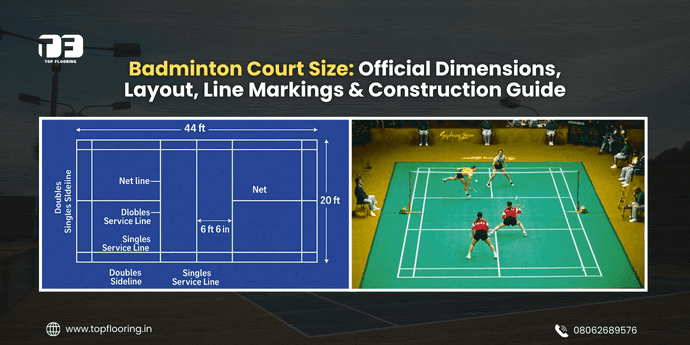
The official badminton court size defined by the Badminton World Federation (BWF) is 13.4 meters in length and 6.1 meters in width for doubles matches, while singles matches use the same length but a narrower width of 5.18 meters. The net height is 1.55 meters at the posts and 1.524 meters at the center. These precise measurements are used worldwide for professional tournaments, training facilities, and sports complexes.
Understanding the correct badminton court dimensions, layout, line markings, and construction requirements is essential for architects, sports infrastructure planners, schools, stadium developers, and sports facility owners. A properly designed badminton court ensures fair gameplay, optimal player movement, and long-term surface durability.
This comprehensive guide explains badminton court size, layout, markings, flooring materials, construction process, lighting, maintenance, and design considerations, helping sports infrastructure projects meet international standards.
What Is the Standard Badminton Court Size?
Badminton courts are designed according to international standards to maintain consistency in competitions and training facilities. These standards ensure that players around the world compete under identical conditions.
The governing body responsible for these standards is the Badminton World Federation.
Official Badminton Court Dimensions
| Feature | Measurement |
| Court Length | 13.4 meters |
| Court Width (Doubles) | 6.1 meters |
| Court Width (Singles) | 5.18 meters |
| Net Height at Posts | 1.55 meters |
| Net Height at Center | 1.524 meters |
| Short Service Line Distance | 1.98 meters from the net |
| Long Service Line (Doubles) | 0.76 meters inside back boundary |
These measurements define the international standard badminton court size used in tournaments, sports academies, and professional training facilities.
Why Precision in Badminton Court Size Matters
Badminton is a fast-paced sport that requires precise court dimensions for accurate gameplay.
Fair Competition
Standardized measurements ensure that:
- Players compete on identical courts
- Tournament conditions remain consistent worldwide
- Strategic gameplay remains balanced
Even small dimension errors can impact gameplay dynamics.
Player Safety
Correct court dimensions provide sufficient movement space for players. This prevents collisions with surrounding structures or other players.
Performance Optimization
Professional badminton players rely on consistent court measurements to execute precise shots, footwork patterns, and tactical plays.
Badminton Court Layout Explained
A badminton court has a rectangular layout divided by a central net. The court is further divided into several zones and service areas.
Key Areas of the Court
Baseline
The baseline marks the back boundary of the court. Any shuttle landing beyond this line is considered out.
Sidelines
Two sets of sidelines exist:
- Inner sidelines for singles matches
- Outer sidelines for doubles matches
Service Courts
Each side of the court contains two service courts:
- Left service court
- Right service court
Players must serve diagonally into the opponent’s service court.
Center Line
The center line divides the service court into two halves.
Badminton Court Lines and Markings
Court markings guide players during gameplay and determine valid service areas.
Standard Line Width
All badminton court lines must be 40 millimeters (4 cm) wide.
Important Court Lines
| Line | Purpose |
| Baseline | Back boundary of the court |
| Doubles Sideline | Outer boundary for doubles matches |
| Singles Sideline | Inner boundary for singles matches |
| Short Service Line | Minimum distance for a valid serve |
| Long Service Line (Doubles) | Doubles service boundary |
| Center Line | Divides service courts |
These lines ensure accurate judgment of shots and fair gameplay.
Singles vs Doubles Badminton Court Dimensions
The same court supports both singles and doubles matches with minor differences in playable areas.
Comparison of Court Dimensions
| Match Type | Length | Width |
| Singles | 13.4 meters | 5.18 meters |
| Doubles | 13.4 meters | 6.1 meters |
Singles Court
Singles matches use the inner sidelines, reducing the court width.
Characteristics:
- Narrower court
- Longer service area
- Greater emphasis on precision shots
Doubles Court
Doubles matches use the outer sidelines, providing a wider playing area.
Characteristics:
- Wider court
- Shorter service area
- Faster-paced gameplay
Badminton Net Height and Placement
The badminton net divides the court into two equal halves and must follow precise specifications.
Net Dimensions
| Feature | Measurement |
| Net Height at Posts | 1.55 meters |
| Net Height at Center | 1.524 meters |
| Net Width | 6.1 meters |
Net posts are positioned on the doubles sidelines, regardless of whether singles or doubles matches are played.
Clearance and Safety Run-Off Areas
Proper clearance space around the badminton court is essential for safe gameplay.
Recommended Safety Clearance
| Area | Recommended Space |
| Side clearance | Minimum 1.5 meters |
| Back clearance | Minimum 2 meters |
| Ceiling height | Minimum 9 meters |
These safety zones allow players to move freely while chasing shuttle shots.
Indoor vs Outdoor Badminton Courts
Badminton courts are primarily designed for indoor use.
Indoor Courts
Professional badminton tournaments and training facilities use indoor courts because they provide:
- Wind-free environment
- Consistent lighting
- Controlled temperature
- Better surface durability
Indoor courts also allow precise shuttle movement.
Outdoor Courts
Outdoor badminton courts are mainly used for recreational play.
Challenges include:
- Wind affecting shuttle trajectory
- Surface wear from weather conditions
- Reduced gameplay precision
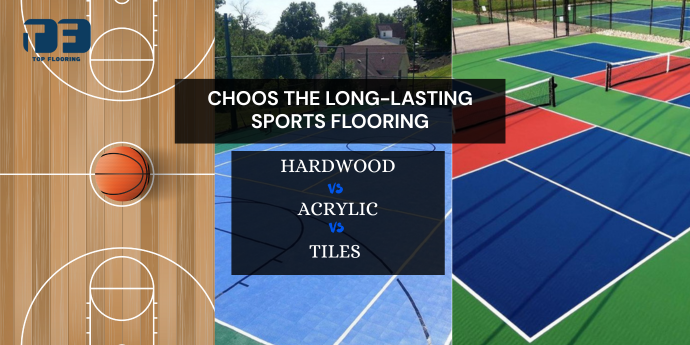
Court Surface Materials: The Foundation of the Game
The playing surface significantly affects player performance and safety.
Wooden Sports Flooring
Traditional badminton courts often use hardwood flooring.
Advantages:
- Excellent shock absorption
- Professional tournament standard
Limitations:
- High cost
- Intensive maintenance
PVC Sports Flooring
PVC flooring is widely used in indoor sports halls.
Benefits include:
- Good grip
- Easy installation
- Moderate cost
Synthetic Acrylic Sports Flooring
Synthetic acrylic flooring is increasingly used in sports complexes and multi-purpose courts.
Benefits include:
- High durability
- UV resistance
- Low maintenance
- Multi-sport compatibility
Why Synthetic Acrylic Flooring Is Popular
Modern sports facilities often prefer synthetic acrylic sports flooring systems.
Key Advantages
Durability
Acrylic surfaces withstand heavy usage and environmental exposure.
Slip Resistance
The textured coating provides better traction for players.
Weather Resistance
Acrylic surfaces resist UV rays and temperature variations.
Cost Efficiency
Compared to hardwood floors, acrylic systems are more affordable.
Multi-Sport Compatibility
The same surface can support badminton, tennis, basketball, and pickleball courts.
These benefits make acrylic surfaces ideal for schools, sports complexes, and community facilities.
How to Construct a Badminton Court
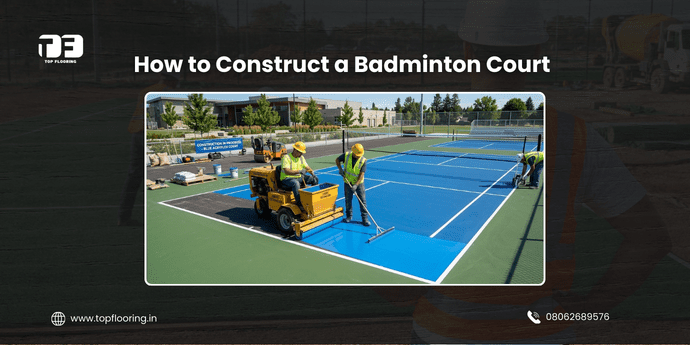
Building a professional badminton court requires precise planning and construction.
Step 1: Site Preparation
Select a location with adequate space and stable ground conditions.
Indoor courts require a minimum ceiling height of 9 meters.
Step 2: Base Construction
The base layer supports the court surface.
Typical base materials include:
- Concrete slabs
- Asphalt layers
- Compacted aggregate foundations
A level base ensures smooth gameplay.
Step 3: Surface Installation
The selected flooring system is installed over the base.
Layers may include:
- Cushion layer
- Surface coating
- Anti-slip finishing
Step 4: Line Marking
Professional sports paint is used to apply precise court markings.
Accurate marking ensures compliance with international badminton standards.
Step 5: Net Installation
Posts and net are installed according to official height specifications.
Badminton Court Construction Cost Considerations
The cost of building a badminton court varies depending on several factors.
Major Cost Components
| Component | Description |
| Ground preparation | Leveling and base construction |
| Flooring system | Acrylic, PVC, or wood |
| Court markings | Professional sports paint |
| Lighting system | Indoor lighting installation |
| Accessories | Nets, posts, padding |
Indoor stadium courts typically require higher investment due to structural and lighting requirements.
Lighting Standards for Badminton Courts
Lighting plays an important role in badminton gameplay.
Key Lighting Requirements
- Uniform illumination across the court
- Minimum glare to protect player vision
- Adequate brightness for shuttle visibility
Professional courts typically require 500 to 1000 lux lighting levels depending on competition standards.
Maintenance of a Badminton Court
Proper maintenance extends the life of sports surfaces.
Regular Cleaning
Dust and debris should be removed regularly to maintain traction.
Surface Inspection
Check for cracks, peeling coatings, or worn markings.
Repainting Lines
Court lines may require repainting after long-term use.
Footwear Policy
Players should use proper indoor sports shoes to prevent surface damage.
Common Mistakes During Court Construction
Poor planning can lead to long-term performance issues.
Common mistakes include:
- Incorrect court measurements
- Uneven surface base
- Low-quality flooring materials
- Poor lighting design
- Insufficient clearance space
Professional construction methods help avoid these issues.
Future Trends in Badminton Court Design
Sports infrastructure is evolving with new technologies.
Smart Sports Surfaces
Modern courts may include sensors for player performance analysis.
Sustainable Materials
Eco-friendly flooring systems are becoming increasingly popular.
Multi-Sport Facilities
Sports complexes now integrate multiple sports courts on shared surfaces.
These innovations improve durability and athlete experience.
Conclusion
The badminton court size and layout follow precise international standards established by the Badminton World Federation to ensure fair and consistent gameplay. A standard court measures 13.4 meters in length, with widths of 6.1 meters for doubles and 5.18 meters for singles, along with specific service lines, boundary markings, and net height regulations.
For sports complexes, schools, and stadium developers, accurate court dimensions combined with high-quality sports flooring materials are essential for long-term performance. Modern synthetic acrylic sports flooring systems offer durability, weather resistance, and low maintenance, making them a practical solution for professional badminton facilities.
A well-designed badminton court not only enhances player performance but also supports the development of high-quality sports infrastructure.
Frequently Asked Questions (FAQs)
The official badminton court size is 13.4 meters long and 6.1 meters wide for doubles matches, while singles matches use a width of 5.18 meters.
The badminton net height is 1.55 meters at the posts and 1.524 meters at the center.
Badminton court lines must be 40 mm wide according to official regulations.
Common flooring options include wood, PVC sports flooring, and synthetic acrylic surfaces, depending on the facility design.
A clearance of 1.5 meters on the sides and 2 meters at the back is recommended.