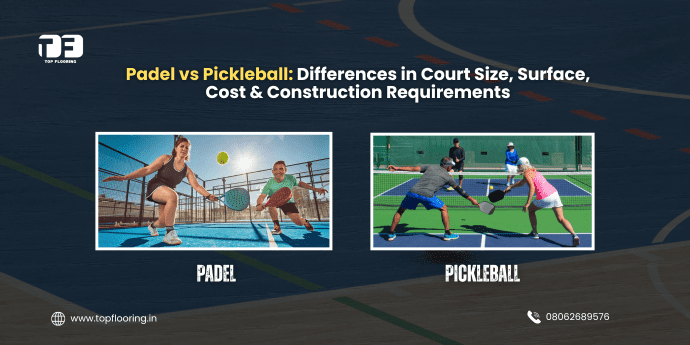
The rapid rise of modern racket sports has created a major discussion across India’s sports infrastructure industry — Padel vs Pickleball: which one should you build?
Both sports are growing in popularity across residential communities, schools, clubs, and commercial sports complexes. However, while they may appear similar at first glance, they differ significantly in:
- Court dimensions
- Surface systems
- Construction complexity
- Investment cost
- Maintenance requirements
- Long-term scalability
For developers, facility planners, and investors, understanding these structural and performance differences is essential before committing to construction.
This comprehensive guide explores padel vs pickleball from a gameplay, engineering, flooring, and financial perspective — helping decision-makers choose the right sport for their facility.
Introduction: Understanding the Core Difference Between Padel vs Pickleball
Padel and pickleball are both paddle-based racket sports, but their structural foundations are very different.
Padel is played inside an enclosed court surrounded by glass and steel mesh walls. The walls are part of active gameplay, allowing the ball to rebound during rallies.
Pickleball, on the other hand, is played on an open hard court similar in layout to a smaller tennis court, with a clearly marked non-volley zone near the net.
The core differences lie in:
- Open vs enclosed court structure
- Turf vs hard acrylic surface
- Construction investment
- Maintenance intensity
- Space requirements
These distinctions directly affect how each sport should be planned, designed, and built.
Is Padel Easier to Learn Than Pickleball?
Both sports are beginner-friendly, but accessibility differs slightly.
Pickleball is generally easier for first-time players because:
- The ball travels slower.
- The court is smaller.
- Rules are simple to grasp.
- It accommodates players of all age groups.
Padel, while also social and engaging, requires players to understand:
- Wall rebounds
- Strategic positioning
- Doubles coordination (as it is always played in pairs)
For schools and community centers introducing a new sport, pickleball often has a shorter learning curve.
Which Sport Is More Physically Demanding: Padel or Pickleball?
Padel typically involves:
- Continuous lateral movement
- Quick direction changes
- Rebound anticipation
- Extended rallies
Pickleball emphasizes:
- Quick reflexes
- Controlled footwork
- Precision over power
Because padel involves more explosive movement and dynamic footwork, its surface system must offer adequate shock absorption and traction. Pickleball flooring focuses more on bounce consistency and surface stability.
Does Court Surface Affect Gameplay More in Padel or Pickleball?
Surface affects both sports significantly, but in different ways.
In padel:
- Turf density influences ball speed.
- Sand infill impacts traction.
- Surface cushioning affects joint stress.
In pickleball:
- Acrylic texture determines bounce height.
- Surface smoothness affects spin control.
- UV stability impacts long-term performance.
In both cases, flooring selection is a technical decision that directly affects gameplay quality and player safety.
Can One Court Design Support Both Padel and Pickleball?
No.
Padel courts require:
- Steel structural framework
- Tempered glass walls
- Artificial turf system
- Engineered enclosure
Pickleball courts require:
- Reinforced concrete base
- Acrylic sports flooring
- Open court layout
While pickleball courts can be integrated into multi-sport complexes, padel requires a fully dedicated structural installation.
Why Is Flooring Often Overlooked in the Padel vs Pickleball Debate?
Many investors focus on:
- Sport popularity
- Equipment trends
- Social appeal
However, flooring determines:
- Surface durability
- Bounce consistency
- Player injury risk
- Maintenance costs
- Lifespan of the court
A poorly prepared sub-base or low-quality surface system can significantly reduce court longevity, regardless of how popular the sport becomes.
The Global Rise of Padel vs Pickleball
Padel has gained enormous popularity across Europe, especially Spain, and is expanding into premium sports clubs in major cities worldwide.
Pickleball has grown rapidly in the United States and is seeing accelerated adoption in India due to its low setup cost and compact footprint.
In India specifically:
- Pickleball is expanding into residential societies and schools.
- Padel is entering high-end sports clubs and premium recreational spaces.
This difference in growth pattern reflects the contrast in construction cost and accessibility.
What Is Padel? A Complete Overview
Padel is a fast-paced doubles sport played on a rectangular enclosed court. It blends elements of tennis and squash and incorporates wall rebounds into gameplay.
Padel Court Structure
A standard padel court includes:
- Reinforced concrete slab foundation
- Artificial turf with sand infill
- Tempered glass back walls
- Steel mesh side walls
- Integrated lighting system
The enclosure is essential to gameplay and significantly increases construction complexity.
Surface Expectations in Padel
The artificial turf system must provide:
- Grip for quick lateral movement
- Controlled ball speed
- Shock absorption
- Drainage capability for outdoor installations
Turf systems require ongoing sand leveling and periodic replacement.
What Is Pickleball? A Complete Overview
Pickleball combines elements of tennis, badminton, and table tennis. It can be played in singles or doubles format and is known for being highly inclusive.
Pickleball Court Design
A pickleball court typically includes:
- Concrete or asphalt base
- Multi-layer synthetic acrylic coating
- Clearly marked non-volley zone
- Central net system
Surface Requirements
Acrylic sports flooring provides:
- Uniform ball bounce
- Slip resistance
- UV resistance
- Customizable color options
- Long-term weather durability
Because there are no structural walls, installation is simpler and faster compared to padel.
Padel vs Pickleball: Core Gameplay Differences
| Factor | Padel | Pickleball |
| Court Type | Enclosed | Open |
| Wall Rebounds | Yes | No |
| Format | Doubles only | Singles & Doubles |
| Movement Pattern | Dynamic & high intensity | Controlled & strategic |
| Surface Type | Artificial turf | Acrylic hard court |
Gameplay style directly influences flooring stress patterns and maintenance frequency.
Padel Court Design Explained
Padel court construction involves structural engineering and precise installation.
Critical factors include:
- Glass alignment
- Turf quality
- Structural stability
- Drainage design
Because the ball frequently contacts walls, consistent surface leveling is crucial.
Why Flooring Matters More in Padel
Uneven turf or poor sand distribution can alter ball bounce and reduce gameplay quality. Surface preparation must meet sport-specific standards.
Pickleball Court Design Explained
Pickleball courts focus on surface flatness and coating precision.
Key Flooring Demands
- Even concrete base
- Crack-resistant foundation
- Anti-slip acrylic finish
- Accurate line markings
Surface uniformity is critical for maintaining bounce accuracy.
Padel vs Pickleball Court Dimensions: Measurements That Define the Game
Standard Padel Court Dimensions
- 20 meters length
- 10 meters width
- Total playing area: 200 square meters
Standard Pickleball Court Dimensions
- 13.41 meters length
- 6.10 meters width
- Total playing area: 81.8 square meters
Why Measurements Matter for Court Flooring
Correct dimensions influence:
- Surface expansion planning
- Drainage slope
- Joint placement
- Structural alignment
Precision ensures tournament-ready standards and long-term durability.
Synthetic Acrylic Flooring: The Common Foundation
While padel uses turf and pickleball uses hard acrylic coatings, both rely on a stable concrete base.
Synthetic acrylic flooring systems offer:
- UV resistance
- Weather durability
- Color customization
- Cost efficiency
- Multipurpose flexibility
For pickleball and other hard courts, acrylic systems remain a preferred solution in Indian climatic conditions.
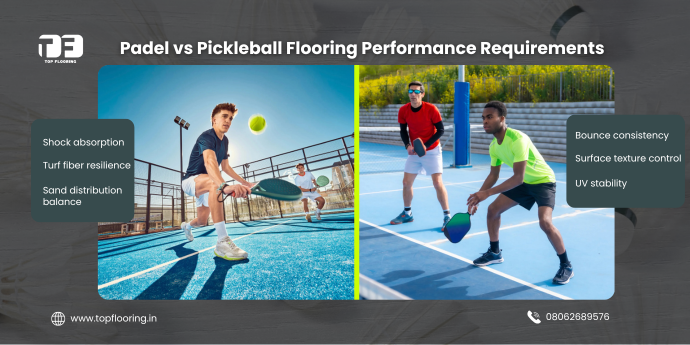
Padel vs Pickleball Flooring Performance Requirements
Padel Flooring Focus
- Shock absorption
- Turf fiber resilience
- Sand distribution balance
- Drainage compatibility
Pickleball Flooring Focus
- Bounce consistency
- Surface texture control
- UV stability
- Crack resistance
Slip Resistance & Player Safety Considerations
Both sports demand surfaces that prevent slipping during sudden stops.
High-quality acrylic coatings incorporate textured layers that improve traction while maintaining bounce consistency.
In padel, proper sand distribution enhances grip.
Weather Resistance & Outdoor Play
Indian climate presents challenges such as:
- High temperatures
- UV exposure
- Monsoon rainfall
- Surface expansion and contraction
UV-stable acrylic coatings and proper drainage systems are critical for long-term outdoor performance.
Indoor vs Outdoor Courts: Padel vs Pickleball
Padel courts are commonly installed outdoors but require weather-resistant glass panels.
Pickleball courts can be installed both indoors and outdoors. Outdoor courts require UV-resistant coatings, while indoor installations prioritize surface smoothness and controlled lighting.
Maintenance & Long-Term Surface Performance
Routine Care for Padel
- Sand brushing
- Turf cleaning
- Glass maintenance
- Structural inspection
Routine Care for Pickleball
- Surface washing
- Minor crack repair
- Recoating every 4–6 years
Lower maintenance needs often make pickleball more attractive for schools and housing societies.
Multi-Sport Facilities: Choosing Between Padel vs Pickleball
Pickleball integrates easily into multi-sport complexes and can share facilities with basketball or tennis courts through adaptable acrylic systems.
Padel requires dedicated space and cannot be easily integrated into multipurpose court designs.
Expert Tips: Choosing the Right Flooring System
- Ensure proper sub-base compaction.
- Use UV-resistant materials for outdoor courts.
- Confirm accurate slope for drainage.
- Avoid compromising on surface thickness.
- Work with experienced sports flooring professionals.
Professional planning significantly reduces long-term maintenance costs.
Common Myths Around Padel vs Pickleball Courts
Myth: Any flat surface can work for pickleball.
Reality: Precision leveling and acrylic layering are essential.
Myth: Turf never needs replacement.
Reality: Sand leveling and turf wear require monitoring.
Myth: Court size does not affect performance.
Reality: Dimension accuracy directly impacts gameplay quality.
The Future of Padel vs Pickleball in India
Pickleball’s compact footprint and affordability make it highly scalable across Indian cities.
Padel is steadily entering premium club environments and may grow in metropolitan regions.
As sports infrastructure continues expanding in India, pickleball is expected to dominate community-level adoption, while padel may remain a premium niche sport.
Conclusion: Padel vs Pickleball — Choosing the Right Court Surface
Choosing between padel and pickleball depends on:
- Available land
- Budget constraints
- Target audience
- Maintenance capacity
- Long-term investment goals
Padel delivers a premium enclosed experience but requires higher capital and structural commitment.
Pickleball offers faster installation, lower investment, scalable growth, and compatibility with synthetic acrylic sports flooring systems.
Ultimately, success lies in thoughtful planning, accurate dimension execution, and high-quality surface engineering.
A well-built court is not just about following trends — it is about creating a durable, safe, and high-performance sports environment for years to come.
Frequently Asked Question
Padel is played inside an enclosed glass court with walls that are part of the game, while pickleball is played on an open hard court without walls. Padel uses turf; pickleball uses acrylic flooring.
Yes. A padel court (20m x 10m) is more than twice the size of a pickleball court (13.41m x 6.10m), so it requires more space.
Padel is more expensive due to steel structures, glass walls, and turf. Pickleball is more affordable and easier to construct.
Synthetic acrylic sports flooring over a concrete base is best. It provides good bounce, grip, and weather resistance.
Pickleball is usually better because it needs less space, lower investment, and simpler maintenance.