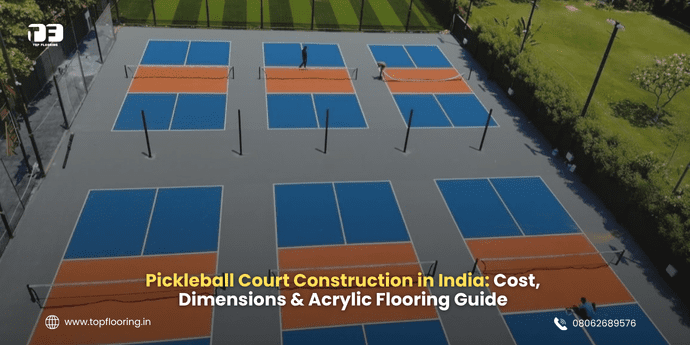
Pickleball court construction involves building a 20 ft × 44 ft (6.1 m × 13.4 m) playing surface with proper markings, base preparation, and durable flooring such as synthetic acrylic. In India, the average cost ranges from ₹4.5 lakh to ₹12 lakh depending on surface type, site conditions, and accessories.
This guide provides a complete expert-level breakdown of pickleball court construction, including dimensions, layout, materials, acrylic court flooring benefits, and cost insights for 2026.
What is Pickleball Court Construction?
Pickleball court construction refers to the design, base preparation, surface installation, and marking of a dedicated playing area for pickleball—a fast-growing paddle sport combining elements of tennis, badminton, and table tennis.
Based on 20+ years of experience in synthetic sports flooring, a well-constructed court is not just about dimensions—it ensures:
- Consistent ball bounce
- Player safety
- Long-term durability
- Low maintenance
Modern courts in India are increasingly built using acrylic court flooring systems, especially for outdoor applications.
Official Pickleball Court Dimensions (Measurement Guide)
Understanding accurate pickleball court measurement is critical for compliance and gameplay quality.
Standard Court Dimensions Table
| Element | Measurement (Feet) | Measurement (Meters) |
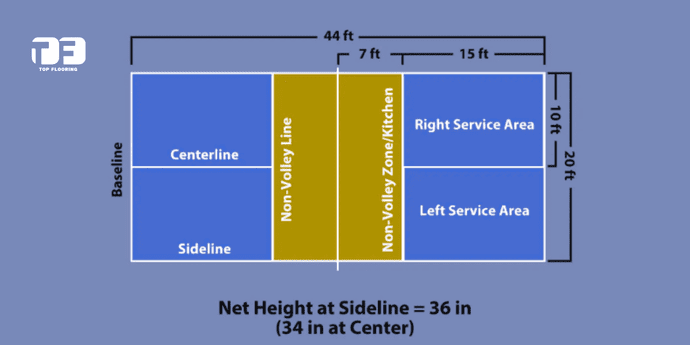
| Total Court Length | 44 ft | 13.41 m |
| Total Court Width | 20 ft | 6.10 m |
| Non-Volley Zone (Kitchen) | 7 ft (each side) | 2.13 m |
| Net Height (Center) | 34 inches | 86.4 cm |
| Net Height (Sides) | 36 inches | 91.4 cm |
| Recommended Playing Area | 60 × 30 ft | 18.3 × 9.1 m |
Pickleball Court Layout Explained
The layout includes multiple zones designed for specific gameplay rules.
Key Areas:
- Baseline & Sidelines – Outer boundaries
- Non-Volley Zone (Kitchen) – No volley area near net
- Service Courts – Left and right service boxes
Court Markings and Rules
Proper markings are essential for tournament-level courts.
Important Markings:
- Baseline (end boundary)
- Sideline (side boundary)
- Centerline (divides service areas)
- Non-volley zone line (7 ft from net)
Line Specifications:
- Line width: 2 inches (5 cm)
- High-contrast color recommended (white or yellow)
Pickleball vs Tennis vs Badminton (Comparison)
Court Comparison Table
| Feature | Pickleball | Tennis | Badminton |
| Court Size | 20 × 44 ft | 36 × 78 ft | 20 × 44 ft |
| Net Height | 34–36 inches | 36 inches | 5 ft |
| Surface Type | Acrylic / Concrete | Clay / Grass / Hard | Wooden / Synthetic |
| Game Speed | Medium | High | Fast |
Insight: A badminton court can be easily converted into a pickleball court with minor adjustments.
Indoor vs Outdoor Pickleball Court Construction
Comparison Table
| Factor | Indoor Court | Outdoor Court |
| Surface | Wooden / PU / Vinyl | Acrylic / Concrete |
| Weather Impact | None | High (UV, rain) |
| Maintenance | Moderate | Low (if acrylic used) |
| Cost | Higher | More economical |
| Lighting | Artificial | Natural + optional floodlights |
Expert Insight: In India, outdoor acrylic pickleball courts dominate due to cost efficiency and climate adaptability.
Step-by-Step Pickleball Court Construction Process
Based on real on-site execution, here is the professional process:
1. Site Preparation
- Soil compaction
- Excavation
- Leveling
2. Base Construction
- PCC (Plain Cement Concrete) or asphalt base
- Thickness: 100–150 mm
3. Surface Preparation
- Grinding and cleaning
- Crack filling
- Primer application
4. Acrylic Court Flooring Installation
- Cushion layers (optional)
- Acrylic resurfacer
- Color coating (2–3 layers)
5. Line Marking
- Precision marking using specialized paint
6. Net Installation & Finishing
- Net posts and accessories
- Fencing (optional)
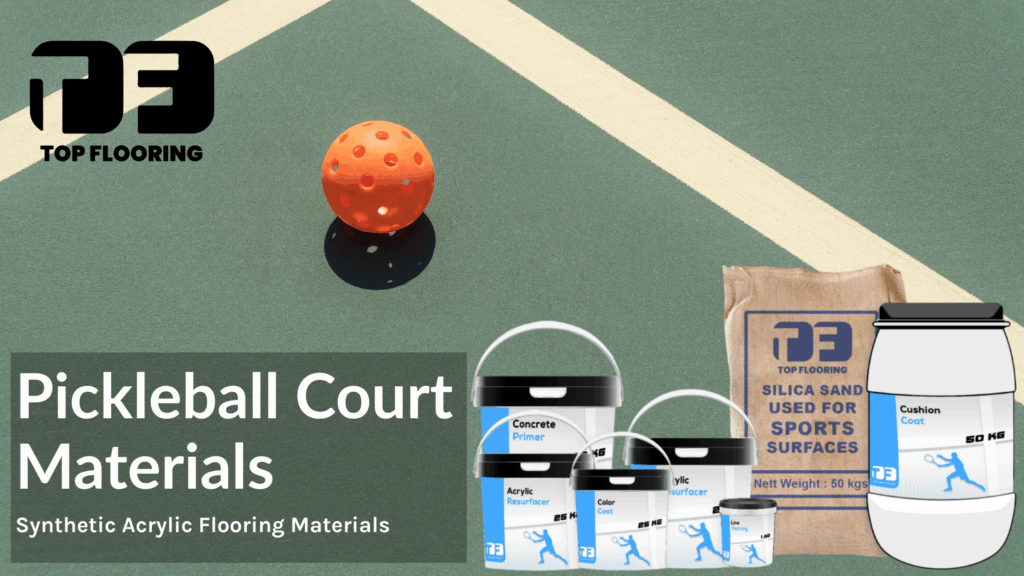
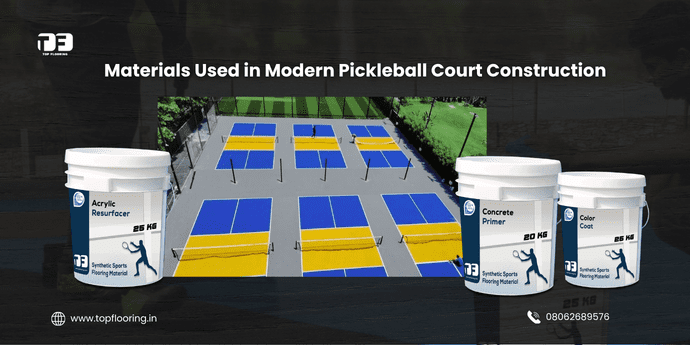
Materials Used in Modern Pickleball Court Construction
Common Materials:
- Concrete or asphalt base
- Acrylic coating system
- Silica sand (for grip)
- Line marking paint
Material Specification Table
| Material | Purpose | Benefit |
| Concrete Base | Structural foundation | Stability |
| Acrylic Coating | Playing surface | Grip, durability |
| Silica Sand | Anti-slip texture | Player safety |
| Cushion Layer | Shock absorption | Injury reduction |
Why Acrylic Court Flooring is Best for Pickleball Courts
Acrylic court flooring is the most recommended surface for outdoor pickleball courts.
Key Advantages:
- UV resistant (ideal for Indian weather)
- Non-slip textured finish
- Consistent ball bounce
- Low maintenance
- Cost-effective compared to PU or tiles
Based on decades of experience, acrylic surfaces offer the best balance of performance, durability, and cost.
Pickleball Court Construction Cost in India (2026)
The cost depends on location, base condition, and specifications.
Cost Breakdown Table
| Component | Estimated Cost (₹) |
| Base Construction | ₹1.5 – ₹3 lakh |
| Acrylic Flooring | ₹2 – ₹5 lakh |
| Fencing (optional) | ₹1 – ₹3 lakh |
| Lighting (optional) | ₹1 – ₹2 lakh |
| Total Cost | ₹4.5 – ₹12 lakh |
Factors Affecting Cost:
- Site condition
- Material quality
- Number of courts
- Location (metro vs rural)
Maintenance and Durability
A properly constructed pickleball court can last 8–10 years with minimal maintenance.
Maintenance Tips:
- Regular cleaning
- Annual inspection
- Recoating every 4–5 years
Common Mistakes in Pickleball Court Construction
From real-world experience, avoid these:
- Poor base preparation (leads to cracks)
- Incorrect slope (water stagnation)
- Low-quality acrylic materials
- Improper line marking
- Ignoring expansion joints
Safety Considerations
Safety is critical in sports infrastructure.
Key Safety Elements:
- Anti-slip surface
- Proper drainage
- Shock-absorbing layers
- Rounded fencing edges
How Many Pickleball Courts Fit in a Standard Area?
Example:
| Area Size | Number of Courts |
| Tennis Court | 2–4 courts |
| 1 Acre Land | 12–16 courts |
| Basketball Court | 2 courts |
Insight: Converting underutilized tennis courts into pickleball courts is a growing trend in India.
Backyard Pickleball Court Construction (Small Space Guide)
For residential or compact areas:
- Minimum space: 30 × 60 ft
- Use acrylic mini-court setup
- Portable net system
Ideal for villas, schools, and clubs.
Temporary vs Permanent Pickleball Courts
Comparison Table
| Feature | Temporary Court | Permanent Court |
| Setup Time | 1–2 days | 2–4 weeks |
| Cost | Low | High |
| Durability | Short-term | Long-term |
| Surface | Tape / mats | Acrylic / concrete |
Future Trends in Pickleball Court Construction (2026 & Beyond)
- Smart courts with sensors
- Eco-friendly coatings
- Multi-sport hybrid courts
- LED integrated surfaces
India is expected to see mass adoption of pickleball infrastructure in schools, clubs, and residential societies.
Conclusion
Pickleball is rapidly emerging as one of the most popular sports in India, and pickleball court construction is becoming a key investment for sports infrastructure development.
From accurate pickleball court measurement to choosing the right pickleball court flooring, every step plays a critical role in performance and longevity. Based on decades of industry experience, acrylic court flooring remains the most reliable and cost-effective solution for Indian conditions.
Whether planning for a school, club, or residential project, investing in professional construction ensures:
- Long-term durability
- Player safety
- Optimal playing experience
As demand continues to grow, high-quality courts built with the right materials and expertise will define the future of pickleball in India.
Frequently Asked Questions (FAQs)
A standard pickleball court measures 20 ft × 44 ft.
Acrylic court flooring is the best option due to durability, grip, and cost efficiency.
It typically ranges between ₹4.5 lakh to ₹12 lakh depending on specifications.
Yes, with minor marking adjustments, a badminton court can be converted.
Construction usually takes 2–4 weeks.
At least 30 × 60 ft is recommended for safe play.