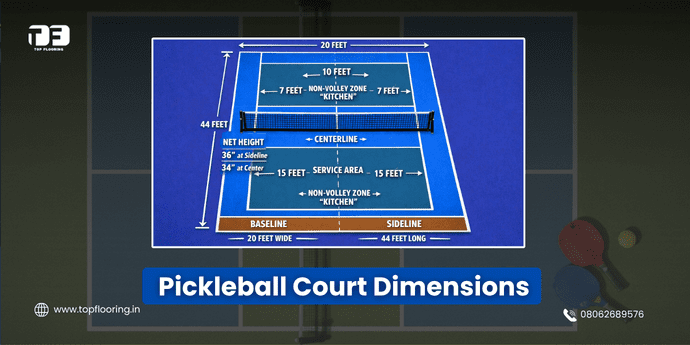
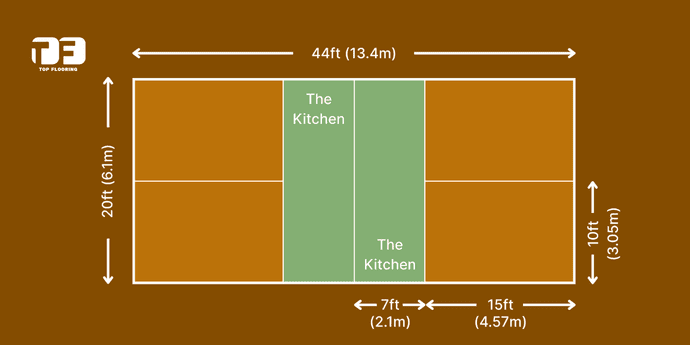
A standard pickleball court measures 20 feet wide × 44 feet long used for both singles and doubles. The minimum recommended total playing area is 30 ft × 60 ft, with 34 ft × 64 ft preferred for competitive and tournament use. The net stands 36 inches high at the sidelines and 34 inches at the centre. Each side has a 7-foot Non-Volley Zone (“the Kitchen”). All court dimensions are identical indoors and outdoors.
What Is a Pickleball Court? Why Dimensions Matter
Pickleball is the world’s fastest-growing sport and every point of every game is shaped by the precision of the court beneath the players’ feet. A pickleball court that is even a few inches out of specification changes ball trajectory, volley angles, and Kitchen zone legality. For sports facility planners, architects, school administrators, and housing society managers across India, getting these dimensions exactly right from day one is not optional it’s what separates a court that performs for 15 years from one that invites disputes, injuries, and costly rework within two.
Based on 20+ years of designing and constructing synthetic acrylic sports surfaces across India from Mumbai residential societies to school campuses in Bengaluru and club facilities in Delhi I can confirm that the single most common and costly error in pickleball court construction is treating the dimensions as approximate. They are not. Every line, every zone, and every buffer measurement is defined by USA Pickleball’s Official Rulebook, and this guide covers every one of them.
Who This Guide Is For
Architects, builders, sports facility managers, school administrators, housing society committees, club owners, and homeowners planning a backyard court in India. Whether you’re building from scratch, converting a tennis court, or verifying an existing surface, every measurement you need is here.
2. Official Pickleball Court Dimensions & Measurements (2026)
The following table represents the complete set of official measurements as specified in the USA Pickleball 2026 Official Rulebook. All values are verified and applicable globally – including for tournament courts in India.
| Measurement | Imperial (ft / in) | Metric (m / cm) | Notes |
| Court Length | 44 ft | 13.41 m | Singles & doubles identical |
| Court Width | 20 ft | 6.10 m | Same for all play formats |
| Min. Total Playing Area | 30 ft × 60 ft | 9.14 m × 18.29 m | USA Pickleball minimum |
| Preferred Total Area | 34 ft × 64 ft | 10.36 m × 19.51 m | Competition standard |
| Non-Volley Zone (Kitchen) | 7 ft each side | 2.13 m | From net, both sides |
| Service Box (each) | 10 ft × 15 ft | 3.05 m × 4.57 m | 2 boxes per side |
| Net Height – Sidelines | 36 inches | 91.44 cm | USA Pickleball official |
| Net Height – Center | 34 inches | 86.36 cm | 2-inch centre dip |
| Net Width (post to post) | 21 ft 9 in minimum | 6.63 m | Net post max. 3 in dia. |
| Net Post Spacing | 22 ft apart | 6.71 m | Centre outside sidelines |
| Net Bottom Clearance | Min. 30 inches wide | 76.2 cm | Prevents ball underpass |
| Line Width | 2 inches | 5.08 cm | All lines same width |
| Court Diagonal | ~49.17 ft | ~14.99 m | For squaring during setup |
Key insight most builders miss: the diagonal measurement of 49.17 ft is your most important quality check. If both diagonals of your court are equal at 49.17 ft, your court is perfectly square. If they are not equal, your court is a parallelogram and no amount of precise line painting will fix it.
3. Pickleball Court Layout: Every Zone Explained
A pickleball court is deceptively simple from above a rectangle divided by a net. In practice, it is a precisely engineered playing field where every line has a function, and every zone has rules attached to it. Here is a zone-by-zone breakdown:
3.1 Baselines
The baselines run the full 20-foot width of the court at each end, parallel to the net. They sit 22 feet from the net on each side (total: 44 ft). Servers must stand behind the baseline – any part of the foot on or over the line during service is a fault. The baseline is the longest line players typically defend during a lob rally.
3.2 Sidelines
Sidelines run the full 44-foot length of the court on each side, 20 feet apart. Unlike tennis – where doubles play uses wider alleys – pickleball uses the exact same 20-foot sideline for both singles and doubles. There are no alleys. The ball is considered in if it lands on any part of the sideline.
3.3 The Non-Volley Zone (NVZ) – “The Kitchen”
The Kitchen is the defining strategic feature of pickleball. It occupies a 7-foot zone on each side of the net, stretching the full 20-foot width. Players cannot volley the ball – hit it in the air without letting it bounce – while standing inside the Kitchen or on the Kitchen line. This applies during the swing and during follow-through: if momentum carries a player into the Kitchen after a volley, it is still a fault.
The Kitchen is why pickleball rewards patience and placement over raw power. Elite players spend most of a rally trying to advance to the Kitchen line, where dinking exchanges test skill, not strength.
Common Misconception
Many players believe the Kitchen rule only applies to the feet. It applies to the entire body and any equipment touching the Kitchen during or after a volley. A player’s hat falling into the Kitchen during a volley is a fault.
3.4 Centreline
The centreline divides the serving side of the court into two equal service boxes. It runs from the Kitchen line to the baseline, splitting the court length beyond the Kitchen in half – creating left and right service areas that are each 10 feet wide by 15 feet long. The centreline only affects legal serve direction; once the serve is returned, the centreline has no further function in that rally.
3.5 Service Areas
Each service box measures 10 ft wide × 15 ft deep. The server must land the serve diagonally from the right service box into the opponent’s right service box, and from the left into the left. The serve must clear the net and the Kitchen line. A serve that lands on the Kitchen line is a fault.
4. Pickleball Court Line Specifications
Every line on a pickleball court has a precise specification. These are not guidelines – they are required for any sanctioned play:
- 2 inches wide – all lines, no exceptions. Lines are included in the court boundary (ball landing on a line is in).
- White or clearly contrasting colour to the playing surface. Most outdoor courts use white on green or blue surfaces.
- Painted with acrylic line paint, applied in two coats for durability. Single-coat line marking fades within 12–18 months.
- Required lines: both baselines, both sidelines, two Kitchen/NVZ lines, one centreline. No other lines are required.
- Lines must not be bevelled, raised, or recessed. They sit flush with the playing surface.
- In multi-sport courts (e.g., dual-use badminton/pickleball), use contrasting line colours – never identical colours for different sports.
5. Pickleball Net Specifications – Every Measurement
The net is one of the most frequently mis-specified elements of a pickleball court construction project. Here are all the specifications from the 2026 USA Pickleball Rulebook:
- Net height at sidelines: 36 inches (91.44 cm) – measured at the post.
- Net height at centre: 34 inches (86.36 cm) – maintained by a centre strap.
- Minimum net width: 21 ft 9 in (6.63 m) post to post.
- Net post spacing: 22 ft (6.71 m) apart – posts sit outside the sidelines.
- Net post maximum diameter: 3 inches (7.62 cm).
- Net material: Any mesh that does not allow a ball to pass through.
- Net minimum height: 30 inches (76.2 cm) from top to bottom edge.
- Top edge: Must have cord or cable covered with 2-inch white tape.
- Portable net requirement for temporary courts: Regulation size 36 in H × 22 ft W.
The 2-inch drop from sideline to centre is intentional. It encourages centre dinking exchanges – a defining tactic of the game – by providing a slightly lower target at the centre.
6. How Pickleball Court Dimensions Compare to Other Sports
One of pickleball’s greatest advantages as a sport to build is its spatial efficiency. Here is how it stacks up against other popular sports courts in India:
| Sport | Length | Width | Total Area | Courts on Tennis |
| Pickleball | 44 ft | 20 ft | 880 sq ft | 4 courts |
| Badminton (Doubles) | 44 ft | 20 ft | 880 sq ft | 4 courts |
| Tennis (Doubles) | 78 ft | 36 ft | 2,808 sq ft | – |
| Tennis (Singles) | 78 ft | 27 ft | 2,106 sq ft | – |
| Squash | 32 ft | 21 ft | 672 sq ft | 5 courts |
| Basketball (Full) | 94 ft | 50 ft | 4,700 sq ft | 1 court |
The key takeaway for facility planners: a standard tennis court (60 ft × 120 ft) provides exactly enough space for four regulation pickleball courts in a 2×2 layout, each with a minimum 30 ft × 60 ft total footprint. This makes tennis court conversion – increasingly common in India – one of the most cost-efficient infrastructure investments available to sports clubs and institutions.
7. How Many Pickleball Courts Fit? Multi-Court Planning
On a Standard Tennis Court (60 ft × 120 ft)
- 4 pickleball courts fit in a 2×2 arrangement using the minimum 30×60 ft footprint.
- 3 courts fit comfortably using the preferred 34×64 ft footprint with adequate spacing.
- The tennis net can be adapted for centre courts; outer courts need permanent posts.
- Shift courts 2 ft to avoid tennis court corner angles interfering with pickleball sidelines.
- Leave 8–10 ft between sidelines of adjacent courts and install divider nets or fencing.
Standard Basketball Court (94 ft × 50 ft)
- 1 full pickleball court fits comfortably with ample buffer on all sides.
- Many schools add pickleball lines on basketball courts – use a contrasting colour for dual-use.
- The 50 ft width accommodates the 20 ft court width with 15 ft buffer each side.
On a Badminton Court (44 ft × 20 ft)
- 1 pickleball court fits – both sports share identical playing dimensions.
- The net height differs: badminton net is 5 ft 1 in vs. pickleball’s 36 in at sidelines.
- Replace or lower the net and repaint Kitchen lines over the badminton short service line.
In a Standard Indian School Hall (60 ft × 30 ft minimum)
- 1 full indoor pickleball court with 5 ft buffer on all sides fits within a 30×60 ft hall.
- Most school multipurpose halls (80×40 ft or larger) can accommodate 2 courts side by side.
8. Backyard Pickleball Court – Minimum Space & What to Expect
Backyard courts are one of the fastest-growing segments of pickleball construction in India, particularly in gated communities and private villas. Here is what you need to know before you commit to a build:
- Absolute minimum: 28 ft × 56 ft. This is below regulation standard and suitable only for recreational drilling, not play.
- Regulation minimum: 30 ft × 60 ft. Provides 5 ft buffer on sidelines and 8 ft behind baselines – adequate for recreational doubles.
- Recommended: 34 ft × 64 ft. Allows confident baseline play, aggressive lobs, and safe two-player movement without collision risk.
- Orientation: Always north–south. A compass check before planning is essential – one wrong orientation decision cannot be corrected after construction.
- Surface: Concrete base with synthetic acrylic is the only permanent-grade option for outdoor backyard courts in India. Asphalt is acceptable but requires more frequent maintenance.
- Net storage: If the court will not be used daily, a portable net system (USAP-compliant: 36 in × 22 ft) reduces wear on the post anchors.
- Fencing: Even in residential courts, 10 ft fencing prevents ball loss and reduces neighbourhood noise complaints. Windscreen mesh on fencing also improves ball visibility against a clean background.
9. Temporary vs. Permanent Pickleball Court Setup
Temporary Court Setup
The Temporary courts are ideal for schools, community events, gym floors, and facilities exploring pickleball before committing to permanent construction.
- Mark lines with chalk, removable tape, or painter’s tape on any flat, hard surface.
- Use a portable regulation net (36 in × 22 ft) – available in India from ₹15,000–₹45,000.
- A basketball court, badminton hall, or flat parking area of 30×60 ft is sufficient.
- Tape lines in a contrasting colour – blue tape on wood floors, white tape on asphalt.
- Important: no tournament sanctioning is possible on temporary surfaces. This is for practice and recreational play only.
- Quickstart courts: USA Pickleball recognises ‘Quickstart’ layouts on smaller surfaces for beginners – useful for school programmes.
Permanent Court Setup
Permanent courts are the right choice for clubs, institutions, housing societies, and any venue expecting regular use.
- Requires base construction (concrete or asphalt), multi-layer acrylic surfacing, painted lines, and permanent net posts anchored in concrete.
- Expected lifespan: 10–15 years with proper maintenance – making it a cost-efficient 20-year infrastructure decision.
- Must be built to USA Pickleball official specifications for sanctioned tournament eligibility.
- Construction timeline: 4–8 weeks including concrete cure time, surfacing, and line marking.
10. Indoor vs. Outdoor Pickleball Court Dimensions
This is one of the most frequently searched questions about pickleball court dimensions – and the answer surprises many first-time planners:
Key Fact
Indoor and outdoor pickleball courts are identical in playing dimensions: 20 ft × 44 ft. The only differences are in construction method, surface material, ball type, and environmental engineering.
| Parameter | Indoor Court | Outdoor Court |
| Court Dimensions | 20 ft × 44 ft (identical) | 20 ft × 44 ft (identical) |
| Recommended Base | Concrete slab or sprung subfloor | Concrete (preferred) or asphalt |
| Surface System | Synthetic acrylic, hardwood, PVC roll | Multi-layer synthetic acrylic |
| Ball Type | Indoor ball – 26 larger holes | Outdoor ball – 40 smaller holes |
| UV Resistance Required | No | Yes – mandatory in India |
| Drainage Slope | Not required | Minimum 1% gradient required |
| Lighting | LED overhead, 300+ lux | Glare-free LED floodlights |
| Noise Consideration | Critical – acoustics design needed | Less critical – open air |
| Orientation Needed | Any (controlled light) | North–South mandatory outdoors |
| India Build Cost | ₹10–15 Lakhs per court | ₹5–10 Lakhs per court |
11. Step-by-Step Pickleball Court Construction Process
After 20+ years of building sports courts across India – from sea-level coastal courts in Kochi to high-altitude sites in Pune hill stations – this eight-phase process is what separates a court that performs for 15 years from one that fails in 3:
Phase 1
Site Survey & Orientation: Assess terrain, soil bearing capacity, drainage flow, sun orientation (north–south), and access for machinery. A total station survey is strongly recommended.
Phase 2
Excavation & Grading: Clear to 150–200 mm depth. Grade for a minimum 1% slope away from the centre. Compact sub-soil to CBR ≥ 4% to prevent future settling.
Phase 3
Granular Sub-base: Lay 100 mm of compacted crushed gravel or stone. This is your drainage layer – it prevents groundwater from migrating upward into the slab.
Phase 4
Concrete Base: Pour a minimum 100 mm RCC slab (25 MPa concrete) with 8 mm mesh reinforcement. Embed net post sleeves before pouring – retrofitting anchors always costs more.
Phase 5
Curing Period (28 Days): Allow full 28-day cure before applying any coating. In hot Indian summers, cure with wet hessian or curing compound – do not rush this phase under any circumstances.
Phase 6
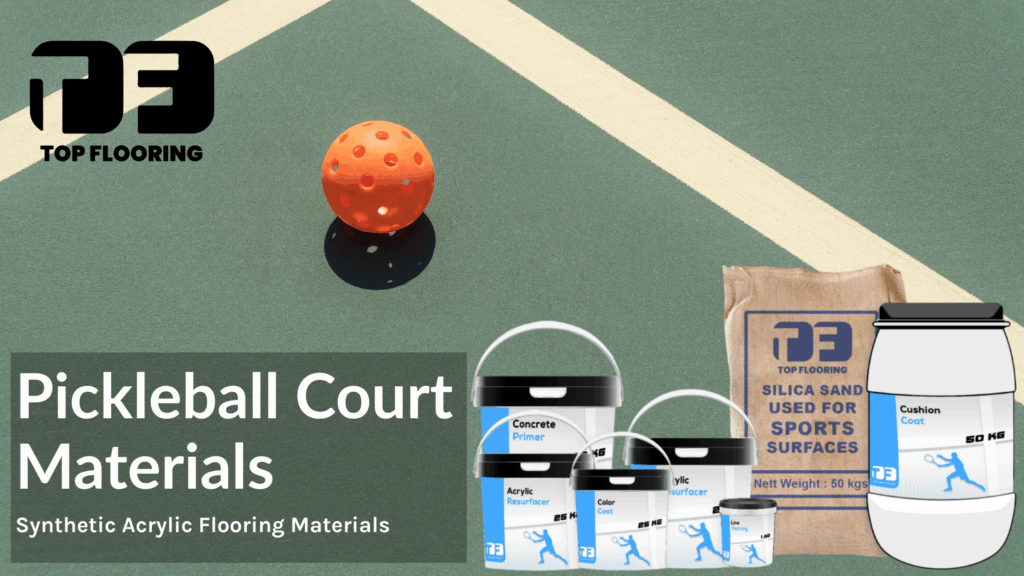
Synthetic Acrylic Surfacing: Fill and patch all surface voids. Apply: primer coat → 2 acrylic resurfacer coats → 1–2 texture/cushion coats → 2 UV-resistant colour top coats. Minimum 5 layers total.
Phase 7
Precision Line Marking: Set out court using total station or laser distance measure. Mark Kitchen lines first – they are the most error-sensitive. Apply 2-coat acrylic line paint in 2-inch width.
Phase 8
Net, Fencing & Lighting: Set net posts in concrete footings (minimum 450 mm deep). Install fencing (10 ft recommended). Add windscreen. Install LED floodlights if required.
Pro Tip from the Field
Always countersink your net post sleeve anchors before pouring the concrete slab. Every contractor who skips this step ends up drilling into cured concrete later – which cracks the slab and creates drainage failure points. In 20+ years, I have never seen a court that saved money by skipping this step.
12. Best Surface Materials for Pickleball Courts
Surface choice is one of the highest-impact decisions in pickleball court construction. It affects player safety, ball behaviour, maintenance cost, and lifespan. Here is a full comparison for India:
| Surface | Lifespan | Safety | Maintenance | India Cost/sq ft | Rec? |
| Synthetic Acrylic (multi-coat) | 10–15 yrs | High | Low | ₹250–₹600 | ✓ Yes |
| Cushion Acrylic (rubber-filled) | 8–12 yrs | Very High | Low–Mod | ₹500–₹900 | ✓ Yes |
| Modular Polypropylene Tiles | 5–8 yrs | High | Very Low | ₹350–₹700 | Indoor |
| Bare Concrete (no coating) | 8–12 yrs | Low | Low | Base only | ✗ No |
| Asphalt (no coating) | 6–10 yrs | Moderate | Moderate | Base only | ✗ No |
| PVC Roll (indoor) | 5–7 yrs | High | Very Low | ₹400–₹800 | Indoor |
Why Synthetic Acrylic Is the Standard for India
- UV stability: Specifically formulated to resist India’s intense solar radiation without colour fade or surface degradation.
- Ball bounce: Consistent response regardless of temperature variation critical for courts used year-round.
- Grip & traction: Anti-slip texture prevents lateral slip during quick directional changes especially important on outdoor courts in monsoon-adjacent months.
- Cushion option: Rubber-filled cushion acrylic systems reduce joint stress ideal for older players and high-frequency use schools and clubs.
- Colour range: Green, blue, red, and terracotta in any combination with contrasting line colours.
- Installation speed: Full acrylic system installed in 5–7 working days after base curing.
13. Pickleball Court Construction Cost in India (2026)
India-specific cost data is one of the most searched topics in this space – and one that most international articles completely miss. These figures are based on current market rates from verified contractors across Maharashtra, Karnataka, Delhi-NCR, and Tamil Nadu:
| Cost Component | Estimated Cost (INR) | What’s Included |
| Site Survey & Levelling | ₹40,000–₹1,20,000 | Topography check, slope correction, soil compaction |
| Concrete Base (100 mm, 25 MPa) | ₹1,20,000–₹2,50,000 | RCC slab with mesh reinforcement, 28-day cure |
| Synthetic Acrylic Flooring | ₹250–₹600/sq ft | Primer + resurfacer + 2 texture coats + UV topcoat |
| Line Marking (Precision) | ₹8,000–₹18,000 | Survey-grade layout, 2-inch acrylic line paint ×2 coats |
| Net System (Regulation Grade) | ₹15,000–₹45,000 | Steel posts, anchor footings, USAP-compliant net & strap |
| Perimeter Fencing (10 ft) | ₹60,000–₹1,60,000 | GI chain-link or PVC-coated mesh with gate |
| LED Floodlighting (optional) | ₹80,000–₹2,00,000 | Glare-free LED (300+ lux), pole mounting, wiring |
| Windscreen (optional) | ₹20,000–₹60,000 | Mesh screen on fencing, improves ball visibility |
| TOTAL – Outdoor Standard | ₹5–10 Lakhs | Concrete base + acrylic + fencing + net (no lighting) |
| TOTAL – Indoor Premium | ₹10–15 Lakhs+ | All above + premium flooring + ceiling lighting + HVAC allowance |
Cost-reduction strategies for multi-court projects:
- Building 4 courts simultaneously reduces per-court base construction cost by 25–35% through shared site mobilisation, concrete pours, and fencing runs.
- Shared fencing between adjacent courts eliminates one full fencing run per pair.
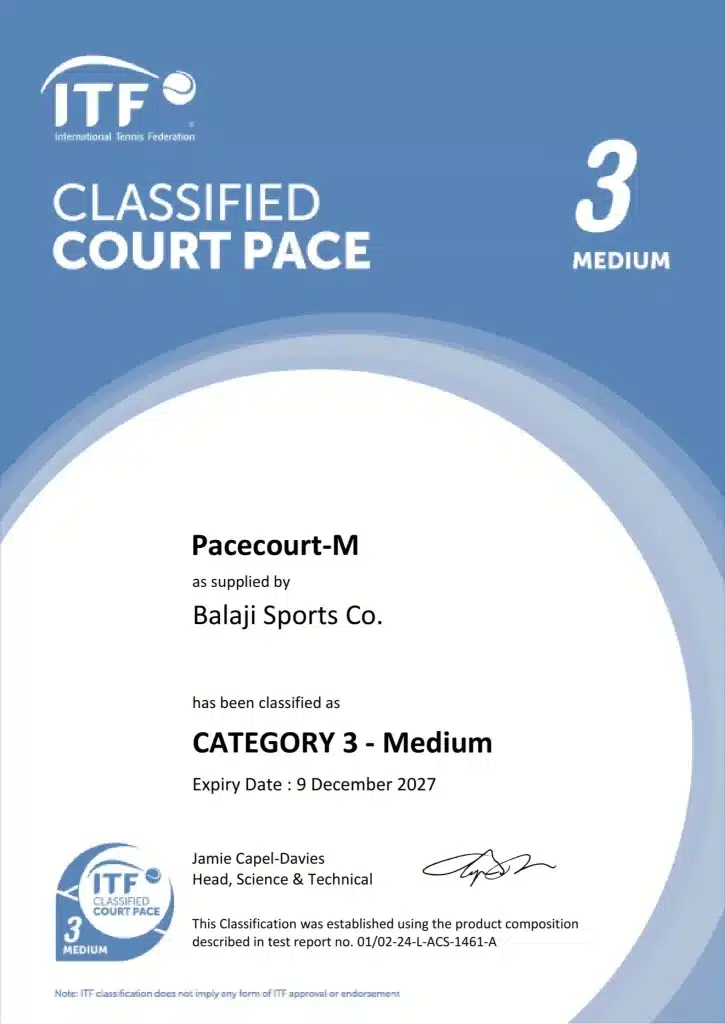
- Specify ITF-classified or ASTM-certified acrylic materials they cost marginally more upfront but outlast cheaper alternatives by 3–5 years.
- Phase lighting as a second-stage project once the court is operational this spreads capital outlay without affecting day-play quality.
14. Safety Considerations in Pickleball Court Design
Court safety is non-negotiable – especially for institutional builds serving mixed-age user groups. These standards apply to every court regardless of budget:
- Buffer zones: Minimum 5 ft from sidelines to any fixed structure. Minimum 8 ft behind baselines. Preferred: 7 ft and 10 ft respectively.
- Surface traction: Anti-slip acrylic coating is mandatory. Coefficient of friction ≥ 0.5 (wet) per ASTM C1028 always specify this in your contractor brief.
- Fencing: 10 ft height is the standard. Avoid sharp exposed wire ends use rolled or capped top edges. No guy-wire anchors within the buffer zone.
- Lighting: Minimum 300 lux (50 fc) at court level for recreational play. 500 lux for competitive use. Lights must be positioned to eliminate shadows and glare on the playing surface.
- Net posts: Must be anchored in concrete footings minimum 450 mm deep. Any loose post is an immediate safety hazard inspect every 6 months.
- Entry/exit: Court gates should be in corners, not mid-sideline. Maintain a clear 6-ft entry corridor outside the buffer zone.
- Noise: USA Pickleball’s Quiet Category certified equipment significantly reduces acoustic impact important for courts in residential compounds and school environments.
15. Maintenance Schedule & Durability
A synthetic acrylic pickleball court is a 10–15 year asset but only with consistent, scheduled maintenance. This is the schedule I recommend based on field data from courts I have built and monitored over 15+ years:
| Frequency | Task | Why It Matters |
| Weekly | Sweep & blow debris | Prevents grit from scratching and degrading the acrylic topcoat |
| Monthly | Inspect surface & lines | Catch hairline cracks, pooling zones, or line wear before they worsen |
| Every 6 months | Check net tension & post anchors | Ensures competition-legal height; loose posts shift under play stress |
| Every 2–3 years | Repaint court lines | Faded lines create disputes; 2-inch width must be maintained |
| Every 5–7 years | Full resurfacing (acrylic topcoat) | Restores traction, UV protection, ball bounce consistency & colour |
| As needed | Crack patching & spot repair | Small cracks < 3mm can be sealed; larger ones need base-level repair |
The biggest maintenance mistake in India: neglecting courts during monsoon season. Post-monsoon inspection (September–October) is your most important maintenance window. Water infiltration into cracks during rain, followed by heat expansion in October and November, is the primary cause of premature surface failure in Indian outdoor courts.
16. Common Pickleball Court Construction Mistakes (And How to Avoid Them)
In 20+ years of inspecting and remediating poorly built courts across India, these are the eight most costly and recurring errors:
| Mistake | What Happens | How to Avoid It |
| No drainage slope | Water pools → acrylic delaminates within 1–2 monsoons | Minimum 1% gradient away from centre, verified by laser level |
| Applying acrylic before concrete cures | Bubbling, peeling, adhesion failure within 12 months | Full 28-day cure time for concrete – non-negotiable |
| Under-coating (< 4 acrylic layers) | Rapid wear, loss of traction, fading in < 3 years | Specify minimum: primer + 2 resurfacer + 2 colour coat = 5+ layers |
| East–west orientation | Players stare into sun → eye strain, injury risk, complaints | North–south axis always. Check with compass before planning |
| Inaccurate Kitchen line | Disputes during play; NVZ violations; tournament disqualification | Use total station or laser distance measure – tape alone is unreliable |
| Skipping the diagonal check | Court is not truly rectangular – lines appear crooked, feel off | Both diagonals must equal 49.17 ft. Measure before painting any line |
| Undersized buffer zone | Players run into fences/walls – injuries and liability | Minimum 5 ft sidelines, 8–10 ft behind baselines – no exceptions |
17. Future Trends in Pickleball Court Design (2026 & Beyond)
- Quiet Category surfaces: USA Pickleball’s Quiet Category standard is reshaping material selection for urban courts. Noise-dampening acrylic systems and modular tiles with acoustic properties are now specified by default for residential compound builds in India.
- Multi-sport court integration: Architects across India are increasingly combining pickleball, badminton, and futsal on a single shared surface using layered line systems and quick-change net posts. Cost savings versus separate courts: 30–45%.
- Smart court technology: Embedded ball-tracking sensors, AI-assisted line call systems, and shot analysis platforms are being piloted at premium facility operators. Expected to reach mid-market India by 2028.
- Eco-formulated acrylic systems: Water-based, low-VOC acrylic coatings are now available from major Indian manufacturers and are increasingly specified for LEED-registered sports facilities.
- Cushion-first design: As India’s pickleball demographic skews older (35–65 age group), facility operators are defaulting to cushion acrylic systems for injury prevention even on budget builds.
- Rooftop courts: High-density urban areas in Mumbai, Delhi, and Bengaluru are driving demand for rooftop pickleball courts with structural reinforcement, waterproofing membranes under the slab, and specialised drainage engineering.
Conclusion: Build to Spec, Build to Last
Pickleball court dimensions are not a starting point for approximation they are the foundation of every fair game, safe match, and durable facility. A regulation court of 20 ft × 44 ft, set within a 34 ft × 64 ft preferred total footprint, with a precisely tensioned net, correctly placed Kitchen zone, and survey verified line markings is the non-negotiable baseline for any serious court project.
From 20+ years of hands-on experience constructing and remediating courts across India, the message to every architect, builder, institution, and facility planner is consistent: the costs of getting dimensions wrong rework, resurfacing, dispute-related downtime, and liability always exceed the cost of getting it right the first time.
India’s pickleball market is growing faster than most facility operators realise. Courts built today to full specification will be in high demand for the next decade. Courts built to approximation will be costly liabilities within three monsoon seasons.
Specify ITF-classified synthetic acrylic materials. Use USA Pickleball 2026 Official Rulebook dimensionswithout compromise. Engage a certified sports infrastructure professional. Your players and your balance sheet will thank you for the next 15 years.
Frequently Asked Questions
What are the official pickleball court dimensions?
A standard pickleball court is 20 feet wide by 44 feet long, used for both singles and doubles play. The minimum recommended total playing area (including safety buffers) is 30 ft × 60 ft, with 34 ft × 64 ft preferred for competitive and tournament use.
How high is the pickleball net?
The pickleball net is 36 inches (91.44 cm) high at the sidelines and 34 inches (86.36 cm) at the centre. A centre strap maintains the lower centre height. The net must be at least 21 ft 9 in wide post to post.
What is the Kitchen in pickleball and how big is it?
The Kitchen is the Non-Volley Zone (NVZ) – a 7-foot area on each side of the net stretching the full court width (20 ft). Players cannot volley the ball (hit it before it bounces) while standing in this zone or on the Kitchen line. It is the most strategically important zone in pickleball.
How many pickleball courts fit on a tennis court?
A standard tennis court (60 ft × 120 ft) accommodates four pickleball courts in a 2×2 layout, each using the minimum 30 ft × 60 ft footprint. With the preferred 34 ft × 64 ft footprint, three courts fit comfortably. This is the most common and cost-effective conversion approach used by clubs and schools in India.
How much does it cost to build a pickleball court in India in 2026?
A standard outdoor pickleball court with synthetic acrylic flooring costs ₹5–10 lakhs in India, depending on location, base type, and accessories. Indoor courts with premium materials and lighting range from ₹10–15 lakhs. Multi-court projects (4+ courts) reduce per-court cost by 25–35% through shared construction.
What is the best surface for an outdoor pickleball court in India?
Synthetic acrylic flooring over a concrete base is the gold standard for outdoor pickleball courts in India. It offers UV resistance, anti-slip traction, consistent ball bounce, and low maintenance. Acrylic surfaces cost ₹250–₹600 per sq ft in India and last 10–15 years with proper care.