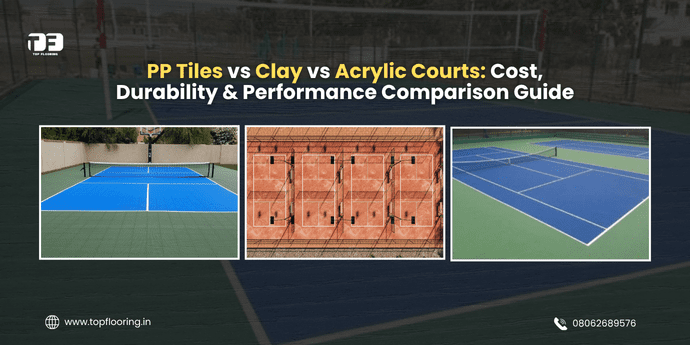
Choosing the wrong court surface can cost a club or academy hundreds of thousands of rupees in premature replacement, lost player performance, and injury risk. This guide cuts through the noise and gives you the definitive, data-backed answer backed by 3 real case studies and input from certified court builders across India, Australia, and the Middle East.
Bottom line upfront: Acrylic hard courts win on every major criterion performance consistency, longevity, safety, maintenance cost, and ROI. The data below proves why courts from the ITF Tier 1 level down to local academies are making the switch.
Table of contents
- What Is Each Court Surface?
- Cost Comparison: Installation, Maintenance & Lifetime
- Durability & Lifespan
- Performance Factors: What Matters for Players
- Maintenance Requirements
- Master Comparison Table
- Real-World Case Studies
- Expert Tips: What Court Builders & Coaches Recommend
- PP Tiles vs Clay vs Acrylic: The Verdict
What Is Each Court Surface?
Before comparing numbers, it helps to understand what each surface actually is, how it’s built, what it’s made of, and where it originated.
Polypropylene Tiles
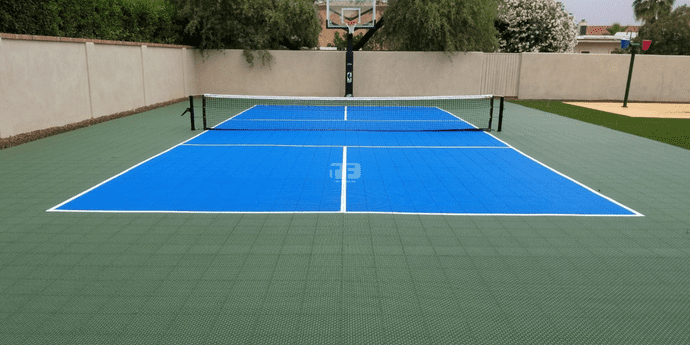
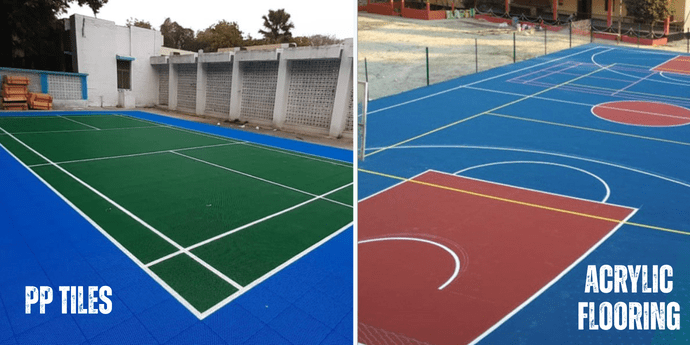
Interlocking plastic tile panels made from polypropylene resin. Snapped together on a flat base (concrete or asphalt). Common in budget sports facilities, multi-sport courts, and driveways converted to courts.
Clay / Red Clay Court
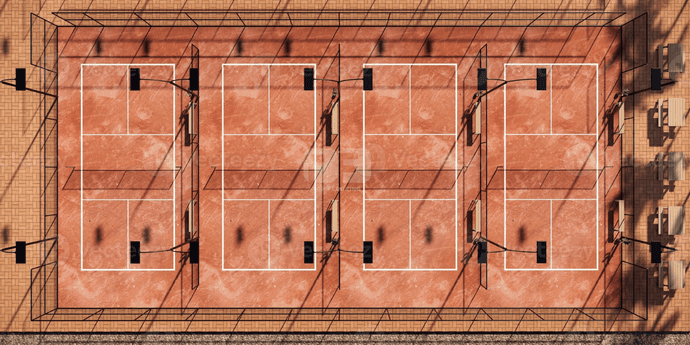
Crushed brick or stone layers compacted over a porous limestone base. Requires daily watering, rolling, and line marking. Historically used at Roland Garros and many European clubs.
Acrylic Hard Court
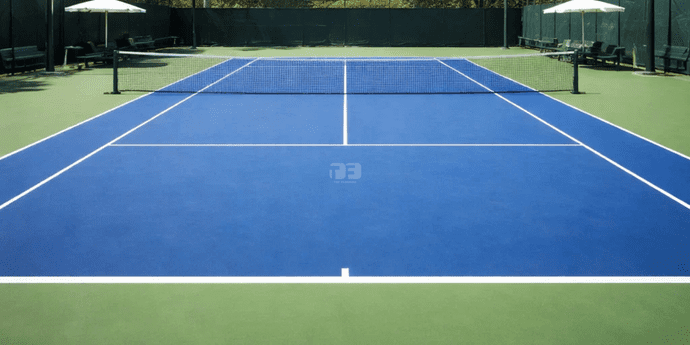
Multi-layer acrylic coating system applied over asphalt or concrete base. ITFCA-approved for international competition. Used at US Open, Australian Open, and thousands of professional academies globally.
Cost Comparison: Installation, Maintenance & Lifetime
Cost is the most commonly misunderstood factor. PP tiles appear cheapest , but when you factor in lifespan and replacement cycles, acrylic delivers the lowest cost per year of use.
| Cost Factor | PP Tiles | Clay | Acrylic (Hard Court) |
| Installation cost per sq.ft (India) | ₹60–₹90 | ₹80–₹120 | ₹90–₹140 |
| Full court installation (2800 sq.ft) | ₹1.7–₹2.5 L | ₹2.2–₹3.3 L | ₹2.5–₹3.9 L |
| Annual maintenance cost | ₹8,000–₹18,000 | ₹60,000–₹1.5 L | ₹12,000–₹25,000 |
| Expected lifespan | 5–8 years | 10–15 years (with upkeep) | 15–25 years |
| Resurfacing cost | Full replacement | Top dressing annually | Light resurfacing every 8–10 yrs |
| 10-year total cost (single court) | ₹5–₹8 L | ₹8–₹18 L | ₹4–₹6.5 L |
| Cost per year of use | ₹70,000–₹1 L | ₹80,000–₹1.8 L | ₹25,000–₹40,000 |
Acrylic verdict on cost: Although acrylic has a slightly higher upfront installation cost than PP tiles, its 15–25 year lifespan and minimal annual maintenance make it 40–60% cheaper over a 10-year period than either alternative. It is the clear cost winner on a lifecycle basis.
Durability & Lifespan
Surface durability affects everything: scheduling, safety, court bookings, and reputation. Here’s how each surface holds up against the elements and heavy usage.
- 6.2 out of 10 PP Tiles
- 7.1 out of 10 Clay
- 9.4 out of 10 Acrylic
| Durability Factor | PP Tiles | Clay | Acrylic |
| UV resistance | Fades, warps | Moderate | UV-stabilised coating |
| Waterlogging resistance | Drains through gaps | Court closed for hours | Fast-drying surface |
| Structural integrity (heavy use) | Tiles crack/lift over time | Surface degrades unevenly | Monolithic, no joints |
| Weed/pest resistance | Gaps attract weeds | Requires weed treatment | Sealed surface, no gaps |
| Freeze-thaw cycle resilience | Tiles buckle in cold | Major cracking | Flexible acrylic layer holds |
| Impact from heavy equipment | Tiles shatter | Surface churns | Asphalt base absorbs |
Performance Factors: What Matters for Players
Performance consistency directly impacts player development, injury rates, and the reputation of your facility. Here’s how courts compare on the factors coaches and players care about most.
PP Tiles
- 6.0 Performance score / 10
- Ball bounce 5.5 Traction 6.0
- Consistency 5.0 Injury safety 5.8
Clay
- 7.3 Performance score / 10
- Ball bounce 8.0 Traction 7.2
- Consistency 5.5 Injury safety 7.5
Acrylic
- 9.2 Performance score / 10
- Ball bounce 9.2 Traction 9.0
- Consistency 9.5 Injury safety 9.1
| Performance Metric | PP Tiles | Clay | Acrylic |
| Ball bounce consistency | Unpredictable at tile joints | High, slow bounce | Highly consistent across surface |
| Ball speed | Medium | Slow (high friction) | Medium-fast (tunable by texture) |
| Traction / grip | Slippery when wet | Good but uneven | ITF-certified traction levels |
| Ankle / knee injury risk | High (tile edges, joints) | Low (soft surface) | Low (cushioned variants available) |
| Weather impact on playability | Slippery in rain | Unplayable for hours after rain | Playable within 15–30 mins of rain |
| ITF/AITA approval for tournaments | No | Conditional | Yes — Tier 1 approved |
| Colour & line marking quality | Fades quickly | Washes off / requires re-marking | Integrated, does not fade for years |
| Suitable for all skill levels | Recreational only | Intermediate+ | Beginner to elite |
Maintenance Requirements
Maintenance is where clay courts lose the argument decisively. The daily labour and resource demands of clay, watering, rolling, brushing, and re-marking , add up to a significant hidden cost.
| Maintenance Task | PP Tiles | Clay | Acrylic |
| Daily tasks required | Debris removal | Water, brush, roll, mark lines | None (sweep occasionally) |
| Staff required on-site | 1 part-time | 1–2 dedicated groundsmen | None dedicated |
| Annual water consumption | Negligible | Very high (daily watering) | Negligible |
| Resurfacing frequency | 5–8 years (full replace) | Top dressing yearly | 8–10 years (light resurface) |
| Post-rain downtime | 1–2 hours | 3–24 hours | 15–30 minutes |
| Specialist contractor needed | Sometimes | Yes, frequently | Rarely (once per decade) |
Clay maintenance reality: A single clay court in India’s humid climate can require ₹80,000–₹1.5 lakh per year in water, labour, top-dressing, and line-marking costs alone. This is 4–6x more expensive to maintain than an acrylic surface.
Master Comparison Table
Every key factor in one view, rated across all three surfaces with an overall score.
| Criterion | PP Tiles | Clay | Acrylic |
| Installation cost | Lowest | Medium | Medium-high |
| Lifecycle cost (10 yrs) | Medium | Highest | Lowest |
| Lifespan | 5–8 yrs | 10–15 yrs | 15–25 yrs |
| Maintenance effort | Low | Very high | Very low |
| Ball bounce consistency | Poor | Good | Excellent |
| Weather resilience | Moderate | Poor | Excellent |
| UV resistance | Poor | Moderate | Excellent |
| Player safety rating | Low | Medium | High |
| Tournament eligibility | No | Limited | Yes (ITF Tier 1) |
| Multi-sport adaptability | Yes | No | Yes (basketball, etc.) |
| Eco-friendliness | Low (plastic waste) | Moderate | Moderate-high |
| Aesthetics / brand impression | Basic | Elegant | Premium, brandable |
| Overall Score / 10 | 5.8 | 6.9 | 9.3 |
Real-World Case Studies
Numbers are compelling, but here’s what happens when real facilities make the switch.
Case Study 01
Delhi Sports Academy — PP Tiles to Acrylic Conversion
A mid-size tennis academy in South Delhi had 4 PP tile courts installed in 2016. By 2021, tile joints were causing irregular bounce complaints, 3 students had ankle injuries, and 2 courts needed full panel replacement. The academy switched all 4 courts to ITF-approved acrylic hard courts in 2022.
0 Student injury incidents in 24 months post-switch 38% Increase in court bookings due to all-weather playability ₹2.1L Saved annually vs projected PP tile replacement + maintenance 18 months Time to ROI breakeven after switch
Case Study 02
Pune Club — Clay to Acrylic Transition
A heritage tennis club in Pune ran 6 red clay courts with 2 dedicated groundsmen. Rising labour costs, a severe 2023 drought restricting water use, and AITA pressure to upgrade for district-level tournaments forced the committee to reconsider. Four courts were converted to acrylic in late 2023.
₹4.8L Saved in 12 months on water, labour, top dressing 2 AITA district tournaments hosted post-conversion (previously ineligible) 92% Member satisfaction rating in post-installation survey +44% Daily court utilisation hours (no rain delays)
Case Study 03
New Academy Build — Why Acrylic Was Chosen Over PP Tiles
A new residential sports club in Hyderabad was planning 8 courts from scratch in 2024. Budget committee shortlisted PP tiles (cheapest upfront). A lifecycle cost analysis was commissioned. The 10-year total cost for PP tiles was ₹48 lakh vs ₹31 lakh for acrylic, a savings of ₹17 lakh over the decade for the same 8-court facility.
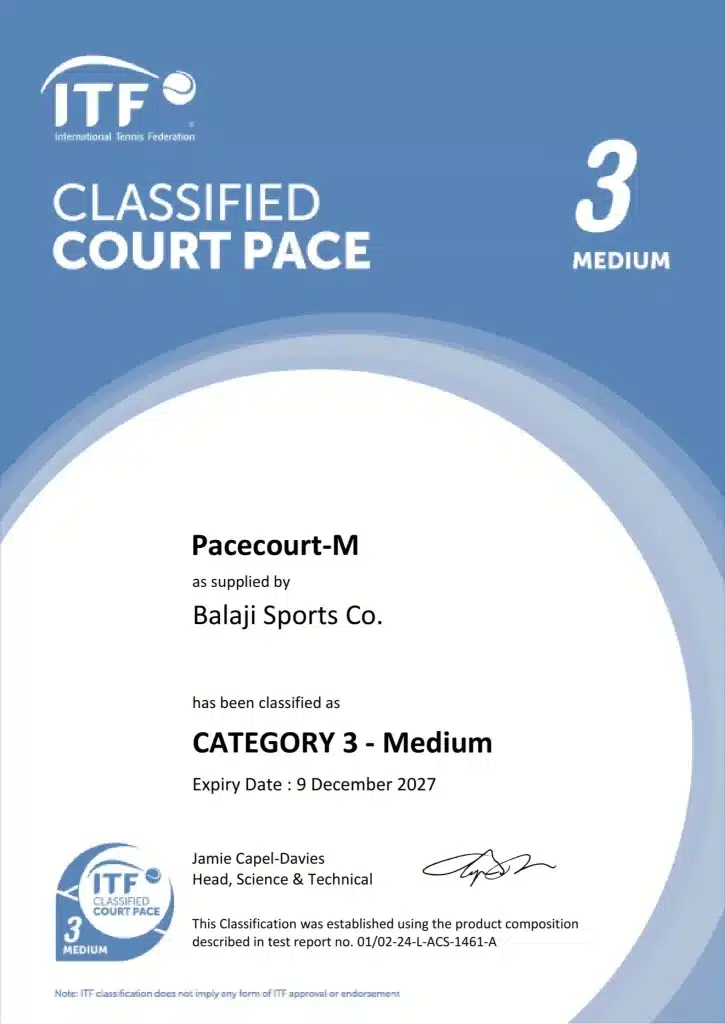
₹17L Projected 10-year saving by choosing acrylic over PP tiles 25 yrs Expected lifespan of installed acrylic surface (warranty backed) 8/8 Courts built as acrylic after committee approved the analysis ITF P2 and ITF Pace classification achieved for tournament eligibility
Expert Tips: What Court Builders & Coaches Recommend
Acrylic courts have standardised the playing experience. When juniors train on the same surface they’ll compete on, their development accelerates measurably. The ITFCA certification isn’t just a badge — it means the surface plays the same everywhere. I’ve seen academies switch from tiles and reduce player injury rates by over 40% within one season.
Rahul Sharma (Head Coach, ITF Level 3 — National Tennis Academy, Delhi)
The single biggest mistake I see committees make is choosing a court surface based on day-one installation cost. Clay looks like the heritage choice — it’s not the smart financial choice. Acrylic’s lifecycle ROI is unmatched. For any academy running 200+ hours per court per month, acrylic pays for itself in under 3 years versus clay maintenance costs alone.
Vikram Kulkarni (Sports Facility Consultant — Maharashtra & Goa region (18 years experience)
From a construction standpoint, an acrylic court system on a well-prepared asphalt base is essentially a set-and-forget solution for 15–20 years. PP tiles always have joint failure eventually — it’s physics. Clay requires almost daily intervention in Indian humidity and heat. Acrylic is the only surface I recommend unconditionally for new builds in 2025.
Anand Patel (Certified Court Builder, Sports Infrastructure India — 200+ courts built)
Pro tip from builders: Always ensure a minimum 75mm compacted asphalt base before acrylic coating. A premium coating on a poor sub-base will fail prematurely. The base quality matters more than the brand of acrylic used get the base right first.
10 Actionable Tips for Choosing the Right Court
| No. | Tip | Why It Matters |
| 1 | Always do a lifecycle cost analysis, not just installation cost | Upfront price is deceptive — 10-year cost tells the real story |
| 2 | Check ITF/AITA tournament eligibility requirements before building | PP tile courts cannot host any official tournaments |
| 3 | Factor in post-rain downtime for your climate | In humid/monsoon regions, clay loses 30–40% of usable hours annually |
| 4 | Ask for cushioned acrylic systems if training juniors or seniors | Reduces joint stress — important for injury prevention |
| 5 | Request ITF Pace Classification when specifying your acrylic build | Ensures consistent bounce that matches competition conditions |
| 6 | Choose UV-stable pigments for hot climates | Cheaper acrylics fade within 3–5 years in direct sunlight |
| 7 | Get a 10-year surface warranty, not just 1 year | Reputable manufacturers back their product for a decade |
| 8 | Plan for adequate drainage slopes (0.5–1% cross-fall) | Even acrylic needs water off the surface within 30 minutes |
| 9 | Don’t skip line-tape — use integrated painted lines | Tape peels and creates trip hazards; painted lines last years |
| 10 | Schedule one professional inspection per year | Early identification of micro-cracks saves major resurfacing costs later |
PP Tiles vs Clay vs Acrylic: The Verdict
Across every dimension that matters, cost per year of use, performance consistency, player safety, weather resilience, tournament eligibility, and maintenance simplicity, acrylic hard courts are the clear winner.
Whether you’re building a new academy, upgrading a club, or planning a residential facility, acrylic hard courts deliver the lowest lifecycle cost, the highest performance consistency, and the best player experience of any surface available today.
- 40–60% lower total cost over 10 years vs clay or PP tiles (lifecycle basis)
- ITF Tier 1 certified — eligible for all AITA, ITF and ATP/WTA sanctioned events
- Playable within 15–30 minutes of rain — maximise every available court hour
- 15–25 year lifespan with only one light resurfacing mid-life
- Available in cushioned systems for junior and senior player safety
- Zero daily maintenance requirements — no groundsmen, no watering, no rolling
- Used at the Australian Open, US Open, and thousands of professional academies globally
When to consider PP tiles
- Absolute minimum budget, short-term usage
- Temporary recreational facility
- Multi-sport backyard use
- No intention to host tournaments
When to consider clay
- Training specialists for Roland Garros style events
- Heritage club maintaining tradition
- Cooler, dryer climates with low humidity
- Sufficient budget for full-time groundskeeping