Understanding tennis court dimensions is far more than a matter of numbers on a blueprint. Whether you are a property developer planning a residential installation, a school authority mapping out a multi-sport complex. A dedicated tennis court builder preparing a tournament-grade facility, every inch of the court carries regulatory weight. The International Tennis Federation (ITF) and the United States Tennis Association (USTA) have codified exact measurements that govern how the game is played fairly at every level. From a neighbourhood club to Wimbledon’s Centre Court. Getting these dimensions right from the very beginning determines not just playability but also long-term surface durability and player safety.
This in-depth guide breaks down every component of official tennis court dimensions – the full court layout, individual line widths, net post placements, clearance zones. And the material layers that go beneath the playing surface. We also explore how tennis court flooring choices, the application of Concrete Primer, Acrylic Resurfacer, and Cushion Coat layers interact with the geometry of the court to deliver a professional finish that lasts decades. Whether you are building from scratch or resurfacing an existing facility. The following sections will serve as your definitive construction and compliance reference.
Official Tennis Court Dimensions: What the Rulebook Says
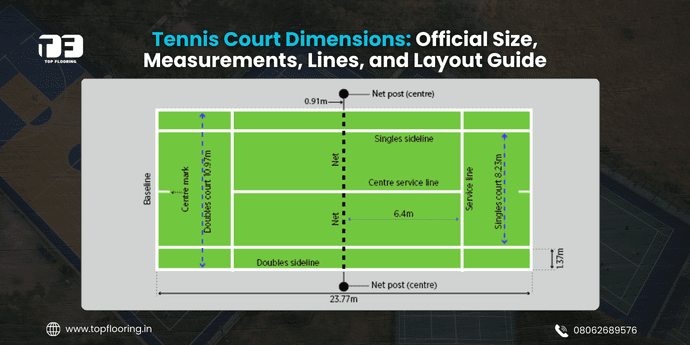
The ITF defines a standard tennis court as a rectangular playing surface measuring 78 feet (23.77 metres) in length and 36 feet (10.97 metres) in width for doubles play. For singles matches, the effective playing width narrows to 27 feet (8.23 metres), defined by the inner sidelines on each side. These measurements have remained unchanged in the modern era of professional tennis, making them a universal benchmark for every tennis court builder worldwide. The precision of these numbers is non-negotiable – even a half-inch deviation in baseline placement can invalidate a court for sanctioned competition.
The net divides the court exactly at its midpoint, placing it 39 feet (11.885 metres) from each baseline. Net height regulations specify 3 feet (0.914 metres) at the centre strap and 3.5 feet (1.07 metres) at the net posts. Net posts must be positioned 3 feet (0.914 metres) outside each sideline, meaning their total spread measures 42 feet (12.80 metres) for a doubles court. These clearance specifications ensure that the net sags correctly at the centre when properly tensioned with a strap – a detail that significantly affects ball trajectory during play near the net.
Standard Tennis Court Dimensions by Play Type
| Court Type | Length | Width (Singles) | Width (Doubles) |
| Standard Full Court | 78 ft (23.77 m) | 27 ft (8.23 m) | 36 ft (10.97 m) |
| Service Box Area | 21 ft (6.40 m) | 13.5 ft (4.11 m) | 13.5 ft (4.11 m) |
| Net Height (Center) | – | 3 ft (0.914 m) | 3 ft (0.914 m) |
| Net Height (Posts) | – | 3.5 ft (1.07 m) | 3.5 ft (1.07 m) |
| Baseline to Net | 39 ft (11.89 m) | – | – |
Service Area Dimensions and Their Importance
The service boxes are perhaps the most precisely regulated zones within the overall tennis court dimensions framework. Each service box measures 21 feet (6.40 metres) in depth from the net to the service line, and 13.5 feet (4.11 metres) in width – exactly half the singles court width. The centre service line runs perpendicular to the net, bisecting the two service boxes and connecting the net to the service line. This line must be precisely centred within the singles court width of 27 feet. Any error here directly impacts where a serve can legally land, making accurate layout critical even in recreational facilities.
Tennis Court Line Widths: Precision That Defines the Game
The lines drawn on a tennis court are not simply cosmetic – they are structural boundaries with prescribed widths that the ITF mandates for competition courts. All lines must be clearly distinguishable from the court surface, which is why white or yellow line paint is universally used. The baseline, being the outermost rear boundary, is the widest line on the court at 4 inches (approximately 10 centimetres). All other lines – sidelines, service lines, and the centre service line – measure 2 inches (5 centimetres) wide. The centre mark, a short perpendicular mark at the midpoint of each baseline, is also 4 inches long and 2 inches wide.
From a construction standpoint, line marking happens after the final colour coat has been applied and cured. Skilled tennis court builders use precision tape and stencil systems to ensure lines are straight, evenly spaced, and correctly dimensioned. Line paint must be acrylic-based to match the surface chemistry and must not create an elevated ridge that would alter ball bounce. In professional tournament settings, painted lines are inspected for both colour contrast and surface consistency to ensure they do not provide an unfair advantage through different bounce characteristics compared to the surrounding court area.
Required Clearance Zones Around Tennis Courts
| Zone | Recreational / Club | Professional / Tournament |
| Behind Baseline | 18 ft (5.49 m) | 21 ft (6.40 m) |
| Side Clearance | 10 ft (3.05 m) | 12 ft (3.66 m) |
| Overhead Clearance | 20 ft (6.10 m) | 40 ft (12.19 m) |
| Total Area (Doubles) | 60 x 120 ft | 60 x 120 ft (min) |
Official Tennis Court Line Specifications
| Line Name | Width | Notes |
| Baseline | 4 in (10 cm) | Outermost boundary at each end |
| Sideline | 2 in (5 cm) | Lateral boundary for singles & doubles |
| Service Line | 2 in (5 cm) | 21 ft from net, parallel to baseline |
| Centre Service Line | 2 in (5 cm) | Divides service boxes (perpendicular to net) |
| Centre Mark | 4 in long | Short mark bisecting each baseline |
Full Court Layout: Understanding Zones and Clearance Areas
Behind-the-Baseline and Side Clearance Zones
Tennis court dimensions extend well beyond the painted playing area. The ITF specifies mandatory clearance zones around every court to ensure player safety during rallies when athletes sprint beyond the baseline or dive wide of the sidelines. For recreational and club-level courts, the minimum clearance required behind each baseline is 18 feet (5.49 metres), while professional tournament courts demand at least 21 feet (6.40 metres). Similarly, the minimum side clearance is 10 feet (3.05 metres) for recreational facilities and 12 feet (3.66 metres) for professional venues. When calculating total land requirements, a standard doubles court with proper professional clearance demands a footprint of approximately 60 feet wide by 120 feet long.
For indoor facilities, overhead clearance is equally important. Recreational halls should provide a minimum of 20 feet (6.10 metres) of clear height above the playing surface, while elite-level indoor venues are expected to reach 40 feet (12.19 metres) or more to accommodate lob shots played at full extension. Any experienced tennis court builder will factor these vertical clearances into the very first stages of architectural planning, as post-construction modifications to ceiling height are prohibitively expensive. Outdoor courts must also account for fencing – typically chain-link or wire mesh at a height of 10 to 12 feet around the perimeter.
Did You Know?
Building a regulation tennis court isn’t just about pouring concrete and painting lines. A professional tennis court builder typically works through 6 distinct phases from geotechnical soil testing and sub-base engineering all the way to final ITF dimension auditing before a single player ever steps on the surface.
Tennis Court Flooring: Surface Types, Materials, and Performance
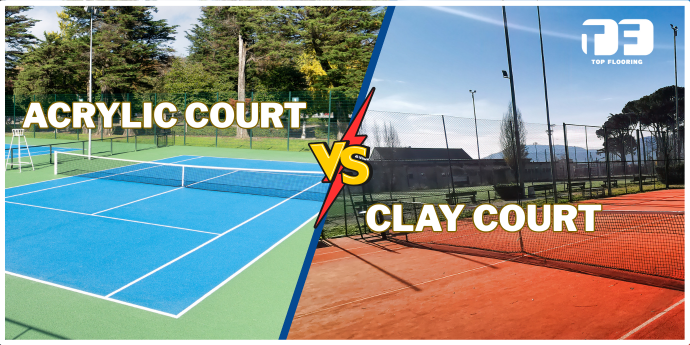
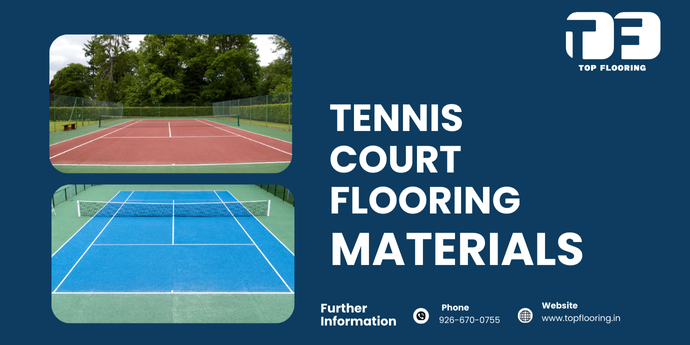
Tennis court flooring is far more complex than simply pouring concrete and painting lines. The surface type fundamentally shapes the style of play, the speed of the ball, and the physical demands placed on athletes. The four primary surface categories recognised by the ITF are hard courts (acrylic on asphalt or concrete), clay courts (crushed brick or shale), grass courts (natural turf), and carpet courts (synthetic fibre). Each surface has distinct construction requirements, maintenance protocols, and impact profiles. Hard courts are by far the most prevalent globally due to their durability, low maintenance cost, and consistent playing conditions across climates.
Modern hard-court tennis court flooring construction follows a multi-layer system designed to balance hardness, grip, cushioning, and water drainage. The structural base – typically asphalt or concrete – must be stable, well-graded, and free from significant cracks before any surface layer is applied. The layering system above the base is where material science plays a decisive role. Products like Concrete Primer, Acrylic Resurfacer, and Cushion Coat are applied in carefully controlled sequences to deliver a surface that meets ITF ball rebound standards while protecting long-term player joint health. Selecting an experienced tennis court builder who understands this layering system is essential for a court that performs correctly from day one.
Transform Your Sports Facility Today!
Contact us for high-quality synthetic sports flooring material and elevate your space!
Concrete Primer: The Critical First Layer
Concrete Primer is the foundational bonding agent applied directly onto the prepared concrete or asphalt base before any acrylic surface coatings are introduced. Its primary function is to penetrate the porous surface of the base material, creating a chemical anchor for subsequent layers to grip onto. Without a properly applied Concrete Primer layer, acrylic coatings can delaminate within months – particularly in climates that experience freeze-thaw cycles or heavy rainfall. A quality Concrete Primer is formulated to seal the base against moisture ingress while remaining flexible enough to accommodate minor thermal movement in the sub-base. Application is typically performed by brush, roller, or spray system, and requires the base to be completely dry, clean, and free of oil, dust, or loose material.
The quality of Concrete Primer application is directly linked to the lifespan of the entire tennis court flooring system above it. Skipping this step – or using an undiluted generic primer not formulated for sports surfaces – is one of the most common and costly mistakes made in court construction. Professional tennis court builders will test the base surface pH levels and porosity before selecting the correct primer grade, as highly alkaline concrete surfaces require a specialist primer formulation that neutralises the base chemistry before accepting acrylic coatings. The drying time for Concrete Primer varies between 4 and 24 hours depending on ambient temperature and humidity, and no subsequent layers should be applied until the primer has fully cured.
Acrylic Resurfacer: Filling, Levelling, and Texturing
Once the Concrete Primer layer has cured, the next material in the sequence is Acrylic Resurfacer – a thicker, aggregate-filled compound designed to fill surface irregularities, minor cracks, and texture variations in the base. Acrylic Resurfacer is typically applied in multiple passes (two to four layers depending on surface condition) using a squeegee or rubber-bladed spreader. Each pass is worked diagonally across the court to build a uniform texture. The aggregate particles within the resurfacer formula determine the eventual court speed – a coarser aggregate creates more surface friction, slowing the ball and favouring baseline players, while a finer aggregate produces a faster surface suited to serve-and-volley game styles.
From a dimensional perspective, Acrylic Resurfacer plays an important role in maintaining accurate tennis court dimensions. If the base has uneven settling or drainage slopes that have been engineered into it (courts typically slope 0.8% in one direction for water runoff), the resurfacer compensates for surface inconsistencies without altering the designed grade. Experienced tennis court builders will laser-level the court after each resurfacer application to confirm that slope tolerances remain within ITF specifications of no greater than 1% in any direction. Any pooling or bird-bath formations visible after rain are signs of inadequate resurfacing – a problem that must be corrected before colour coats and line marking proceed.
Cushion Coat: Protecting Players and Extending Surface Life
Cushion Coat is the most performance-critical layer in the modern hard-court system, representing the bridge between structural surface science and player biomechanics. Applied above the Acrylic Resurfacer, Cushion Coat is a rubber-modified acrylic formulation containing recycled rubber granules that create microscopic elastic zones within the playing surface. These zones compress slightly under foot impact and ball bounce, reducing the peak force transmitted to players’ joints – particularly the knees, hips, and ankles. Studies commissioned by the ITF and independent sports medicine researchers consistently demonstrate that Cushion Coat surfaces reduce lower-limb impact forces by 20 to 35 percent compared to unmodified acrylic surfaces on rigid concrete bases.
Cushion Coat is available in multiple cushioning grades – typically ranging from two-layer to eight-layer systems – allowing tennis court builders to customise the level of shock absorption based on the facility’s intended user profile. Senior fitness programs and junior development academies benefit enormously from higher-grade cushion systems, as these athletes are either most susceptible to repetitive stress injuries or are in critical developmental stages where joint protection is paramount. From a tennis court dimensions standpoint, Cushion Coat adds measurable thickness to the surface system – each layer adds approximately 0.3 to 0.5 millimetres – which must be accounted for when setting net post heights and verifying that drainage gradients remain within tolerance after all layers have been applied.
Tennis Court Flooring Material Layers and Functions
| Material Layer | Product / Type | Function |
| Base Primer Layer | Concrete Primer | Bonds surface to concrete or asphalt base |
| Resurfacing Layer | Acrylic Resurfacer | Fills cracks, levels surface texture |
| Cushion Layer | Cushion Coat | Reduces impact, joint stress, player fatigue |
| Color Finish Coat | Acrylic Color Coat | UV protection, ball visibility, aesthetics |
| Line Marking | White Acrylic Paint | Court boundary definition (2 in / 4 in wide) |
Tennis Court Construction: Step-by-Step Build Process
Site Preparation and Sub-Base Engineering
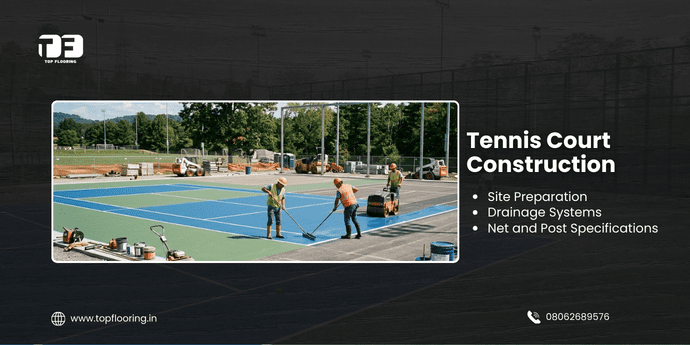
The construction of any regulation tennis court begins long before the first drop of Concrete Primer touches the ground. Site preparation involves geotechnical analysis of the soil bearing capacity, topography surveying, and drainage design. The sub-base must be engineered to carry both static load (the weight of the surface system and net posts) and dynamic load (the repeated impact forces of play). A well-prepared sub-base typically consists of a compacted gravel or crushed stone layer (typically 4 to 6 inches deep) topped by the structural base course – either asphalt or concrete. The asphalt base is preferred in climates with significant temperature variation because it offers greater flexibility than concrete, resisting cracking through thermal cycles.
Concrete bases, while more rigid, offer superior long-term dimensional stability and are often preferred in tropical or subtropical climates where asphalt may soften under intense heat. When using a concrete base, a minimum thickness of 4 inches is recommended for residential courts and 6 inches for commercial or institutional facilities. Expansion joints must be planned and cut into concrete bases to control where cracking occurs – uncontrolled cracking will telegraph through every surface layer above, including the Acrylic Resurfacer and Cushion Coat. Post-pour curing of concrete should extend a minimum of 28 days before any surface application begins, ensuring the slab has reached full structural maturity.
Fun Fact !!
The difference between a court that lasts 5 years and one that lasts 25 often comes down to one step most people never see — the Concrete Primer layer. Skilled tennis court builders treat this invisible foundation coat as the most critical application in the entire build, because without it, every layer above it can peel, crack, or delaminate within seasons.
Drainage Systems Within Tennis Court Dimensions
Proper drainage is embedded directly into the tennis court dimensions planning process. ITF guidelines specify that no court surface should retain standing water after rainfall – water must drain completely within 30 minutes of precipitation ending. This is achieved through a combination of surface slope (0.5% to 1% gradient across the court width or length, but never diagonally) and perimeter drainage channels or French drain systems around the court boundary. The direction of slope must be clearly determined in the design phase because it affects how the Acrylic Resurfacer is applied and how final ball bounce characteristics will differ microscopically across different court zones.
Net and Post Specifications Within the Court Layout
The tennis net is an integral dimensional element of the court, not simply an accessory. According to ITF rules, the net must completely fill the space between the two posts with no gaps, and must extend at least 3 feet beyond each singles sideline in doubles court configurations. The mesh cord or cable at the top of the net must be covered by a white band between 2 and 2.5 inches (5 to 6.35 centimetres) wide. Net posts for single-court permanent installations are set in concrete footings, positioned exactly 3 feet (0.914 metres) outside each sideline. For tournament configurations, portable posts with weighted bases are permissible, provided they maintain identical positioning relative to tennis court dimensions.
The tension of the net centre strap is also regulated – it must hold the net down to exactly 36 inches (0.914 metres) at the midpoint. Net post height for a doubles court must be precisely 42 inches (1.07 metres). One of the most frequent errors made during court installation is failing to account for the additional height added by Cushion Coat and colour coat layers when positioning net post footings. If footings are cast at a height calibrated for a bare slab but the finished surface adds 8 to 10 millimetres of coating thickness, the net will sit fractionally higher than regulation. Skilled tennis court builders pre-calculate total surface system thickness before setting any post footings to ensure final heights are compliant.
Maintaining Tennis Court Dimensions and Surface Integrity Over Time
Even the most precisely built court with flawless Concrete Primer, Acrylic Resurfacer, and Cushion Coat layers will require scheduled maintenance to preserve both dimensional accuracy and surface performance. Surface cracking is the most common issue affecting hard courts – thermal cycling, tree root intrusion, and sub-base settlement can all cause cracks to develop over time. Minor hairline cracks (under 1/16 inch wide) can be filled with acrylic crack filler and resurfaced without affecting court playability. Larger structural cracks indicate sub-base movement and may require saw-cutting, injection grouting, or even partial slab replacement before resurfacing can occur.
Line repainting is typically required every three to five years on heavily used courts, as UV exposure and ball abrasion gradually fade the white acrylic line paint. During line repainting, it is essential to verify that original court dimensions have not shifted due to paint build-up at line edges. Each successive repainting adds a thin layer of material, and over decades, this can result in lines that are measurably wider than the original ITF specification. Professional resurfacing projects include a dimension audit where lines are taped and measured against official tennis court dimensions before repainting commences. Courts that have deviated beyond tolerance are stripped back to the colour coat before fresh lines are applied.
How Surface Classification Affects Tennis Court Dimensions Strategy
The ITF classifies hard court surfaces on a five-tier pace rating scale from Pace 1 (Slow) to Pace 5 (Fast). The surface pace rating is determined by the aggregate texture of the Acrylic Resurfacer and the thickness of the Cushion Coat layer – not by the physical tennis court dimensions, which remain constant regardless of surface type. A slower surface (Pace 1 or 2) has a coarser texture that grips the ball more aggressively, reducing ball speed and increasing bounce height. This naturally encourages longer rallies and benefits players with powerful topspin groundstrokes. A faster surface (Pace 4 or 5) has a smoother texture that allows the ball to skid through at low trajectory, rewarding players with flat, aggressive serves and groundstrokes.
Understanding the interaction between surface pace and court geometry is important for facility planners. Tournament directors selecting a Cushion Coat grade and Acrylic Resurfacer aggregate combination are effectively shaping the tactical environment of their event. Grand Slam tournaments are famous for their distinctive surface choices – each venue has tailored its Cushion Coat specification over decades to create a consistent but unique playing experience. For club and recreational facilities, the Pace 3 (Medium) classification represents the best general-purpose choice, offering fair conditions for players of all skill levels without overemphasising any particular game style.
Indoor Tennis Court Dimensions and Special Considerations
Indoor tennis facilities share identical playing surface dimensions with outdoor courts – the 78-by-36-foot rectangle is universal – but the surrounding environment introduces unique design challenges. The most significant factor is the controlled air circulation required to prevent moisture condensation on the court surface. High humidity inside an enclosed space can compromise both the adhesion of Acrylic Resurfacer layers and the ball bounce consistency at the surface level. Indoor facilities must be equipped with HVAC systems capable of maintaining relative humidity between 40 and 60 percent and temperatures between 60°F and 75°F (15°C and 24°C) for optimal play conditions and surface longevity.
Lighting design for indoor courts must deliver a minimum of 200 lux at court surface level for recreational play, scaling up to 1,000 lux or higher for broadcast-quality tournament facilities. The placement of lighting rigs must respect the overhead clearance zones discussed earlier – fixtures positioned too low can interfere with high lob trajectories and create dangerous glare conditions for players tracking overhead smashes. Indoor tennis court flooring often incorporates lighter-coloured top coats to maximise light reflection efficiency, reducing overall energy demand from the lighting installation. This colour selection does not alter the official tennis court dimensions or line layout but is a considered aesthetic and functional choice by the tennis court builder.
Choosing the Right Tennis Court Builder for Your Project
The precision demanded by official tennis court dimensions makes the selection of a qualified tennis court builder among the most consequential decisions in any court development project. An experienced builder brings not only technical knowledge of ITF and USTA standards but also hands-on proficiency with the complete material system – from sub-base engineering through Concrete Primer application, multi-layer Acrylic Resurfacer builds, Cushion Coat selection, and final colour and line work. Requesting a portfolio of completed courts with verifiable references, ITF surface certifications, and evidence of third-party dimension auditing is a reasonable and advisable due-diligence step before signing any construction contract.
Budget planning for a new court should account for all phases: site preparation (10–15% of total cost), structural base construction (30–35%), surface layering including Concrete Primer, Acrylic Resurfacer, and Cushion Coat (25–30%), net and post installation (5%), line marking (5%), and perimeter fencing and lighting (10–15%). Courts that appear dramatically cheaper during the bidding phase often achieve their lower price by eliminating the Cushion Coat system or applying a single-pass Acrylic Resurfacer instead of the recommended multiple coats – false economies that result in premature cracking, poor player comfort, and costly resurfacing within five years rather than the expected fifteen or more.
Transform Your Sports Facility Today!
Contact us for high-quality synthetic sports flooring material and elevate your space!
Conclusion: Every Dimension Matters
Tennis court dimensions are a precise, interdependent system where each measurement supports the integrity of every other. The 78-foot court length, the 27-foot singles width, the 21-foot service boxes, the regulated line widths, the clearance zones, the net height specifications – none of these exist in isolation. They form a unified framework that makes tennis a globally consistent sport where a player trained in Delhi can step onto a court in London or New York and immediately feel at home. For those charged with building, maintaining, or upgrading tennis facilities, this consistency is both the challenge and the reward of getting every dimension right.
Frequently Asked Questions (FAQ)
A standard doubles tennis court measures 78 feet (23.77 metres) in length and 36 feet (10.97 metres) in width. The net divides the court at its exact midpoint, sitting 39 feet from each baseline.
Official clearance zones require a minimum of 18 feet behind each baseline and 10 feet on each side for recreational courts. Professional and tournament-grade facilities extend this to 21 feet behind the baseline and 12 feet on each side.
Concrete Primer is the critical bonding layer applied directly onto the asphalt or concrete base before any acrylic coatings begin. It penetrates the porous base material, sealing it against moisture and creating a chemical anchor for all layers above it including the Acrylic Resurfacer and Cushion Coat.
Cushion Coat is a rubber-modified acrylic layer applied above the Acrylic Resurfacer that introduces microscopic elastic zones into the playing surface. These zones compress under foot impact and ball bounce, reducing peak force on players’ joints particularly knees, hips, and ankles by up to 35% compared to unmodified hard surfaces.
A full professional tennis court build typically takes 4 to 8 weeks from groundbreaking to final line marking, depending on site conditions, base material choice, and weather. The concrete base alone requires a 28-day curing period before surface coatings like Concrete Primer, Acrylic Resurfacer, and Cushion Coat can begin.