
A 400m running track is the global standard for athletics competitions, schools, universities, and professional stadiums. Whether planning a new sports facility or understanding official specifications, knowing the exact 400m running track dimensions, lane width, turning radius, and marking layout is essential.
This guide explains everything in simple terms — from track length and lane size to staggered starts and construction basics.
What Are the Official 400m Running Track Dimensions?
A standard outdoor athletics track measures:
- Total Length: 400 meters (measured in Lane 1)
- Shape: Oval
- Straights: 84.39 meters each
- Curved Sections Radius: 36.5 meters (inside lane)
- Total Lanes: Usually 6, 8, or 9 lanes
- Lane Width: 1.22 meters (standard)
The 400m distance is measured 30 cm from the inner edge of Lane 1.
These standards follow international athletics guidelines used worldwide in competitive events.
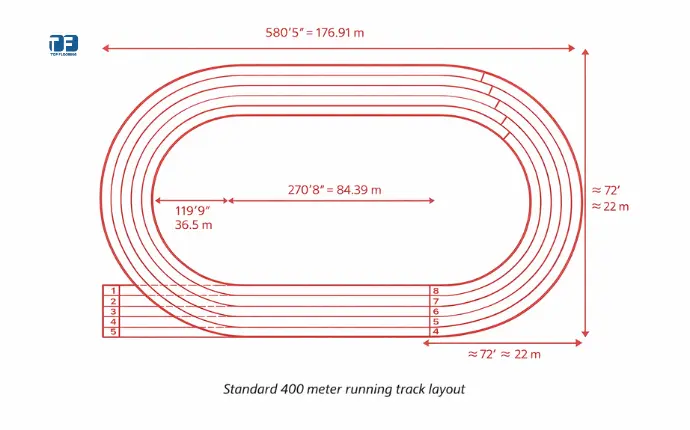
Standard 400m Running Track Measurements (Quick Table)
| Component | Measurement |
| Total Length | 400 meters |
| Straight Length | 84.39 m |
| Curve Radius (Lane 1) | 36.5 m |
| Lane Width | 1.22 m |
| Total Width (8 lanes) | ~9.76 m |
| Inner Border Width | 5 cm |
This layout ensures fairness in competitive races.
Why Is a 400m Track Oval?
The oval shape ensures:
- Equal race distance
- Smooth sprint transitions
- Standardized competition format
- Efficient space usage
Two straights + two semicircular curves make up the complete 400m distance.
Lane Width & Number of Lanes
Most tracks include:
- 6 lanes – Schools
- 8 lanes – District / state stadiums
- 9 lanes – International competitions
Each lane is 1.22 meters wide.
Additional space is sometimes provided outside the final lane for safety.
Understanding Staggered Starts
Because outer lanes cover a larger curve radius, races like 200m and 400m use staggered start positions.
This ensures:
- Equal total distance for all runners
- Fair competition
- Accurate race timing
The stagger varies depending on lane number.
400m Track Markings Explained
A standard athletics track includes:
- Start lines (100m, 200m, 400m)
- Finish line
- Relay exchange zones
- Lane numbering
- Break lines (for 800m events)
- Hurdle markings (if applicable)
All lines are painted with durable, high-visibility track paint to withstand weather and wear.
Space Required to Build a 400m Running Track
For a full-size 8-lane track:
- Approximate overall area required: 176m × 92m
- Inner field typically used for:
- Football
- Cricket practice
- Field events (shot put, long jump)
Proper land planning is crucial before construction.
Types of Surfaces Used for 400m Running Tracks
Common surface types include:
1. Synthetic Polyurethane (PU) Track
- Used in international competitions
- Shock-absorbing
- High durability
2. Acrylic Running Track Surface
Synthetic acrylic Running Track surfaces are commonly used for durability, safety, and performance.
- Cost-effective
- Ideal for schools and training facilities
- Good UV resistance
3. Rubberized Track
- Durable
- Weather resistant
Modern tracks prioritize:
- Player safety
- Injury reduction
- Long lifespan
- Anti-slip performance
400m Running Track Dimensions in Feet
For easier understanding:
- 400 meters = 1,312.34 feet
- Lane width = 4 feet
- Straight length ≈ 276.8 feet
- Curve radius ≈ 119.7 feet
This helps architects and contractors working in imperial measurements.
Indoor vs Outdoor 400m Track Dimensions
| Type | Length |
| Outdoor Standard | 400m |
| Indoor Track | Usually 200m |
Indoor tracks are shorter due to space limitations.
Common Mistakes in Track Planning
- Incorrect curve radius
- Wrong lane width
- Poor drainage planning
- Low-quality surface material
- Inaccurate marking alignment
Proper engineering ensures accurate competition standards.
Construction Basics of a 400m Track
Basic construction layers include:
- Compacted sub-base
- Asphalt or concrete base
- Cushion layer
- Synthetic or acrylic top surface
- Line marking
Professional construction ensures:
- Surface evenness
- Shock absorption
- Long-term durability
Maintenance of a 400m Running Track
- Regular cleaning
- Drainage inspection
- Repainting markings
- Surface crack repairs
Well-maintained tracks can last 8–15 years, depending on material quality.
Final Thoughts
Understanding 400m running track dimensions is essential for accurate construction, competitive compliance, and long-term durability. From lane width and curve radius to surface materials and markings, every detail impacts performance and safety.
If planning a school ground, stadium, or sports complex, following official measurement standards ensures the track meets professional expectations and search demand alike.
Frequently Asked Questions (FAQs)
A standard outdoor athletics track measures 400 meters in Lane 1, with 1.22-meter-wide lanes and a 36.5-meter curve radius.
Most tracks have 6 to 9 lanes, depending on facility level.
Each lane is 1.22 meters wide.
Staggered starts ensure all athletes run the same distance due to larger outer lane curves.
An 8-lane track requires approximately 176m × 92m area.
Synthetic polyurethane and Synthetic acrylic surfaces are commonly used for durability, safety, and performance.