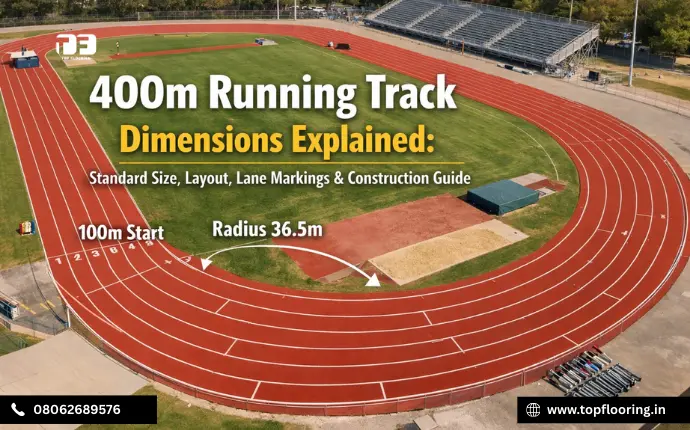
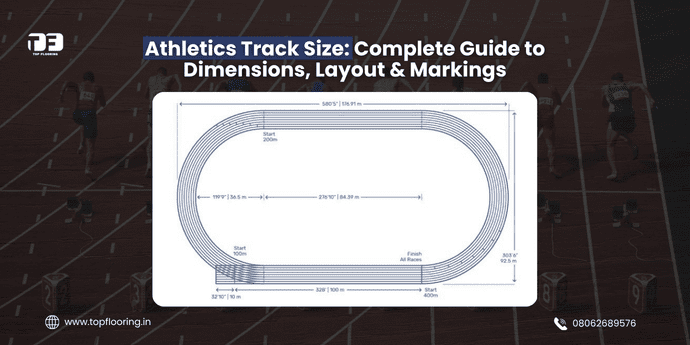
A standard athletics track is 400 metres in circumference, measuring 176.91 metres in length and 92.52 metres in width as per World Athletics (formerly IAAF) specifications. The track consists of two straight sections of 84.39 metres each and two semicircular curves with an inner radius of 36.80 metres. Most competition tracks have 8 lanes, each 1.22 metres wide, though some facilities offer 9 or 10 lanes.
This 400m dimension is the global benchmark used in the Olympics, Commonwealth Games, Asian Games, and every serious athletics competition around the world, including all Khelo India and SAI-recognised facilities in India.
Table of contents
- Why Athletics Track Size Matters More Than You Think
- Breaking Down the 400m Track Layout
- Staggered Start Positions The Most Misunderstood Part of a Track
- Athletics Track Lane Width Detailed Breakdown
- Indoor Athletics Track Size
- Official Markings on an Athletics Track Full Guide
- Synthetic Acrylic vs PU Rubber Surface Materials Compared
- Step-by-Step Athletics Track Construction Process
- Athletics Track Construction Cost in India (2025)
- School Athletics Track Size in India
- Common Mistakes in Athletics Track Construction
- Maintenance and Durability of Athletics Tracks
- Safety Considerations
- Conclusion
- Frequently Asked Questions
Why Athletics Track Size Matters More Than You Think
After 20+ years of working on athletics infrastructure across India from school grounds in tier-3 cities to SAI-affiliated academies in metro regions the single most common and costly mistake I have seen is building a track without understanding the full specification picture. A track that is 2 metres short in circumference or has lane widths of 1.10 metres instead of 1.22 metres will fail official inspection, waste your entire investment, and be ineligible for any sanctioned competition.
This guide covers everything: exact dimensions, lane specifications, marking standards, surface materials, construction steps, cost estimates for India, and what separates a track that lasts 15 years from one that needs resurfacing in three.
Standard Athletics Track Dimensions Complete Specification Table
| Parameter | Measurement |
| Total Circumference | 400 metres |
| Straight Length (each) | 84.39 metres |
| Semicircle Inner Radius | 36.80 metres |
| Total Track Width (8 lanes) | ~9.76 metres |
| Standard Lane Width | 1.22 metres |
| Minimum Lane Width | 1.00 metre |
| Maximum Lane Width | 1.25 metres |
| Kerb Width (inside) | 5 cm raised or flat |
| Number of Standard Lanes | 8 (competition) |
| Overall Track Area (approx.) | 10,000–11,000 sq m |
| Infield Dimensions | ~68 m × 109 m |
Breaking Down the 400m Track Layout
The Two Straights
Each straight section runs exactly 84.39 metres. This measurement is precise because the two 100m sprint races, the 100m and 110m hurdles, are run on the straight. The finishing straight (main straight) typically faces the main grandstand and contains the finish line for all races.
The Two Semicircular Curves
Each curve has an inner radius of 36.80 metres. The curve length for each semicircle is approximately 115.61 metres. This geometry is what produces the 400m total when combined with the two straights.
The tighter the curve radius, the more centrifugal force is placed on athletes. World Athletics specifies 36.80m as the minimum inner radius for a competition track; anything tighter compromises biomechanics and athlete safety.
Lane Numbering
Lanes are numbered 1 through 8 (or 9/10 on wider tracks), with Lane 1 being the innermost lane. Lane 1 is measured along the inner edge of its kerb. Lanes 2 through 8 are measured 20 cm from the inside of the preceding lane line; this is the key measurement that often gets wrong during construction.
Staggered Start Positions The Most Misunderstood Part of a Track
Staggered starts exist because each lane follows a different circumference. If all athletes started at the same line, outer lane runners would travel more distance. The stagger compensates for this.
| Lane | Stagger Distance Over Lane 1 (400m race) |
| Lane 1 | 0.00 m (scratch line) |
| Lane 2 | +7.04 m |
| Lane 3 | +14.16 m |
| Lane 4 | +21.28 m |
| Lane 5 | +28.40 m |
| Lane 6 | +35.52 m |
| Lane 7 | +42.64 m |
| Lane 8 | +49.76 m |
These stagger positions must be marked precisely using certified measurement equipment. Even a 5cm error in stagger marking can result in disqualification of results in competition.
Athletics Track Lane Width Detailed Breakdown
Lane width is one of the most frequently debated specifications in track construction. Here is what World Athletics mandates:
- Competition tracks: 1.22 metres per lane, with the outermost lane having an additional 30 cm for safety
- Training/school tracks: A minimum of 1.00 metre is accepted, though 1.22m is always recommended
- Hurdles lanes: Must be a minimum of 1.22m to allow proper hurdle placement at 1.00m offset from lane lines
Lane lines themselves are 5 cm wide and painted in white. Critically, the lane line belongs to the higher-numbered lane meaning the measured width of Lane 3 includes the right boundary line of Lane 3, not the left.
Indoor Athletics Track Size
Indoor tracks follow a different standard. World Athletics specifies indoor facilities as follows:
| Parameter | Indoor Standard |
| Circumference | 200 metres |
| Straights | 2 × 35 metres approx. |
| Lanes | 4–8 (typically 6) |
| Lane Width | 1.00 metre minimum |
| Bank Angle (curves) | Up to 18 degrees |
| Surface | Polyurethane (PU) |
| Minimum Ceiling Height | 9 metres |
Indoor tracks use banked curves typically angled between 10 and 18 degrees to compensate for the tighter 200m radius. Without banking, athletes would lose traction and speed on every curve. This is why indoor track construction is significantly more complex and expensive than outdoor.
India currently has fewer than 10 certified indoor athletics tracks. This is a massive infrastructure gap and an opportunity for institutions and state sports authorities to invest.
Official Markings on an Athletics Track Full Guide
A properly marked athletics track carries numerous event-specific lines. Here is what should appear on a World Athletics compliant track:
| Marking | Colour | Purpose |
| Lane Lines | White | Divides all lanes |
| Finish Line | White | Shared finish for all running events |
| 100m Start Line | White | Sprint start |
| 200m Start Lines | White (staggered) | Sprint start per lane |
| 400m Start Lines | White (staggered) | One lap race |
| 800m Start Lines | White + staggered | Two-lap race |
| 1500m Start Line | White | Middle distance |
| 4×100m Exchange Zones | Yellow | 20m relay exchange box |
| 4×400m Exchange Zones | Blue | Relay take-over zone |
| Hurdle Marks | Yellow | Placement guides |
| Steeplechase Water Jump | Fixed installation on infield |
One real-world insight from our track projects:
Relay exchange zone errors are among the most common mistakes on school tracks. The 4×100m exchange zone is 20 metres long, but it begins 10 metres before the nominal exchange line, not at it. Many contractors mark it incorrectly, causing relay teams to be disqualified at their first competition.
Synthetic Acrylic vs PU Rubber Surface Materials Compared
Two surface systems dominate athletics track construction today:
| Feature | Synthetic Acrylic | PU Rubber (Polyurethane) |
| Typical Use | Training, school, community tracks | Competition, professional tracks |
| Thickness | 3–8 mm | 10–13 mm |
| Shock Absorption | Moderate | High |
| Durability | 8–12 years | 10–15 years |
| Maintenance | Low | Low to moderate |
| IAAF Certification | Class 1 & 2 eligible | Class 1 eligible |
| Cost per sq m (India) | ₹600–₹1,200 | ₹1,800–₹3,500 |
| UV Resistance | Excellent | Good |
| All-Weather Performance | Yes | Yes |
For most Indian institutions schools, colleges, municipal bodies synthetic acrylic is the practical choice. It delivers consistent performance, handles India’s monsoon and UV load well, and costs 40–60% less than PU rubber systems. For state-level or national competition tracks, a full-pour or prefabricated PU system is the appropriate specification.
Step-by-Step Athletics Track Construction Process
Based on projects executed across Bengaluru, Delhi NCR, Hyderabad, and Pune, here is the standard construction sequence for a synthetic athletics track:
Step 1 Site Survey & Design Topographical survey to establish existing levels. Design to achieve proper drainage slope (1:100 cross-fall recommended).
Step 2 Subgrade Preparation Excavation and compaction of natural soil to achieve CBR value of minimum 8%. Poor subgrade preparation is the number one cause of premature cracking.
Step 3 Sub-base Layer 75–100mm compacted granular sub-base (GSB) layer. This distributes load and improves drainage.
Step 4 Base Course 40–50mm dense bituminous macadam (DBM) or concrete base. Concrete is preferred for longevity. For concrete bases, M25 grade with minimum 150mm thickness is standard.
Step 5 Levelling & Priming Surface is ground flat to ±3mm tolerance over a 3m straight edge. Concrete primer applied as bonding agent.
Step 6 Acrylic Resurfacer One or two coats of acrylic resurfacer to fill surface texture and create uniform base for colour coats.
Step 7 Colour Coats Two to three coats of acrylic colour coat (typically brick red, terracotta, or dark green for athletics tracks). Each coat contains silica sand for grip.
Step 8 Line Marking Precision marking using certified surveying equipment. All event-specific lines painted in correct colours and dimensions.
Athletics Track Construction Cost in India (2025)
Cost varies significantly based on track type, surface material, and location. Here is a realistic range based on current market rates:
| Track Type | Approx. Cost (₹) |
| 400m Acrylic Track (School/Training) | ₹60 lakh – ₹1.2 crore |
| 400m PU Rubber Track (Competition) | ₹1.5 crore – ₹3.5 crore |
| 200m Indoor Track | ₹2 crore – ₹5 crore |
| 200m Acrylic Track (Training) | ₹35 lakh – ₹65 lakh |
| Track Resurfacing Only | ₹20 lakh – ₹60 lakh |
What drives cost in India:
- Base type (concrete vs bituminous)
- Number of lanes (6, 8, or 10)
- Surface system (acrylic vs PU)
- Drainage infrastructure
- Location and site accessibility
- Line marking complexity
- Lighting and fencing (if included)
One important note: never evaluate track quotations on price per square metre alone. A contractor quoting ₹700/sq m on an acrylic system may be skipping the resurfacer coat or reducing colour coat thickness from 3 coats to 1. Always specify the layer system in writing before awarding any contract.

School Athletics Track Size in India
Most Indian schools cannot accommodate a full 400m track. Here are practical alternative configurations:
| Track Configuration | Approx. Space Required | Suitable For |
| 400m, 8-lane | 180m × 100m | University, SAI centre |
| 200m, 4-lane | 100m × 60m | Large schools |
| 100m straight only | 120m × 15m | Primary & middle schools |
| Compact oval, 250m | 120m × 70m | Secondary schools |
A 100m straight track with proper acrylic surface and line marking can still develop excellent sprint athletes and is far more valuable than no infrastructure at all.
Common Mistakes in Athletics Track Construction
From two decades of field experience, these are the errors that cost institutions lakhs in rework:
1. Insufficient base preparation The most expensive mistake. A weak sub-base will produce cracking within 2–3 monsoon cycles regardless of how good the surface material is.
2. Wrong inner radius Many contractors build curves with radii of 32–34m to fit tighter sites. This changes the total circumference and renders the track non-compliant.
3. Inaccurate stagger marking Even professional facilities have been found with stagger errors of 30–50cm. Always use a certified surveyor with theodolite equipment for marking.
4. Single-coat colour application Standard specification requires a minimum of two colour coats. Single-coat application reduces grip and fades within 12–18 months.
5. No drainage planning A flat track will pool water at the curves during monsoon, leading to surface delamination and algae growth.
Maintenance and Durability of Athletics Tracks
A well-constructed synthetic acrylic track requires minimal but consistent maintenance:
- Monthly: Sweep to remove leaf litter, dust, and debris. Do not use hard metal brooms.
- Quarterly: Wash with mild detergent and water. Check for surface cracks.
- Annually: Professional inspection. Apply crack sealant where needed.
- Every 5–8 years: Full resurfacing with new acrylic colour coat and fresh line marking.
Tracks that are properly maintained last 10–15 years before requiring full replacement. Poorly maintained tracks need resurfacing within 3–5 years.
Safety Considerations
- Minimum 1m safety zone beyond all lane boundaries
- Kerb height must not exceed 5cm to prevent tripping
- Surface coefficient of friction must be 0.5 or higher (wet) as per World Athletics guidelines
- Shock absorption value of 35–50% is recommended for training tracks to protect athlete joints
- Adequate drainage to prevent waterlogging a wet acrylic track can be 40% more slippery than a dry one
Conclusion
An athletics track is one of the most demanding sports infrastructure projects demanding in precision, in material selection, in construction sequence, and in long-term maintenance commitment. The 400m standard exists for a reason: every dimension, from the 36.80m curve radius to the 1.22m lane width, serves a biomechanical or competitive purpose that cannot be approximated.
Whether you are planning a national-level competition facility or a simple 4-lane school track, the fundamentals do not change. Get the base right. Use certified materials. Mark with precision. And maintain consistently.
For institutions, architects, and sports planners in India, the time to invest in quality athletics infrastructure is now with Khelo India and state government grants making funding more accessible than ever before. A well-built track does not just host competitions. It builds athletes, builds habits, and builds communities that return to that track for decades.
If you are planning a track project and need guidance on surface selection, layer systems, or layout design, connect with a certified synthetic sports flooring specialist before any ground is broken.
Frequently Asked Questions
400 metres circumference, two 84.39m straights, two curves with 36.80m inner radius, 8 lanes of 1.22m each.
1.22 metres for competition tracks. School and training tracks can use a minimum of 1.00 metre.
Approximately 180m × 100m around 18,000 sq m of total land area.
A 200m track is half the circumference, used indoors with banked curves up to 18° to handle the tighter radius.
Acrylic track: ₹60 lakh – ₹1.2 crore. Competition PU track: ₹1.5 crore – ₹3.5 crore.
Every 5–8 years with proper maintenance. Total surface life can reach 12–15 years.