Every tennis match begins and ends within fixed boundaries – and knowing the exact length of a tennis court gives players, coaches, facility designers, and sports enthusiasts a critical edge in understanding the game at its deepest level.
Table of contents
- What Is the Standard Length of a Tennis Court?
- Full Tennis Court Dimensions – All Measurements Explained
- Tennis Court Dimensions Information Table
- Tennis Court Surface Types and Their Impact on Play in India 2026
- Comparison Table – Tennis Court vs Other Sport Courts
- ITF Rules Governing Tennis Court Length – 2026 Update
- How to Measure a Tennis Court Correctly
- Common Measurement Mistakes to Avoid
- Estimated Construction Costs in India 2026
- Frequently Asked Questions
What Is the Standard Length of a Tennis Court?
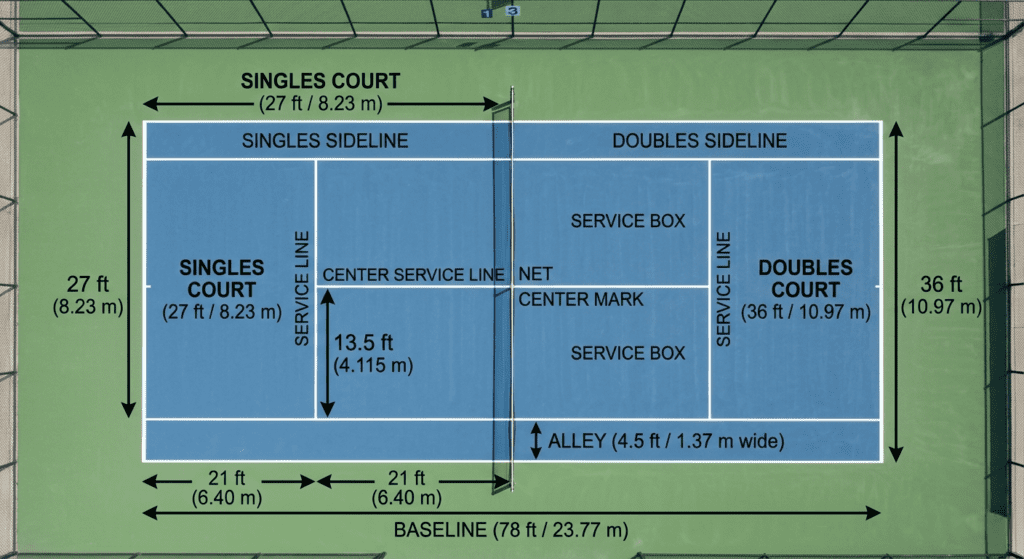
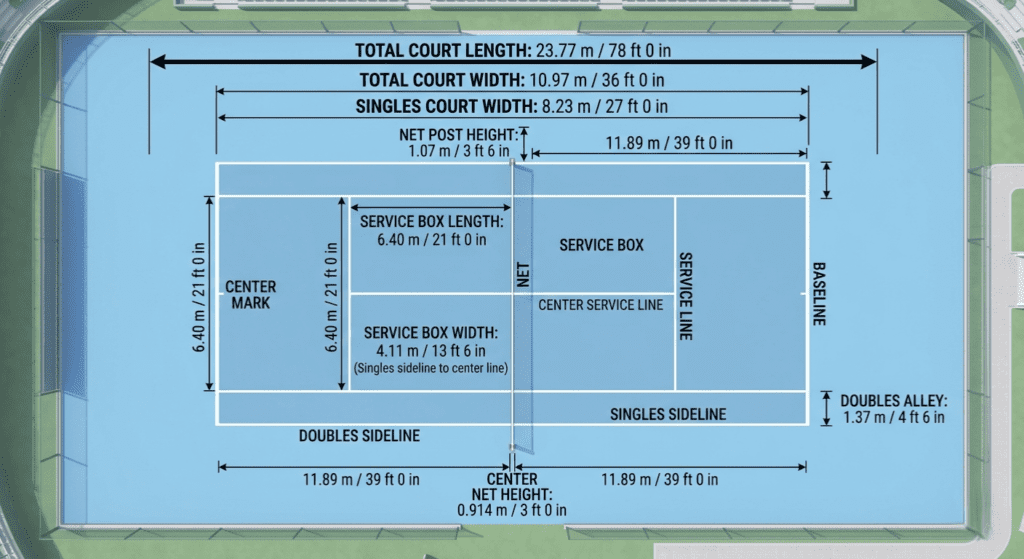
The standard length of a tennis court measures exactly 23.77 metres, which equals 78 feet. This dimension runs from one baseline to the opposite baseline. The International Tennis Federation (ITF) establishes and enforces this measurement globally. Every professional court – from Wimbledon to Roland Garros to the Indian Open – must meet this specification precisely.
The net divides the court into two equal halves. Each half measures 11.885 metres (39 feet) from the net to the respective baseline. Players use these zones strategically during rallies, serving, and volleying. Understanding the exact length helps players calculate shot depth and position themselves correctly during competitive play.
Courts in India follow the same ITF-mandated length of 23.77 metres. The Sports Authority of India (SAI) updated its facility construction guidelines in 2025–2026 to strictly enforce international standards. State tennis associations across Delhi, Mumbai, Bangalore, and Chennai now conduct annual audits to verify court measurements at registered venues.
Full Tennis Court Dimensions – All Measurements Explained
Length and Width Breakdown
A tennis court carries several distinct measurements beyond its total length. The full playing area includes the court itself plus additional runback and side clearance zones. Players need space to chase balls beyond the baselines and sidelines safely. The ITF mandates minimum clearance zones around the court perimeter.
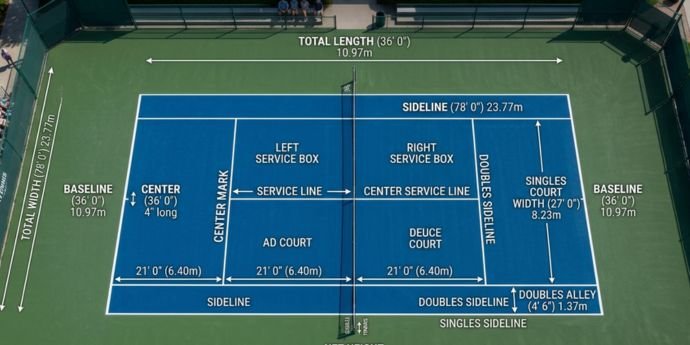
The court length of 23.77 metres remains constant for both singles and doubles formats. However, the width changes based on the format played. Singles courts measure 8.23 metres wide, while doubles courts extend to 10.97 metres wide. The additional 1.37 metres on each side creates the doubles alleys, which become live playing zones in doubles matches only.
Service Box Dimensions
The service boxes sit on either side of the net within the court. Each service box measures 6.40 metres (21 feet) in length from the net toward the baseline. The width of each service box is 4.115 metres (13.5 feet), matching half the singles court width. Players must land their serve within the diagonally opposite service box to begin each point legally.
The service line runs parallel to the net at a distance of 6.40 metres. This line marks the far boundary of the service boxes. The center service line bisects both service boxes and runs perpendicular from the net to the service line. These markings create four distinct service areas that players target during serving strategy in 2026 professional matches.
Net Height and Position
The net stretches across the full width of the court at the exact centre, dividing the 23.77-metre length equally. The net height measures 0.914 metres (3 feet) at the center and rises to 1.07 metres (3.5 feet) at the posts. The net posts stand 0.914 metres outside each sideline. This slight sag at the center creates different tactical considerations when players aim shots down the middle versus the sidelines.
Tennis Court Dimensions Information Table
| Measurement | Metres | Feet |
| Total Court Length | 23.77 m | 78 ft |
| Half Court Length (each side) | 11.885 m | 39 ft |
| Singles Court Width | 8.23 m | 27 ft |
| Doubles Court Width | 10.97 m | 36 ft |
| Service Box Length | 6.40 m | 21 ft |
| Service Box Width (each) | 4.115 m | 13.5 ft |
| Net Height at Center | 0.914 m | 3 ft |
| Net Height at Posts | 1.07 m | 3.5 ft |
| Doubles Alley Width | 1.37 m | 4.5 ft |
| Minimum Runback (ITF) | 6.40 m | 21 ft |
| Minimum Side Clearance (ITF) | 3.66 m | 12 ft |
| Total Recommended Area | 36.57 m × 18.29 m | 120 ft × 60 ft |
Tennis Court Surface Types and Their Impact on Play in India 2026
Hard Courts
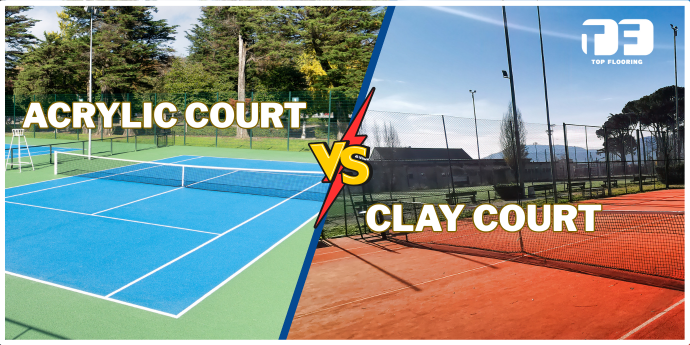
Hard courts represent the most common surface type in India as of 2026. The SAI reports that over 68% of registered tennis facilities across India now use hard acrylic or polymeric surfaces. Hard courts provide a consistent, medium-paced bounce that suits baseline players. The court length of 23.77 metres feels “faster” on hard courts because the ball skids through the surface rather than gripping it, allowing players to attack the baseline more aggressively.
Indian tennis academies in Bangalore, Hyderabad, and Pune actively use hard courts for training due to their low maintenance cost and durability in tropical climates. The AITA (All India Tennis Association) revised its court construction standards in 2025 to mandate shock-absorbing underlay beneath all new hard court installations, reducing player injury risks significantly across club and academy facilities.
Clay Courts
Clay courts slow the game down considerably. The ball grips the clay surface and bounces higher, giving baseline players more time to reach shots near the back of the 23.77-metre court. Roland Garros in France uses red clay, while many South American and European clubs use green clay (called Har-Tru). Indian clay courts primarily use red clay imported from Spain or locally sourced red soil compounds processed to ITF specifications.
Clay court maintenance requires daily rolling, watering, and line brushing. The MSLTA (Maharashtra State Lawn Tennis Association) released updated clay court maintenance guidelines in January 2026. These guidelines address India-specific challenges such as monsoon season court protection, heat management during peak summer months, and dust control during dry northern India winters.
Grass Courts
Grass courts represent the fastest playing surface. The Wimbledon Championships uses grass exclusively and is the most prestigious grass court tournament globally. In India, the DLTA (Delhi Lawn Tennis Association) maintains two grass courts at its South Delhi facility as of 2026. Grass courts require intensive daily maintenance including mowing, rolling, marking, and irrigation. The ball stays low on grass, making the 23.77-metre court length feel longer as players need to cover more ground quickly.
Carpet and Indoor Courts
Carpet courts appear almost exclusively indoors. Several five-star hotels in Mumbai, Delhi, and Gurgaon operate indoor carpet courts for member use. The surface provides a fast, consistent bounce similar to hard courts. Carpet courts allow year-round play regardless of weather, making them increasingly popular among urban Indian tennis clubs. The carpet material must meet ITF thickness and traction standards regardless of the indoor setting.
Comparison Table – Tennis Court vs Other Sport Courts
| Sport | Court Length | Court Width | Surface | Governing Body |
| Tennis (Singles) | 23.77 m (78 ft) | 8.23 m (27 ft) | Multiple | ITF |
| Tennis (Doubles) | 23.77 m (78 ft) | 10.97 m (36 ft) | Multiple | ITF |
| Badminton (Singles) | 13.40 m (44 ft) | 5.18 m (17 ft) | Synthetic/Wood | BWF |
| Badminton (Doubles) | 13.40 m (44 ft) | 6.10 m (20 ft) | Synthetic/Wood | BWF |
| Basketball | 28.00 m (91.9 ft) | 15.00 m (49.2 ft) | Hardwood/Asphalt | FIBA |
| Volleyball | 18.00 m (59 ft) | 9.00 m (29.5 ft) | Multiple | FIVB |
| Squash | 9.75 m (32 ft) | 6.40 m (21 ft) | Wood/Glass | WSF |
| Pickleball | 13.41 m (44 ft) | 6.10 m (20 ft) | Hard | IFP |
ITF Rules Governing Tennis Court Length – 2026 Update
The International Tennis Federation published its latest Rules of Tennis document in January 2026. These rules confirm that the court length of 23.77 metres remains unchanged since its standardization in the late 19th century. The ITF Rules of Tennis Rule 1 explicitly defines the court: “The court shall be a rectangle 23.77 metres long and for singles matches, 8.23 metres wide.” No national federation – including the AITA – holds authority to modify these dimensions for sanctioned competitive events.
The ITF introduced updated court inspection protocols in 2026. Certified court inspectors now use laser measurement technology to verify court length accuracy to within ±2 millimetres. Tournament directors at ITF-sanctioned events in India must submit court measurement certificates signed by a certified inspector at least 21 days before the tournament begins. The AITA adopted this protocol for all national-ranking events starting from the 2026 season calendar.
AITA 2026 Court Standards for India
The All India Tennis Association released its updated National Court Standards document in February 2026. This document specifies minimum court dimensions, surface quality benchmarks, lighting requirements, and drainage standards for Indian tennis facilities. All courts seeking AITA registration must demonstrate a playing surface length of exactly 23.77 metres verified through laser measurement. Courts falling outside the ±2mm tolerance receive a non-compliance notice and must undergo resurveying before hosting any ranking event.
The AITA also introduced a new tiered certification system in 2026. Level 1 certification covers courts meeting full ITF standards for international events. 2nd Level covers courts meeting national standards for domestic ranking events. 3rdLevel covers courts suitable for training and non-ranking competitions. This tiered approach allows more grassroots facilities across smaller Indian cities to receive formal recognition while ensuring top-tier venues maintain international standards.
How to Measure a Tennis Court Correctly
Measuring a tennis court requires precision tools and a systematic approach. Players, coaches, and facility managers in India increasingly use laser distance measurers for accurate results. Traditional tape measures introduce human error, especially over a 23.77-metre span. Laser devices provide readings accurate to within ±1 millimetre and complete the measurement in seconds.
Start measurement at the inside edge of one baseline. Stretch the measuring device in a straight line parallel to the sidelines. The opposing baseline’s inside edge should register exactly 23.77 metres. Measure the court length from both sideline positions to confirm the court is not skewed or parallelogram-shaped. An irregular court shape indicates installation error that affects ball bounce consistency and player fairness.
Common Measurement Mistakes to Avoid
Many facility managers mistakenly measure from the outside edges of baseline markings rather than inside edges. This error adds approximately 5–10 centimetres to the apparent length, creating a non-compliant court. Line tape typically measures 5 centimetres in width, so measuring from the outside edge rather than inside edge of the baseline shifts the effective playing area beyond ITF tolerances.
Another common error involves measuring along a curve rather than in a perfectly straight line. Courts built on uneven ground sometimes develop slight curves in the baseline due to surface expansion or poor initial installation. Laser measurers detect this problem immediately because they measure only straight-line distances. Always verify court measurements after major weather events, resurfacing work, or any ground-shifting activity near the court perimeter.
Case Study – Renovating a Non-Compliant Court at a Bangalore Tennis Club (2025)
- Background: A mid-sized tennis club in Whitefield, Bangalore discovered during its annual AITA audit in September 2025 that one of its three hard courts measured only 23.61 metres in length – 16 centimetres shorter than the ITF standard. The club had operated this court for 11 years without detection, using traditional tape-measure inspections.
- The Problem: The shorter court length affected serve depth accuracy during training. Players practicing first serves were calibrating their toss and swing to a shorter court, which translated into shorter serves during tournament play on correctly measured courts. Three junior players from the club underperformed on national-ranking circuits, and coaches initially attributed this to technique deficiencies.
- The Discovery: The 2025 AITA audit introduced laser measurement as mandatory for the first time. The laser device identified the 16-centimetre discrepancy in under 90 seconds. Further investigation revealed the original construction contractor had measured from the outside edge of the baseline markings rather than the inside edge, compounded by a 6-centimetre surface expansion error caused by poor thermal management during initial installation.
- The Solution: The club engaged an ITF-certified court resurfacing company from Chennai. The team stripped the acrylic surface layer, repositioned the baseline markings using laser-guided placement tools, and reapplied the surface coating across the full corrected 23.77-metre length. Total renovation cost came to approximately ₹3.8 lakhs and took nine days to complete.
- The Outcome: Following court correction and re-certification in November 2025, all three junior players showed measurable improvement in serve depth accuracy within six weeks of training on the properly measured court. The club now uses annual laser measurement audits as a standard operational practice. This case underlines why precise court length compliance matters beyond regulatory compliance – it directly impacts player development outcomes.
Tennis Court Length in Recreational vs Professional Settings
Recreational tennis courts often deviate from exact ITF measurements, especially in schools, apartment complexes, and small clubs across India. A 2025 survey by the Indian Tennis Development Foundation found that approximately 34% of recreational courts surveyed across 12 Indian cities measured outside ITF tolerances by more than 5 centimetres. These deviations rarely affect casual play but create significant problems when players transition to competitive settings.
Professional courts undergo rigorous measurement verification before every sanctioned event. Tournament officials at ATP, WTA, and ITF events conduct baseline-to-baseline laser measurements within 48 hours of first match play. Any court outside tolerance receives immediate remediation before competition begins. The consistency of the 23.77-metre court length across all professional venues worldwide allows players to develop muscle memory and tactical patterns that transfer reliably from one tournament to the next.
Mini Tennis Court Dimensions for Young Players
Mini tennis uses shorter courts designed for children aged 5 to 10. The ITF’s mini tennis program recommends courts of three standard sizes. Red stage courts for 5–8 year olds measure 11 metres long and 6 metres wide. Orange stage courts for 8–9 year olds measure 18 metres long and 6.5 metres wide. Green stage courts for 9–10 year olds use near-full dimensions at 23.77 metres long with modified net height and slower balls. India’s Khelo India Tennis program adopted mini tennis court standards officially in 2025, funding the construction of 480 mini tennis courts across government schools in 11 states.
Space Requirements for Building a Tennis Court in India 2026
Building a tennis court in India requires significantly more space than the court dimensions alone suggest. The total recommended area including runback zones and side clearances stretches to 36.57 metres in length and 18.29 metres in width. Urban land costs in Indian metros make this space requirement a major financial consideration for private clubs and residential societies.
The minimum runback distance behind each baseline stands at 6.40 metres per ITF guidelines. Side clearance requires a minimum of 3.66 metres beyond each sideline. For multiple adjacent courts, the ITF recommends 3.66 metres between court sidelines, though many Indian facilities use 4.0 metres to reduce ball interference between simultaneous matches. Orient courts on a north-south axis wherever possible to minimize players facing direct sunlight during morning and evening play.
Estimated Construction Costs in India 2026
| Court Type | Estimated Cost (INR) | Lifespan | Maintenance/Year |
| Basic Hard Court (Concrete) | ₹8–12 Lakhs | 15–20 years | ₹40,000–60,000 |
| Acrylic Hard Court (Premium) | ₹15–22 Lakhs | 10–15 years | ₹60,000–90,000 |
| Clay Court | ₹10–16 Lakhs | Ongoing resurface | ₹1.5–2.5 Lakhs |
| Synthetic Grass | ₹18–28 Lakhs | 8–12 years | ₹50,000–80,000 |
| Indoor Carpet Court | ₹25–40 Lakhs | 5–8 years | ₹80,000–1.2 Lakhs |
Why the Length of a Tennis Court Matters Strategically
The 23.77-metre court length directly shapes every tactical decision in tennis. The distance from the baseline to the net (11.885 metres) determines the minimum pace a player must generate to prevent the opponent from attacking a short ball. Coaches use court length awareness to teach players about rally depth – landing shots near the opponent’s baseline forces them further from the net and reduces their offensive options.
Serve velocity and angle calculations depend entirely on the fixed court length. A server standing at the baseline must clear the net at minimum height (0.914 metres) and land the ball within the service box 6.40 metres from the net. Physics dictates the optimal ball trajectory based on these fixed measurements. Professional servers study these geometry principles to maximize serve effectiveness, and the court length forms the foundational variable in every serving algorithm and tactical software coaches use today.
Baseline Strategy and Court Length
Baseline players benefit from understanding how court length creates space for aggressive cross-court shots. A cross-court shot travels a longer diagonal distance than a down-the-line shot, giving the ball more time in the air and clearing the net at its lowest center point. The diagonal length of a singles court from corner baseline to the opposite corner baseline measures approximately 25.64 metres – nearly 2 metres longer than the straight court length. Players who master diagonal court geometry gain clear tactical advantages in modern baseline-to-baseline exchanges.
Conclusion
The length of a tennis court precisely 23.77 metres is far more than just a number in a rulebook. It defines the rhythm of every rally, the arc of every serve, the depth of every groundstroke, and the spacing of every tactical manoeuvre. From Wimbledon’s perfectly measured grass to a newly built hard court in a Bangalore school funded under Khelo India 2026, this single measurement remains the universal constant connecting every tennis player on earth.
India continues to expand its tennis infrastructure in 2026, with the SAI, AITA, and state tennis associations working together to ensure every new court meets the ITF-standard 23.77-metre length requirement. Players who train on properly measured courts develop accurate muscle memory, better serve mechanics, and superior tactical awareness all built on the foundation of a court measured to the exact centimetre. Whether you are a beginner, a club player, a coach, or a facility builder, respecting and understanding the length of a tennis court is the first step toward excellence in the sport.
Frequently Asked Questions
The standard length of a tennis court is 23.77 metres (78 feet) for both singles and doubles matches worldwide.
No – the court length stays at 23.77 metres for both formats; only the width changes (8.23 m for singles, 10.97 m for doubles).
Each service box extends 6.40 metres (21 feet) from the net toward the baseline on each side of the court.
A full tennis facility including runback and clearance zones requires approximately 36.57 metres × 18.29 metres of total land area.
Yes – the AITA mandates the exact ITF-specified court length of 23.77 metres for all registered and ranking events as of 2026.
Recreational courts may use modified dimensions, but only ITF-standard 23.77-metre courts qualify for AITA-sanctioned competitive play in India.