Choosing the right tennis court surface is one of the most critical decisions for builders, sports infrastructure developers, schools, clubs, and private property owners. The surface determines not only how the game feels and plays, but also long-term maintenance costs, durability, climate adaptability, and overall return on investment.
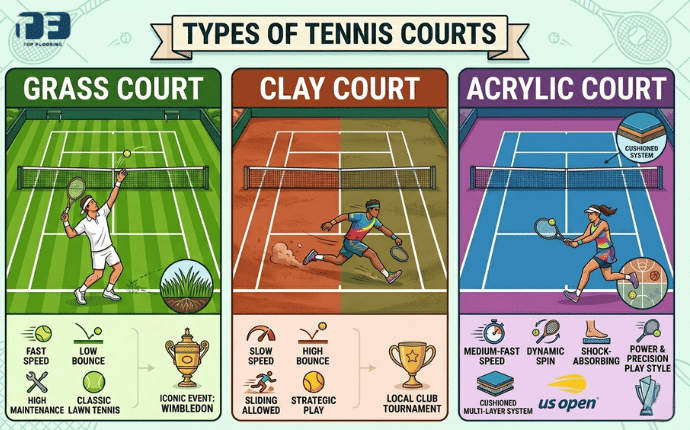
Across the world, professional tournaments showcase different court types — from the grass courts of Wimbledon Championships to the clay courts of French Open and the hard courts of US Open and Australian Open. Each surface offers a unique playing experience and requires a specific construction approach.
This complete guide explains:
- All major types of tennis court surfaces
- Pros and cons of each surface
- Cost, durability, and maintenance factors
- Best tennis court surface for Indian climate
- How to choose the right surface for your project
Whether building a single residential court or a multi-court academy, this guide provides expert-level clarity.
Table of contents
- 1. Grass Tennis Court Surface
- 2. Clay Tennis Court Surface
- 3. Hard Tennis Court Surface (Concrete / Asphalt Base)
- 4. Acrylic Tennis Court Surface (Synthetic Hard Court)
- 5. Synthetic Turf Tennis Court
- 6. Cushioned Tennis Court Systems
- Comparison Table: Types of Tennis Court Surfaces
- Key Factors Builders Must Consider
- Expert Decision Guide Choosing the Right Surface
- Which Tennis Court Surface is Best in India?
- Construction Process Overview (Acrylic Hard Court Example)
- Maintenance Guide
- Real-World Case Studies
- Cost Overview (India Estimate)
- Final Thoughts
- Frequently Asked Questions (FAQs)
1. Grass Tennis Court Surface
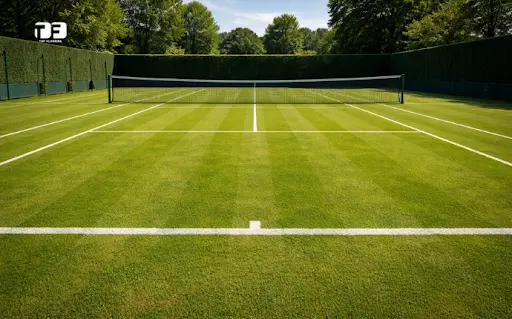
Overview
Grass is the oldest tennis court surface in history. It offers a fast-paced game with low bounce and quick ball speed.
Playing Characteristics
- Fastest court surface
- Low and skidding ball bounce
- Favors serve-and-volley players
- Demands quick reflexes
Advantages
- Premium aesthetic appeal
- Soft on joints
- Prestigious and traditional
Disadvantages
- Extremely high maintenance
- Requires constant watering, mowing, rolling
- Sensitive to heavy rainfall and heat
- High long-term operational cost
Ideal For
- Elite clubs with high maintenance budgets
- Premium residential estates
- Tournament-level infrastructure
Not recommended for most Indian regions due to climate challenges and maintenance intensity.
2. Clay Tennis Court Surface
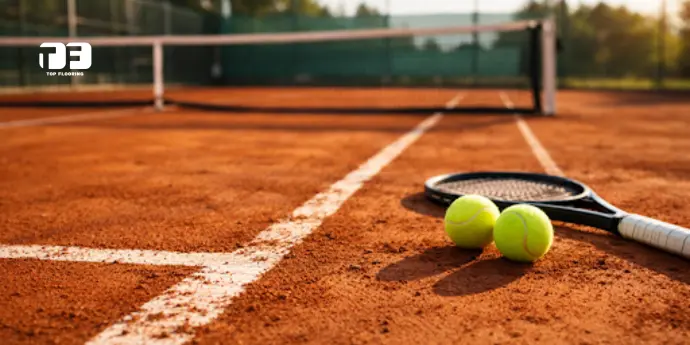
Overview
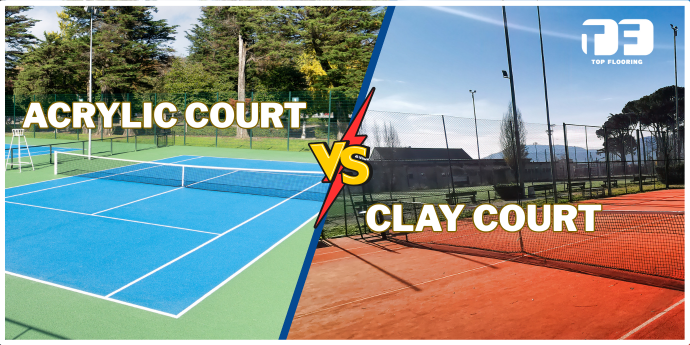
Clay courts are made from crushed brick, shale, or stone. They are popular in Europe and South America.
Playing Characteristics
- Slower ball speed
- Higher bounce
- Encourages baseline rallies
- Players can slide
Advantages
- Reduces joint stress
- Develops endurance and tactical skills
- Cooler surface temperature
Disadvantages
- Requires regular watering
- Surface erosion during monsoon
- Frequent leveling required
- Higher maintenance than hard courts
Ideal For
- Tennis academies focusing on skill development
- Regions with moderate climate
In high-rainfall areas, clay courts demand continuous upkeep and drainage planning.
3. Hard Tennis Court Surface (Concrete / Asphalt Base)
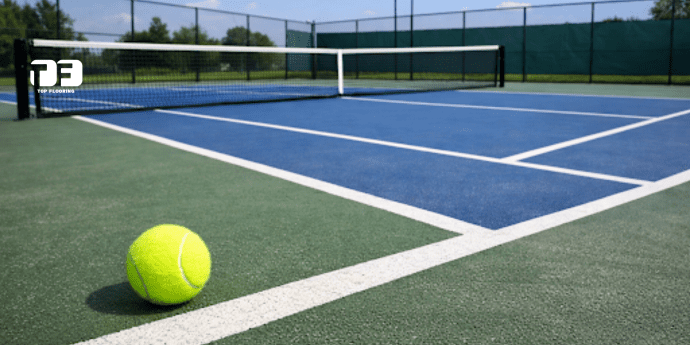
Overview
Hard courts are built on asphalt or concrete bases and coated with synthetic layers such as acrylic.
Most modern tennis facilities use this category due to durability and cost efficiency.
Playing Characteristics
- Medium-fast speed
- Consistent bounce
- Balanced for all playing styles
Advantages
- Durable
- Lower maintenance than grass and clay
- Suitable for heavy usage
- Cost-effective long-term
Disadvantages
- Can feel hard on joints if poorly cushioned
- Surface cracks possible without proper base preparation
Hard courts are currently the most practical solution globally.
4. Acrylic Tennis Court Surface (Synthetic Hard Court)
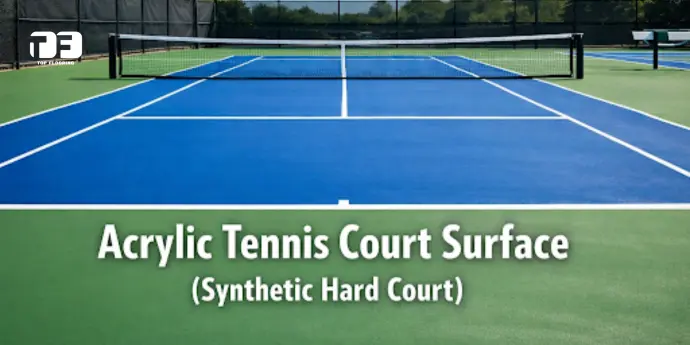
Overview
Acrylic tennis court surfaces are the most popular modern solution, especially in India and other hot-climate regions.
This surface is built over a concrete or asphalt base and coated with multiple layers of acrylic resins mixed with silica sand for texture and grip.
Why Acrylic is Dominating the Market
- UV resistant
- Weather resistant
- Low maintenance
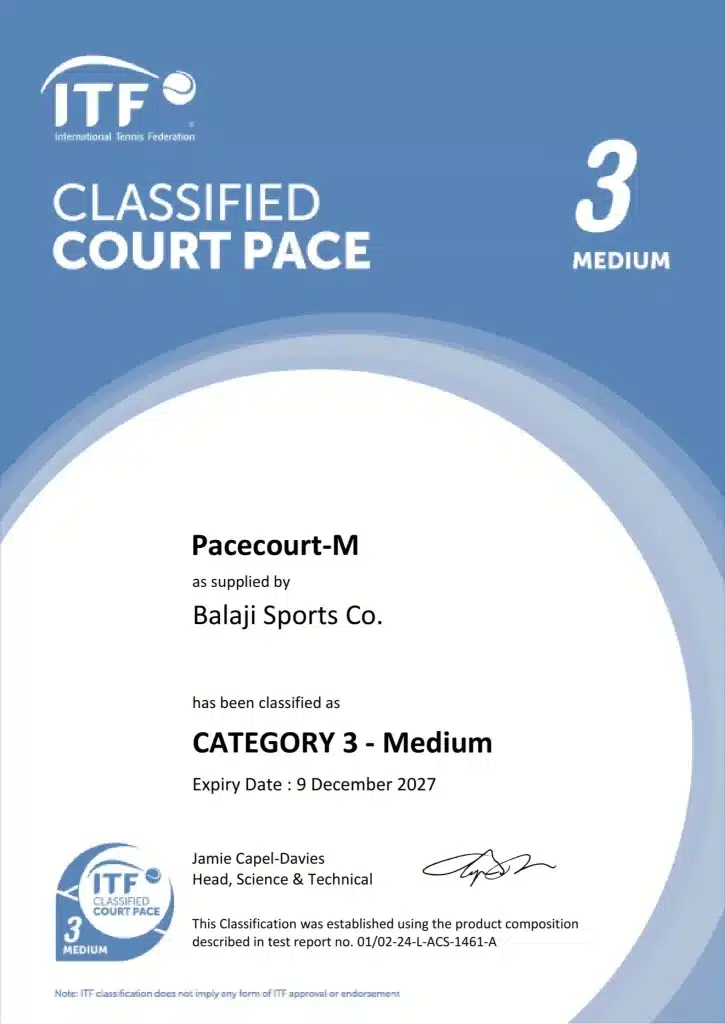
- Customizable speed (ITF pace categories)
- Long lifespan (5–8+ years before recoating)
Playing Characteristics
- Uniform bounce
- Adjustable cushioning options
- Medium-paced performance
- Excellent grip
Advantages for Builders & Owners
- Cost-effective installation
- Fast construction timeline
- Suitable for schools, clubs, housing societies
- Minimal water requirement
- Easy color customization
Best for Indian Climate
High heat, dust, and monsoon conditions make synthetic acrylic the most reliable outdoor tennis court surface in India.
5. Synthetic Turf Tennis Court
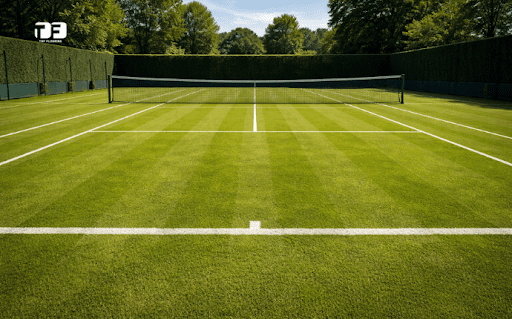
Overview
Synthetic turf mimics grass but uses artificial fibers with sand infill.
Playing Characteristics
- Medium-fast speed
- Slightly softer feel
- Lower maintenance than natural grass
Advantages
- Aesthetic appeal
- Lower upkeep than natural grass
- Suitable for multi-sport use
Disadvantages
- Infill displacement over time
- Uneven bounce if not maintained
- Shorter lifespan compared to acrylic
6. Cushioned Tennis Court Systems

Cushioned systems are advanced acrylic courts with rubberized shock-absorbing layers beneath the top coating.
Benefits
- Reduced player fatigue
- Ideal for academies
- Enhanced comfort
- Lower injury risk
Ideal For
- Professional training centers
- Senior player facilities
- High-performance academies
Comparison Table: Types of Tennis Court Surfaces
| Surface Type | Speed | Maintenance | Cost | Lifespan | Best For |
| Grass | Fast | Very High | Very High | Low | Elite Clubs |
| Clay | Slow | High | Moderate | Moderate | Academies |
| Hard Court | Medium | Low | Moderate | High | Public & Private |
| Acrylic | Medium | Low | Cost-Effective | High | India Climate |
| Synthetic Turf | Medium | Moderate | Moderate | Moderate | Multi-use |
Key Factors Builders Must Consider
1. Climate Conditions
Hot climates demand UV-resistant surfaces like acrylic.
2. Usage Volume
High footfall requires durable systems.
3. Budget
Initial cost vs lifetime maintenance cost matters.
4. Drainage & Base Preparation
Poor sub-base leads to cracks and water pooling.
5. Player Profile
Professional training vs recreational use impacts choice.
Expert Decision Guide Choosing the Right Surface
The Five Questions Every Builder Must Answer First
- What is the primary user profile? (recreational players, trained athletes, children, seniors)
- What is the annual maintenance budget, not just the construction budget?
- What are the specific climate conditions at the site? (rainfall, temperature extremes, humidity)
- How many hours per day will the courts be in active use?
- Is the project a new build or a renovation of existing infrastructure?
The answers to these five questions will immediately eliminate two or three surface options and narrow the choice to one or two serious candidates.
Which Tennis Court Surface is Best in India?
For most Indian cities:
- High temperature
- Monsoon rainfall
- Dust exposure
- Budget-conscious projects
Acrylic tennis court surfaces provide the best balance of cost, durability, performance, and low maintenance.
That’s why most modern sports infrastructure projects now prefer synthetic acrylic flooring systems.
Construction Process Overview (Acrylic Hard Court Example)
- Site leveling and compaction
- Concrete or asphalt base construction
- Primer application
- Acrylic resurfacer layer
- Cushion layers (if required)
- Color coating layers
- Line marking
Total construction time: 20–30 days (depending on curing conditions).
Maintenance Guide
- Weekly cleaning
- Monthly inspection
- Annual crack check
- Recoating every 5–8 years
Proper maintenance extends lifespan significantly.
Real-World Case Studies
The following case studies illustrate how surface selection plays out in practice across different facility types, budgets, and Indian regions. Names of institutions are representative of typical project profiles.
| CASE STUDY 01: Multi-Court Sports Academy — Bengaluru, Karnataka |
| Project Type: New construction 4 outdoor tennis courts for a private sports academy |
| Surface Chosen: Synthetic Acrylic 8-Layer Cushion System (Top Flooring) |
| Base: Fresh concrete (M25 grade) laid over compacted WBM sub-base |
| Site Challenge: Clay-rich soil with high moisture retention; risk of base heave in monsoon |
| Solution: Perimeter drainage channels installed before concrete pour; 72-hour curing monitoring |
| Construction Time: 28 days across all 4 courts (sequential construction) |
| Colors Chosen: Royal Blue (playing area) + Grass Green (outer zone) |
| Outcome: Courts operational year-round, including full monsoon season; players reported significantly lower fatigue vs. previous concrete courts |
| Cost Insight: Total project cost recovered in 14 months through hourly court rental revenue |
| Key Learning: In clay-soil regions, a proper drainage sub-base is not optional it is the most important cost in the project. |
| CASE STUDY 02: Government Sports Complex — Lucknow, Uttar Pradesh |
| Project Type: Replacement of degraded clay courts at a district-level government facility |
| Previous Surface: Red clay installed 11 years prior; severe erosion and uneven bounce |
| Surface Chosen: Synthetic Acrylic 5-Layer System on new asphalt base |
| Reason for Switch: Clay maintenance cost had become unsustainable; dedicated groundskeeper no longer budgeted |
| Challenge: Existing clay had to be removed and base regraded before asphalt lay |
| Construction Time: 35 days (demolition + base + acrylic) |
| Outcome: Annual maintenance cost dropped by approximately 70% in Year 1; courts now used by 3x more players due to all-weather availability |
| Key Learning: Clay-to-acrylic conversion has a clear economic case in Indian public sports facilities. The higher upfront cost is recovered within 2–3 years of reduced maintenance expenditure. |
Cost Overview (India Estimate)
| Surface | Approx Cost (per sq ft) |
| Clay | Moderate |
| Acrylic Hard Court | Competitive |
| Cushioned Acrylic | Slightly Higher |
| Synthetic Turf | Moderate |
(Actual cost varies based on site condition and material quality.)
Final Thoughts
Selecting the right tennis court surface is not just about play style — it is about long-term performance, safety, durability, and maintenance economics.
While grass and clay have historical prestige, modern sports infrastructure increasingly relies on acrylic hard court systems for their adaptability and performance consistency.
For builders and owners seeking a future-ready solution, synthetic acrylic tennis court surfaces provide the ideal combination of:
- Cost efficiency
- Climate resistance
- Player comfort
- Long lifespan
- Professional-grade performance
Invest wisely, build professionally, and choose a surface that delivers value for years to come.
Frequently Asked Questions (FAQs)
Hard courts with acrylic coating are the most durable for outdoor use.
Acrylic tennis courts require the least maintenance compared to clay and grass.
Grass courts are the fastest.
Medium-paced acrylic courts provide consistent bounce for learning.
Typically 5–8 years before resurfacing; base lasts much longer.
Initial cost may vary, but acrylic offers the best long-term value.