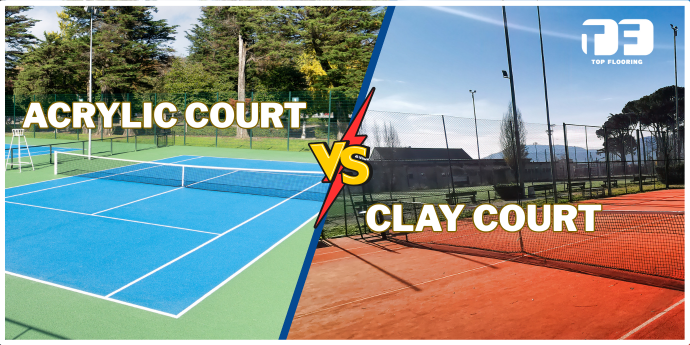
In India the climate varies from scorching heat in Rajasthan to cloudburst monsoons in Kerala, choosing the best tennis court in India is not just a preference, but it’s a necessity. The choice between a clay court vs. acrylic tennis court surface plays a big role in overall performance, maintenance and long term durability under Indian weather conditions.
Among the many types of tennis court surfaces used globally, two are the most practical and widely used in India are acrylic and clay courts. Each has its own advantage and disadvantage, but only one fits more with Indian weather, usage patterns and resource availability. This guide will give you a deep dive into both options for tennis court flooring and compare their suitability for Indian conditions.
Understanding the Tennis Court Surface Types
What is an Acrylic Tennis Court?
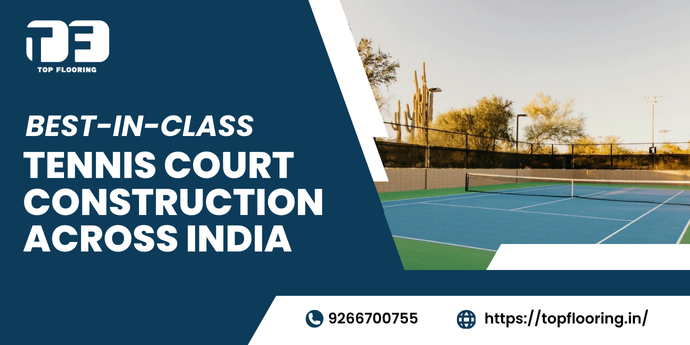
An acrylic tennis court surface is built using a synthetic acrylic material system layered over a concrete or asphalt base. These courts are known for their smooth finish, bright look and resilience to extreme weather. The surface consists of a multi layered coating that includes primer, resurfacer, color coats and cushion coats that add shock absorption.
Acrylic courts have consistent bounce and medium to fast playing speed. The surface is engineered for non-slip, UV resistant and can drain quickly during rains. These properties make acrylic ideal for outdoor tennis court flooring especially in countries with unpredictable weather like India.
The acrylic tennis court flooring cost depends on the number of layers, site preparation and application of cushioning but typically ranges between ₹250 to ₹450 per square foot. While the initial tennis court cost may seem slightly higher than clay, the long term maintenance and durability makes it cheaper as compared to clay court.
What is a Clay Tennis Court?
Clay tennis courts, on the other hand, are made using crushed stone, shale or brick. These materials are spread and compacted to create a soft, earthy surface. Known for their slow ball speed and high bounce, clay courts are traditionally used in Europe and Latin America. The French Open for instance is played on red clay.
Players love clay courts for their friendly nature and ability to encourage longer rallies. But clay courts come with a lot of maintenance especially when exposed to extreme weather. In India, that’s where they start to show their limitations. Clay courts need attention. Clay tennis court maintenance includes daily watering to keep the surface compact, rolling to keep the surface even and sweeping to remove loose particles. In humid areas clay courts are prone to moss and algae, in dry weather the surface can crack and loosen.
Advantages and Disadvantages of Acrylic and Clay Tennis Courts
When choosing between acrylic and clay for your tennis court surface, go beyond surface level comparisons. Each tennis court flooring has its own performance characteristics, cost implications and maintenance requirements that impact long term usability especially in the Indian environment. Here’s a more detailed look at the pros and cons of both.
Acrylic Tennis Courts Advantages
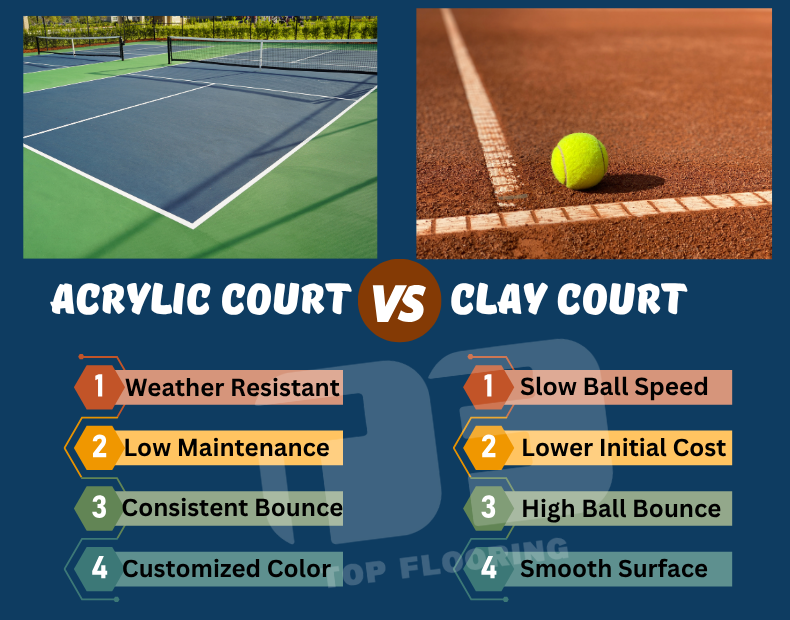
1. Weather Resistant and UV Stable: Acrylic tennis court surfaces are made of synthetic materials that are formulated to withstand prolonged sun exposure. The surface doesn’t fade, crack or warp in extreme heat, perfect for Indian cities that have harsh summers.
2. Quick Drying After Rain: With an acrylic system and proper slope, water drains off the surface quickly. You can play within 30 to 60 minutes after rain, a big advantage in cities with long or frequent monsoon seasons.
3. Minimal Maintenance Required: Unlike clay courts which require daily grooming, acrylic courts need only basic cleaning and periodic inspection. No watering, rolling or daily repairs required, saving time and operational costs in the long run.
4. Consistent Bounce and Speed: Acrylic courts provide a predictable playing experience. The bounce is consistent across the surface, helps in developing accurate shot mechanics and competitive gameplay. The medium fast pace also supports modern aggressive playing styles.
5. Customizable Cushioning: Advanced systems allow installation of cushion layers under the color coats. These reduce impact on players’ knees and ankles, making the surface safer for high volume training environments and veteran players.
6. Ideal for Indian Environment: Acrylic flooring performs well in dusty, humid or polluted environments. Unlike clay, it doesn’t absorb moisture or become slippery during monsoon and doesn’t degrade in dry conditions.
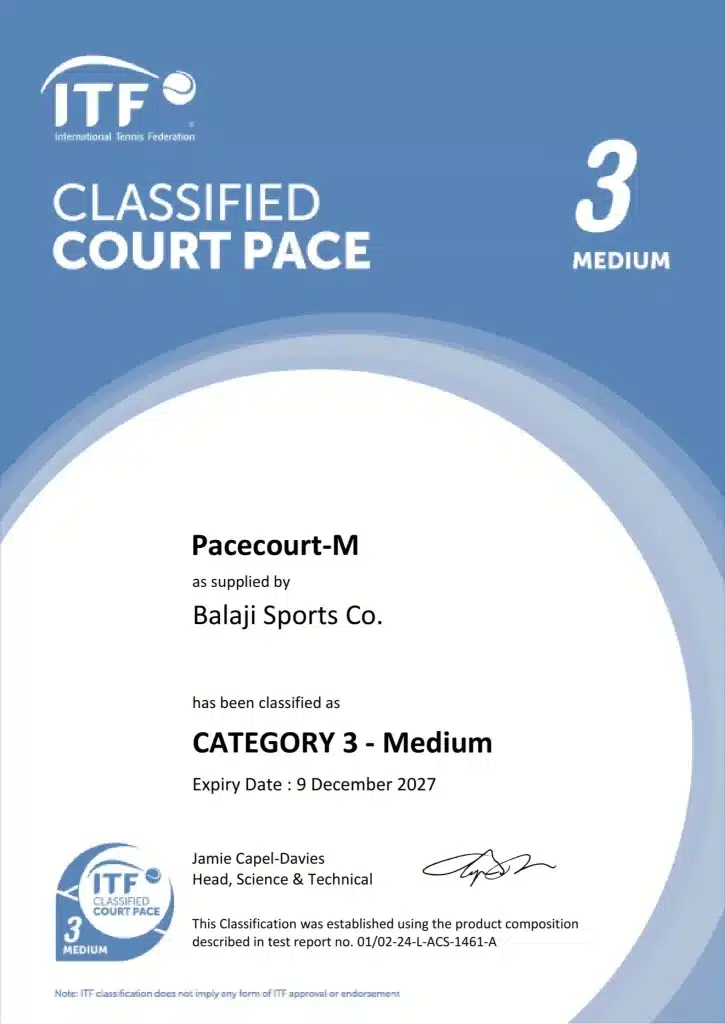
7. Globally Recognized and ITF Approved: Acrylic surfaces are used in top international tournaments like the US Open and Australian Open. And ten performance ratings of tennis courts are certified by the International Tennis Federation (ITF), which ensures global standard compliance.
Acrylic Tennis Courts Disadvantages
1. Slightly Higher Initial Cost: The installation cost for acrylic tennis court surfaces can be higher than clay, especially if cushioning layers are included. But this is balanced by long term savings on maintenance.
2. Concrete Base Required: Acrylic systems need to be installed on a prepared asphalt or concrete base. Not suitable for temporary or low budget setups where only soil preparation is planned.
3. Hard Surface Without Cushioning: If the tennis court is built without cushion layers, the surface can feel hard during long play sessions. Not suitable for players with joint issues unless a cushioned acrylic system is chosen.
Advantages of Clay Tennis Courts
1.Smooth Surface: Clay courts are soft and reduce impact on knees and ankles. Good for players recovering from injuries or those who care about joint health.
2. Slower Ball Speed Promotes Strategy: The slower tennis court surface gives players more time to react, longer rallies and strategic shot placement. Ideal for developing tactical skills and endurance especially for juniors.
3. Encourages Defensive Play and Endurance: High bounce and slower surface rewards patient defensive players. Improves movement, positioning and physical conditioning over time.
4. Lower Initial Cost: Clay courts can be built without concrete base, using local materials which may reduce upfront cost especially in rural or semi-urban areas.
Disadvantages of Clay Tennis Courts
1. Daily Maintenance: Clay courts need constant attention. Daily watering, sweeping and rolling is non-negotiable to maintain surface integrity. Without it the court becomes uneven or dusty.
2. Weather Damage: Clay court doesn’t take waterlogging or dry spells well. In monsoon the clay tennis surface becomes unplayable for days. In summer it dries out and cracks without regular watering.
3. Seasonal Inconsistency: Clay courts are not year round in most parts of India. Usage drops significantly during monsoons and peak summer, reducing the value of the court.
4. High Water Usage and Staff Dependency: Maintaining a clay court requires regular irrigation which may not be feasible in areas facing water shortage. It also requires trained maintenance staff increasing operational cost.
5. Surface Irregularities Affect Gameplay: Without perfect upkeep the clay surface can develop soft spots or uneven patches which can make the ball behave unpredictably frustrating both players and coaches.
Which Tennis Court Surface Handles the Indian Climate Better?
India has a unique climate challenge for any outdoor infrastructure. With temperatures crossing 45°C in summer, intense UV exposure, heavy rainfall in monsoon and dry winds in winter, sports courts need to be extremely durable. This is where acrylic surfaces outperform clay courts.
Acrylic surfaces are designed to resist UV damage, they won’t crack or fade under the sun. They dry quickly after rain, making them usable year round even during monsoon. With proper drainage built underneath, an acrylic court can be ready for play in 30 to 60 minutes after a downpour. There’s no risk of the surface becoming muddy or slippery like clay.
Clay courts are heavily affected by climate. Excessive heat can dry out the surface making it dusty and loose. Rain turns the surface into mud making the court unusable until it dries completely, a process that can take hours or even days. Maintaining optimal moisture levels is an everyday task which is not practical for schools, academies or public parks.
If you want uninterrupted play across seasons, acrylic court flooring is a far more sustainable and climate friendly solution for India.
Acrylic Vs. Clay Tennis Court Installation and Maintenance
Building and maintaining a tennis court requires not just money but time, resources and skilled labor. Again, acrylic courts have an edge in both installation and maintenance.
Installing an acrylic tennis court involves preparing a solid base, usually concrete, followed by applying several layers of synthetic material. It’s a systematic process and once done, the surface needs only occasional cleaning. Dust or debris can be removed with a mild detergent and water and the surface doesn’t need daily upkeep. Recoating may be needed after 5-7 years but that’s far more economical than the daily care clay demands.
Clay courts are easy to install in terms of material availability and technique but the simplicity ends there. Maintaining them involves a daily schedule of watering, brushing, leveling and cleaning. These are not optional, but without them the surface will deteriorate quickly. And during rainy or extremely dry spells the tennis court maintenance load only increases.
This high maintenance requirement makes clay courts unsuitable for institutions that don’t have full time ground staff. In contrast acrylic courts are almost hands free, freeing up time and reducing long term costs.
Performance and Playing Experience
From a player’s perspective surface feel and performance are as important as durability. Each surface affects gameplay differently and understanding these nuances helps choose the right surface for your intended users.
Acrylic surfaces deliver a predictable and consistent bounce. The ball travels at medium to fast speed, supports aggressive baseline play and rewards accurate shot placement. That’s why professional tournaments like the US Open court type use acrylic surfaces. Acrylic also offers excellent foot traction reducing the chances of slipping and allowing for fast directional changes.
Clay courts produce a slower game. The ball bounces higher and slows down quickly, encourages longer rallies and defensive play. This suits players who rely on stamina and strategic placement rather than power. But the unpredictability caused by uneven surfaces or accumulated dust can affect gameplay quality. Players need to adapt constantly to minor changes in court behavior.
In India where most courts are used by beginners, intermediate players or for coaching, acrylic courts provide a more consistent and supportive learning environment.
What is the Cost of Tennis Court Flooring?
Budget is always a consideration in any tennis court construction decision and here the difference between upfront tennis court cost and total tennis court cost of ownership becomes clear. Clay tennis courts may seem cost effective at first with less installation cost. But the daily labor, water and periodic resurfacing adds up to much higher annual costs. Even with the best maintenance a clay court may need resurfacing in 3-5 years.
Acrylic tennis courts cost depends on materials you are using to install. But with minimal upkeep and a longer life (8-12 years) the total cost over time is much lower. Also acrylic courts are more compatible with multi use sports areas and offer better ROI. Whether you’re building a court for a school, academy, or housing society, acrylic gives more value for every rupee spent.
Which Tennis court Trending Globally?
Globally, most professional tournaments use either acrylic or hybrid hard court systems. The Australian Open and US Open tennis courts use acrylic based cushioned systems, Wimbledon tennis court type uses grass and only the French Open still uses clay as its traditional surface.
Why are top tournaments moving towards acrylic? The answer lies in its balanced performance, lower injury rates and predictable surface response. In fact many synthetic tennis court materials used today are ITF approved and engineered to reduce joint stress while enhancing gameplay. This trend is seen in India too, where sports infrastructure developers and institutions are moving away from clay due to its impracticality.
Conclusion
When you consider all factors weather, cost, performance and longevity the answer is clear: acrylic tennis court surfaces are the best for Indian climate and usage. They are easy to maintain, more weather resistant, suitable for all levels and have a longer life. Whether you are an academy looking to train future champions or a school looking for a reliable and safe play area, acrylic surfaces meet all the criteria. Clay courts still have aesthetic and traditional value but require resources and manpower that many facilities in India cannot afford. They are less practical in today’s fast paced, resource conscious world.
Choose Top Flooring for best synthetic acrylic tennis court flooring. Contact us now!
Frequently Asked Questions
Acrylic surfaces are the best surfaces for tennis court due to their durability, weather resistance, and minimal maintenance.
Yes, acrylic tennis courts must be installed over a concrete or asphalt base for durability and performance.
Yes, but it requires proper base preparation, including installing a concrete or asphalt foundation before applying the acrylic layers.
Acrylic tennis court require resurfacing every 5 to 7 years, depending on usage intensity. Regular cleaning helps extend the life of the surface.
Acrylic flooring is the top choice for residential complexes in India due to its low upkeep, long life, and clean aesthetic appearance.