Basketball is one of the most popular sports in the world, played in schools, parks, clubs, and professional arenas. While the game may look simple, the basketball court diagram reveals a carefully designed layout that defines every rule and movement in the game. Each line and zone on the court has a specific purpose, from determining scoring areas to organizing player positioning during gameplay.
Understanding a basketball court diagram is important for players, coaches, architects, and sports facility planners. Whether the court is used for professional competitions, school tournaments, or recreational play, the correct markings ensure fair gameplay and smooth match operations.
This guide explains the basketball court diagram in detail, including the lines, zones, and markings that make up a standard basketball court. The article also covers measurements, court areas, and the role of modern surfaces such as acrylic sports flooring, which is widely used for outdoor basketball courts.
What Is a Basketball Court Diagram?
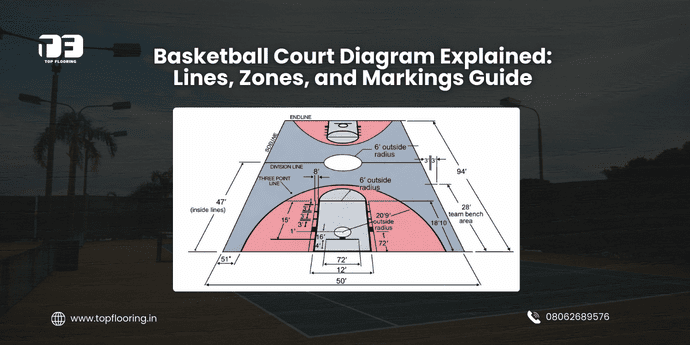
A basketball court diagram is a visual representation of a basketball court layout. It shows the exact placement of all lines, circles, and zones that define how the game is played.
The diagram helps players and officials understand:
- Court boundaries
- Scoring zones
- Player positioning areas
- Free throw and three-point areas
- Offensive and defensive zones
The layout remains consistent across most courts worldwide, although dimensions may vary slightly depending on governing organizations such as NBA, FIBA, or school-level leagues.
Standard Basketball Court Dimensions
Before exploring the lines and zones, it is important to understand the overall Basketball court size.
NBA Basketball Court
- Length: 94 feet (28.65 meters)
- Width: 50 feet (15.24 meters)
FIBA Basketball Court
- Length: 28 meters (91.86 feet)
- Width: 15 meters (49.21 feet)
Most international competitions and schools follow FIBA standards, while professional leagues in the United States use NBA dimensions.
Although there are slight differences, the court markings and zones remain largely similar, making the basketball court diagram easy to understand across leagues.
Key Lines in a Basketball Court Diagram
The basketball court diagram includes several important lines that regulate gameplay.
Baseline (End Line)
The baseline, also called the end line, forms the boundary behind each basketball hoop.
Functions of the baseline:
- Marks the end of the playing area
- Determines out-of-bounds situations
- Used for inbound passes after scoring
Players must remain within these boundaries during gameplay.
Sidelines
The sidelines run along the length of the basketball court and mark the outer edges of the playing area.
Key roles of sidelines include:
- Defining court boundaries
- Determining out-of-bounds violations
- Organizing substitutions and team benches
If the ball crosses these lines, possession is given to the opposing team.
Half-Court Line (Center Line)
The half-court line divides the basketball court into two equal halves.
It plays an important role in:
- The 8-second rule, requiring teams to move the ball past half court within eight seconds
- Organizing offensive and defensive transitions
- Starting the game with the jump ball at center court
Center Circle
Located at the middle of the court, the center circle is used for the opening jump ball.
Key details include:
- Diameter of approximately 12 feet in NBA courts
- Used to start the game and overtime periods
- Provides equal positioning for both teams during tip-off
Important Zones in a Basketball Court Diagram
Beyond the lines, the basketball court includes specific zones that affect gameplay and scoring.
The Key (Paint Area)
The key, often called the paint, is one of the most important zones on the court.
It is the rectangular area under the basket and includes the free throw lane.
Functions of the key:
- Controls defensive positioning
- Regulates the three-second violation
- Determines free throw alignment
Players often battle for rebounds and scoring opportunities inside this zone.
Free Throw Line
The free throw line is located at the top of the key and is used during free throw attempts.
Important details:
- Distance from backboard: 15 feet
- Players shoot from this line during fouls
- Other players must stand along the key boundaries until the ball hits the rim
Free throws are one of the most important scoring opportunities in basketball.
Free Throw Circle
The free throw circle surrounds the free throw line and ensures proper player spacing during free throw attempts.
Half of the circle is inside the key, while the other half extends outside it.
This circle ensures players maintain the correct distance during free throws.
Three-Point Line
The three-point line marks the boundary for three-point shots.
Shots made beyond this arc count as three points instead of two.
Distances vary depending on the league:
NBA:
- 23.75 feet from the basket
FIBA:
- 6.75 meters (22.15 feet)
The three-point line has transformed modern basketball strategy, encouraging long-distance shooting.
Restricted Area
The restricted area is a semicircle located directly under the basket.
Key purpose:
- Prevents defenders from drawing charges while standing directly under the rim
- Protects offensive players during drives and dunks
This rule helps maintain fair play near the basket.
Backboard and Basket Placement
The basketball hoop and backboard are positioned above the baseline.
Key measurements include:
- Rim height: 10 feet from the floor
- Rim diameter: 18 inches
- Backboard width: 6 feet
These dimensions remain consistent across most leagues and competitions.
Half-Court Basketball Diagram
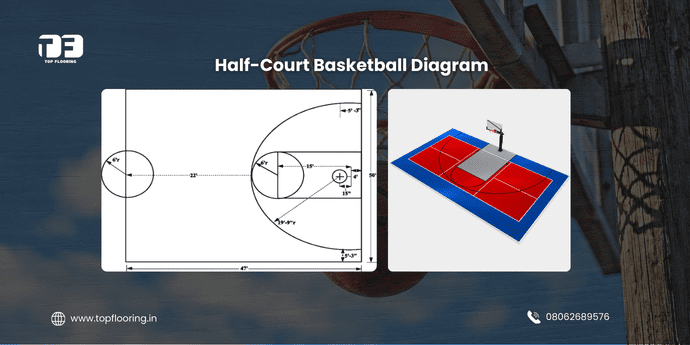
Many schools and recreational facilities use half-court layouts instead of full courts.
A half-court diagram includes:
- One basket
- One key area
- One free throw line
- A three-point arc
Half courts are commonly used in:
- Practice facilities
- Street basketball courts
- Small recreational spaces
They require less space and lower construction costs while still allowing competitive play.
Outdoor Basketball Court Markings
Outdoor courts often follow the same basketball court diagram as indoor courts but with slight modifications.
Common features include:
- Durable painted lines
- Weather-resistant surfaces
- Non-slip coatings
Many outdoor courts use synthetic acrylic basketball sports flooring, which provides:
- Better grip for players
- UV resistance
- Long-lasting surface durability
- Low maintenance requirements
These surfaces are widely used in schools, parks, sports complexes, and community courts.
Importance of Accurate Basketball Court Markings
Correct court markings are essential for maintaining professional standards in basketball.
Proper markings help ensure:
- Fair gameplay
- Clear scoring zones
- Accurate officiating
- Better player positioning
- Consistent training environments
Incorrect or poorly designed markings can create confusion during games and reduce the quality of play.
Basketball Court Diagram for Construction Planning
A basketball court diagram is also essential during court construction.
Architects and sports facility planners use these diagrams to determine:
- Court layout and dimensions
- Player movement zones
- Equipment placement
- Surface design
Modern basketball courts often use synthetic acrylic sports flooring systems, which are specifically designed for outdoor performance and safety.
These systems provide:
- High traction
- Shock absorption
- Consistent ball bounce
- Resistance to weather conditions
Because of these advantages, acrylic flooring has become one of the most popular solutions for outdoor basketball court construction.
Differences Between NBA, FIBA, and School Court Diagrams
Although basketball courts look similar worldwide, there are small differences in diagrams depending on the league.
NBA Courts
- Larger three-point distance
- Larger court size
- Slightly wider key
FIBA Courts
- Slightly shorter court length
- Smaller three-point arc
- Used for international competitions
School and Recreational Courts
- Often smaller than professional courts
- Simplified markings
- Designed for limited space
Despite these variations, the basic basketball court diagram remains the same, making the game universal.
Tips for Designing a Basketball Court Layout
When planning a basketball court using a diagram, several factors should be considered.
Space Availability
Ensure that enough space is available not only for the court but also for safety margins around the playing area.
Surface Material
Choose a durable surface such as acrylic sports flooring to ensure long-term performance.
Lighting
Outdoor courts should have proper lighting for evening play.
Drainage
Proper drainage is essential for outdoor courts to prevent water accumulation.
Safety Zones
Adequate space around the court helps reduce injury risks during gameplay.
Conclusion
The basketball court diagram is the foundation of the game’s structure. Every line, circle, and zone on the court has a specific role in regulating gameplay, scoring, and player positioning.
From the baseline and sidelines to the three-point arc and key area, each marking helps organize the fast-paced nature of basketball. Whether the court is built for professional leagues, school tournaments, or recreational play, maintaining the correct layout ensures fairness and consistency.
Modern basketball courts increasingly use acrylic sports flooring systems, especially for outdoor courts. These surfaces enhance durability, player safety, and performance while maintaining clear and long-lasting court markings.
Understanding the basketball court diagram not only helps players and coaches improve their strategies but also assists architects and facility planners in building courts that meet international standards.
A well-designed court with accurate markings creates the perfect environment for players to enjoy the game and perform at their best.
Frequently Asked Questions
A basketball court diagram is a visual layout showing all lines, zones, and markings on a basketball court.
The main lines include the baseline, sidelines, half-court line, free throw line, and three-point line.
A standard basketball court is typically 94 feet long and 50 feet wide in NBA competitions.
The key is the rectangular painted area under the basket that includes the free throw lane.
The three-point line determines the distance from which shots count as three points.
Outdoor courts often use synthetic acrylic sports flooring because it provides durability, grip, and weather resistance.