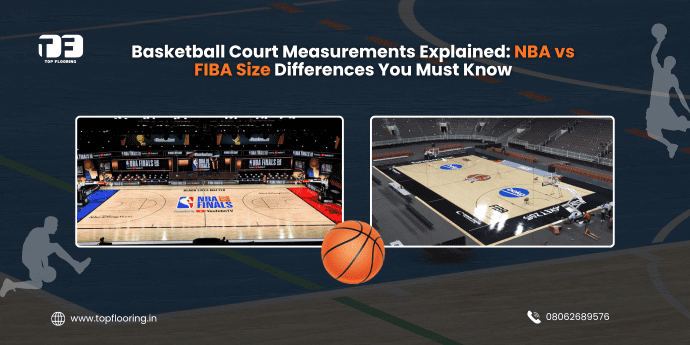
Basketball is played on courts that may look similar at first glance, but when you examine the official measurements, important differences appear. Whether you are a player, coach, architect, school administrator, or sports court contractor, understanding basketball court dimensions is essential.
Two major governing bodies define international and professional basketball standards: the NBA (National Basketball Association) and the FIBA (Fédération Internationale de Basketball). While both follow the same fundamental structure of the game, their court measurements differ in subtle but meaningful ways.
Official NBA Basketball Court Dimensions
The NBA court is slightly larger in width compared to the international standard. Here are the official NBA court measurements:
- Length: 94 feet (28.65 meters)
- Width: 50 feet (15.24 meters)
- Basket Height: 10 feet (3.05 meters)
- Three-Point Line (arc): 23.75 feet (7.24 meters)
- Three-Point Line (corner): 22 feet (6.7 meters)
- Lane (Paint) Width: 16 feet (4.88 meters)
- Free Throw Line Distance: 15 feet (4.57 meters) from backboard
The NBA court is designed for elite-level professional basketball, where spacing, athleticism, and perimeter shooting are major strategic elements.
Official FIBA Basketball Court Dimensions
FIBA governs international basketball competitions, including the Olympics and World Cup. The FIBA basketball court measurements are:
- Length: 28 meters (91.86 feet)
- Width: 15 meters (49.21 feet)
- Basket Height: 3.05 meters (10 feet)
- Three-Point Line: 6.75 meters (22.15 feet)
- Lane (Paint) Width: 4.9 meters (16.08 feet)
- Free Throw Line Distance: 4.6 meters (15.09 feet)
At first glance, the differences appear minimal. However, even small variations in court size significantly impact gameplay strategy and spacing.
NBA vs FIBA Court Size Comparison (Quick Overview)
Here is a direct comparison of key measurements:
| Feature | NBA | FIBA |
| Court Length | 94 ft (28.65 m) | 28 m (91.86 ft) |
| Court Width | 50 ft (15.24 m) | 15 m (49.21 ft) |
| Three-Point Line | 23.75 ft | 22.15 ft |
| Lane Width | 16 ft | 16.08 ft |
| Basket Height | 10 ft | 10 ft |
The most noticeable difference lies in:
- Court length
- Court width
- Three-point arc distance
Why Is the NBA Court Slightly Larger?
The NBA court is marginally longer and wider. This design supports:
- Faster gameplay
- Greater spacing for isolation plays
- Increased emphasis on perimeter shooting
- More room for defensive rotations
Professional NBA players are generally taller and more athletic, and the larger dimensions enhance the physical and strategic aspects of the game.
In contrast, FIBA courts are slightly more compact, which encourages quicker ball movement and team-oriented play.
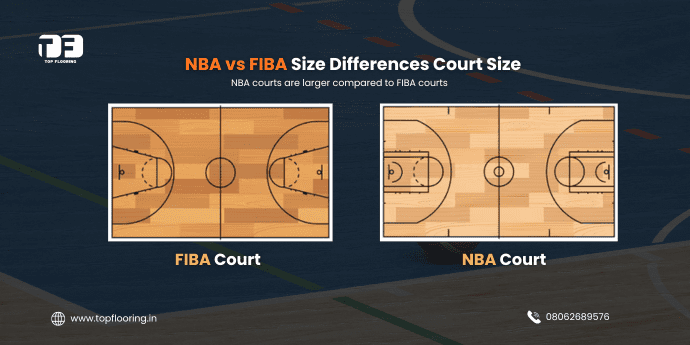
Three-Point Line Differences: Why It Matters
One of the most significant differences between NBA and FIBA court measurements is the three-point line.
NBA Three-Point Line
- 23.75 feet from the basket (arc)
- 22 feet at the corners
FIBA Three-Point Line
- 6.75 meters (22.15 feet)
The NBA three-point line is roughly 1.5 feet farther from the basket than the FIBA line.
Impact on Gameplay
A longer three-point line:
- Makes long-range shooting more challenging
- Creates additional spacing
- Expands driving lanes
- Increases floor stretch
This difference is especially noticeable when international players transition to the NBA.
The Key (Paint Area) Differences
The lane or “paint” area width is nearly identical in both standards, but historically it has evolved differently.
- NBA lane: 16 feet
- FIBA lane: 4.9 meters (approx. 16.08 feet)
The difference is negligible today, but it previously varied more significantly. Modern standardization has minimized this gap.
Free Throw Line & Basket Height
Both NBA and FIBA maintain:
- Free throw line at 15 feet
- Basket height at 10 feet
This consistency ensures that fundamental shooting mechanics remain universal across professional and international play.
How Court Size Affects Strategy
Court measurements are not just numbers. They directly influence:
1. Spacing
A larger court provides more room for:
- Isolation plays
- Pick-and-roll action
- Three-point shooting
2. Defensive Coverage
On a larger NBA court:
- Defenders must cover more ground
- Help defense rotations are longer
- Close-outs require greater speed
3. Pace of Play
FIBA courts often promote:
- Faster passing
- More compact defensive schemes
- Emphasis on team structure
The subtle dimension differences shape how the game is played at each level.
Which Standard Should You Choose for Court Construction?
If you are building a basketball court, choosing between NBA and FIBA dimensions depends on:
For Schools & Colleges
FIBA dimensions are generally preferred internationally.
For Professional Academies
If the goal is NBA-style training, building a 94 ft x 50 ft court is recommended.
For Multipurpose Indoor Arenas
FIBA size is often more space-efficient.
For Private Facilities
NBA dimensions are popular due to global recognition and branding.
Always ensure compliance with local sports authority regulations before finalizing dimensions.
Measurement Accuracy in Court Marking
When constructing a basketball court, precision is critical. Even minor deviations can:
- Affect gameplay fairness
- Cause tournament disqualification
- Disrupt shooting rhythm
Professional court marking requires:
- Laser measurement tools
- Accurate line thickness (usually 2 inches)
- Proper surface leveling
- Correct acrylic or wooden flooring systems
Final Thoughts
Understanding basketball court measurements is crucial for players, coaches, sports planners, and facility owners. While the NBA and FIBA courts share the same structure, the subtle size differences significantly influence gameplay, spacing, and shooting dynamics.
Frequently Asked Questions
An NBA basketball court measures 94 feet long and 50 feet wide.
A FIBA basketball court measures 28 meters long and 15 meters wide.
The NBA court is slightly larger to promote spacing, athleticism, and perimeter shooting at the professional level.
No. Both NBA and FIBA use a basket height of 10 feet (3.05 meters).
FIBA dimensions are generally recommended for youth development, especially outside the United States.
No. The NBA three-point line is farther (23.75 ft) compared to FIBA (22.15 ft).