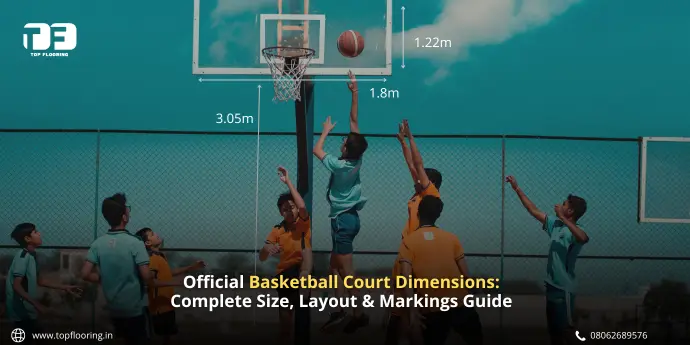
Understanding official basketball court dimensions is essential for anyone involved in court construction, sports facility planning, school infrastructure, or even players who want to understand how the game is structured. Accurate court size, correct layout, and precise markings are not just about following rules—they directly affect gameplay, safety, and overall performance.
This complete guide explains basketball court dimensions, standard measurements, court layout, and markings in a clear and simple way.
Why Official Basketball Court Dimensions Matter
Basketball is a fast-paced sport that depends heavily on space, positioning, and movement. If a court is shorter, wider, or incorrectly marked, it can affect:
- Player movement and spacing
- Shooting distance and accuracy
- Game fairness
- Safety and injury risk
- Compliance with tournament standards
That’s why following official basketball court dimensions is mandatory for schools, clubs, academies, and professional facilities.
Standard Basketball Court Dimensions (Overview)
Basketball courts follow international and national standards. The most commonly used standards are FIBA (international) and NBA (professional USA). In India and many other countries, FIBA dimensions are widely accepted.
Official Basketball Court Size (FIBA Standard)
- Court length: 28 meters (91.86 feet)
- Court width: 15 meters (49.21 feet)
- Playing area shape: Rectangle
- Basket height: 3.05 meters (10 feet)
These dimensions apply to indoor and outdoor courts used for professional matches, clubs, and tournaments.
Basketball Court Dimensions in Feet (Quick Reference)
For easier understanding, here is the conversion:
- Length: 91.9 feet
- Width: 49.2 feet
- Basket height: 10 feet
These measurements are useful for planning and marking during construction.
Basketball Court Layout Explained
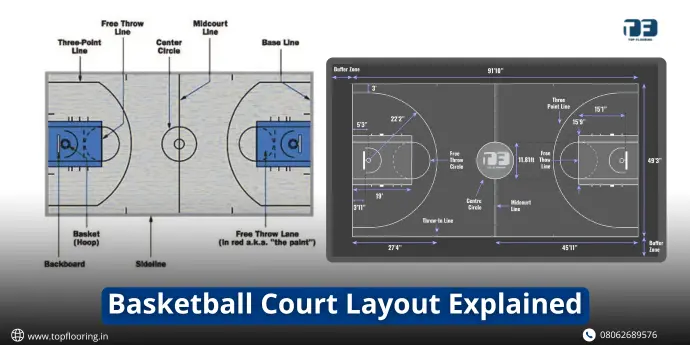
The basketball court layout consists of several clearly defined zones and markings. Each marking has a purpose and must be accurately placed to meet official standards.
Center Circle
- Radius: 1.8 meters
- Located at the exact center of the court
- Used for the opening jump ball
The center circle helps ensure a fair start to the game.
Center Line
- Divides the court into two equal halves
- Runs across the width of the court
- Used to define frontcourt and backcourt
This line plays a key role in backcourt violation rules.
Free Throw Lane (The Key / Paint Area)
The free throw lane is one of the most important areas on a basketball court.
Free Throw Lane Dimensions (FIBA)
- Lane width: 4.9 meters
- Free throw line distance: 5.8 meters from the backboard
- Free throw circle radius: 1.8 meters
This area controls player positioning during free throws and rebounding situations.
Backboard and Basket Specifications
Even if the court dimensions are correct, incorrect basket placement can ruin gameplay.
Basket & Backboard Measurements
- Basket height: 3.05 meters (10 feet)
- Rim diameter: 45 cm
- Backboard width: 1.8 meters
- Backboard height: 1.05 meters
The basket must be perfectly aligned with the center of the court to ensure consistent shooting angles.
Three-Point Line Dimensions
The three-point line defines long-range shots and spacing.
FIBA Three-Point Line
- Distance from basket (arc): 6.75 meters
- Corner three distance: 6.6 meters
This distance is shorter than NBA standards, making it suitable for international and amateur play.
Restricted Area (No-Charge Semi-Circle)
- Radius: 1.25 meters from the center of the basket
- Located under the hoop
This marking helps referees judge charging and blocking fouls more accurately.
Basketball Court Boundary Lines
Boundary lines define the playable area.
- Sidelines: Longer sides of the court
- Baselines (end lines): Shorter sides behind the baskets
All boundary lines must be clearly visible and typically measure 5 cm in width.
Indoor vs Outdoor Basketball Court Dimensions
The court size remains the same for indoor and outdoor basketball courts. However, the difference lies in:
- Flooring material
- Surface texture
- Drainage and slope (outdoor courts)
- UV resistance and weather durability
Outdoor courts require extra attention to surface quality to maintain correct ball bounce and player grip.
Basketball Court Dimensions for Schools and Colleges
In schools and recreational facilities where space is limited, slightly smaller courts may be used. However, proportions should always remain consistent.
Common School Court Sizes
- Length: 24–28 meters
- Width: 13–15 meters
Even for smaller courts, correct marking placement is essential to maintain gameplay balance.
Space Requirement Beyond the Court (Run-Off Area)
For safety and smooth movement, extra space around the court is required.
- Minimum clearance: 2 meters on all sides
- Recommended clearance: 3 meters or more
This buffer area helps prevent injuries and allows room for officials and players.
Importance of Accurate Court Markings
Correct markings are just as important as correct dimensions. Poorly marked courts can cause:
- Confusion during play
- Incorrect foul calls
- Safety hazards
- Tournament disqualification
Professional court marking ensures clarity, compliance, and better gameplay experience.
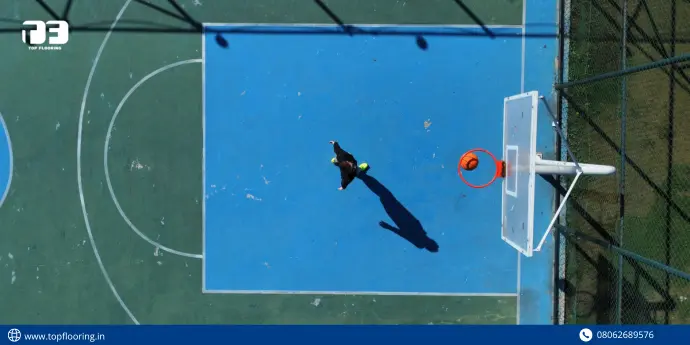
Basketball Court Dimensions and Player Performance
When dimensions and markings are accurate:
- Shooting distances feel natural
- Defensive spacing improves
- Player movement becomes smoother
- Training conditions match match-day conditions
This is why professional academies strictly follow official basketball court dimensions.
Transform Your Sports Facility Today!
Contact us for high-quality synthetic sports flooring material and elevate your space!
Common Mistakes to Avoid During Basketball Court Construction
During basketball court construction, several common mistakes can affect gameplay quality and long-term durability. One of the most frequent issues is an incorrect three-point line distance, which directly impacts shooting accuracy and match compliance. Another common error is a narrow free throw lane, often caused by poor measurement or rushed marking work.
Improper basket height is also seen in poorly planned courts and can make the court unsuitable for official play. Over time, faded or uneven markings—especially on low-quality surfaces—create confusion for players and referees alike. Finally, many projects ignore the required safety buffer area, increasing the risk of injuries near the sidelines and baselines.
Using high-quality basketball court flooring, such as acrylic synthetic flooring, plays a major role in avoiding these issues. Professionally installed surfaces from experienced brands like TopFlooring help ensure accurate markings, consistent grip, proper ball bounce, and long-lasting performance. By focusing on correct dimensions, quality materials, and expert installation, these common mistakes can be avoided—resulting in a durable, tournament-ready basketball court that meets official standards.
Final Thoughts
Following official basketball court dimensions is not optional—it is essential for quality gameplay, player safety, and professional standards. Whether the court is for a school, club, academy, or public space, accurate size, proper layout, and clear markings make all the difference. A well-dimensioned basketball court improves performance, reduces injuries, and ensures compliance with international standards. Planning with precision today saves correction costs tomorrow.
Frequently Asked Questions
The official FIBA basketball court size is 28 meters long and 15 meters wide.
A standard basketball court measures approximately 91.9 feet by 49.2 feet.
The basket height is fixed at 3.05 meters or 10 feet.
Under FIBA rules, the three-point line is 6.75 meters from the basket.
Yes, the playing dimensions are the same for both indoor and outdoor courts.
A minimum of 2 meters of clear space is recommended around all sides of the court.