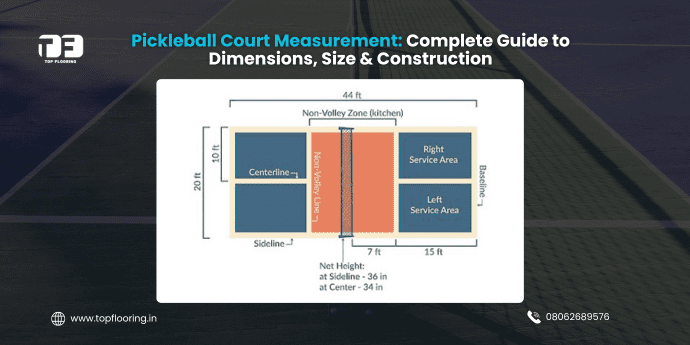
Accurate pickleball court measurement is the foundation of a professional, safe, and tournament-ready playing surface. Whether the court is being constructed for schools, residential societies, sports clubs, academies, or commercial sports complexes, correct dimensions ensure fair gameplay, proper ball bounce, and long-term durability of the flooring system.
Even small errors in line markings, non-volley zone dimensions, or net height can significantly impact match quality and player experience. This complete guide explains pickleball court dimensions, pickleball court size in square feet, singles and doubles measurements, kitchen size, net height, ceiling clearance, total ground area, and how measurements influence pickleball court construction and flooring performance.
Why Pickleball Court Measurement Is So Important
Pickleball is a fast-growing paddle sport that combines elements of tennis, badminton, and table tennis. Because of its compact court size and quick rallies, precision in court dimensions is critical.
Proper pickleball court measurement ensures:
- Uniform playing conditions for all players
- Compliance with national and international standards
- Accurate ball bounce and depth control
- Safe movement around the non-volley zone
- Better durability of pickleball court flooring
In professional pickleball court construction, dimensions are not flexible—they must follow standardized specifications.
Standard Pickleball Court Dimensions
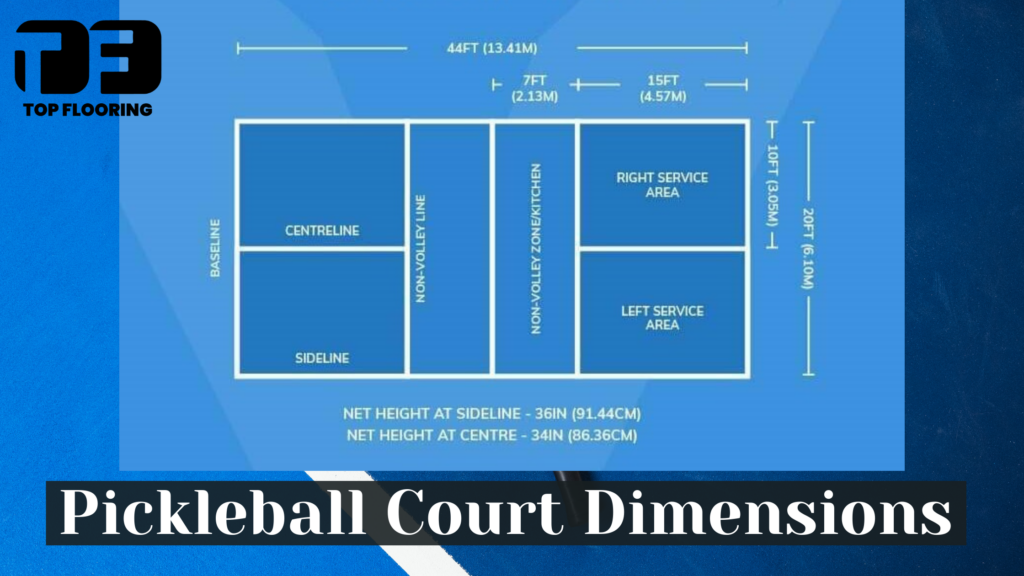
A pickleball court is rectangular and smaller than a tennis court. Interestingly, the dimensions remain the same for both singles and doubles matches.
Overall Pickleball Court Measurement
| Court Feature | Measurement (Feet) | Measurement (Meters) |
| Court Length | 44 ft | 13.41 m |
| Court Width | 20 ft | 6.10 m |
| Diagonal Length | 48 ft 4 in | 14.73 m |
These pickleball court dimensions are followed worldwide for both indoor and outdoor courts.
Pickleball Court Measurement for Singles and Doubles
Unlike tennis or badminton, pickleball uses the same court size for singles and doubles. The only difference lies in player positioning and strategy—not in the dimensions.
Pickleball Court Dimensions (Singles & Doubles)
- Length: 44 feet (13.41 meters)
- Width: 20 feet (6.10 meters)
- Net placement: Center of the court
Because the dimensions are identical, line markings must be extremely precise during pickleball court construction.
The Non-Volley Zone (Kitchen) Measurements
The most unique part of a pickleball court is the non-volley zone, commonly known as the “kitchen.”
Kitchen Dimensions
- Depth: 7 feet (2.13 meters) from the net on both sides
- Width: Full court width (20 feet / 6.10 meters)
Players cannot volley the ball while standing inside this zone. Incorrect kitchen markings can lead to rule violations and disputes during play.
Service Court Dimensions Explained
The service courts are divided by a centerline and determine where serves must land.
Service Area Measurements
- Each service court width: 10 feet (3.05 meters)
- Service court length: 15 feet (4.57 meters)
- Baseline: Back boundary line
- Centerline: Divides left and right service areas
Unlike tennis, there are no service boxes near the net—serves must land beyond the kitchen area.
Incorrect service line placement is one of the most common mistakes in pickleball court construction.
Pickleball Court Size in Square Feet
Many planners and facility owners specifically search for pickleball court size in square feet for budgeting and space planning.
Pickleball Court Area
- Total playing area:
44 ft × 20 ft = 880 square feet
≈ 81.75 square meters
This is the same area used for both singles and doubles matches.
Understanding pickleball court square footage helps in:
- Flooring material estimation
- Construction cost calculation
- Indoor space planning
- Conversion of existing courts
Pickleball Net Height and Placement
The net plays a critical role in gameplay dynamics.
Standard Pickleball Net Height
- At the sidelines: 36 inches (0.91 meters)
- At the center: 34 inches (0.86 meters)
- Net width: 22 feet minimum
The net must be properly tensioned and positioned exactly at the center of the 44-foot court length.
Incorrect net height can drastically alter gameplay and ball trajectory.
Line Markings and Thickness
The Line clarity directly impacts match accuracy.
Line Specifications
- Line thickness: 2 inches (50 mm)
- Lines must be clearly visible (usually white)
- All boundary lines are part of the playing area
Faded or uneven lines reduce court quality and professionalism.
Ceiling Height for Indoor Pickleball Courts
Ceiling clearance is crucial for indoor facilities.
Recommended Ceiling Height
- Minimum: 18 feet (5.5 meters)
- Ideal: 20–25 feet (6–7.6 meters)
Adequate vertical clearance ensures uninterrupted lobs and high defensive shots.
Total Pickleball Ground Size (Including Safety Area)
A pickleball ground includes more than just the 880 sq ft playing court.
Recommended Clearance Space
- Minimum 5 feet on each side
- Preferred 8–10 feet for tournament play
Total Recommended Ground Area
- Recreational setup: approx. 1,200–1,400 square feet
- Professional setup: 1,500–1,800 square feet
Extra clearance enhances safety, spectator movement, and player comfort.
Converting a Tennis Court to Pickleball
One standard tennis court can accommodate multiple pickleball courts.
- A regulation tennis court (78 ft × 36 ft) can fit up to four pickleball courts
- Requires precise repainting and accurate pickleball court measurement
This is a popular solution in sports complexes looking to maximize space utilization.
Role of Flooring in Pickleball Court Construction
Accurate pickleball court measurement must be supported by a high-performance surface system.
Ideal Pickleball Court Flooring Features
- Seamless and joint-free surface
- Anti-slip texture for grip
- Consistent ball bounce
- UV-resistant for outdoor courts
- Shock-absorbing base for injury prevention
- Durable and low maintenance
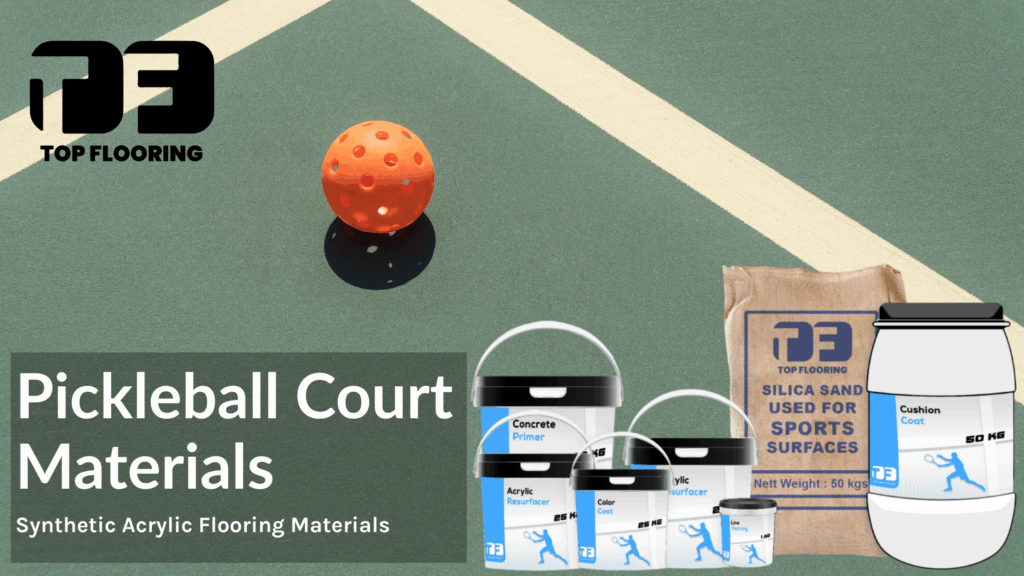
Synthetic acrylic sports flooring is widely used in modern pickleball court construction and pickleball court flooring because it maintains dimensional stability and long-term performance.
Common Pickleball Court Measurement Mistakes
Avoid these frequent construction errors:
- Incorrect kitchen depth (less or more than 7 feet)
- Wrong net height at the center
- Uneven baseline markings
- Poor centerline alignment
- Insufficient safety clearance
- Sloping or uneven surface level
Such mistakes can prevent courts from meeting professional standards.
Maintenance and Rechecking Measurements
Over time, resurfacing and repainting can affect line accuracy.
Best Practices
- Recheck all line markings after resurfacing
- Measure net height periodically
- Ensure surface remains level
- Maintain clear and visible boundary lines
Regular inspections keep the pickleball court accurate and tournament-ready.
Final Thoughts
Correct pickleball court measurement is the backbone of professional pickleball court construction. From overall court dimensions and kitchen size to net height and flooring selection, every measurement directly influences gameplay quality and safety.
When precise measurements are combined with high-quality synthetic sports flooring, the result is a reliable, durable, and tournament-ready pickleball court that performs consistently for years.
Frequently Asked Questions (FAQs)
A pickleball court measures 44 feet long and 20 feet wide for both singles and doubles.
The total playing area is approximately 880 square feet.
No, both singles and doubles use the same court dimensions.
The non-volley zone (kitchen) is 7 feet deep from the net on both sides.
Including safety clearance, a total area of 1,200–1,800 square feet is recommended.
No, the dimensions remain the same. Only flooring, lighting, and drainage systems differ.