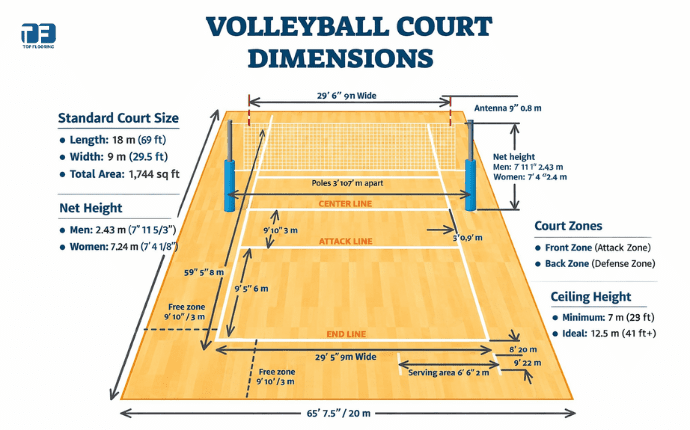
Accurate Volleyball Court measurement is the foundation of a professional, safe, and tournament-ready volleyball court. Whether building a facility for schools, academies, sports complexes, clubs, or residential societies, correct measurements ensure fair gameplay, proper ball movement, and long-term flooring durability.
Even small mistakes in Volleyball Court dimensions, line markings, or net height can affect match quality and professional approval. This complete guide explains standard Volleyball Court dimension, Volleyball Court size in square feet, service zone markings, net height, safety clearance, flooring choices, and how measurements directly impact Volleyball Court construction.
Official standards are governed globally by the Fédération Internationale de Volleyball (FIVB), and professional courts must strictly follow these specifications.
Why Volleyball Court Measurement Is So Important
Volleyball is a speed and coordination-based sport. Every rally depends on positioning, timing, jumping accuracy, and clear boundary judgment. Proper Volleyball Court measurement ensures:
- Uniform playing conditions
- Compliance with national and international standards
- Accurate ball trajectory and line calls
- Reduced injury risks
- Better durability of Volleyball Court flooring
- Tournament eligibility
In professional construction, measurements are not flexible suggestions — they are strict standards.
Standard Volleyball Court Dimensions
A volleyball court is rectangular and divided equally by a center line and net.
Overall Volleyball Court Measurement
| Court Feature | Measurement (Meters) | Measurement (Feet) |
| Court Length | 18 m | 59 ft |
| Court Width | 9 m | 29.5 ft |
| Attack Line Distance | 3 m from center line | 9.84 ft |
| Total Playing Area | 162 sq m | Approx. 1,744 sq ft |
These Volleyball Court dimensions are followed globally for indoor and outdoor courts.
Volleyball Court Size in Square Feet
Many planners specifically search for Volleyball Court size in square feet for budgeting and flooring estimation.
Volleyball Court Area Calculation
- 18 m × 9 m = 162 square meters
- 162 sq m ≈ 1,744 square feet
Understanding total square footage helps calculate Volleyball Court material cost and overall construction planning.
Volleyball Court Zones Explained
Front Zone (Attack Zone)
- Extends 3 meters from the center line on each side
- Marked by the attack line
- Used for spiking and offensive play
Back Zone (Defense Zone)
- Extends from attack line to back boundary
- Used for service reception and defensive positioning
Correct zone marking is essential in professional Volleyball Court construction.
Service Zone Measurements
The service zone is located behind the back boundary line.
Service Area Dimensions
- Width: 9 meters (entire back line width)
- Depth: Minimum 3 meters behind back boundary
- Service must be executed from within this area
Incorrect service zone marking is a common mistake in local court construction.
Volleyball Net Height and Placement
The net divides the court into two equal halves and must be placed precisely on the center line.
Standard Volleyball Net Height
- Men: 2.43 meters (7 ft 11 5/8 in)
- Women: 2.24 meters (7 ft 4 1/8 in)
Additional Net Specifications
- Net width: 1 meter
- Net length: 9.5–10 meters
- Net posts: 0.5–1 meter outside sidelines
Improper net height can make a court non-compliant for tournaments.
Line Markings and Thickness
Line accuracy is critical in Volleyball Court measurement.
- Line thickness: 5 cm (50 mm)
- Lines must be clearly visible (white preferred)
- All boundary lines are part of the playing area
Poor marking quality reduces match professionalism and decision accuracy.
Ceiling Height for Indoor Volleyball Courts
Ceiling clearance is extremely important for indoor play.
Recommended Ceiling Height
- Minimum: 7 meters
- Ideal for tournaments: 12.5 meters or more
Adequate height allows high serves and spikes without obstruction.
Volleyball Ground Size (Including Safety Area)
A professional volleyball ground includes safety clearance around the court.
Recommended Free Zone
- Minimum: 3 meters on all sides
- Professional level: 5 meters on sides & 6–8 meters at ends
Total Area with Minimum Safety Clearance
- Approx. 24 m × 15 m
- Around 3,800–4,000 square feet
This additional area ensures player safety and smooth movement during dives and saves.
Role of Flooring in Volleyball Court Construction
Accurate Volleyball Court measurement must be supported by the right Volleyball Court Flooring system.
Ideal Volleyball Court Flooring Features
- Seamless and level surface
- Anti-slip texture
- Shock absorption for jumping
- UV resistance (for outdoor courts)
- Long-lasting durability
Common Volleyball Court Flooring Materials
- Acrylic Flooring – Best for outdoor courts
- PVC Vinyl Flooring – Popular for indoor courts
- Wooden Flooring – Used in professional indoor arenas
- PU Synthetic Flooring – High-performance indoor option
Correct flooring improves play quality and reduces maintenance costs.
Volleyball Court Material Cost (Estimated – India 2026)
Budget planning requires understanding Volleyball Court material cost.
Approximate Cost Per Square Foot (India)
| Flooring Type | Approx Cost (INR) |
| Acrylic Outdoor Flooring | ₹80 – ₹150 |
| PVC Indoor Flooring | ₹180 – ₹350 |
| Wooden Flooring | ₹350 – ₹600 |
| PU Flooring | ₹200 – ₹400 |
Estimated Full Court Cost (1,744 sq ft)
- Acrylic: ₹1.5 lakh – ₹2.8 lakh
- PVC: ₹3 lakh – ₹6 lakh
- Wooden: ₹6 lakh+
Costs vary based on base condition, cushioning layers, and customization.
Step-by-Step Volleyball Court Construction Process
1. Site Preparation
- Ground leveling
- Soil compaction
- Drainage slope creation
2. Base Construction
- PCC or RCC base
- Surface finishing
3. Surface Preparation
- Crack repair
- Cleaning and priming
4. Flooring Installation
- Cushion layer (if required)
- Acrylic or synthetic coating application
5. Line Marking & Net Installation
- Accurate dimension marking
- Net alignment and height verification
Each step must follow official Volleyball Court dimensions for compliance.
Common Volleyball Court Measurement Mistakes
Avoid these errors:
- Incorrect 18m × 9m marking
- Wrong attack line placement
- Improper net height
- Ignoring safety clearance
- Uneven flooring surface
Such mistakes reduce play quality and may require costly corrections.
Indoor vs Outdoor Volleyball Court Measurement
Measurements remain the same for indoor and outdoor courts. The differences lie in:
- Flooring material
- Lighting system
- Drainage design
- Surface coating type
Outdoor courts require weather-resistant materials and proper slope for drainage.
Maintenance and Rechecking Measurements
Over time, resurfacing or repainting may affect court accuracy.
Best Practices
- Re-measure lines after resurfacing
- Check net height regularly
- Inspect flooring level
- Repaint faded markings
Routine inspection keeps the court tournament-ready and professional.
Final Thoughts
Correct Volleyball Court measurement is the backbone of professional Volleyball Court construction. From precise court dimensions and service zones to net height and flooring selection, every detail directly affects safety, performance, and long-term durability.
When accurate Volleyball Court dimension is combined with high-quality flooring, it creates a safe, durable, and tournament-ready playing surface suitable for schools, academies, and competitive sports complexes.
Frequently Asked Questions (FAQs)
The standard Volleyball Court dimension is 18 meters long and 9 meters wide.
The total playing area is approximately 1,744 square feet.
Men: 2.43 meters and Women: 2.24 meters
Approximately 3,500–4,000 square feet including minimum clearance.
No, official dimensions remain the same. Only flooring, drainage, and lighting systems differ.