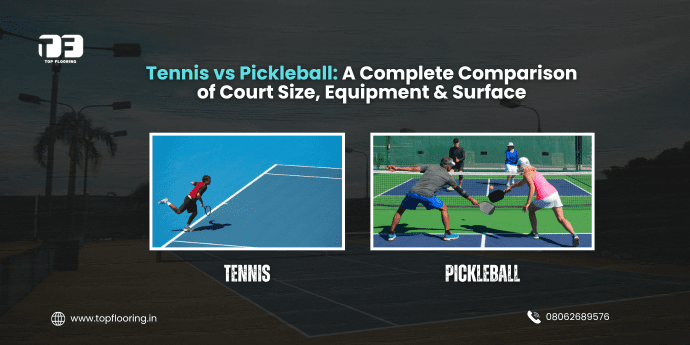
The world of racket sports is evolving rapidly. While tennis has remained one of the most prestigious and widely played sports for decades, pickleball has recently emerged as one of the fastest-growing recreational games worldwide.
At first glance, both sports appear similar — they involve a net, a ball, and striking equipment. However, when examined from a structural, technical, and infrastructure perspective, tennis vs pickleball differ significantly.
From court dimensions and equipment to surface requirements and construction feasibility, understanding these differences is essential for:
- Sports facility developers
- Schools & institutions
- Residential societies
- Club owners
- Recreational planners
This guide offers a complete and detailed comparison of tennis and pickleball, especially from a court planning and sports flooring perspective.
The Core Difference: Tradition vs Accessibility
Tennis is traditionally seen as a high-performance sport requiring:
- Endurance
- Strength
- Technical precision
Pickleball, however, is built around accessibility. It is:
- Easy to learn
- Suitable for all age groups
- Less physically demanding
This distinction directly influences how courts are designed and constructed.
Court Size Comparison
Court size is the most noticeable and impactful difference between tennis vs pickleball.
Tennis Court Dimensions
A standard tennis court measures:
- Length: 78 feet
- Width (Singles): 27 feet
- Width (Doubles): 36 feet
Additionally, tennis requires surrounding run-off space for player movement, increasing total construction area.
Total Recommended Space
Including safe movement zones:
- Around 120 feet x 60 feet may be required
This makes tennis courts land-intensive.
Pickleball Court Dimensions
Pickleball courts are significantly smaller.
Standard size:
- Length: 44 feet
- Width: 20 feet
Even with buffer zones, pickleball requires much less space.
Practical Impact
One tennis court can fit:
Up to 4 pickleball courts
This makes pickleball ideal for:
- Urban facilities
- Schools
- Community centers
- Real estate projects
Net Height & Gameplay Effect
The net plays a crucial role in determining playing style.
| Sport | Net Height |
| Tennis | 36 inches at sidelines / 34 inches at center |
| Pickleball | 36 inches at sidelines / 34 inches at center |
While the heights appear similar, the smaller court in pickleball changes the dynamics significantly.
Pickleball encourages:
- Precision
- Strategy
- Soft placement
Tennis allows:
- Power serves
- Deep baseline shots
- Fast rallies
Equipment Comparison
Rackets vs Paddles
Tennis uses stringed rackets made for speed and spin.
Pickleball uses solid paddles made from:
- Polymer
- Composite
- Fiberglass
Key Differences
| Feature | Tennis Racket | Pickleball Paddle |
| Structure | Stringed | Solid surface |
| Swing Speed | High | Moderate |
| Control | Moderate | High |
| Learning | Harder | Easier |
Pickleball paddles allow more controlled play, reducing physical strain.
Ball Comparison
Tennis Ball
- Rubber core
- Felt covering
- High bounce
Pickleball Ball
- Plastic
- Perforated design
- Lower bounce
The pickleball moves slower, making it beginner-friendly.
Surface Requirements
Court surface directly affects:
- Player safety
- Ball bounce
- Durability
- Maintenance
Tennis Court Surfaces
Common options include:
- Grass
- Clay
- Hard concrete
- Synthetic acrylic flooring
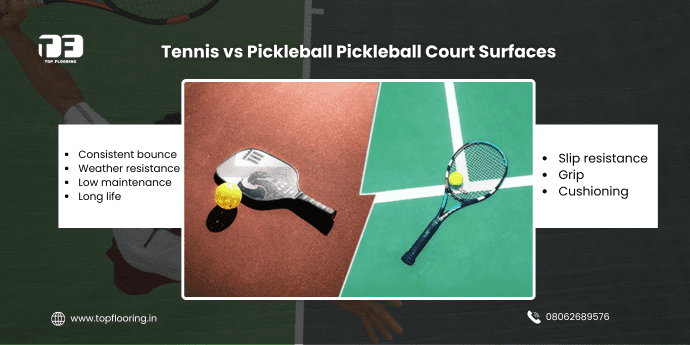
Modern facilities increasingly prefer synthetic acrylic sports flooring due to:
- Consistent bounce
- Weather resistance
- Low maintenance
- Long life
Pickleball Court Surfaces
Pickleball is typically played on:
- Concrete base
- Asphalt base
- Acrylic sports coating
Because the game involves quick lateral movement, the surface must provide:
- Slip resistance
- Grip
- Cushioning
Acrylic flooring ensures:
Uniform play
Player safety
Durability
Construction Differences
Tennis Court Construction
Requires:
- Larger excavation
- Stronger base
- Higher material usage
Also involves:
- Extended curing time
- Larger drainage planning
Pickleball Court Construction
Requires:
- Smaller foundation
- Faster installation
- Lower material consumption
This reduces:
- Construction time
- Labor cost
- Overall investment
Gameplay Style & Movement
Tennis involves:
- Long rallies
- Wide court coverage
- High-speed serves
Pickleball involves:
- Strategic shot placement
- Shorter rallies
- Controlled gameplay
The Non-Volley Zone (Kitchen) in pickleball adds tactical depth not found in tennis.
Physical Demand
Tennis:
- Requires endurance
- Demands agility
- Involves large movement
Pickleball:
- Requires moderate movement
- Is easier on joints
- Suitable for older players
This inclusivity is a major reason behind pickleball’s rapid growth.
Maintenance Needs
Tennis Court
Needs:
- Regular resurfacing
- Cleaning
- Crack repair
Pickleball Court
Needs:
- Minimal upkeep
- Occasional repainting
Synthetic acrylic surfaces simplify maintenance for both.
Safety Considerations
Surface safety affects:
- Injury prevention
- Player comfort
- Long-term usability
Pickleball needs high grip due to fast direction changes.
Tennis requires balance between:
- Bounce
- Cushioning
Acrylic flooring meets both needs effectively.
Space Efficiency
Pickleball wins in terms of space utilization.
Tennis remains superior for:
- Professional training
- Competitive tournaments
Facilities often choose pickleball when land is limited.
Cost Comparison
| Factor | Tennis Court | Pickleball Court |
| Land Needed | High | Low |
| Construction | Expensive | Affordable |
| Maintenance | Moderate | Low |
Pickleball offers better ROI for recreational projects.
Multi-Sport Compatibility
Modern sports infrastructure favors flexibility.
With synthetic acrylic flooring:
- Tennis courts can support pickleball
- Dual markings are possible
- Multi-use design increases usability
This is especially useful for:
- Schools
- Housing societies
- Sports academies
Popularity Growth
Tennis continues to dominate professional sports.
Pickleball is growing rapidly in:
- Residential communities
- Wellness centers
- Corporate campuses
The sport’s simplicity is attracting new players.
Which Court is Right for You?
Choose Tennis if:
- Professional training is required
- Larger land is available
Choose Pickleball if:
- Recreational use is the goal
- Space is limited
- Budget matters
Choose Multi-Purpose if:
- Maximum utilization is needed
Future of Court Development
The future lies in:
Flexible infrastructure
Multi-sport surfaces
Durable coatings
Synthetic acrylic flooring supports:
- Long-term performance
- Weather adaptability
- Multi-sport functionality
Conclusion
Tennis and pickleball serve different purposes in modern sports infrastructure.
Tennis offers tradition and competitive depth.
Pickleball offers accessibility and efficiency.
Understanding their differences in:
- Court size
- Equipment
- Surface needs
helps make smarter decisions in sports facility planning.
With advanced acrylic sports flooring solutions, facilities can now support both sports efficiently.
Frequently Asked Questions (FAQs)
The standard court size is 20 feet wide and 44 feet long, with a 7-foot non-volley zone on each side of the net.
Synthetic acrylic flooring is considered the best option due to durability, weather resistance, and consistent ball bounce.
Typically 3–5 weeks depending on site conditions and weather.
Yes, with proper resurfacing and marking adjustments.