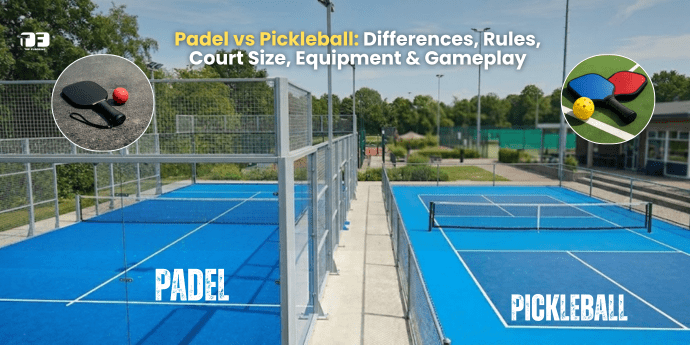
Two of the fastest-growing racket sports in the world Padel and Pickleball are attracting millions of players every year. At first glance, they look similar: compact courts, small rackets, and simple rules that make them accessible to all ages and fitness levels. But dig deeper, and the two sports are remarkably different in their origins, physics, strategy, and culture.
This guide covers every single difference between Padel and Pickleball from the millimetre-level court dimensions all the way to professional tournament formats so you leave with a complete understanding of both games.
Quick Answer
Padel is an enclosed court sport played in doubles with solid rackets and pressurised balls, where walls are legally in play. Pickleball is played on an open court often a repurposed tennis court with a perforated plastic ball and unique kitchen (no-volley) zone rules. Both are doubles-friendly, beginner-accessible, and wildly addictive.
Table of contents
- Overview: What Are These Sports?
- Court Size, Dimensions & Surface
- Equipment: Racket, Paddle, Ball & Net
- Rules of the Game: Key Differences
- Scoring System: How Each Game Is Won
- Serving Rules: Padel vs Pickleball
- Gameplay & Strategy: How Each Sport Is Played
- Fitness & Physical Demands
- Cost to Play: Equipment, Court Hire & Access
- Popularity, Growth & Global Reach
- Which Sport Is Better for Beginners?
- Final Verdict: Padel vs Pickleball — Which Should You Play?
- Choose Your Sport
- Frequently Asked Questions (FAQs)
Overview: What Are These Sports?
Before comparing the two head-to-head, it helps to understand where each sport came from and what makes it unique at its core.
Padel
Origin: Mexico, 1969
- Enclosed glass-and-mesh court
- Always played as doubles (4 players)
- Solid carbon/fibreglass racket (no strings)
- Pressurised rubber ball (like tennis)
- Walls are part of play
- Huge in Spain, Argentina, UK, Italy
- 25 million players worldwide
Pickleball
Origin: Washington USA, 1965
- Open, badminton-sized court
- Singles or doubles (2–4 players)
- Solid paddle (graphite, fibreglass, wood)
- Perforated plastic wiffle ball
- No-volley zone (“kitchen”)
- Dominant in USA, growing globally
- 36+ million players (USA alone)
Brief History of Padel
Padel was invented in 1969 by Mexican businessman Enrique Corcuera at his vacation home in Acapulco. He had limited space for a full tennis court, so he built a smaller enclosed court with walls made of concrete and wire mesh. His friend Alfonso de Hohenlohe brought the sport to Spain in 1974, where it exploded in popularity. Today Spain alone has over 4 million regular players and an estimated 20,000 courts. The sport is governed internationally by the International Padel Federation (FIP) and has been on a rapid global expansion particularly across Europe, the Middle East, and Latin America.
Brief History of Pickleball
Pickleball was invented in the summer of 1965 on Bainbridge Island, Washington, by Congressman Joel Pritchard, businessman Bill Bell, and Barney McCallum. The three families were looking for a game to entertain their bored children. Using table tennis paddles, a perforated plastic ball, and a badminton net lowered to 34 inches, they improvised what became pickleball. The quirky name reportedly came from the Pritchard family’s cocker spaniel, Pickles, who would chase and hide the ball though some sources suggest it was named after the “pickle boat” concept in rowing (a crew made up of leftover oarsmen). The USA Pickleball (USAPA) was founded in 1984 and the sport has grown explosively since 2020.
Court Size, Dimensions & Surface
This is arguably the biggest structural difference between the two sports. A padel court is an enclosed space surrounded by walls, while a pickleball court is an open playing area more similar to a scaled-down tennis court.
10×20m Padel court dimensions
200 m² Padel total court area
6.1×13.4m Pickleball court dimensions
81.7 m² Pickleball total court area
Padel Court Details
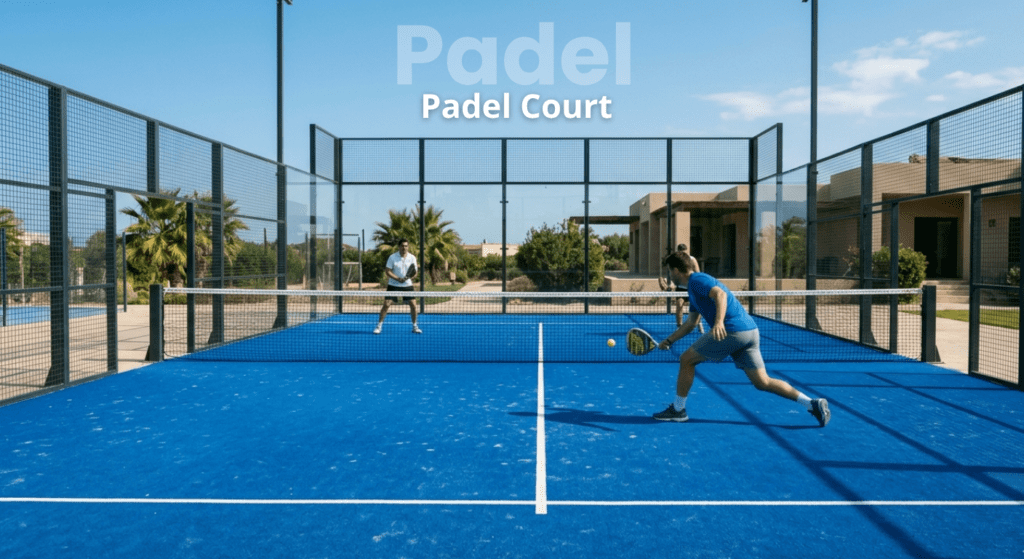
A standard padel court measures exactly 10 metres wide by 20 metres long, giving a total playing area of 200 m². The court is divided in half by a net (91 cm high at the sides, 88 cm at the centre). What makes padel courts unique is their enclosure: glass and metallic mesh walls surround all four sides. The back walls are typically 4 metres high and the side walls are 3 metres high. The court surface is usually artificial grass (similar to mini football), porous concrete, or synthetic carpet all designed to give good ball bounce characteristics and comfortable grip underfoot. The service boxes, marked within the court, extend 6.95 metres from the back wall.
Pickleball Court Details
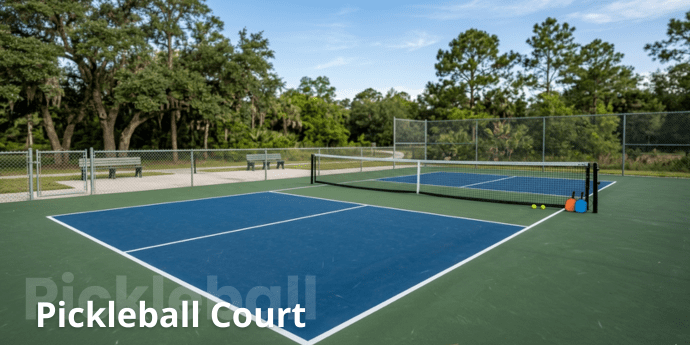
A pickleball court measures 6.1 metres (20 feet) wide by 13.4 metres (44 feet) long, making it roughly the same size as a badminton court or a third of a tennis court. It has an open playing area with no surrounding walls. The net stands 91.4 cm (36 inches) high at the posts and dips slightly to 86.4 cm (34 inches) at the centre. The most distinctive feature is the Non-Volley Zone (NVZ), colloquially known as the “kitchen” a 2.13-metre (7-foot) zone on each side of the net where players cannot volley the ball. The court surface is most commonly asphalt or concrete, though indoor courts use wood or sports flooring.
Court Size Comparison at a Glance
| Dimension | Padel | Pickleball |
|---|---|---|
| Total Length | 20 metres (65.6 ft) | 13.4 metres (44 ft) |
| Total Width | 10 metres (32.8 ft) | 6.1 metres (20 ft) |
| Total Area | 200 m² | 81.7 m² |
| Net Height (sides) | 91 cm (35.8 in) | 91.4 cm (36 in) |
| Net Height (centre) | 88 cm (34.6 in) | 86.4 cm (34 in) |
| Enclosure | Yes glass + metal mesh walls | No — open court |
| No-Volley Zone | None | 2.13m (7ft) each side |
| Typical Surface | Artificial grass / porous concrete | Asphalt / concrete / hardwood |
| Lines on Court | Service lines, centre line | Baseline, kitchen, service, centre |
Equipment: Racket, Paddle, Ball & Net
The equipment differences between padel and pickleball go well beyond appearance they fundamentally determine how the ball behaves and how the game is played.
The Racket / Paddle
Padel Racket
Also called: padel pala / racquet
- Max length: 45.5 cm
- Max width: 26 cm
- Weight: 330–390 grams
- Perforated foam/EVA core
- No strings — solid face with holes
- Carbon fibre, fibreglass, or foam
- $50–$400+ (entry to pro)
Pickleball Paddle
Also called: pickleball paddle / bat
- Max length: 43.18 cm (17 in)
- Max width + length: 60.96 cm (24 in)
- Weight: 198–255 grams
- Polymer honeycomb / nomex core
- Smooth or textured solid face
- Graphite, fibreglass, carbon fibre
- $15–$250 (entry to pro)
The padel racket is noticeably heavier and thicker it has a perforated rubber/EVA core sandwiched between two hard surfaces (carbon or fibreglass). The holes in the face reduce drag and affect ball spin. The handle is shorter since players never generate racket-head speed the same way as in tennis. Pickleball paddles are lighter, with a honeycomb polymer core that gives a distinctive “pop” sound on contact. The surface texture has become a hot topic in competitive pickleball — rougher surfaces create more spin and are subject to rule-setting by USA Pickleball.
The Ball
Padel Ball
Padel uses a pressurised rubber ball nearly identical to a tennis ball, but with slightly lower internal pressure. The diameter is 6.35–6.77 cm and weight is 56–59.4 grams. The lower pressure (10–11 psi vs tennis’s ~14 psi) makes the ball bounce a little less, which suits the smaller court. The ball is covered in felt and behaves predictably on both court surfaces and walls.
Pickleball Ball
The pickleball is a hollow plastic ball with 26–40 round holes (indoor balls have fewer, larger holes; outdoor balls have more, smaller holes for wind resistance). Diameter is 7.37–7.62 cm and weight is just 22–26 grams very light. Because it’s plastic with no internal pressure, it doesn’t compress on contact the way a rubber ball does, making spin harder to apply but the ball more predictable in flight. Outdoor balls are notably harder and faster than indoor ones.
Net Comparison
Both sports use a net to divide the court, but with slight dimensional differences. The padel net is 10 metres wide (spanning the full court), 88 cm tall at the centre and 91 cm at the posts, and sits on a solid base. The pickleball net is 6.7 metres wide (slightly wider than the court itself at the posts), with a height of 86.4 cm at the centre and 91.4 cm at the posts very similar to padel but slightly lower at the centre. Neither net has a let rule for serves that clip the top.
| Equipment | Padel | Pickleball |
|---|---|---|
| Racket/Paddle type | Solid with holes (no strings) | Solid smooth/textured face |
| Racket weight | 330–390 grams | 198–255 grams |
| Handle length | Short (approx. 10 cm) | Medium (approx. 12 cm) |
| Ball type | Pressurised rubber (felt-covered) | Hollow perforated plastic |
| Ball diameter | 6.35–6.77 cm | 7.37–7.62 cm |
| Ball weight | 56–59.4 grams | 22–26 grams |
| Ball behaviour | Bounces off walls, spins well | No walls, less spin, slower |
| Entry cost | $50+ for racket, $4–8/balls | $15–30 paddle, $10–20/6 balls |
Rules of the Game: Key Differences
This is where padel and pickleball diverge most dramatically. Understanding these rules is essential not just to play correctly, but to appreciate the very different strategic demands of each sport.
Wall Play (Padel)
In padel, the ball can bounce off any wall after landing in the opponent’s court. Players actively use walls to keep the ball in play returning shots off the back glass is a fundamental skill. The ball must land in the court first before hitting a wall on the opponent’s side.
The Kitchen Rule (Pickleball)
Players cannot volley (hit the ball in the air) while standing in the Non-Volley Zone (NVZ or “kitchen”). You can enter the kitchen to play a ball that has bounced but you must exit before volleying. This single rule defines pickleball’s entire close-net strategy.
No Let Rule (Padel)
As of modern padel rules, there is no let call for serves that touch the net and land in. The point plays on. A fault occurs only if the serve lands outside the service box or in the net. The serve must bounce before the returner plays it.
Two-Bounce Rule (Pickleball)
After a serve, both the serve and the return of serve must bounce before being played. Only after these two bounces can players volley freely (outside the kitchen). This rule prevents a net-rushing advantage on serve and extends rallies.
Doubles Only (Padel)
Padel is always played as doubles four players on court (two per team). Singles padel technically exists but is extremely rare. The doubles format is central to the social nature of the game and the strategic use of court positioning.
Side-Out Scoring (Pickleball)
Only the serving side can win a point. If the receiving side wins the rally, it’s a side-out (service transfer) but no point is scored yet. Each player on the serving team gets to serve before side-out in doubles. This “rally scoring” variant is now also widely used.
Ball Out of Court (Padel)
If the ball flies out of the court structure (over the walls), the hitter loses the point. Players can actually exit through the gate/door in the back fence to retrieve a ball that exits low, and continue playing it this is one of padel’s most dramatic and spectacular plays.
Foot Fault (Pickleball)
On the serve, players must keep both feet behind the baseline and within the imaginary extension of the centreline and sideline. Stepping on or over the line during the serve motion results in a fault and loss of serve.
More Key Rules Side by Side
| Rule | Padel | Pickleball |
|---|---|---|
| Players per match | 4 (doubles always) | 2 (singles) or 4 (doubles) |
| Ball must bounce on serve | Yes in service box | Yes in service court |
| Walls in play | Yes after first bounce | No walls |
| Ball can exit court | Yes (players can leave to play it) | No out of bounds = point over |
| Underarm serve only | Yes below hip level | Yes below navel/wrist below paddle |
| Volley restriction | None (volley anywhere) | No volley in kitchen |
| Double bounce rule | No | Yes serve + return must bounce |
| Overhead smash | Common, but ball may rebound off glass | Common, but kitchen proximity limits it |
| Ball hits net on serve | Play continues (no let) | Let is called (re-serve) USA rules vary |
| Spin allowed | Yes extensive topspin and slice | Yes but less effective due to ball type |
Scoring System: How Each Game Is Won
The scoring systems are fundamentally different padel uses the tennis scoring system while pickleball uses a simpler numerical system more akin to volleyball or badminton.
Padel Scoring
- Point values: 15, 30, 40, Game
- Deuce at 40–40, then Advantage
- Must win game by 2 clear points
- 6 games = 1 set (need 2-game lead)
- Tiebreak at 6–6 (first to 7, win by 2)
- Match = best of 3 sets
- Final set may use super-tiebreak (10 pts)
Pickleball Scoring
- Points are 1, 2, 3 … 11 (or 15/21)
- Only serving side scores (traditional)
- Win by 2 clear points required
- Game to 11 points (most common)
- Match = best of 3 or 5 games
- Rally scoring: every rally = 1 point (used in pro/rec play increasingly)
- Score announced: server – receiver – server number (doubles)
“Pickleball’s scoring call in doubles is uniquely complex: players must announce three numbers ‘five-three-two’ means the serving team has 5 points, the receiving team has 3, and this is the second server.”
Scoring Comparison
| Scoring Element | Padel | Pickleball |
|---|---|---|
| Scoring format | 15-30-40-Game (tennis) | 1-2-3…11 (numerical) |
| Who scores points | Any team wins the rally | Serving team only (traditional) |
| Match format | Best of 3 sets | Best of 3 games to 11 |
| Tiebreak | Yes 7-point or super tiebreak | Win by 2 (game extends past 11) |
| Average match duration | 60–90 minutes | 30–60 minutes |
Serving Rules: Padel vs Pickleball
Both sports use underhand serves, which is one of their biggest differences from tennis. This keeps the serve from being an overwhelming weapon and promotes longer, more collaborative rallies.
Padel Serving Rules
In padel, the server must stand in the service box diagonally opposite to the receiver. The serve is made underhand the ball must be bounced once on the ground before being struck, and contact with the ball must happen below the server’s hip level. The ball is served diagonally into the opponent’s service box. If the first serve lands outside the box, in the net, or strikes the wire mesh (not glass) on the side walls, it is a fault. Two faults in a row result in a double fault and loss of the point. The serve must be a continuous motion no faking or stopping. There is no let rule (serves that clip the net and land in are played).
Pickleball Serving Rules
Pickleball serves must be made underhand with the paddle head below the wrist at contact, and the highest point of the arc of the paddle head must be below the waist (navel). The ball must be struck in the air servers are not permitted to bounce the ball first (unlike padel). The serve must be hit diagonally cross-court, clearing the net and the kitchen zone, and landing in the service area beyond the kitchen. A fault on serve results in loss of serve (not loss of point directly, unless rally scoring is used). Notably, a “drop serve” variant is allowed: the ball can be dropped from height and allowed to bounce before being struck.
| Serving Rule | Padel | Pickleball |
|---|---|---|
| Serve type | Underhand, ball bounced off floor first | Underhand, ball struck in air (or drop serve) |
| Contact height | Below hip level | Below waist/navel |
| Direction | Diagonally cross-court | Diagonally cross-court |
| Landing zone | Diagonal service box | Beyond the kitchen, in service area |
| Net let on serve | No let play continues | Let re-serve (some rule sets allow play) |
| Faults per serve | Two faults = point lost | One fault = side-out (traditional) |
| Server moves | Yes can move after serving | Yes must stay behind baseline at contact |
Gameplay & Strategy: How Each Sport Is Played
The strategic depth of padel and pickleball are completely different despite both being compact racket sports. Understanding this helps you appreciate why both attract such passionate communities.
Padel Gameplay Strategy
Padel is a three-dimensional sport. Because the ball can rebound off walls, players constantly think about angles that their opponents haven’t encountered — hitting the ball so it caroms off the back glass at an unpredictable angle is called a “vibora” or “bandeja” smash. The defensive position is at the back; the attacking position is at the net. The dominant strategy is to work your way into the net position (la red) from which you can angle volleys and finish the point. When pushed back, elite players use the back glass as a tool, scooping the ball off the floor-wall junction (the “wall shoot” or “rulo”) to relaunch themselves into an attacking position.
Key padel shots include: the vibora (a spin smash angled to the wall), the bandeja (a defensive overhead), the globo (a defensive lob), the bajada (returning off the back wall), and the chiquita (a soft cross-court passing shot when pinned back).
Pickleball Gameplay Strategy
Pickleball strategy revolves almost entirely around the kitchen. The golden rule is: get to the kitchen line as fast as possible after the serve, because controlling the NVZ line gives you the angle advantage for volley exchanges. The third-shot drop a soft, arching shot that lands in the opponent’s kitchen and forces them to let the ball bounce is the most important shot in intermediate-to-advanced pickleball. It neutralises the opponent’s net position and gives you time to advance. The “dink” game soft cross-court exchanges at the kitchen rewards patience, placement, and nerve rather than power.
Key pickleball shots include: the third-shot drop (the fundamental transition shot), the dink (soft kitchen exchange), the erne (jumping outside the kitchen to volley), the ATP (around-the-post shot), speed-up attacks, and reset dinks.
| Gameplay Aspect | Padel | Pickleball |
|---|---|---|
| Wall use | Essential walls create shots | None |
| Dominant formation | Both at the net when attacking | Both at kitchen line to control |
| Key skill | Wall reading, lob/smash, positioning | Third-shot drop, dinking, patience |
| Power vs control | Balance power at net, control at back | Control-dominant power often punished |
| Lob importance | Very high resets position | Moderate used to push back opponents |
| Rally length | Long 10–30+ shots common | Moderate 5–15 shots typical |
| Spin significance | High especially topspin lobs and slices | Growing especially with textured paddles |
Fitness & Physical Demands
Both sports provide excellent cardiovascular exercise, but they challenge the body in somewhat different ways.
Padel Physical Demands
Padel is highly aerobic. The larger court means more lateral movement, frequent sprinting to retrieve shots off back glass, and repetitive split-steps and direction changes. A competitive padel match can burn 500–800 calories per hour and involves significant shoulder and arm work due to the heavier racket. The dominant physical stress is on the knees and hips (for lateral movement) and the shoulder and elbow (for smashes and viboras). The enclosed court means players are always running there are few natural rest moments. Padel players also engage core muscles heavily when scooping balls off the floor.
Pickleball Physical Demands
Pickleball’s smaller court and lower ball speed make it lower-impact overall which is a primary reason it’s become so popular among older adults and those recovering from injury. However, competitive pickleball is surprisingly demanding: the kitchen-line game requires explosive short sprints, quick reflexes, and sustained focus. The repetitive dinking motion stresses the elbow and wrist. Studies show recreational pickleball burns 350–500 calories per hour. The risk of common injuries includes elbow tendinitis (“pickleball elbow”), knee strains, and ankle sprains from quick pivots on hard courts.
| Fitness Aspect | Padel | Pickleball |
|---|---|---|
| Calories burned/hour | 500–800 (competitive) | 350–500 (recreational) |
| Cardiovascular demand | High | Moderate–High |
| Impact level | Moderate (softer surfaces typical) | Moderate–High (hard courts common) |
| Primary muscles | Legs, core, shoulders | Arms, wrist, legs |
| Age-friendliness | Good for all ages | Excellent very popular 50+ |
| Common injuries | Shoulder, knee, elbow | Elbow tendinitis, knee, ankl |
Cost to Play: Equipment, Court Hire & Access
One of the most practical differences between the two sports and a major driver of pickleball’s explosive growth is the cost of entry.
Cost of Playing Padel
Padel courts are expensive to build (typically $30,000–$80,000 USD per court), which means court hire fees are substantial. In Europe and the UK, a one-hour court hire typically costs €10–€30 per person ($10–$35). Equipment costs are higher: a quality padel racket suitable for beginners starts at around $60–100 and professional models run $250–$400+. Balls typically cost $4–8 per can of three. Shoes are important padel requires shoes with a herringbone or clay-court tread for grip on artificial grass (standard court shoes often don’t work well). Total start-up cost for a beginner: approximately $100–$200 for equipment.
Cost of Playing Pickleball
Pickleball’s accessibility is largely driven by cost. Paddles start at just $15–25 for entry-level wood or composite options, and quality intermediate paddles are $50–100. Balls cost around $10–20 for a pack of six. The biggest advantage: pickleball can be played on any hard flat surface public parks, community centres, repurposed tennis courts, and gym floors. Many municipalities in the US have free public pickleball courts. Even private club rates are generally lower than padel: $3–15 per person per session in the US. Total start-up cost for a beginner: as little as $30–50.
| Cost Element | Padel | Pickleball |
|---|---|---|
| Entry-level racket/paddle | $60–$100 | $15–$50 |
| Pro-level racket/paddle | $250–$400 | $120–$250 |
| Balls (per can/pack) | $5–$8 (3 balls) | $10–$20 (6 balls) |
| Court hire (per person/hr) | $10–$35 | $0–$15 |
| Specialist shoes needed? | Yes (clay/omni-sole) | Court shoes fine |
| Free public courts? | Very rare | Widely available (US especially) |
| Total beginner start-up | $120–$200+ | $30–$80 |
Popularity, Growth & Global Reach
Both sports are among the fastest-growing in the world, but their geographic distribution and trajectory differ significantly.
25M+Padel players worldwide
90+Countries play padel
36M+Pickleball players in USA
70+Countries play pickleball
Padel’s Global Footprint
Padel is the second most popular sport in Spain (behind football) with over 4 million players and 20,000+ courts. Argentina is another heartland with over 2 million players. The sport has seen extraordinary growth in Italy, Sweden, the UAE, the UK, and Mexico. The Premier Padel tour (backed by FIFA) launched in 2022 and features prize money comparable to ATP 250 tennis events. Investment from tennis stars like Rafael Nadal and Neymar has supercharged the sport’s profile. In the UK, padel court construction grew by over 300% between 2020–2023.
Pickleball’s Dominance in North America
The Sports & Fitness Industry Association (SFIA) reported over 36 million pickleball players in the US in 2023, making it the fastest-growing sport in America for multiple consecutive years. Professional leagues including the MLP (Major League Pickleball), PPA Tour, and APP Tour have attracted star-power investment from celebrities and athletes including LeBron James, Tom Brady, and Drew Brees. ESPN has begun broadcasting professional pickleball. Internationally, the sport is growing rapidly in Canada, India, Australia, and the UK though padel maintains a stronger global footprint outside North America.
| Popularity Metric | Padel | Pickleball |
|---|---|---|
| Global player base | ~25 million | ~36M+ (US) + growing globally |
| Strongest region | Europe, Latin America, Middle East | North America (dominant) |
| Pro tour | Premier Padel, World Padel Tour | MLP, PPA Tour, APP Tour |
| Olympic status | Not yet (FIP working toward it) | Not yet (IFP recognised by GAISF) |
| TV/streaming presence | Growing (DAZN, beIN Sports) | ESPN, CBS Sports, streaming platforms |
| Celebrity interest | Nadal, Neymar, tennis world | LeBron, Brady, Brees, Silicon Valley |
Which Sport Is Better for Beginners?
This is one of the most common questions asked by people discovering both sports for the first time.
Pickleball for Beginners
Pickleball is generally considered the easier sport to pick up from zero. The smaller paddle surface area is actually more forgiving than a tennis racket, the lighter ball moves slowly enough to react to, the smaller court means less running, and the rules though initially confusing become intuitive within a few sessions. Most people can have a genuine rally within their very first session. The slower ball and larger “sweet spot” relative to the ball size makes solid contact easier. The main learning curve for beginners is the kitchen rule and the two-bounce rule, which require conscious thought until they become second nature.
Padel for Beginners
Padel is also very accessible more so than tennis, which is its natural comparison point. The small court means balls are never too far, the lower ball pressure makes it slower than tennis, and the walls actually help beginners keep the ball in play rather than hitting it out. The challenge for beginners is understanding and exploiting the walls initially, people try to avoid walls, which is the wrong instinct. Learning to let the ball come off the back glass takes adjustment. The heavier racket is also a small physical adjustment. Most beginners who’ve played any racket sport (tennis, squash) adapt to padel within 2–3 sessions.
Padel Beginner Pros
- Walls keep ball in play
- Social doubles format
- Lower pressure ball = slower pace
- Familiar tennis-like scoring
- Excellent community/social vibe
Padel Beginner Cons
- Courts harder to find
- Higher cost to play
- Wall strategy takes time
- Always need 4 players
- Specialist footwear needed
Pickleball Beginner Pros
- Very low cost to start
- Courts everywhere (US)
- Playable with 2 or 4 people
- Rally within first session
- Very welcoming community
Pickleball Beginner Cons
- Kitchen rule confusing at first
- Scoring system complex
- Hard court surface is high-impact
- Less available globally
- Pro-level skill gap is steep
Final Verdict: Padel vs Pickleball — Which Should You Play?
There is no universally correct answer — the best sport is the one you’ll actually play, enjoy, and stick with. But here’s a clear framework based on everything we’ve covered:
Choose Your Sport
Based on your priorities, here’s what each sport offers:
Choose Padel if…
- You love social doubles
- You have tennis background
- You’re in Europe/LatAm
- You want dynamic 3D play
- You like longer matches
- Budget isn’t the priority
Choose Pickleball if…
- You’re in North America
- Budget is important
- You’re 50+ or recovering
- You want quick games
- You like 1v1 or 2v2
- Courts are nearby (US)
What’s clear is that both sports deserve their explosive growth. Padel offers a uniquely immersive, three-dimensional doubles experience with a sophisticated strategic layer centred on wall play. Pickleball offers extraordinary accessibility, a welcoming community, and a deceptively deep game that rewards patience and touch over raw power.
The good news? There’s no reason you can’t play both. Many players find that skills transfer well between the two — and having two racket sports in your rotation keeps the game fresh and challenges different physical and cognitive skills.
“The real winner in the padel vs pickleball debate is the recreational sports market — both games are growing simultaneously, drawing millions of people off the sofa and onto the court.”
Summary: All Differences at a Glance
| Category | Padel | Pickleball |
|---|---|---|
| Origin | Mexico, 1969 | USA, 1965 |
| Players | 4 (doubles only) | 2 or 4 |
| Court size | 10m × 20m (200 m²) | 6.1m × 13.4m (81.7 m²) |
| Enclosed court | Yes — glass + mesh walls | No walls |
| Racket/Paddle | Solid perforated foam (330–390g) | Solid paddle (198–255g) |
| Ball type | Pressurised rubber, felt-covered | Hollow perforated plastic |
| Serve | Underhand, bounce first, below hip | Underhand, no bounce, below navel |
| Wall play | Central to game | Not applicable |
| No-volley zone | None | 2.13m kitchen each side |
| Two-bounce rule | No | Yes (serve + return) |
| Scoring | Tennis (15-30-40, sets) | Numerical (1–11, games) |
| Net height (centre) | 88 cm | 86.4 cm |
| Surface | Artificial grass / porous concrete | Asphalt / concrete / hardwood |
| Avg calories/hr | 500–800 | 350–500 |
| Beginner cost | $120–$200+ | $30–$80 |
| Match length | 60–90 min | 30–60 min |
| Global players | ~25 million | 36M+ (USA) |
| Strongest region | Europe & Latin America | North America |
Frequently Asked Questions (FAQs)
Yes. Padel requires players to understand wall rebounds, positioning, and advanced tactical strategies.
Padel generally burns more calories due to higher movement demands.
Padel courts are significantly more expensive because of glass walls, steel structures, and synthetic turf systems.
Both are growing rapidly, but pickleball dominates North America while padel dominates many European and Middle Eastern markets.
Yes. Many tennis skills transfer effectively to padel.