Planning a basketball court without knowing its dimensions is rather like trying to pour concrete without a clear plan in sight. The size of your court is what determines everything, right from picking the right plot all the way to laying the groundwork, marking out the lines, putting up the fencing, and choosing the perfect flooring. For schools, clubs, academies and the everyday residential projects in India, making sure you get the basketball court dimension right from the very start will save you from a whole load of costly reworks a bit further down the line.
This guide is going to cover the basketball court dimension in meters, the total basketball court area in square feet, and just how different court sizes fit into real-life plots. We will focus on the FIBA-specified dimensions most commonly used in India and compare them with NBA standards to provide a clearer context. Along the way, we’ll be tying each measurement in to the actual decisions you’ll be making on the ground in the construction of your basketball court in India – especially when using acrylic flooring for your basketball court flooring and synthetic options too.
Standard Basketball Court Dimension in India – Why FIBA is Important?
- Most Competitive Tournaments in India Stick to FIBA Dimensions – Because schools, colleges and national competitions all aim for consistency, they follow FIBA standards. By doing so, they ensure that every court in India feels the same for players alike.
- Court Length: About 28m ( 92 feet)-This length supports a well-balanced game by giving players enough space to set up their offence and control their movements. It also makes it a lot easier for athletes competing locally and those who are trying to make it to bigger competitions.
- Court Width: 15m (50 ft)- In terms of giving players enough space to move and get the ball around, the width does the trick. It ensures the court is in line with FIBA’s official guidelines on ball play and safety.
- The Total Court Area: 420 m² or 4,521 sq. ft- That’s just the surface area, don’t forget there’s usually some extra room around the sides for safety. Knowing the area lets you plan the flooring, base of the court and whole site accurately.
- NBA Courts are slightly bigger at 94 ft x 50 ft- You get a faster-paced game with more space for players to move about, but in most Indian projects, we just don’t need that kind of size.
- Why FIBA Standards Matter for India – Since we compete in international events using FIBA rules, sticking to their dimensions makes sense. Not only does it keep us compliant, but it also makes things a lot easier for people building new courts – budgeting, construction and installing the flooring is a whole lot simpler.
Basketball Court Dimension in Feet vs Meters
To make design, drawings, and BOQs easier, it helps to look at basketball court dimension in feet and meters together.
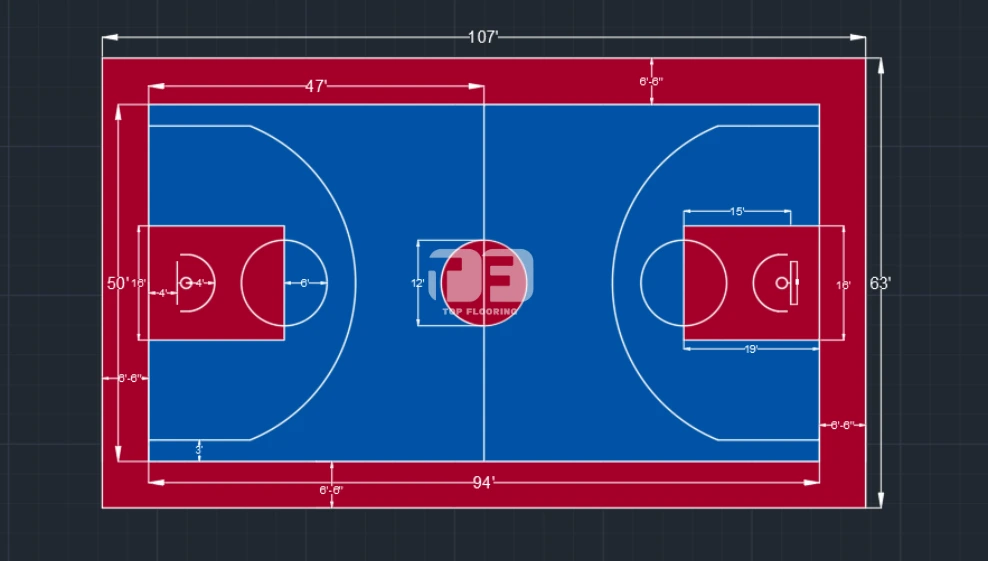
Full-size FIBA Court
| Parameter | In Meters | In Feet (approx.) |
| Court length | 28 m | 91.9 ft |
| Court width | 15 m | 49.2 ft |
| Playing area | 420 m² | 4,520–4,600 sq. ft. |
| Rim height | 3.05 m | 10 ft |
| Free throw line distance (board) | 4.6 m | 15.1 ft |
| Three-point line distance (arc) | 6.75 m | 22.1 ft |
| Centre circle diameter | 3.6 m | 11.8 ft |
This quick table helps everyone – architects, contractors, and clients – align on basketball court dimension in meters for drawings and basketball court dimension in feet for on-site measurements.
Full-Size Basketball Court Dimension – From Playing Area to Plot Size
When searching for full-size basketball court dimension, most people are after more than just the specs on the official playing field. When you build a school, academy, club, or township facility, you need to understand a few key factors from the very beginning.
Official Playing Area (FIBA Standard)
As it happens, FIBA – the group regulating most competitive basketball in India – sets the standard, and it’s the one most people use: 28m x 15m is the rectangle inside which all the main action from simple dribbles to crazy shots takes place. Get that measurement wrong, not only could it mess up the line marking, but also change the whole experience on the court and even affect the flooring.
Why Run-Off / Safety Margins Matter
The playing area is only half the story. Basketball players are always pushing the boundaries, sprinting beyond the sidelines, scrambling for loose balls, and landing outside the main court after a big slam. Without some wiggle room, you’re looking at a higher risk of scrums, ankle injuries, and just plain unsafe bounces.
Run-off areas ensure:
- Giving players room to pull up short and not come to grief after a quick break.
- Allowing for comfortable movement around the substitution benches.
- Even giving you space to put in a fence around the court without spoiling the action.
Industry guidelines are followed globally and increasingly used in India:
- Pro courts and academies get at least 2.0m of clearance all the way around the court
- Community, school or club courts 1.0m to 1.5m on either side is a good target.
The better the safety margin, the more premium and player-friendly the court feels.
Half Court Basketball Dimensions & Compact Set-ups
Not every location has the space or budget for a full-size FIBA court, so half-court layouts become a clever and budget-friendly solution. These designs are perfect for residential areas, schools, villages and rooftops that want to enjoy a playable court without sacrificing functionality.
Typical Half-Court Dimensions
- Length: 14 to 15 meters– This length gives enough room for dribbling, shooting, and defensive drills, all while still fitting neatly into a compact plot of land. And the best part is that it still captures the rhythm and flow of the game, even when scaled back.
- Width: 15 meters- Keeping the full width makes sure that the spacing, wing play, and court balance feel natural for players. Plus, it keeps the key, free-throw lane, and perimeter zones all lined up correctly.
- Area: 210 to 225 square meters- This size creates a functional practice space that’s perfect for training sessions and casual play. It also means you can use materials more efficiently and minimize the amount of construction work required.
In very tight Indian projects, designers might choose to reduce the width slightly or compress the run-off margins to squeeze the court into the available space. But the key thing is to keep the proportions, three-point arc and free-throw line intact, so that the basic layout of the basketball court still feels right.
Breaking Down Basketball Court Dimension & Other Zones
Getting a handle on basketball key dimensions and the way the other zones are set out is key to having accurate basketball court markings – and in turn that makes for a top-quality game. Under FIBA rule:
The Key (Paint / Lane)
The key itself is a standard 4.9 metres (16.08 ft) wide and 5.8 metres (19 ft) long – and that’s the most intense part of the court. You need it right – or else you can end up with a situation where rebounds, post moves and even just the officiating get all messed up – because even a tiny mistake can really disrupt the rhythm of the game and consistency of the rules.
That Free Throw Line
Now the free-throw line – that’s 4.6 metres (15.1 ft) away from the backboard – that’s where all foul shots take place. And if that line is even a smidge off, shooting and training and just the fairness of competition are all impacted straight away.
Three-point line – FIBA’s rules
FIBA three-point arc is set at 6.75 metres (22.1 ft) from the hoop – though it’s slightly closer at the corners – 6.6 metres (21.65 ft). That line makes a real difference in the way your team space out, and it is a key point of difference between that and the deeper arc used in the NBA, which is handy if you’ve got players who play in both formats.
The Centre Circle
Now the centre circle – that’s 3.6 metres (11.8 ft) in diameter with a 1.8 metres radius. It all starts here. Accurate markings here make sure your court looks balanced – and if you’ve got a logo or branding here, it all looks nice and neat.
Turning Basketball Court Dimensions into a Real Court – A Guide
Dimensions on paper don’t quite translate into a court you can play on. You need a clear court marking guide to help you turn numbers into a real basketball court layout. Here’s a standard marking sequence that’s typically followed for basketball court installation companies, although you might want to adjust for your specific needs:
Get the main rectangle right
Mark out a solid 28 m × 15 m to get the boundaries right. Then double-check that the diagonals are spot on; you don’t want any wonky lines to make sure the court is a perfect square.
Centre line and centre circle time
Get the centre line down at exactly 14 m, splitting the court in two, so you can get a clear view of the court. On top of that, you need to add a centre circle with a 1.8 m radius to help with jump balls and keep things tidy.
Baskets and backboards next
The backboard should be positioned so its front is 1.2 m inside the baseline. That way, players have enough space to run up to the basket without getting in the way. The rim should be 3.05 m off the ground for maximum height and performance.
Key restricted area
Measure out 5.8 m from each baseline to get the free-throw line in the right spot. Then mark out a 4.9 m wide lane to help with post play and positioning.
Add the free-throw circle & rebound blocks
Draw on the free-throw circle with a 1.8 m radius to get things looking neat. Then add some rebound block marks to help players get in position.
Three-point arc time
Now use a 6.75 m radius from the centre of the hoop to get that regulation FIBA three-point arc going. Make sure it’s nice and smooth, and connects up with those lines running parallel to the sidelines.
Color Coat
Markings should be done with high-quality acrylic paint in contrasting colours if you’re using acrylic basketball court flooring. A good installer will use measurement tools and templates to get it spot on, not try to wing it.
Outdoor vs Indoor Basketball Court Dimension
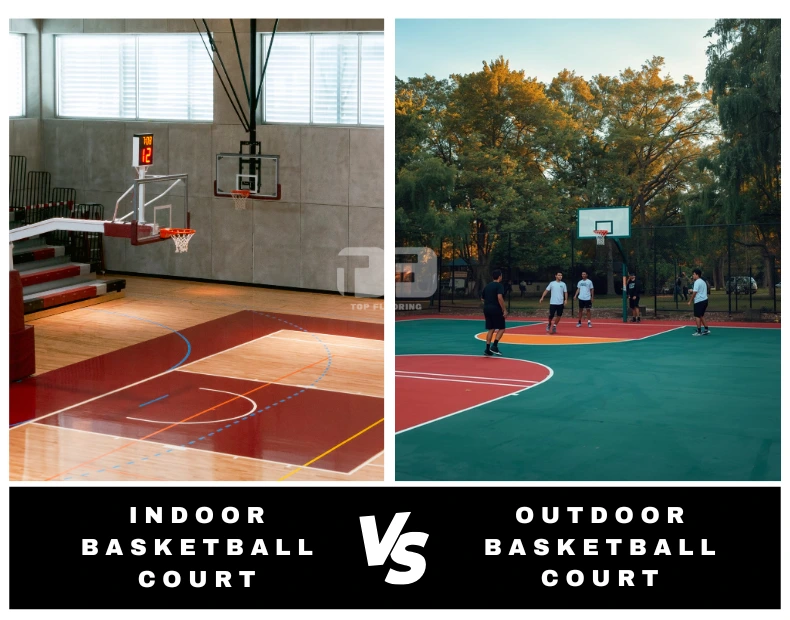
If we’re just talking numbers, indoor basketball court and outdoor basketball court dimension can be pretty much the same deal. FIBA doesn’t change the core measurements, whether you’re building a court in a gym or one in a field.
Outdoor Basketball Court Dimension – India Context
When it comes to an outdoor basketball court, you’ll need to take into account a few extra considerations:
- Slope for drainage – a gentle slope is really important outdoors, so rainwater doesn’t pool on the surface. Proper drainage is going to protect all the acrylic layers, help maintain a good grip and keep the court playable in the long run.
- Edge or intercept drains – courts in areas that get a lot of rain need side drains to redirect water away quickly. This stops erosion at the boundaries and keeps the flooring system structurally stable.
- Fencing clearance – you need a bit more space around the court for fencing safely, and you’ve also got to make sure the gates aren’t obstructing the play area.
- Sun direction – orientation matters outdoors because direct sunlight can be a real issue. In most cases, courts are aligned so they don’t get the sun in players’ eyes during peak hours.
- Wind direction on open grounds – it’s worth thinking about the wind flow when laying out an open court. This helps with even ball movement and also keeps spectators comfortable.
The core court still uses FIBA basketball court dimension, but the overall size of the built-up area will probably be bigger to include fencing offsets, spectator spaces and walkways.
Designing For Your Indoor Court
For indoor basketball court dimension, the playing rectangle is usually still 28 m × 15 m (FIBA) or 94 ft × 50 ft (NBA). But here are a few design considerations:
- Enough headroom above the hoop – you need to make sure there’s enough space up above for shots and rebounds without anything getting in the way. It’s also vital for getting lighting rigs and ventilation ducts in safely.
- No columns in the way of the sidelines and baselines – the design should make sure there’s enough space for players to run off the court. If you’ve got columns too close to the action, they can become a real hazard.
- Clear space to the side of the court – as well as keeping players safe, this also helps officials move around the court and lets the overall arena function better.
- Right lighting and ventilation, nd air conditioning – even lighting is essential for visibility, and proper ventilation keeps everyone comfortable during matches. A well-designed HVAC system helps control the temperature and humidity, which protects the players and the flooring.
In both cases, you can use synthetic basketball court flooring on a concrete or asphalt base, although indoor projects might go for wood or PU systems instead. For a multi-use, weather-exposed project in India, acrylic-based synthetic basketball court flooring often gets picked for the mix of cost, performance and maintenance it gives.
Basketball Court Area in Square Feet – What Size Fits Which Project?
When it comes to planning a basketball court, it’s helpful to know how the basketball court area in square feet relates to different types of projects. Here are some common use cases:
- Regulation FIBA full court (4,520 to 4,600 sq ft)- This is the size to go with if schools, training academies, or competitive facilities need a full-court layout that can be used for official games. It gives a good amount of space for drills and practice without feeling too cramped.
- Full court with an extra space around the sides (5,490 sq ft)- A slightly larger court gives people some extra room to move around without running into trouble near the sidelines. It’s a good compromise between safety and keeping costs and space usage in check.
- Full court with plenty of extra space around the sides (6,545 sq ft)- If you need a court for pros or high-performance training, this is the size you need. It gives athletes plenty of room to move without getting hurt and supports all sorts of extras like seating areas and camera setups.
- Half court (2,420 sq ft)- This size is perfect for smaller spaces in homes or residential areas. You can still get a good amount of real basketball in – basic drills, practice shots, and even some short matches.
How Basketball Court Dimensions Influence Acrylic & Synthetic Flooring Design?
Getting the right dimensions on a basketball court isn’t just about helping officials and players out – it plays a huge part in making sure the acrylic flooring system is going to perform consistently right across the whole surface. Even tiny mistakes on the dimensions can mess up how thick the coating is, how the ball bounces, and how long the court lasts.
Material Estimation
Full FIBA Court – When you’ve got a standard 28 by 15 meter court layout, installers know exactly how much space they’ve got to play with, so they can estimate exactly how much material they need with no waste left over. This clarity makes sure the coating is applied consistently, and the playability is balanced across the whole surface.
Half Court – For a half-court project, you use less material, but you must still mark all zones accurately to keep the layout clear and functional. Precise measurements prevent the free-throw line, three-point arc, and other key areas from overlapping or being placed incorrectly.
Custom Training Pad – Training courts come in many shapes and sizes, so installers must get the dimensions right to customise layer counts and marking plans and deliver the right playing feel, even when the court is scaled down from regulation size.
Accurate Dimensions Help Calculate
Primer Quantity- If the available area is smaller or larger than planned, it leads to using too little or too much primer, causing under-primed patches that weaken coating adhesion.
Resurfacer Coverage- If the resurfacer layers aren’t spread evenly, you’ll get thin spots that can make the ball bounce unevenly – and that’s the last thing you want on a basketball court.
Cushion Coat Area- If you get the dimensions wrong on a cushioned system, you’ll end up using too much or too little cushion coats – that messes with the shock absorption and player comfort.
Top Colour Coat & Line-Mark Paint- Getting the dimensions right helps you get the right amount of colour coat and the right amount of line-mark paint – and it makes it a lot easier to get the markings on the court nice and sharp.
Why Accuracy Matters- If you get the dimensions just a little bit wrong, it can end up costing you hundreds of square feet of materials – that’s going to mess up your budget, and it’s going to give you a court that doesn’t perform right.
Performance & Layout
Logical Zoning for Multi-Sport Use- When you’ve got the dimensions right, you can fit basketball, volleyball, futsal, or tennis markings on the same surface without having to worry about them getting in the way of each other. This makes the court a lot more useful and a lot less cluttered.
Colour Blocking for Keys, Arcs & Centre Circle- When the dimensions are spot on, the colour blocks look nice and clean – it’s a lot easier for players to know where they are on the court, which makes the whole game nicer to play.
Brand / Academy Logos- Precise court geometry ensures logos fit symmetrically at the centre circle or inside the key without distorting gameplay space. Proper sizing maintains aesthetics while respecting official marking boundaries.
Indoor & Outdoor Construction Considerations in India
When planning basketball court construction in India, dimensions are the starting point, but the following factors tie everything together:
Base type & quality
Getting the base right is what ultimately determines how well a basketball court performs over the long term. If the slab is poorly engineered, the acrylic flooring system cannot bond correctly, leading to early surface failure and costly repairs. This is why professionals recommend using M20 or higher grade concrete, or premium quality asphalt, as these bases can withstand heavy player movement, ball impact, and continuous sports loads. A strong base minimises cracking, uneven settlement, and premature wear of acrylic coatings. For outdoor basketball courts, proper drainage is equally critical. The surface must slope away from the centre at approximately 1:100 to allow rainwater to drain efficiently. Poor drainage causes water stagnation, slippery conditions, and coating damage. Incorporating expansion joints and treating existing cracks helps the slab absorb temperature-related movement and environmental stress. Together, these base preparation measures ensure durability, player safety, consistent performance, and a longer-lasting basketball court surface.
Environment & climate
The climate where a basketball court is built plays a critical role in deciding material selection, colour choices, and the sequence of coating application. When designers understand how heat, sunlight, rain, and humidity stress the surface, they can create a court that delivers reliable performance throughout the year. In high-sun regions, UV-resistant topcoats are essential to prevent premature breakdown and colour fading. Lighter surface colours are also preferred because they reflect heat, reduce surface temperature, and improve player comfort during extended play. In contrast, areas that experience heavy rainfall demand a strong focus on water management. Proper slope, perimeter drainage systems, and edge tapping help channel water away from the court and stop moisture from penetrating beneath the acrylic layers. Ignoring these climate-related factors can lead to blistering, cracks, and uneven play conditions. By aligning materials and construction methods with local climate conditions, basketball courts remain safer and more durable.
Usage profile
The way you plan to use a basketball court plays a major role in selecting the right flooring system and deciding how many coating layers are required. Courts that experience heavy, daily play need a surface designed to handle continuous wear while maintaining player safety and reliable traction. School basketball courts demand durable systems that withstand constant student activity, frequent training sessions, and varied footwear without rapid surface damage. For academies and professional training centers, performance becomes critical, as players rely on fast footwork, precision grip, and consistent ball bounce. In such cases, a premium acrylic flooring system with added cushioning layers delivers comfort, shock absorption, and long-term stability. Residential or backyard basketball courts have different requirements, where intense usage is limited, and maintenance simplicity matters more. A standard acrylic system works well here, offering smooth playability, weather resistance, and easy upkeep. Proper selection improves performance, durability, and player safety.
The dimensions remain the same for a private home, school, or national facility, but the flooring system and layers vary based on climate, usage intensity, and performance requirements, so selecting the right layer thickness, cushioning, and durable line markings ensures the best results.
Why Choose Top Flooring for Your Basketball Court?
Top Flooring has been the go-to choice in synthetic acrylic basketball court flooring in India for over 14 years, and its success isn’t by accident. Our team has a deep understanding of what works in the Indian climate, and we pair that with high-performance materials that can take a beating on the court. Every court we build needs to be able to withstand heavy use and last for years to come – that’s where our teams come in. We meticulously check every detail, from making sure our courts have the exact FIBA dimensions to laying out the court so it’s perfect for play and finishing it off with professional line markings so you can play consistently.
We build our courts on a solid foundation – literally. Our UV-resistant, ITF-standard acrylic systems are designed not only to look good but also to really deliver on the court. You get a surface that provides a great grip, colours that will last, and a tough surface that can put up with all sorts of weather, whether you’re playing indoors or outdoors. And whether a full-sized court, half court, or a 3×3 layout is what you need – we design it to fit your land, how you plan to use it and your budget to the letter.
Top Flooring has experienced installation teams across India and years of expertise in designing and building multi-sport courts, giving complete confidence that every court remains safe, visually appealing, and built to last. For projects that demand a surface engineered for serious play—not a basic concrete slab treated as an afterthought—Top Flooring delivers reliable solutions for schools, clubs, academies, and community sports facilities.
Conclusion
Before even thinking about what colours to go with, or how that fence is gonna look, every successful basketball court project starts with one thing: getting the dimensions just right. Once you’ve got that core rectangle, the zones, and all your court markings lined up perfectly, the rest – base construction, installing that synthetic flooring, lighting, and putting up a fence – can all start to fall into place around it.
Building a court to the correct dimensions and finishing it with a high-grade, top-of-the-line acrylic surface ensures years of safe, enjoyable play—whether on a school campus, within a private development, or at a professional-level academy. If you’re looking to create a FIBA-standard or a totally custom design, the next thing to do is to match up your site measurements with those standards and then hammer out the exact court size, run-offs, and all the details of your court’s acrylic system so it all fits together just right.
Frequently Asked Questions
The standard basketball court size in India is 94 ft x 50 ft. This fits with FIBA guidelines and all other specs you’d need to meet.
Absolutely – the solution could be a half-court or even just a compact training area. They still have a lot to offer even in a tight space.
The actual playing area is the same, but if you’re building an outdoor court, you will need to think about extra space around the edges for run-off, plus good drainage and some pretty resilient UV-resistant flooring to last.
FIBA spec courts in India work best with an acrylic synthetic sports floor. It’s all about the durability, grip and how well it will stand up to the elements.