
Basketball’s come a long way from being just some indoor game played in professional arenas. These days it’s one of the most popular and easy to get into – not just in pro arenas. Whether its schools, universities, housing estates, sports clubs, and even backyards. The growing popularity has created a demand for outdoor basketball courts. Which can handle the diverse climates of India – from torrential downpours to sizzling summer heat. Whether it’s a community, a school wanting to offer top-notch sports facilities or a family planning to get a basketball court installed in their garden. The kind of flooring and installation process you use are really important for performance, safety and how long it’ll last.
In this guide, we’ll be looking at the various types of basketball court flooring. How the installation works, what influences the cost of building an outdoor basketball court. And why hiring a good basketball court construction company is the smartest long-term investment.
Why Does a Need For Professional Basketball Court Installation?
- Safety & performance: A pro team makes sure the right slope, sub-base is solid and the lines are marked just right. All of which can make or break player safety and how good the game is. Without precision, you could be left with problems like waterlogging, uneven bumps or slippery patches.
- Long-lasting surfaces: Using top grade basketball court materials during installation gives you a surface that will last for years, even with heavy use and bad weather. This means less frequent repairs and time out of action.
- Staying on the rules: Expert installers stick to international guidelines, making sure the court is the right size, has the right kit and markings to match official FIBA standards. This means the court is good enough for both casual games and competitive matches.
- Long-term value: Courts put together by trustworthy basketball court builders save you money on repairs down the line. And make sure the playing conditions are always consistent. This makes the whole project a cost-effective investment for schools, clubs or homes.
Whether your after backyard basketball court installation or a full size facility. Hiring the right pros makes sure your court delivers on safety, quality and performance for years to come.
Which Surface for your Outdoor Basketball Court?
1) Acrylic over concrete/asphalt
- Why its outdoors winner: Acrylic systems give you a non-slip finish, UV stable colors, adjustable friction. And a consistent ball response – all at a relatively affordable cost. They’re also pretty easy to give a fresh new color to when needed, giving you even more years out of the court.
- Where it really excels: Best suited for schools, housing estates, academies and local parks. It’s also a great choice for backyard basketball court installation where you’ve already got a concrete or asphalt base.
Things to check: Make sure the concrete has had a good month to set, do some moisture tests, get a vapor control system in place and make sure you’ve got proper expansion joints to keep things durable.
2) Modular polypropylene tiles
- Pros: These interlocking tiles are a breeze to install – they drain water like a charm and can be swapped tile by tile if needed – making them a great choice for a home basketball court on uneven slabs.
- Cons: Sure, they come with a higher upfront cost per square meter, and the bounce and sound aren’t exactly the same as acrylic; plus you’ve got to leave some space in between for when the tiles expand with heat.
3) Rubberized or polymeric systems
- Pros: They’ve got the perfect amount of shock absorption for player safety and are even recyclable, which is a big plus for multipurpose playgrounds.
- Cons: Their softer feel affects ball speed, and you can’t always count on the surface temp and color staying the same – that depends on the rubber formulation.
4) PU & indoor wood
- PU: Indoors is where PU usually shines – it’s all about a nice cushioned playing experience. But if you’re going for an outdoor installation you’re going to need some very specific weather conditions. And then make sure the subbase is installed properly.
- Maple wood: If you’re going for the high-end, professional feel in your indoor arena. Maple wood is the way to go – it’s got the best play quality out there. But it’s totally not suited for being outside because of all the moisture.
Types of Surface Failures and How to Prevent Them
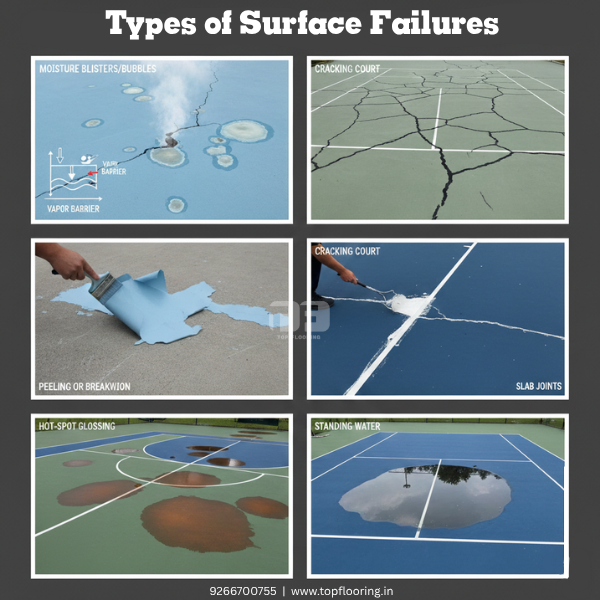
- Moisture blisters/bubbles: These happen when there’s steam trapped under the surface and it all comes bubbling up through during hot weather – to avoid this, just make sure water can drain properly, slap on a vapor barrier and don’t seal on freshly poured or uncured concrete.
- Peeling or breakdown: This occurs when the surface layers begin to separate due to improper cleaning or priming of the subbase or improper sealing of dust and moisture. The solution to avoiding this and ensuring that the subbase is excellent before proceeding to the next stage.
- Cracking Court: You see these cracks and they’re often mirroring the joints in the slab below or the result of a subgrade that’s shifted a bit during basketball court construction. The solution is to fill these cracks using acrylic resurfacer and slab joints in the design and make sure the base is solid before you do anything else.
- Hot-spot glossing: This is caused by poorly applied paint, insufficient pigments, or a poorly blended paint job. Sticking with a tried-and-true strategy from a respected basketball court manufacturer who is knowledgeable about the field is the best choice.
- Standing water: The problem occurs when puddles accumulate because of poor slope and drainage, which leads to damage and the growth of algae. With careful design and some flood testing, you can get those slopes just perfect (a slope of 1:100) and you won’t ever have to worry about it.
Choosing a Basketball Court Installation Company
- Portfolio & references:
A good basketball court installer should have a portfolio that covers schools, clubs, housing societies and academies, showing a variety of projects. Always ask for site visits to completed courts to see real world quality before making a decision. - Material quality:
Check if the company can provide detailed documentation on their acrylic systems, including slip resistance, UV stability and durability. Reputable basketball court manufacturers are open and honest about their warranty conditions and technical specifications. - Standards literacy:
The company should be familiar with official FIBA dimensions, runoff clearances and equipment guidelines. They should also be able to customize layouts for smaller community spaces or 3×3 formats without compromising play quality. - Moisture & base:
A qualified team will always offer a documented plan that covers joint treatments, vapor barriers, slope design, and curing time. To prevent problems like bubbling, cracking, or delamination later on, they should also test for moisture. - Transparent BOQ:
Ask for a bill of quantities (BOQ) that breaks down base preparation, acrylic layers, labor, fencing, lighting and basketball equipment separately. Clear cost transparency builds trust and shows the installer’s confidence in their process. - Maintenance roadmap:
A good basketball court installation company also guides you on long term maintenance with a cleaning schedule, minor repair protocols and resurfacing cycles. So you know when to look for a basketball court resurfacing near me in the future.
Basketball Court Construction Process with Top Flooring
Top Flooring follows a detailed process to ensure durability, safety and international play standards. Our installers follow the given steps-
Site Survey & Design
- We start with accurate land measurement, slope analysis and drainage planning to make sure the court is functional in all weather conditions.
- Based on the available space, we design it as a full size (28m × 15m) FIBA court or a half court for backyard basketball court installation.
Base Preparation
- Concrete Base: Before applying surface coatings, the concrete base must cure to establish stability. It offers a sturdy and long-lasting basis.
- Asphalt Base: Although asphalt bases are faster than concrete, they must meet strict compaction requirements to avoid future cracking or unevenness.
Each base is constructed with a 1:100 slope to guarantee water drainage. And protect the basketball court flooring from moisture damage.
Acrylic System Layering
- Primer coat is applied first to create adhesion between the base and the acrylic surface layers.
- Resurfacer smooths out small cracks, pores or imperfections, to prepare the surface for a uniform finish.
- Cushion coats (optional) adds shock absorption and player comfort, reduces strain during long practice or games.
- Color coats enhance aesthetics and provide UV resistance, to retain color even under harsh sunlight.
- Line marking is done as per FIBA standards, to ensure accurate gameplay boundaries.
Quality Inspection & Handover
- The final step involves testing bounce consistency, slip resistance and water drainage to ensure safety and performance.
- Once the court passes all quality checks, it is handed over with guidelines for maintenance and resurfacing schedules.
Outdoor Basketball Court Construction: Cost Factors
The cost of building an outdoor basketball court depends on multiple factors that affect both durability and long-term performance:
- Base construction: The foundation is the most expensive part, usually concrete or asphalt, and its quality directly impacts surface life, drainage and crack resistance.
- Material system: Choosing 5-layer or 8-layer acrylic system changes the price and comfort, ball bounce and UV resistance.
- Labor charges: Skilled applicators, painters and engineers add to the cost but ensures correct slope, smooth coatings and professional line marking.
- Court size: Full FIBA court is more expensive than half court or home setup, so sizing is a key factor for budgeting.
- Extras: Lighting, fencing, bleachers and branded backboards are optional features that add usability and aesthetics but increases overall cost.
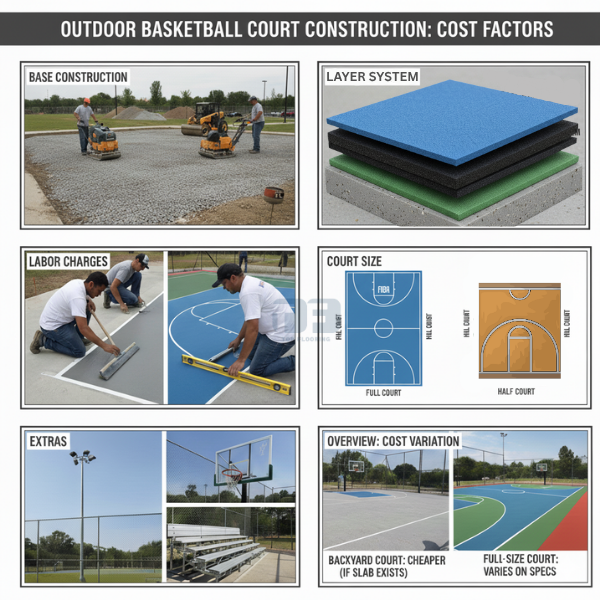
For a standard full size court, pricing varies on specifications. While backyard basketball court installation is low cost. If a slab already exists and only resurfacing or coatings are needed.
Basketball Court Resurfacing
Even the best courts need resurfacing after years of use to get their performance and safety back. If you’re looking for basketball court resurfacing near me here’s what the process includes:
- Cleaning and patching cracks: To create a level and smooth base, the surface is cleaned of any dust, moss, or debris and all cracks are repaired. This prevents the spread of structural damage and water seepage.
- Reapplying resurfacer, cushion and color coats: New coats of resurfacer and cushion are applied for comfort, followed by color coats for UV protection and traction.
- Repainting lines and refreshing grip: Court markings are repainted for better visibility and the surface texture is restored for consistent ball bounce and player grip.
- Adds 4-5 years of extra life: Resurfacing adds several years to the life of the court at a fraction of the cost of a new build, it’s a smart and affordable maintenance solution.
Backyard Basketball Court Installation
Personal courts are becoming more and more popular in private residences, villas, and farmhouses, turning unused spaces into sports facilities. Families can play in the comfort of their own home by installing a backyard court.
- Year round practice for kids and enthusiasts: A backyard court gives players the convenience of practicing anytime without depending on public courts, helps kids to hone their skills and families to bond over sport.
- Adds value to property and community appeal: A well designed court not only enhances the lifestyle of the homeowners but also increases property resale value, making it a desirable feature for potential buyers.
- Flexible sizing—half courts are popular for basketball court home installation: Depending on the space available half court setups are a cost effective solution while still giving all the play experience for home installations.
Acrylic is best for backyard basketball court installation: Both options give durable and weather resistant surfaces, acrylic gives authentic play feel and modular tiles gives quick installation and easy maintenance.
Why Choose Top Flooring for Basketball Court Installations?
When it comes to building a basketball court, there is a big difference between good and great. Top Flooring offers international standards basketball court flooring. Here’s what sets them apart:
1. Years of Experience with Synthetic Acrylic Systems
Top Flooring has been perfecting their craft. And delivering top-notch acrylic flooring for basketball courts that can handle India’s tough weather. Their materials are not only UV-resistant. But also slip-resistant and long-lasting. So your basketball court will be safe to play on all year round. No matter how harsh the sun or rain gets.
2. One-Stop Solution for Outdoor Basketball Court Construction
From start to finish, Top Flooring takes care of everything – from getting the base right to adding the final line markings. Whether you’re a school, club or just a backyard enthusiast looking to build your own basketball court, we offer end-to-end support.
3. Certified and Standard Materials
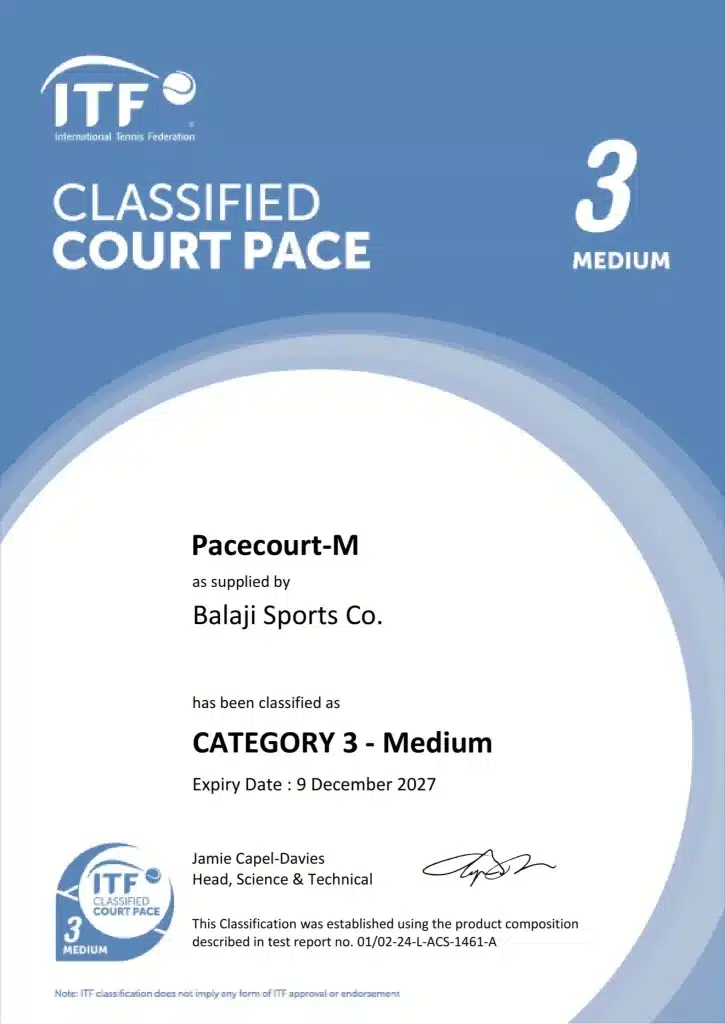
Top Flooring only uses the best, ITF-rated and ISO-compliant basketball court materials that meet global standards. We test every system thoroughly to ensure your basketball court delivers the right ball bounce, friction, and durability for pro-level play.
4. Experienced, Reliable Court Builders You Can Trust
Top Flooring has a reputation for delivering successful installations all over the country. Whether its schools, academies and housing societies. Our team ensures correct installation, without any errors like a bad slope design or uneven coating.
5. Transparent Pricing
You’ll get a clear breakdown of the costs for your outdoor basketball court installation. And there is no hidden cost for base work or coatings.
6. Long-Term Maintenance Support to Keep Your Court Looking Its Best
Top Flooring offers best maintenance tips and advice on cleaning, inspections and basketball court resurfacing to keep your court safe and in top condition for years to come.
How to Maintain Your Basketball Court Surface
- Give your court a regular clean to keep looking it best. Keeping your basketball court clean using water and a mild detergent helps keep the surface grip and prevents dirt and moss from building up which makes it slippery. Regular cleaning also makes sure the color coat stays looking good and the ball bounces in the right way.
- Protect the basketball court from heavy vehicles and sharp objects. Try to keep bikes, cars and heavy equipment off the court. They can scratch the surface, dent or crack it, and put the acrylic layers under a lot of strain. Heavy loads can also make it easier for water to get underneath the surface and stay there.
- Check Your Basketball Court for cracks and water damage. Even a quick once-a-year check round can help you catch small cracks or any issues with drainage or water building up before they get out of hand. This can help you avoid having to do a major repair job and keep your court looking good for longer.
- Resurface your outdoor acrylic basketball court every 3 or 5 years to keep it looking its best. Acrylic courts start to lose their grip and color after a while. So resurfacing them from time to time keeps the play quality up. It’s a simple maintenance step that keeps your court looking fresh and feeling like new.
Conclusion
By choosing a reputable basketball court builder like Top Flooring, you can avoid a lot of the common problems that come with owning a court, like cracks, water damage or fading. You’ll also get high-performance surfaces that are affordable and meet international standards. And with the right maintenance and planning, your court can last for years without breaking the bank.
In this day & age, where sports facilities are really important for fitness, community spirit and helping kids develop, spending money on a professional court is more than just a luxury, it’s a necessity. A good basketball court builder will not only give you a top quality surface but also create a place that inspires the next generation of players. By choosing wisely now, you can make sure your court stays a valuable asset for years to come – something that brings joy to players of all ages.
Frequently Asked Questions
Acrylic flooring is the most reliable and cost-effective for basketball flooring outdoor projects.
The cost of building an outdoor basketball court depends on base, materials, and add-ons, usually quoted per square foot.
Yes, backyard basketball court installation is possible with half-court designs and acrylic or modular tile systems.
Courts typically need resurfacing every 3–5 years, depending on usage and climate.
A standard basketball full court is 28m × 15m, while half-courts are popular for home installations.
Yes, but it is best when coated with acrylic for durability and safety.
Backboards, poles, fencing, lighting, and benches enhance play and safety.