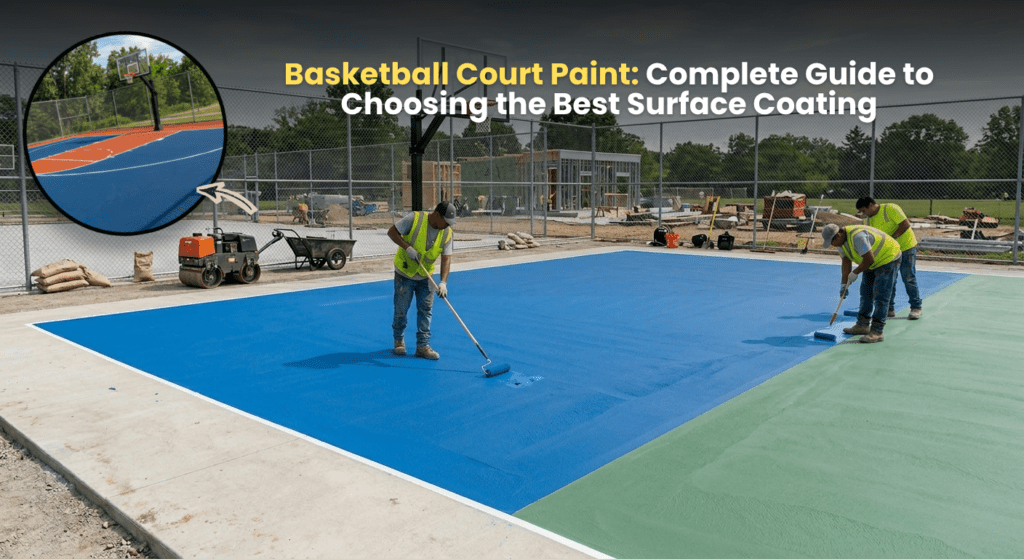
Whether you’re resurfacing a backyard slab or outfitting a professional arena, choosing the right basketball court paint , and applying it correctly , determines how long your court lasts, how safe it is, and how well it performs on game day.
Table of contents
- Why Basketball Court Paint Matters More Than You Think
- Types of Basketball Court Paint
- Indoor vs Outdoor Basketball Court Paint: Key Difference
- Color & Line Marking: Getting the Court Layout Right
- How to Apply Basketball Court Paint: Step-by-Step
- What to Look for in the Best Basketball Court Paint
- Maintenance & Recoating Your Basketball Court
- Final Verdict: Making the Right Court Paint Choice
- Frequently Asked Questions
Why Basketball Court Paint Matters More Than You Think
Most people assume basketball court paint is purely cosmetic, a way to add color and court lines. In reality, the court paint you choose directly affects player safety, ball bounce consistency, surface grip, UV resistance, and how many years your court stays functional without costly repairs.
A properly coated court using the right sport court paint will last 5–10 years with minimal maintenance. A poor choice? You’ll be peeling, cracking, and re-coating within two seasons. The economics alone make getting this decision right extremely important.
Did you know? According to surface specialists, using the wrong paint on a concrete or asphalt court can reduce its lifespan by up to 60% , and create dangerous slip hazards, especially in wet conditions.
Types of Basketball Court Paint
Not all basketball court coating products are the same. Here are the main formulations you’ll encounter when shopping for court surface paint:
Acrylic Latex Court Paint
Acrylic Latex Court Paint is the most popular for outdoor courts. Water-based, UV-stable, fast-drying, and affordable. Ideal for asphalt and concrete.
Epoxy-Based Paint
Highly durable 2-part system. Excellent for indoor courts with heavy traffic. Chemical and abrasion resistant.
Polyurethane Coating
Premium indoor option. Flexible, glossy finish. Outstanding impact resistance and scratch protection.
Rubberized Court Paint
Added cushion and slip resistance. Used for recreational and school outdoor courts. Lower maintenance.
Acrylic Latex: The Workhorse of Outdoor Court Paint
Acrylic court paint dominates the outdoor basketball court market for good reason. It bonds well to both asphalt and concrete, resists fading from UV exposure, and allows moisture vapor transmission, meaning it won’t bubble or peel the way non-breathable coatings do. Most professional outdoor basketball court paint systems are acrylic-based, often applied in two or more coats with a silica sand texture additive for grip.
Epoxy: Built for Indoor Punishment
If you’re coating a gymnasium or indoor facility, epoxy-based basketball floor paint offers unmatched hardness and chemical resistance. It’s the top choice for high-traffic indoor courts where scuff marks, sneaker rubber, and cleaning chemicals take a constant toll. Two-component epoxy systems are harder to apply, you need to mix the components and work quickly, but the results are dramatically more durable than single-component options.
Polyurethane: Premium Performance Coating
Polyurethane finishes are increasingly popular for professional indoor courts. As a court surface coating, polyurethane remains flexible after curing, which matters on wood subfloors that expand and contract seasonally. It also provides a high-gloss, television-ready finish favored by competitive venues.
Indoor vs Outdoor Basketball Court Paint: Key Difference
Choosing between indoor court paint and outdoor court paint isn’t just about location , it’s about the specific stressors each environment throws at your surface.
| Factor | Indoor Court Paint | Outdoor Court Paint |
| Primary Substrate | Wood, concrete, tile | Asphalt, concrete |
| Key Stress | Abrasion, scuff marks | UV rays, rain, freeze-thaw |
| Recommended Type | Epoxy or polyurethane | Acrylic latex |
| Texture Additive | Fine silica (optional) | Medium silica (essential) |
| Recoat Interval | Every 3–5 years | Every 2–4 years |
| Avg. Cost per sq ft | $0.80 – $2.50 | $0.40 – $1.20 |
| Drying Time | 12–24 hrs per coat | 4–8 hrs per coat |
| VOC Concerns | Ventilation required | Less critical outdoors |
Color & Line Marking: Getting the Court Layout Right
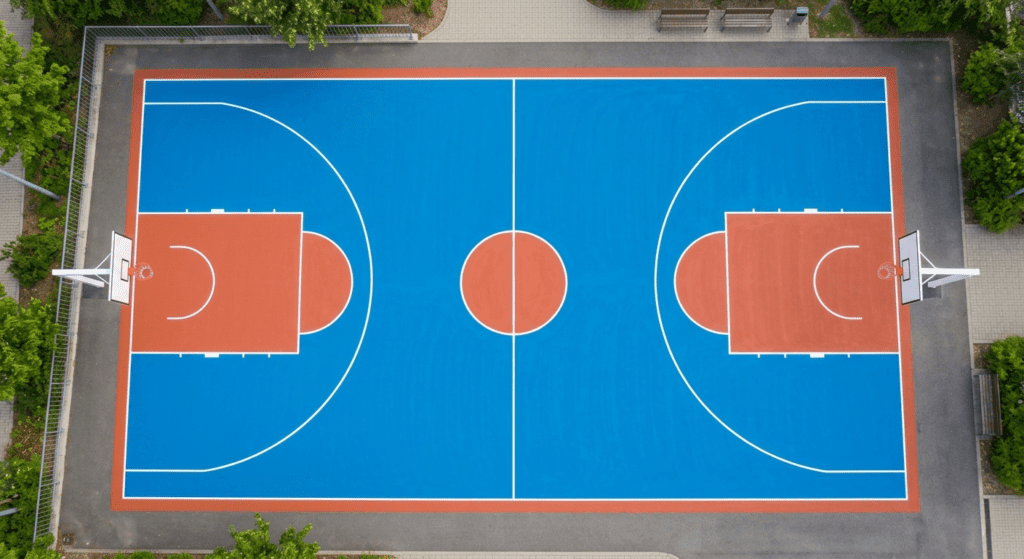
Beyond the base court paint, proper line marking is essential for official play and for the overall look of your court. Whether you’re painting a backyard basketball court or a full-size regulation floor, the line layout must be precise.
Standard Court Colors
NBA courts typically feature hardwood with contrasting lane colors (often team-branded). Outdoor public courts commonly use: Forest Green Slate Blue Burnt Orange for the main surface, with white or yellow court line paint markings applied on top.
Pro tip: Always apply your base basketball court paint first and let it cure fully (minimum 48 hours) before adding line markings. Painting lines on an uncured base coat causes adhesion failure and premature peeling of your line marks.
Key Court Lines You Must Mark
- Center circle and half-court line
- Three-point arc (NBA: 23’9″ at top, 22′ at corners)
- Free throw lane (the paint / key area)
- Free throw line (15 ft from backboard)
- Sidelines and baseline (boundary lines)
- Restricted area arc under the basket
Use a chalk line or string guide for accuracy. Purpose-made sports court line marking paint in aerosol or roller form is available specifically for this job, standard wall paint is not an acceptable substitute as it lacks the adhesion and texture properties needed.
How to Apply Basketball Court Paint: Step-by-Step
Correct application is just as important as the basketball court coating product itself. Follow this process for professional-grade results:
- Surface Inspection & Repair: Check for cracks, spalling, or oil contamination. Fill cracks with an appropriate patching compound. Any oils must be degreased, otherwise the paint will not adhere.
- Pressure Washing: Thoroughly pressure wash at 2,500–3,000 PSI. Allow 24–48 hours drying time. Moisture is the number-one enemy ofcourt paint adhesion.
- Apply Filler Coat (if needed): On porous or rough asphalt, apply a leveling or resurfacer coat first. This fills voids and creates a uniform base for thebasketball court paint.
- First Coat of Sport Court Paint: Apply with a long-nap roller (3/4″ for rough surfaces) or squeegee. Work in sections. Apply evenly with no puddles or thin spots. Mix in silica sand additive for outdoor slip resistance.
- Allow Proper Dry Time: Wait the manufacturer’s recommended time (usually 4–8 hours for acrylic, 12–24 for epoxy) before applying the next coat. Do not rush this step.
- Second Coat Application: Apply the second coat perpendicular to the first for even coverage. Two coats minimum for propercourt surface protection. High-traffic courts benefit from three coats.
- Line Marking: Once the base coats are fully cured (48–72 hours), apply yourcourt line paintusing stencils and a small brush or line-marking machine for precision.
- Curing Period: Keep traffic off the court for 72 hours minimum after the final coat. Full cure to maximum hardness takes 7 days — avoid dragging equipment across the surface during this period.
What to Look for in the Best Basketball Court Paint
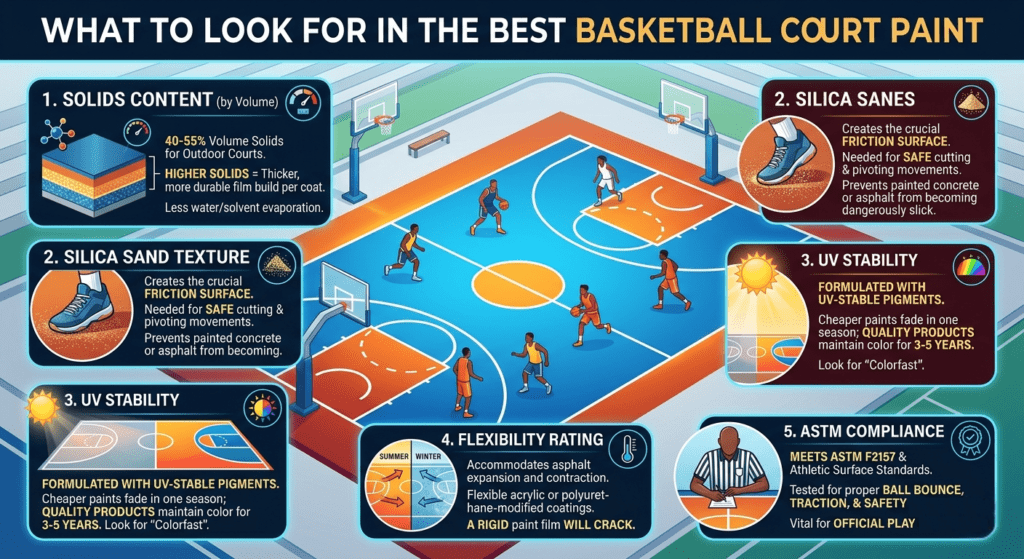
When evaluating basketball court paint products, these are the specifications that matter most:
1. Solids Content
Higher solids content (by volume) means more actual coating material remains after the water or solvent evaporates. Look for products with 40–55% volume solids for outdoor courts. Higher solids = thicker, more durable film build per coat.
2. Silica Sand Texture
Any outdoor court paint must include or allow for a silica sand additive. This creates the friction surface needed for safe cutting and pivoting movements. Without it, an acrylic-painted concrete or asphalt surface becomes dangerously slick when wet.
3. UV Stability
Outdoor sport court paint must be formulated with UV-stable pigments. Cheap paints fade within one season; quality products maintain color for 3–5 years. Look for “UV-resistant” or “colorfast” in product descriptions.
4. Flexibility Rating
Courts , especially asphalt ones, expand in summer heat and contract in winter cold. A rigid paint film will crack. Flexible acrylic or polyurethane-modified court surface paint accommodates these movements without cracking.
5. ASTM Compliance
For official play surfaces, look for paints that meet ASTM F2157 (synthetic turf) or relevant athletic surface standards. Compliance ensures the product has been tested for ball bounce, traction, and safety characteristics.
Our Overall Recommendation
For most outdoor courts: a high-solids, acrylic latex basketball court paint with silica sand additive, applied in two coats. For indoor gyms: a two-part epoxy base with a polyurethane topcoat delivers the best long-term value. Always buy from manufacturers specializing in athletic surfaces, not general-purpose exterior paint.
Maintenance & Recoating Your Basketball Court
A well-painted court requires ongoing care to maximize the life of your basketball court coating. Follow these maintenance principles:
Regular Cleaning
Sweep the court weekly to remove abrasive grit and debris. For outdoor courts, a periodic pressure wash (1,500–2,000 PSI, gentler than the prep wash) removes embedded dirt without damaging the paint. Avoid harsh degreasers or solvents that break down acrylic binders.
Watch for These Warning Signs
- Fading or chalking of the surface color
- Fine hairline cracking in the paint film (map cracking)
- Peeling or lifting edges, especially near cracks in the substrate
- Loss of texture / slippery surface feel
- Water pooling in previously sealed areas
Recoating Schedule
Most outdoor courts need a maintenance recoat every 2–4 years. A recoat doesn’t require full stripping, clean the surface, lightly abrade glossy areas, apply one fresh coat of sport court paint, and re-mark lines as needed. This is far more cost-effective than full resurfacing and dramatically extends court life.
Budget tip: Partial recoating of high-wear zones (the lane, top of the key, and along the baseline) between full recoats is a cost-effective way to extend the overall life of your basketball court paint system.
Final Verdict: Making the Right Court Paint Choice
Choosing the right basketball court paint comes down to three key questions: Is it indoor or outdoor? What’s your substrate (wood, concrete, asphalt)? And what’s your traffic level? Answer those, and the right court surface coating category becomes clear.
Invest in a quality, purpose-formulated sport court paint with proper texture additives, follow the application steps precisely, and your court will deliver years — even decades — of safe, great-looking performance. Cut corners on prep or product quality, and you’ll pay for it in premature failures and repeat costs.
Whether you’re coating a backyard basketball court, a school gymnasium, or a full professional facility, the principles in this guide give you the foundation to make the right call every time.
Frequently Asked Questions
Synthetic acrylic basketball court paint is considered one of the best options for outdoor courts due to its durability, UV resistance, and anti-slip properties.
A professionally applied acrylic court paint system can last several years with proper maintenance and resurfacing.
Acrylic sports coatings are water-resistant and designed to withstand outdoor weather conditions.
Yes, acrylic court paint systems are widely used for multi-purpose sports courts including tennis, volleyball, badminton, and pickleball courts.
Textured basketball court paint improves grip, player safety, and gameplay performance.