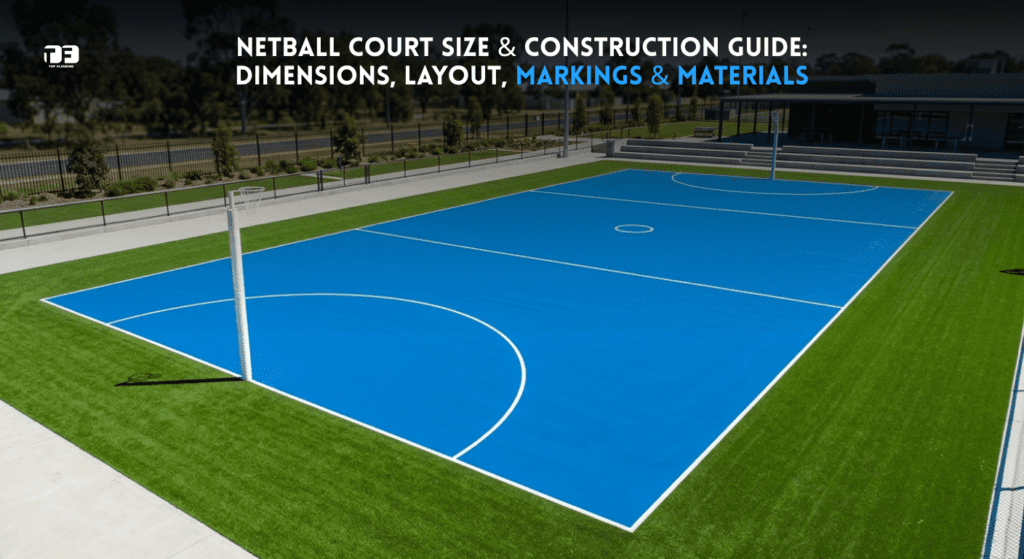
Netball courts may look simple, but building a professional, long-lasting, and safe court requires precise dimensions, proper layout planning, and the right material selection. Whether the goal is a school facility, academy court, or multi-sport complex, understanding every technical detail ensures better performance and durability.
This detailed guide covers official netball court size, hoop specifications, markings, construction process, materials, expert insights, and real-world applications.
Table of contents
- Standard Netball Court Size
- Court Layout & Zoning Explained
- Netball Hoop Height & Ring Size
- Space Requirements & Safety Areas
- Step-by-Step Netball Court Construction
- Acrylic Coating System (Layer Structure)
- Expert Guide: Practical Insights from Industry Experience
- Case Study: Acrylic Netball Court for a School Sports Facility (Delhi NCR)
- Cost of Netball Court Construction in India
- Common Mistakes to Avoid
- Netball Court vs Other Sports Courts
- Final Thoughts
- Quick Recap
- Frequently Asked Questions (FAQs)
Standard Netball Court Size
A regulation netball court follows globally accepted dimensions used in competitive and recreational play:
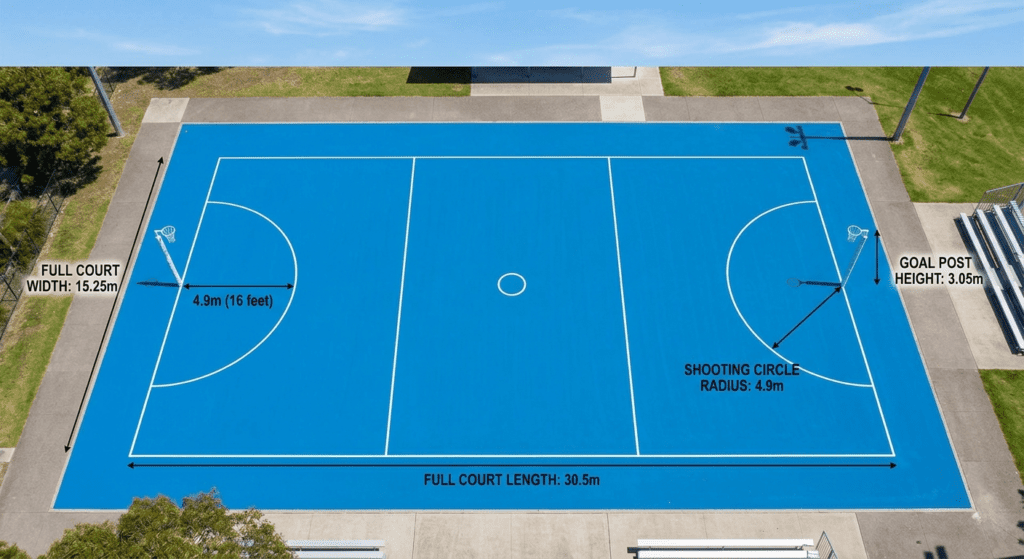
- Length: 30.5 meters (100 feet)
- Width: 15.25 meters (50 feet)
- Shape: Rectangular
- Total Playing Area: ~465 square meters
These dimensions remain consistent across international, school, and club-level courts, ensuring uniform gameplay.
Court Layout & Zoning Explained
The netball court is divided into three equal sections, which control player movement and game strategy.
Court Division
- Centre Third: Middle section where the game starts and restarts
- Two Goal Thirds: Located at each end for attacking and defending
Each third measures approximately 10.17 meters in length.
Key Markings
- Centre Circle:
- Diameter: 0.9 meters
- Used for starting play
- Goal Circle:
- Radius: 4.9 meters (semi-circle)
- Only shooting players can score within this area
- Transverse Lines:
- Divide the court into thirds
- Line Width:
- Standard 50 mm
Accurate marking is essential not only for compliance but also for fair gameplay and professional appearance.
Netball Hoop Height & Ring Size
The goalpost setup is one of the most distinctive features of netball.
Standard Specifications
- Hoop Height: 3.05 meters (10 feet)
- Ring Diameter: 380 mm (15 inches)
- Backboard: Not used
Unlike basketball, netball requires direct shooting without a backboard, making precision more important.
Junior Court Adjustments
For training and school-level play:
- Ages 7–9: 2.44 meters
- Ages 9–11: 2.75 meters
This helps young players develop skills progressively.
Space Requirements & Safety Areas
A netball court should never be limited to just the playing area. Safety zones are critical.
- Minimum Run-Off Space: 3.05 meters on all sides
- Recommended Total Area: ~36.5m × 23.3m
This extra space prevents injuries and allows smooth movement during matches.
Step-by-Step Netball Court Construction
Building a netball court involves multiple stages, each contributing to durability and performance.
1. Site Preparation
- Land clearing and leveling
- Soil compaction to avoid future sinking
- Planning for drainage with a slight slope (~1%)
2. Sub-Base Installation
- Use of WMM (Wet Mix Macadam) or compacted stone layers
- Provides stability and load-bearing strength
3. Concrete or Asphalt Base
- Concrete Thickness: 100–150 mm
- Smooth surface finish is critical
- Expansion joints added to prevent cracking
4. Surface Flooring Installation
Acrylic Sports Flooring (Most Recommended)
- Anti-slip texture
- UV-resistant and weatherproof
- Suitable for outdoor Indian conditions
- Cost-effective and low maintenance
Other Options
- PU Flooring: Premium indoor courts
- Wooden Flooring: Used in indoor stadiums
- Asphalt: Budget outdoor option (less durable)
Acrylic Coating System (Layer Structure)
A high-quality netball court uses a multi-layer acrylic system:
- Primer Layer – Primer Layer ensures bonding with base
- Base/Cushion Layer – Adds comfort and shock absorption
- Acrylic Color Coats – Acrylic Color Coats provides finish and durability
- Line Marking Paint – Line Marking applied with precision
This system ensures consistent ball bounce, player grip, and long-term performance.
Expert Guide: Practical Insights from Industry Experience
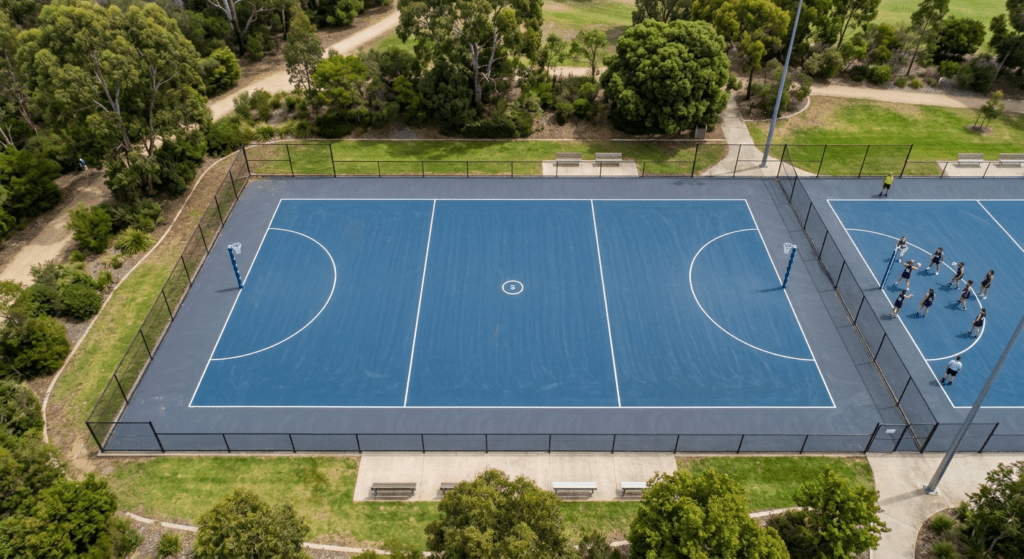
With years of experience in sports cou–rt construction, several factors significantly impact the quality of a netball court:
Choose the Right Surface
Acrylic flooring performs best in outdoor environments due to its ability to handle heat, rain, and UV exposure.
Prioritize Drainage
Improper drainage leads to water accumulation, surface damage, and safety hazards.
Use Cushion Systems
Adding a cushioned layer reduces stress on joints and minimizes injury risks during gameplay.
Focus on Accuracy
Even minor errors in dimensions or markings can affect gameplay standards and professional usability.
Plan for Multi-Sport Usage
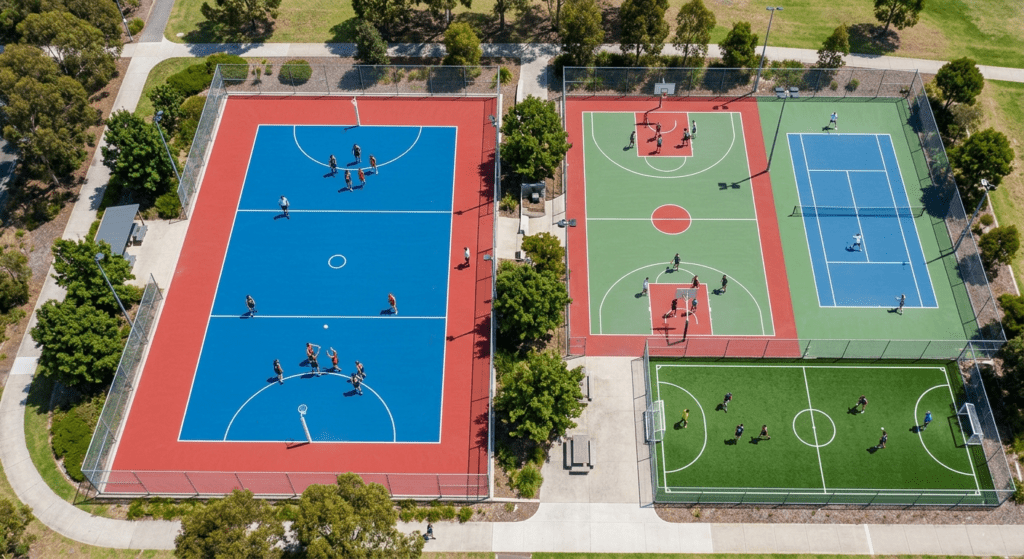
Many facilities combine netball with basketball or volleyball courts to maximize space and investment.
Case Study: Acrylic Netball Court for a School Sports Facility (Delhi NCR)
Project Overview
A private school in Delhi NCR aimed to develop a dedicated netball court within its campus to support structured sports training and inter-school competitions. The requirement was to build a durable, low-maintenance, and multi-functional court that could also be used for basketball and general physical activities.
Key Challenges
- Limited Budget: The school needed a cost-effective solution without compromising quality
- Extreme Weather Conditions: High summer temperatures and monsoon rains
- Multi-Sport Requirement: The surface needed to support netball along with other sports
- Safety Concerns: Ensuring anti-slip and injury-resistant flooring for students
Solution Implemented
1. Base Construction
- Compacted sub-base with proper leveling
- 125 mm thick concrete base for long-term stability
- Designed with a slight slope for efficient water drainage
2. Surface System
- Installed acrylic sports flooring system
- Multi-layer coating including primer, cushion layer, and UV-resistant color coats
- Anti-slip texture to enhance player safety
3. Court Layout & Marking
- Marked as per official netball dimensions (30.5m × 15.25m)
- Included accurate goal circles, center circle, and thirds division
- Additional markings added for basketball to enable multi-sport use
Results & Performance
- Durability: Court maintained performance with minimal wear after continuous usage
- Weather Resistance: No surface damage during monsoon; color retained under strong sunlight
- Player Safety: Improved grip reduced slips and injuries among students
- Cost Efficiency: Acrylic system proved 35–40% more economical than alternative premium surfaces
- Versatility: Court successfully used for netball, basketball, and training drills
Expert Insight
This project highlights why acrylic flooring is ideal for school-level netball courts in India. It balances performance, cost, and durability, making it suitable for institutions that require multi-purpose sports infrastructure.
Key Takeaway
A well-planned acrylic netball court can deliver long-term value, safety, and multi-sport functionality, even under budget constraints and challenging weather conditions.
Cost of Netball Court Construction in India
The total cost depends on location, materials, and design complexity.
- Base Construction: ₹80–₹150 per sq ft
- Acrylic Surface: ₹120–₹250 per sq ft
- Total Project Cost: ₹6–₹12 lakh
Additional features like fencing, lighting, and seating can increase overall investment.
Common Mistakes to Avoid
- Incorrect court dimensions
- Poor drainage planning
- Low-quality coating materials
- Inaccurate line markings
- Skipping surface cushioning
Avoiding these mistakes ensures long-term durability and professional-quality gameplay.
Netball Court vs Other Sports Courts
- Netball courts have fixed shooting zones, unlike basketball
- No backboard is used
- Court size is similar but layout differs significantly
- Requires more precise positioning and movement control
Final Thoughts
Constructing a netball court is a technical process that goes beyond simply marking lines on a surface. It requires accurate dimensions, proper base construction, high-quality materials, and expert execution.
Acrylic sports flooring remains the most practical choice for outdoor courts, especially in India, due to its durability, safety, and cost efficiency. By following standard guidelines and expert practices, a netball court can deliver consistent performance for years.
Quick Recap
- Court Size: 30.5m × 15.25m
- Hoop Height: 3.05m
- Ring Diameter: 380 mm
- Goal Circle Radius: 4.9m
- Best Surface: Acrylic sports flooring
Frequently Asked Questions (FAQs)
A standard netball court measures 30.5 meters in length and 15.25 meters in width. It is divided into three equal sections, which help regulate player movement during the game.
The official height of a netball hoop is 3.05 meters (10 feet) from the ground. This standard is used in all professional and competitive matches.
A netball ring has a diameter of 380 mm (15 inches). Unlike basketball, netball does not use a backboard, making shooting more skill-based.
Acrylic sports flooring is the most preferred choice for outdoor netball courts. It offers good grip, weather resistance, durability, and requires minimal maintenance.
Along with the playing area, a minimum run-off space of 3.05 meters on all sides is recommended. This brings the total required space to approximately 36.5m × 23.3m for safe play.