Designing or understanding a handball court requires more than just knowing the basic size. Every line, arc, and zone on the court is defined with precision to ensure fair play, safety, and consistency across all levels of the game. The official standards are set by the International Handball Federation, and following these specifications is essential for professional and competitive use.
This detailed guide explains handball pitch size, complete court measurements, line markings, goal dimensions, and layout planning in a clear and practical way.
Table of contents
- Standard Handball Court Size (Handball Pitch Dimensions)
- Safety Area and Clearance Space
- Court Orientation and Planning Considerations
- Complete Handball Court Layout Explained
- Goal Area (6-Meter Line)
- Free Throw Line (9-Meter Line)
- Penalty Line (7-Meter Line)
- Goalkeeper Restriction Line (4-Meter Line)
- Center Line
- Substitution Area
- Goal Dimensions
- Line Markings Specifications
- Handball Pitch Surface Requirements
- Indoors vs Outdoor s Handball Courts
- Importance of Accurate Measurements
- Quick Reference Table
- Conclusion
- Frequently Asked Questions (FAQs)
Standard Handball Court Size (Handball Pitch Dimensions)
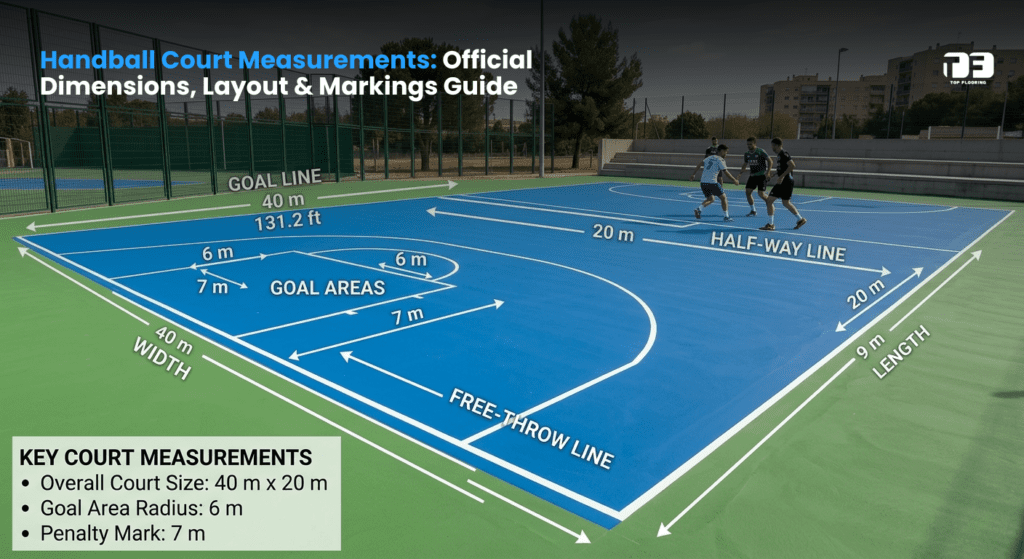
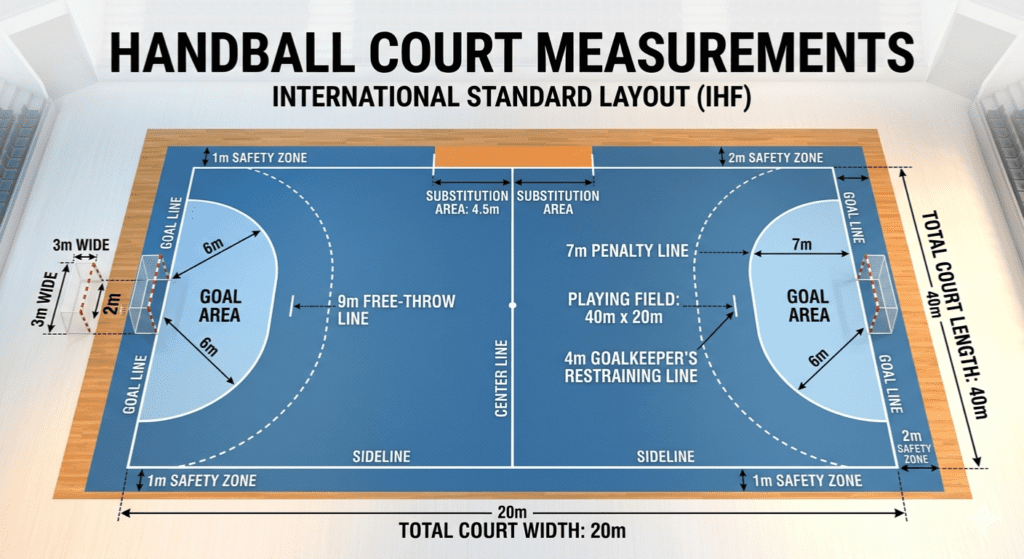
A handball court is a rectangular playing area used for 7-a-side matches.
Official Measurements
- Length: 40 meters
- Width: 20 meters
- Total Area: 800 square meters
In Feet (Approximate)
- Length: 131 feet
- Width: 66 feet
These dimensions apply to all official indoor courts and are mandatory for international competitions.
Safety Area and Clearance Space
The playing court is always surrounded by a free space that ensures player safety and smooth movement.
Minimum Required Clearance
- Along sidelines: 1 meter
- Behind goal lines: 2 meters
Recommended for Professional Facilities
- 2 meters on each sideline
- 3 meters behind each goal
This surrounding space is critical to avoid injuries during high-speed gameplay and allows room for officials and team staff.
Court Orientation and Planning Considerations
Although measurements are fixed, orientation and layout planning play a key role in performance.
Indoor Court Orientation
- Typically aligned with arena architecture
- Lighting must avoid glare toward players and goalkeepers
Outdoor Court Orientation (if applicable)
- Recommended north-south alignment to minimize sun interference
Ceiling Height Requirement (Indoor)
- Minimum 7 meters clearance, though 9–12 meters is preferred for professional arenas
This ensures unobstructed ball movement, especially during high throws.
Complete Handball Court Layout Explained
A handball court is divided into multiple functional zones. Each zone has a specific measurement and role in gameplay.
Goal Area (6-Meter Line)
The goal area is one of the most crucial parts of the court.
Measurements
- Located 6 meters from the goal line
- Forms a semi-circular arc connected to straight segments near the goalposts
Function
- Only the goalkeeper is allowed to stand inside this area
- Attacking players may jump into the area but must release the ball before landing
This rule ensures a balance between offensive play and goalkeeper protection.
Free Throw Line (9-Meter Line)
The free throw line is marked outside the goal area.
Measurements
- Positioned 9 meters from the goal
- Drawn as a broken (dashed) line
Dash Pattern
- Each dash: 15 cm
- Gap between dashes: 15 cm
Function
- Used when play resumes after fouls
- Defenders must remain outside this line during free throws
Penalty Line (7-Meter Line)
The penalty line is used for penalty throws after clear scoring opportunities are denied.
Measurements
- Distance from goal: 7 meters
- Line length: 1 meter
Function
- Only the shooter and goalkeeper participate in the action
- All other players must remain outside the free throw line
Goalkeeper Restriction Line (4-Meter Line)
This line regulates the goalkeeper’s movement during penalties.
Measurements
- Positioned 4 meters from the goal line
- Length: 15 cm
Function
- During a penalty throw, the goalkeeper cannot cross this line before the ball is released
Center Line
The center line divides the court into two equal halves.
Measurement
- Located at 20 meters from each goal line
Function
- Used to restart play after goals
- Defines each team’s half
Substitution Area
This is a designated zone where players enter and exit the court.
Measurements
- Extends 4.5 meters on both sides of the center line along the sideline
Function
- All substitutions must occur within this marked area
- Incorrect substitutions can result in penalties
Goal Dimensions
The goal is centrally positioned on each goal line.
Standard Size
- Width: 3 meters
- Height: 2 meters
- Net depth: Typically around 1 meter
Construction Details
- Goalposts and crossbar: 8 cm thick
- Painted in contrasting colors (often striped) for visibility
Line Markings Specifications
All lines on a handball court must follow strict uniformity.
Key Standards
- Line width: 5 cm
- Lines must be clearly visible and contrast with the surface
- All lines are considered part of the area they enclose
For example, if the ball touches the line, it is still considered inside the court.
Handball Pitch Surface Requirements
The quality of the playing surface significantly impacts performance and safety.
Common Court Surfaces
- Acrylic-based sports flooring
- Indoor wooden flooring
- Synthetic polyurethane (PU) systems
Ideal Surface Characteristics
- Non-slip texture
- Shock absorption to reduce injuries
- Consistent ball bounce
- Durable and easy to maintain
Indoor synthetic surfaces are widely preferred due to their longevity and consistent playing conditions.
Indoors vs Outdoors Handball Courts
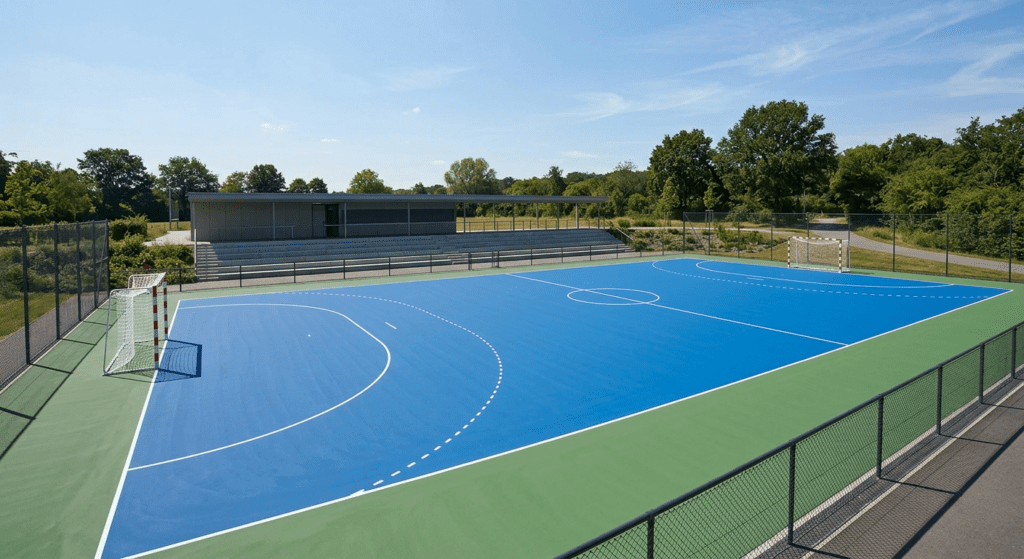
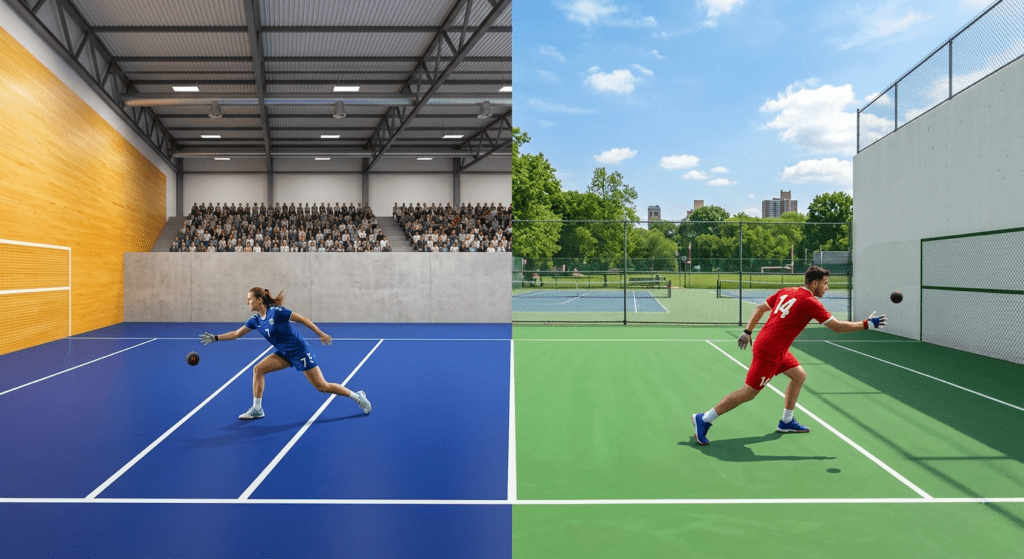
Indoor Courts
- Must strictly follow 40 × 20 meters
- Used for professional and competitive matches
Outdoor or Recreational Courts
- May have slight variations
- Still generally follow proportional dimensions
For official tournaments, only standardized indoor courts are accepted.
Importance of Accurate Measurements
Precision in handball court dimensions is not optional, it directly affects the quality of the game.
Why It Matters
- Ensures fair competition
- Maintains compliance with official rules
- Enhances player safety
- Supports professional-level gameplay
- Avoids disputes during matches
Even small deviations in markings can influence player positioning and game flow.
Quick Reference Table
| Court Element | Measurement |
| Court Length | 40 meters |
| Court Width | 20 meters |
| Goal Area Line | 6 meters |
| Free Throw Line | 9 meters |
| Penalty Line | 7 meters |
| Goalkeeper Line | 4 meters |
| Goal Size | 3m × 2m |
| Line Width | 5 cm |
Conclusion
A well-designed handball court is defined by precision, clarity, and adherence to official standards. From the 40 × 20 meter handball pitch size to the exact placement of lines such as the 6-meter goal area and 9-meter free throw line, every measurement plays a vital role in gameplay.
Following the guidelines established by the International Handball Federation ensures that the court meets global standards and delivers a professional playing experience.
Whether planning a new sports facility or upgrading an existing one, accurate court measurements combined with a high-quality surface will result in a durable, safe, and high-performance handball environment.
Frequently Asked Questions (FAQs)
The standard size is 40 meters in length and 20 meters in width.
The goal area line is located 6 meters from the goal.
The free throw line is positioned 9 meters from the goal.
A handball goal measures 3 meters wide and 2 meters high.
All markings are 5 cm wide and must be clearly visible.