
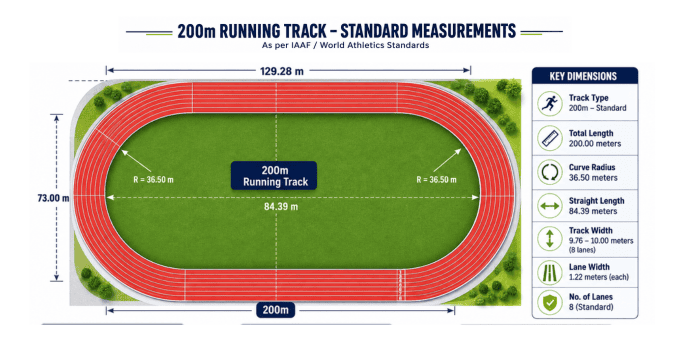
Most people picture a running track and immediately think of the classic 400m oval seen in the Olympics. But in schools, indoor arenas, community sports complexes, and space-constrained facilities, the 200m running track is far more practical. It delivers the same fairness and precision as its larger cousin while fitting into roughly a quarter of the footprint.
If you’re an architect, facility planner, coach, or sports flooring contractor working on a 200m track project, getting the measurements right isn’t optional – it’s the difference between a certified, competition-ready surface and one that produces inaccurate race distances. This guide walks through everything you need: standard dimensions, layout geometry, lane markings, staggers, and construction considerations.
Table of contents
What Is a 200m Running Track?
A 200m running track is a compact oval athletics track where the inside lane measures exactly 200 meters per lap. It follows the same design logic as a standard 400m track – two straight sections connected by two semicircular curves – but with tighter turns and shorter straights to fit the reduced total distance.
Because of its smaller footprint, the 200m track is the go-to choice for:
- Indoor arenas and fieldhouses
- Schools and universities with limited land
- Training centers and compact sports complexes
- Multi-purpose facilities where a full 400m oval isn’t feasible
Despite being smaller, it must follow the same rigorous measurement standards as a full-size track to keep race distances accurate and fair across all lanes.
Core Geometry: How a 200m Track Is Built
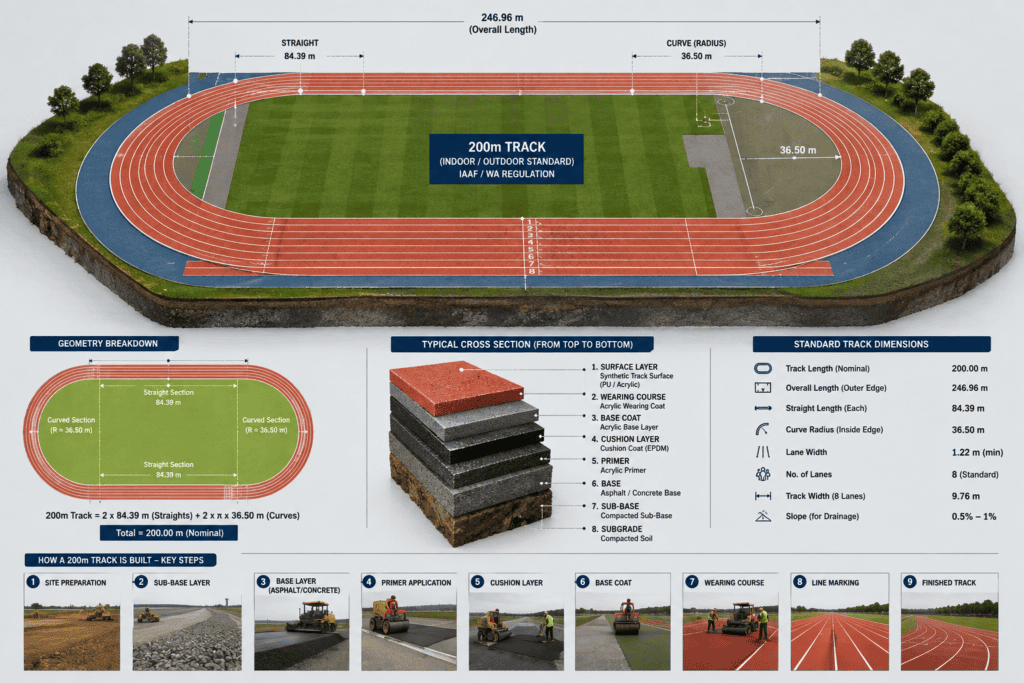
Every oval running track – 200m or 400m – is built from the same two basic shapes:
- Two straight sections (the home straight and back straight)
- Two semicircular curves connecting them at each end
The official inside-lane distance is calculated using this simple relationship:
Track length = (2 × straight length) + (2 × π × curve radius)
For a 200m track, the commonly used specification is:
- Straight (parallel) length: 25.01 m
- Curve radius: 23.87 m
Plugging these into the formula confirms the measurement standard: two 25.01 m straights plus two semicircles built on a 23.87 m radius produce a 200-meter inner-lane loop. This mirrors how a 400m track is designed around 84.39 m straights and a 36.5 m radius – just scaled down.
Standard Lane Dimensions
Lane width is one of the most tightly regulated aspects of track design, since it directly affects both fairness and safety.
| Specification | Standard Value |
|---|---|
| Lane width | 1.22 m (minimum), up to 1.25 m |
| Number of lanes | Typically 6–8 |
| Line width | 5 cm |
| Line color | White |
| Measurement reference | Inner edge of each lane line |
A few important notes on measurement convention:
- All distances are measured from the inner edge of the lane line, not the center or outer edge. This is standard practice across World Athletics (formerly IAAF) specifications.
- Lane 1 is measured 30 cm out from the inside edge of the track if there’s a raised curb or border, or 20 cm out if there is no border – this accounts for the fact that a runner can’t hug the literal inside edge.
- Every lane beyond lane 1 is measured 20 cm out from the inner line of that lane.
Understanding Staggers
Because outer lanes are longer than inner lanes on any curved section (a runner in lane 8 covers more ground on the bend than a runner in lane 1), races run around a curve use a staggered start – each lane’s starting block is offset forward by a calculated distance so that every athlete runs the same total distance to the finish line.
Key points on staggers for a 200m track:
- The stagger for each lane is calculated based on the difference in circumference between adjacent lanes around the curve, which depends on lane width and curve radius.
- Because the 200m track has tighter curves (23.87 m radius vs. 36.5 m on a 400m track), the stagger differences between lanes are proportionally smaller, but still must be calculated precisely – errors compound quickly on tighter radii.
- Stagger marks are measured along the same 20 cm/30 cm offset line described above, not along the raw lane boundary.
For competition-grade tracks, staggers should always be verified using official World Athletics stagger tables or trigonometric calculation rather than estimated by eye.
Step-by-Step Layout Process
Here’s a practical sequence for laying out a 200m track from scratch:
1. Establish the Center Line and Straights
Mark two parallel straight lines 25.01 m long, separated by a distance equal to twice the curve radius (2 × 23.87 m = 47.74 m between straight centerlines, adjusted for the actual radius geometry used).
2. Set the Curve Radius Points
At each end of the straights, establish the center point for the semicircular curve using a 23.87 m radius. This is typically done with a surveyor’s transit or a fixed-point trammel (a rope or steel cable anchored at the center point, swept out to mark the arc).
3. Draw the Semicircles
Using the radius point, sweep a 180° arc connecting the ends of the two straights. Repeat at the opposite end. Together, the two straights and two semicircles form the inner boundary of Lane 1.
4. Add Lane Lines Outward
Working outward from Lane 1, add each subsequent lane at a consistent width (1.22–1.25 m), maintaining the same curve center points so the curves remain concentric.
5. Mark Start and Finish Lines
- The finish line is typically placed at the end of a straight, perpendicular to the direction of running, and is common to all lanes.
- Start lines for curved-start races are staggered per lane, calculated as described above.
6. Apply Line Markings
All markings — lane lines, start lines, finish line, and any event-specific marks (hurdles, relay zones) — should be 5 cm wide and rendered in white, per international convention, unless a specific event marking calls for a different color (commonly used for relay exchange zones or steeplechase markings on larger tracks).
Don’t Forget the Practical Stuff
Getting the geometry right is half the job. Here’s what else goes into a solid build:
- Prep the ground first. Level and compact the site so you’ve got a stable, well-draining base before any surfacing goes down.
- Choose the right surface. Most tracks today use synthetic rubber – spray-coat, sandwich systems, or full-pour polyurethane – for good grip and shock absorption.
- Plan for drainage. Outdoor tracks typically need a gentle ~1% cross-slope so water runs off without throwing off race fairness.
- Consider banked curves (indoors). Some indoor 200m tracks bank their curves to help runners keep speed through the tighter turns. This is rare outdoors.
- Get it certified. If you want to host official races, have a certified track measurer verify the distances before you call it done.
Quick Reference Cheat Sheet
| Element | Measurement |
|---|---|
| Total inner-lane distance | 200 m |
| Straight length | 25.01 m |
| Curve radius | 23.87 m |
| Lane width | 1.22 m – 1.25 m |
| Typical lane count | 6–8 |
| Line width | 5 cm |
| Line color | White |
| Lane 1 offset | 30 cm (with border) / 20 cm (no border) |
| Other lane offsets | 20 cm |
Frequently Asked Questions
Not quite – it’s a scaled-down version, not literally cut in half. The straights and curve radius are both reduced so the proportions still work out correctly to 200 meters.
Indoor 200m tracks are common in gyms and fieldhouses, but you’ll need enough clear floor space for the full oval, including curve radius on both ends. Check your facility’s dimensions before committing to a layout.
Only for races that start on a curve. If a race starts on a straight (like a short sprint), staggers usually aren’t needed since everyone’s running the same distance without a curve to worry about.
Even small errors – a few centimeters in the radius or straight length – can throw off the total distance once multiplied across a lap, and it gets worse across multiple laps. That’s why certification matters for competitive tracks.
Final Thoughts
A 200m track might be the smaller sibling of the classic Olympic oval, but it plays by the exact same rules. Every measurement – from the 23.87 m curve radius down to the 20 cm lane offset – exists for one reason: making sure every runner, in every lane, covers the exact same distance.
Whether you’re planning a school facility, an indoor training space, or a compact competition venue, sticking to these standards is what makes the track fair, safe, and race-ready. And if it’s headed for official competition, get a certified track measurer to double-check the layout before the paint dries – it’s a lot easier to fix on paper than after the lines are down.