Pickleball has gone from “what sport is that?” to one of the most searched-for court types in India in under three years. And a lot of that demand isn’t coming from clubs or resorts – it’s coming from homeowners with a farmhouse, a bungalow lawn, a terrace, or an unused corner of their plot who want their own court to play on whenever they like.
A backyard pickleball court is a different project from a commercial one. The scale is smaller, the priorities are different, and most of the “cost guides” floating around online are written for facility owners building four courts at once – not for a family building one. This guide is written specifically for that homeowner.
Is Your Backyard Big Enough?
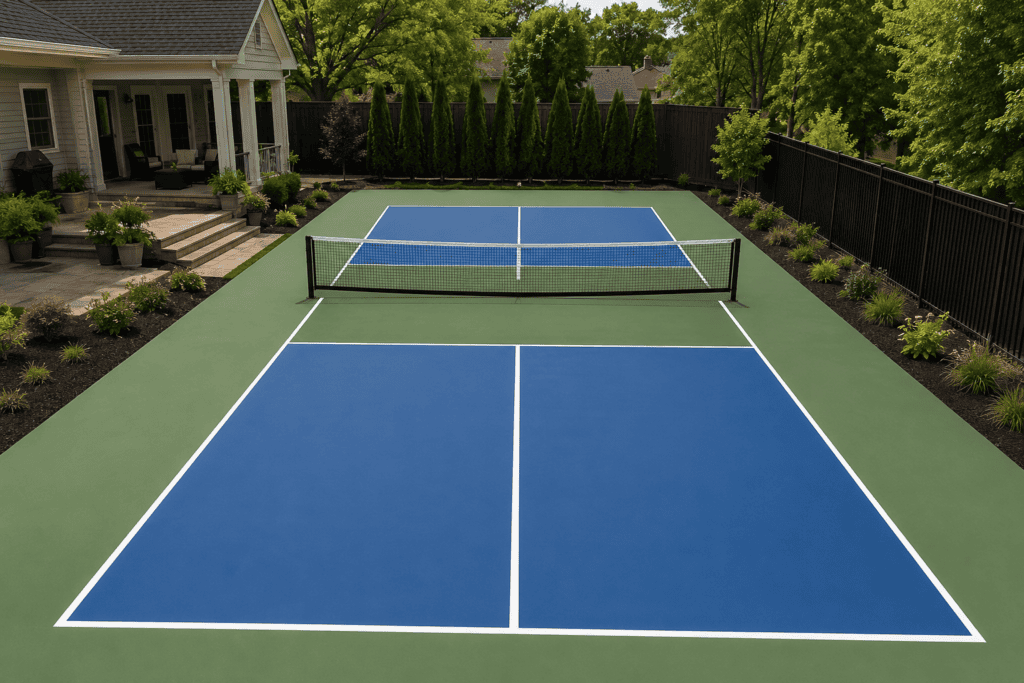
The official pickleball playing area is 20 ft × 44 ft (6.1m × 13.4m). But you can’t just fit the lines to your plot – players need run-off space to move, stop, and swing safely without hitting a wall or fence mid-rally.
Here’s what to plan for:
| Space Type | Dimensions | Notes |
|---|---|---|
| Playing area only | 20 × 44 ft | Lines and net only – too tight for real play |
| Recommended minimum | 30 × 60 ft | Comfortable single-court with safe run-off |
| Ideal backyard court | 34 × 64 ft | Matches most professional recommendations |
If your plot is smaller, you still have options – a court can be built slightly tighter with reduced side run-off (down to about 24–26 ft width), though it’s not ideal for fast, competitive play. Measure your available space first; it decides everything else about the design.
Backyard vs Commercial Pickleball Court – What’s Actually Different
It’s tempting to assume a home court is just a “smaller version” of a commercial one, but a few things genuinely change:
- No bulk-pricing advantage. Commercial builders constructing 3–4 courts at one facility get better rates per court on material and labour. A single backyard court doesn’t benefit from that scale, so per-square-foot cost can actually run a little higher.
- Site logistics are more custom. Existing landscaping, boundary walls, drainage slopes, and tree roots all have to be worked around – every backyard is a slightly different puzzle.
- Usage load is lower. A home court sees a fraction of the footfall of a club or society court, which affects how you think about resurfacing cycles and long-term maintenance costs.
- Aesthetics matter more. A backyard court sits right next to your home, so color coordination with your house, garden, and boundary walls tends to matter more than it does for a commercial facility.
Step-by-Step Build Process
A typical backyard pickleball court build follows this sequence:
- Site Survey & Design — Assessing slope, soil, drainage, sunlight direction (courts are ideally oriented north-south to reduce sun glare during play), and existing structures.
- Base Preparation — Building a solid concrete or asphalt base with the correct drainage slope (roughly 1% gradient) so water runs off instead of pooling.
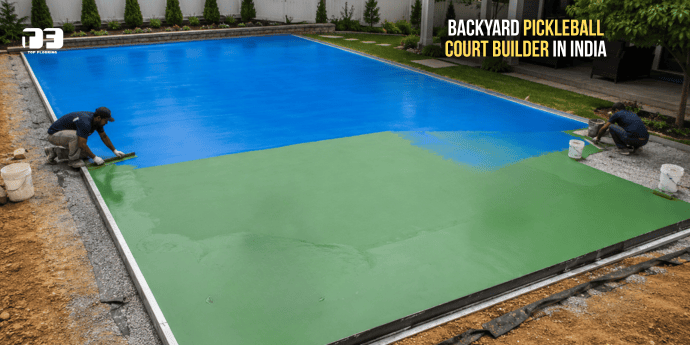
- Acrylic Flooring Application — A multi-layer acrylic system (primer, resurfacer, cushion coats, color coats) applied over the base for grip, ball bounce consistency, and shock absorption.
- Line Marking — Precise, ITF-standard court lines painted for correct dimensions and kitchen (non-volley zone) markings.
- Net, Fencing & Accessories — Permanent net posts, boundary fencing if required, and optional extras like lighting for evening play or windscreens.
For an existing hard surface ( like a driveway or old badminton court ), timelines are shorter since base preparation is minimal. For a full ground-up build, expect 2 to 4 weeks depending on weather and site conditions.
Cost Breakdown for a Home Court in India
Costs vary by base condition, flooring system, and add-ons. As a general guide for a single outdoor backyard court in 2026:
| Component | Approximate Cost |
|---|---|
| Base construction (new concrete/asphalt) | ₹1.5 – 3 lakh |
| Acrylic flooring (standard 2–4 coat system) | ₹1.5 – 2.5 lakh |
| Acrylic flooring (cushioned multi-coat system) | ₹2.5 – 4 lakh |
| Line marking, net & posts | ₹30,000 – 60,000 |
| Fencing (optional) | ₹50,000 – 1.5 lakh |
| Lighting (optional) | ₹40,000 – 1 lakh |
Total range: roughly ₹3.5 lakh to ₹9 lakh, depending on whether you’re building on a bare plot or converting an existing paved surface, and whether you add fencing and lighting.
If you already have a flat concrete surface (an old badminton court, driveway, or terrace), you can often skip the base-construction cost entirely and bring the total down significantly – sometimes to under ₹2 lakh for flooring and markings alone.
Best Flooring Choice for a Home Court
For a residential court, synthetic acrylic flooring is generally the best fit, and here’s why it suits a backyard specifically:
- Comfort over intensity — a cushioned acrylic system reduces joint strain, which matters more for family and casual play than for competitive tournament use.
- Low maintenance — no re-taping or frequent resurfacing like modular tiles can need in high heat.
- Weather resilience — UV-stabilised acrylic holds its color and grip through Indian summers and monsoons, so it stays playable and good-looking year-round.
- Color flexibility — with a wide range of shades available, a home court can be color-matched to your house or garden rather than sticking to standard club colors.
Common Mistakes Homeowners Make
- Ignoring court orientation — building east-west instead of north-south, which puts the setting sun directly in players’ eyes during evening games.
- Skipping the drainage slope — a flat, unsloped base leads to water pooling and surface damage within a couple of monsoons.
- Underestimating run-off space — squeezing the court right up to a boundary wall makes it unsafe and uncomfortable to play on.
- DIY resurfacing — acrylic layering needs correct curing time between coats; rushed DIY jobs often peel or crack within a year.
- Not checking society/local permissions — for courts within gated communities or municipal limits, it’s worth confirming there’s no approval needed before starting construction.
Case Study: A Homeowner’s Backyard Court in Gurugram
A family in a farmhouse community on the outskirts of Gurugram approached Topflooring in early 2026 with an unused 40 × 70 ft lawn area behind their house. Their brief was simple: they wanted a court their kids and weekend guests could use, without turning the garden into a construction site for months.
The challenge: The plot had a gentle natural slope toward the boundary wall, and the family wanted the court to visually blend with the house’s grey-and-white exterior rather than look like a standalone sports facility.
What was done:
- The site was surveyed and the court oriented north-south within the available space, leaving generous run-off on all sides.
- A concrete base was laid with a corrected 1% drainage slope directed away from the house.
- A cushioned 6-layer acrylic system was applied in a custom grey and white color combination to match the home’s exterior – made possible by Topflooring’s expanded color range, which allows shade-matching without minimum order restrictions.
- ITF-standard line marking and a permanent net system were installed, along with low-glare LED lighting for evening play.
The result: The full project – from site survey to handover – was completed in 18 days. The family now uses the court almost daily, and it has become a regular weekend gathering spot for their extended family and neighbours, several of whom have since enquired about building their own courts.
This kind of project is a good example of what a backyard build actually involves: less about scale, more about fitting the court precisely to the space, the household’s routine, and the way the home looks.
Expert Advice
“The biggest difference between a home court and a club court isn’t the size – it’s the decision-making. A facility owner is optimising for footfall and durability under heavy use. A homeowner is optimising for how the court fits their life – how it looks from the kitchen window, whether the kids can play right after school, whether it’s still comfortable to play on after a hot afternoon. We design backyard courts around that, not around a stripped-down commercial spec.” – Topflooring Design & Installation Team
A few practical pointers our installers consistently pass on to homeowners:
- Get the base right before anything else. Flooring quality can’t compensate for a poorly sloped or unstable base – this is the single most common source of long-term problems.
- Think about noise if you’re close to neighbours. A cushioned acrylic system also slightly reduces the sound of paddle strikes compared to hard concrete or tile surfaces.
- Plan for shade or a rest area, even a simple pergola or a few trees nearby – Indian summers make continuous outdoor play difficult without some cover.
- Ask about color combinations early. Matching the court to your home’s exterior is far easier to plan at the design stage than to adjust after installation.
Frequently Asked Questions
Yes, if it’s reasonably flat and structurally sound. You’ll save on base construction costs, though the surface may need levelling or minor repair work before the acrylic system is applied.
It’s possible, provided the terrace can bear the load and has proper waterproofing beneath the court base. A structural check is recommended before construction.
With a quality acrylic system and reasonable upkeep, a backyard court typically lasts 8–10 years before it needs resurfacing, often longer given the lighter usage compared to commercial courts.
For independent plots, generally no. For courts within a gated community or housing society, it’s worth checking with your RWA or builder for any internal approval process before starting work.
Very little – regular sweeping to keep the surface free of leaves and debris, and an occasional wash, is usually enough between periodic professional check-ups.
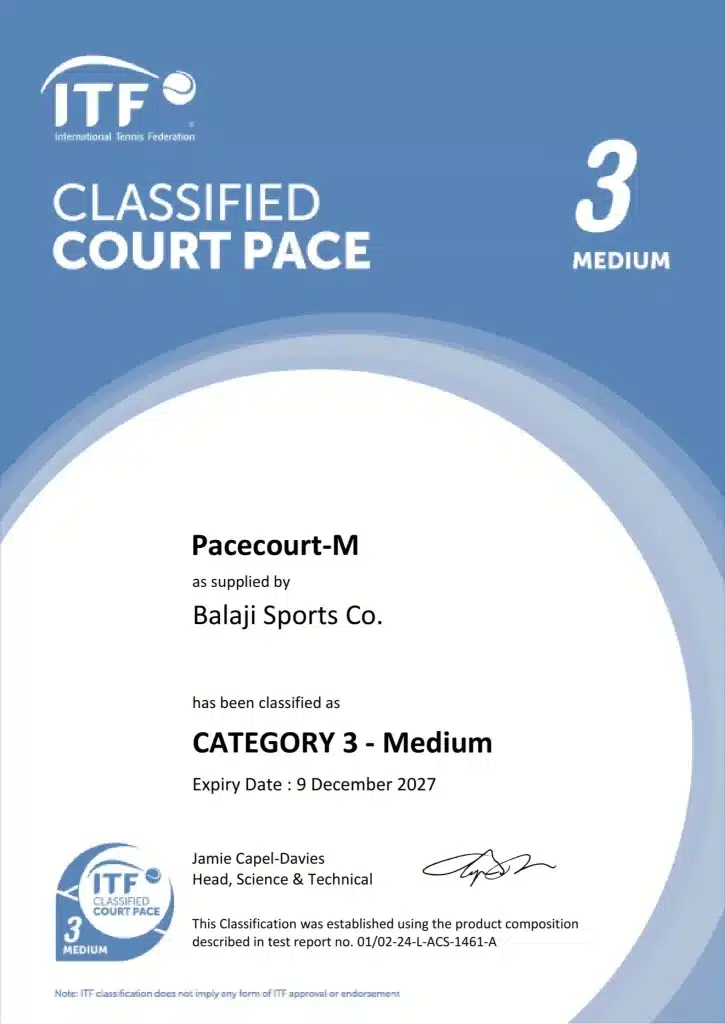
Thinking about building a pickleball court at home? Pacecourt has installed 4,000+ courts across India with ITF-certified acrylic flooring and 800+ color options – including custom shades to match your home. Get in touch for a free site consultation, or explore our Pickleball Court Flooring services to get started.