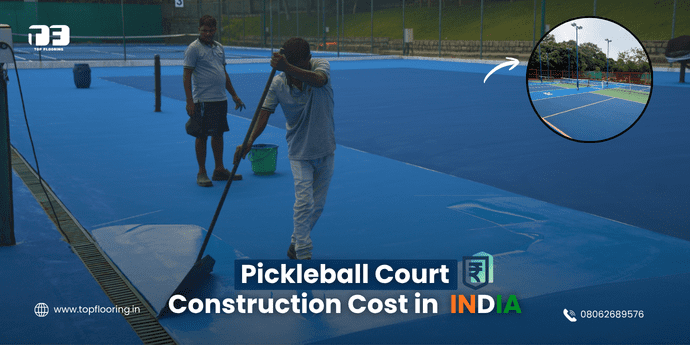
India’s sports landscape is transforming at an extraordinary pace, and pickleball stands at the very center of this revolution. From gated residential societies in Gurugram to sprawling sports academies in Bengaluru, the demand for quality pickleball court construction has never been stronger. If you are planning to build a court and want to understand the real pickleball court construction cost in India for 2026, this guide delivers everything – from ground-level civil work to acrylic finishing, fencing, lighting, and long-term maintenance – with accurate pricing, expert insights, and actionable advice.
Quick Reference: Pickleball Court Construction Cost
| Court Type | Estimated Cost (INR) | Surface | Best For |
|---|---|---|---|
| Basic Outdoor Court | ₹3,00,000 – ₹5,00,000 | Asphalt / Basic Acrylic | Residential Backyard |
| Standard Outdoor Court | ₹5,00,000 – ₹8,00,000 | Acrylic Coating (5-Layer) | Clubs & Societies |
| Premium Outdoor Court | ₹8,00,000 – ₹12,00,000 | Cushioned Acrylic (8-Layer) | Commercial & Academy |
| Standard Indoor Court | ₹10,00,000 – ₹15,00,000 | Acrylic / Wooden Flooring | Gyms & Sports Halls |
| Premium Indoor Court | ₹15,00,000 – ₹25,00,000+ | Multi-Layer Cushioned | Professional Facilities |
What Is Pickleball and Why Is India Building Courts in 2026?
Pickleball is a dynamic racquet sport that blends elements of tennis, badminton, and table tennis into one fast-paced, accessible game. Players use solid paddles to hit a lightweight perforated ball over a low net on a compact court. The sport demands agility and strategy but remains easy enough for beginners of all ages to learn within a single session. India first encountered pickleball in 2006 when sports enthusiast Sunil Valavalkar introduced the game, and since then the sport has grown from a niche hobby to a mainstream competitive discipline attracting over 50,000 active players across the country by 2024.
The pickleball boom in India accelerates in 2026 for several compelling reasons. Urban fitness culture grows stronger every year, and pickleball perfectly suits India’s high-density residential environments because a single pickleball court occupies only 20 x 44 feet – roughly one-quarter the area of a standard tennis court. Residential townships, corporate campuses, schools, and private clubs all invest in dedicated courts to attract members and boost property value. The sport’s low equipment cost and social nature make it ideal for community engagement, which drives demand for pickleball court installation cost optimization and smart infrastructure planning.
Official Pickleball Court Dimensions and Layout Requirements
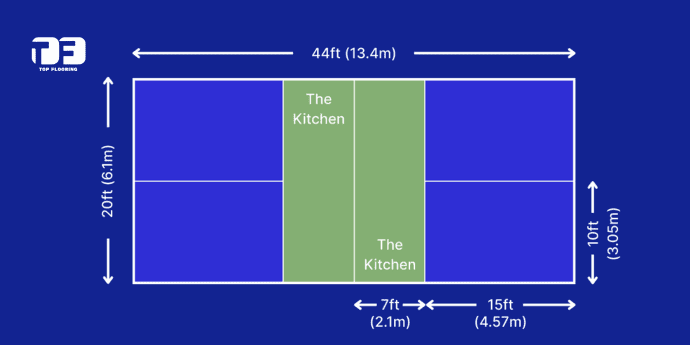
Before calculating pickleball court construction cost, understanding the exact dimensions is essential because errors in planning lead to costly rework. A regulation pickleball court measures 20 feet in width and 44 feet in length, covering a total playing area of 880 square feet. However, professional construction always includes buffer run-off zones on all sides to ensure player safety and ball recovery. With the recommended safety margins, the total footprint required for a single court typically reaches 30 feet wide by 60 feet long, translating to 1,800 square feet of total prepared surface area.
| Court Zone | Measurement | Purpose |
|---|---|---|
| Playing Width | 20 feet (6.1 m) | Singles and Doubles |
| Playing Length | 44 feet (13.4 m) | Full Court |
| Total Width with Run-off | 30 feet (9.1 m) | Safety Buffer |
| Total Length with Run-off | 60 feet (18.3 m) | Safety Buffer |
| Non-Volley Zone (Kitchen) | 7 feet from net each side | No Volley Rule Zone |
| Net Height at Center | 34 inches (86 cm) | Standard Regulation |
| Net Height at Sidelines | 36 inches (91.4 cm) | Standard Regulation |
| Service Area (each side) | 15 x 10 feet (approx.) | Two Service Boxes |
The court orientation plays a critical role in outdoor construction. Contractors recommend aligning the court along a north-south axis to minimize direct sun glare during morning and evening play. Proper drainage design also demands attention – the court surface should slope at a gradient between 0.5% and 1.0% to allow rainwater runoff without pooling. Failure to address drainage causes surface deterioration, which increases long-term pickleball court flooring replacement costs significantly.
Pickleball Court Flooring Options in India: A Deep Comparison
Choosing the right pickleball court flooring is arguably the single most impactful decision you make during construction. The flooring choice determines ball bounce consistency, player safety, maintenance frequency, weather resistance, and total lifecycle cost. India’s diverse climate – ranging from humid coastal conditions in Kerala to extreme heat in Rajasthan and cold winters in Delhi – means that not all flooring materials perform equally across regions. Understanding each option helps you make an informed investment decision aligned with your budget and location.
1. Acrylic Synthetic Flooring (Recommended)
Acrylic synthetic flooring ranks as the most popular and recommended pickleball court material for Indian conditions. Manufacturers apply multiple coats of acrylic polymer directly over a concrete or asphalt base. A standard system uses five layers – one primer coat, two resurfacer coats, one cushion or color filler coat, and one top coat with integrated line marking. A premium eight-layer system adds additional cushioning layers that absorb joint impact, making courts safer for older players. Acrylic flooring delivers UV resistance, weather protection, consistent ball bounce, and an expected lifespan of 8 to 12 years with regular maintenance.
2. Concrete Base with Acrylic Finish
A concrete base forms the foundation for most high-quality pickleball courts in India. Contractors pour M25-grade concrete to a thickness of 4 to 6 inches over a compacted gravel sub-base. Concrete offers exceptional rigidity, near-zero long-term deformation, and a lifespan exceeding 25 years with minimal structural intervention. The surface finish applied over concrete – typically multi-layer acrylic – determines the final playing characteristics. Concrete bases cost more upfront than asphalt but deliver lower repair and resurfacing costs over a decade, making them the preferred pickleball court material for permanent commercial installations.
3. Asphalt Base with Acrylic Overlay
Asphalt provides a cost-effective alternative base for outdoor pickleball courts, particularly in budget-conscious club and residential projects. Contractors lay asphalt to a thickness of 3 to 4 inches before applying the acrylic surface coating. Asphalt is slightly more flexible than concrete, which reduces cracking risk in regions with moderate temperature fluctuations. However, asphalt demands resurfacing every five to seven years in India’s high-temperature zones because intense summer heat causes surface softening and deformation. Acrylic overlays on asphalt bases remain a widely used solution across clubs in Tier 2 and Tier 3 Indian cities due to their lower initial pickleball court installation cost.
4. Modular Interlocking Tiles
Modular interlocking tiles represent a modern, portable solution for pickleball court construction, especially suitable for rooftop installations, indoor multi-sport halls, and temporary setups. Manufacturers produce these tiles from polypropylene plastic with perforated surfaces that allow drainage and airflow beneath the playing area. Installation requires no adhesive and no specialized civil work, which dramatically reduces the pickleball court installation cost for rooftop and indoor applications. The tiles provide built-in cushioning, are resistant to UV degradation, and can be dismantled and relocated if needed – a significant advantage for commercial spaces exploring multiple revenue streams.
5. Wooden Flooring for Indoor Courts
Wooden sprung flooring, commonly used in indoor badminton facilities, also serves as an excellent pickleball court material for multi-sport indoor halls. Maple hardwood with a shock-absorbing spring system delivers superior ball bounce and player comfort. Line markings for pickleball can be applied in a contrasting color over existing court markings. While wooden flooring carries a higher per-square-foot cost than acrylic systems, it offers an unmatched playing experience for serious athletes and justifies the investment in premium sports academies. Courts in air-conditioned facilities benefit most from this flooring type as it remains stable under controlled humidity conditions.
| Flooring Type | Cost per Sq. Ft. | Lifespan | Best Climate | Maintenance |
|---|---|---|---|---|
| Basic Acrylic (5-Layer) | ₹45 – ₹70 | 8–10 years | All India | Low |
| Premium Acrylic (8-Layer) | ₹80 – ₹130 | 10–15 years | All India | Low |
| Concrete Base + Acrylic | ₹350 – ₹600 | 25+ years | All India | Very Low |
| Asphalt Base + Acrylic | ₹250 – ₹450 | 15–20 years | Moderate | Medium |
| Modular Tiles | ₹120 – ₹200 | 10–12 years | Indoor/Rooftop | Very Low |
| Wooden Sprung Floor | ₹350 – ₹700 | 20+ years | Indoor Only | Medium |
Complete Pickleball Court Construction Cost Breakdown in India 2026
A realistic pickleball court construction cost estimate demands a line-item breakdown of every component involved. Many first-time builders underestimate total project cost by focusing only on the surface flooring, neglecting site preparation, base construction, drainage, fencing, lighting, and net infrastructure. This detailed breakdown covers an outdoor standard pickleball court with acrylic flooring in an Indian metro city during 2026, serving as a practical budget reference for individuals, clubs, and institutions.
Component-Wise Cost Breakdown (Single Standard Outdoor Court)
| Cost Component | Specification | Estimated Cost (INR) |
|---|---|---|
| Site Survey & Planning | Measurement, slope analysis, layout design | ₹5,000 – ₹15,000 |
| Site Clearing & Leveling | Debris removal, excavation, compaction | ₹20,000 – ₹50,000 |
| Sub-base (Gravel/WBM) | 4-inch compacted gravel layer | ₹40,000 – ₹80,000 |
| Asphalt Base Layer | 3–4 inch bituminous macadam | ₹80,000 – ₹1,50,000 |
| Concrete Base (Alternative) | M25 concrete, 4–6 inches | ₹1,20,000 – ₹2,00,000 |
| Acrylic Surface (5-Layer) | ₹45/sq.ft × 1,800 sq.ft | ₹81,000 – ₹1,26,000 |
| Acrylic Surface (8-Layer) | ₹90/sq.ft × 1,800 sq.ft | ₹1,50,000 – ₹2,30,000 |
| Line Marking | Professional court lines with UV paint | ₹8,000 – ₹15,000 |
| Net System (Poles + Net) | Galvanized poles, regulation net | ₹12,000 – ₹35,000 |
| Perimeter Fencing | GI mesh, 10 ft height, around court | ₹1,50,000 – ₹2,50,000 |
| Lighting (LED Floodlights) | 4–6 floodlights, 300W each | ₹60,000 – ₹1,50,000 |
| Drainage System | Perimeter drains, channels | ₹20,000 – ₹50,000 |
| Toe Wall (Edge Wall) | 8-inch perimeter retaining wall | ₹25,000 – ₹50,000 |
| GST (18%) | Applied on materials and services | ~18% on taxable items |
| Contingency (5–10%) | Unforeseen site conditions | ₹20,000 – ₹60,000 |
The total pickleball court construction cost for a standard outdoor acrylic court in India 2026 falls between ₹5,00,000 and ₹8,00,000 for a well-specified project in a metro city. Premium 8-layer cushioned acrylic courts with full fencing and LED lighting typically range from ₹8,00,000 to ₹12,00,000. Indoor courts demand ₹10,00,000 to ₹25,00,000 or more, depending on roofing, air conditioning, and specialized flooring choices.
City-Wise Pickleball Court Installation Cost Variation Across India
Pickleball court installation cost varies considerably between Indian cities due to differences in labor rates, material availability, transportation costs, and local contractor competition. Metro cities like Mumbai and Delhi carry premium labor and logistics costs that push project budgets 20% to 40% higher than Tier 2 cities. Understanding this geographic variation helps you set realistic budgets whether you build in a major urban hub or a smaller city with emerging sports infrastructure demand.
| City / Region | Labor Cost Factor | Outdoor Court (Approx.) | Indoor Court (Approx.) |
|---|---|---|---|
| Mumbai | High (+30%) | ₹7,00,000 – ₹12,00,000 | ₹15,00,000 – ₹28,00,000 |
| Delhi NCR | High (+25%) | ₹6,50,000 – ₹11,00,000 | ₹14,00,000 – ₹25,00,000 |
| Bengaluru | High (+20%) | ₹6,00,000 – ₹10,00,000 | ₹12,00,000 – ₹22,00,000 |
| Hyderabad | Moderate (+10%) | ₹5,50,000 – ₹9,00,000 | ₹11,00,000 – ₹20,00,000 |
| Chennai | Moderate (+10%) | ₹5,50,000 – ₹9,00,000 | ₹11,00,000 – ₹19,00,000 |
| Pune | Moderate (+15%) | ₹5,80,000 – ₹9,50,000 | ₹12,00,000 – ₹21,00,000 |
| Tier 2 Cities | Base Rate | ₹5,00,000 – ₹8,00,000 | ₹10,00,000 – ₹17,00,000 |
Step-by-Step Pickleball Court Construction Process in India
Understanding the construction sequence helps project owners monitor quality, manage timelines, and avoid costly rework caused by skipped steps. Professional contractors follow a structured methodology that progresses from ground assessment to final handover. Each stage demands attention to detail because errors at foundational levels create compounding problems that affect the playing surface years later. This step-by-step guide mirrors the process used by leading Indian sports infrastructure companies.
Step 1 – Site Assessment and Soil Testing
Every quality pickleball court construction project begins with a thorough site assessment. Surveyors evaluate the ground slope, soil bearing capacity, water table level, and drainage conditions. Rocky or clay-heavy soil demands additional excavation and sub-base preparation that increases project cost. Rooftop courts require structural load calculations to confirm the building slab supports the added weight of base layers, fencing, and lighting infrastructure. This preliminary evaluation takes one to three days and costs between ₹5,000 and ₹15,000 but saves significantly more by preventing expensive surprises during construction.
Step 2 – Excavation, Leveling, and Compaction
After assessment, the contractor clears the site of all vegetation, debris, and topsoil to a depth of 6 to 10 inches below the finished court level. Workers grade the earth to achieve the required drainage slope of 0.5% to 1.0% before mechanically compacting the sub-grade soil. Proper compaction prevents future settlement and surface cracking. A perimeter toe wall or edge restraint is installed to contain the base layers and prevent lateral spreading. This foundation stage largely determines the durability of your pickleball court flooring system over time.
Step 3 – Sub-base and Base Layer Construction
The sub-base consists of a compacted layer of water-bound macadam (WBM) or clean crushed stone gravel, typically 4 to 6 inches thick, that provides drainage and load distribution. Above the sub-base, contractors lay the structural base – either asphalt (bituminous macadam) or M25 concrete. Asphalt base installation takes one to two days to lay and 24 to 48 hours to cure before surface application. Concrete bases require 7 to 14 days of curing before the acrylic surface system can be applied. Rushing curing time compromises bond strength and causes premature pickleball court flooring delamination.
Step 4 – Acrylic Surface Application
Once the base cures fully, skilled applicators begin the multi-layer acrylic surface system. They apply a primer coat that bonds the acrylic layers to the concrete or asphalt base, followed by resurfacer coats that fill surface voids and create a uniform texture. Cushion layers follow in premium systems to provide energy absorption and player comfort. The final color coat – typically bright blue with contrasting boundary colors – goes on last, followed by professional line marking using UV-resistant paint. Each coat requires 4 to 8 hours of drying time, making the full surface application a 3- to 5-day process depending on weather and humidity.
Step 5 – Net, Fencing, and Lighting Installation
With the playing surface complete, crews install the net post system using galvanized steel or aluminum sleeves anchored into the concrete base at the center of the court. The net assembly meets regulation specifications – 36 inches at sidelines and 34 inches at center. Perimeter fencing rises to 10 feet height using GI tubular frames and PVC-coated chain-link mesh, which prevents balls from escaping and provides a professional appearance. LED floodlights mounted on poles at 10 to 12 feet height illuminate the court for evening play. Specifying galvanized fixtures over painted mild steel increases upfront pickleball court material cost by 15% to 20% but eliminates rust replacement costs within three to five years.
Step 6 – Final Inspection and Handover
The project concludes with a formal quality inspection that verifies court dimensions against official pickleball standards, checks surface smoothness using a straight-edge ruler, tests net tension and height, confirms lighting lux levels across the playing surface, and validates drainage by simulating rainfall with water. A professional contractor provides a maintenance manual, warranty documentation, and a recommended maintenance schedule as part of project handover. Request a written defect liability period of at least 12 months covering surface delamination, line marking fade, and structural settling issues.
Pickleball Court Material Guide: What to Specify in 2026
Selecting the right pickleball court material at each layer of the construction system determines how your court performs across India’s diverse climate zones and heavy usage patterns. Material specification errors – choosing untested local acrylic brands or inadequate net materials – result in premature failure that costs more to repair than the original savings justified. This section provides specific material guidance for every major component, reflecting current 2026 market standards available in India.
| Component | Recommended Material | Key Specification | 2026 Market Cost |
|---|---|---|---|
| Sub-base | Crushed Granite / WBM | 4–6 inch, compacted | ₹40–₹80/sq.ft |
| Base Layer | M25 Concrete or Asphalt | 4–6 inch thickness | ₹110–₹200/sq.ft |
| Acrylic Primer | Latex-based acrylic primer | 1 coat, UV stable | Included in acrylic |
| Resurfacer Coats | Silica-filled acrylic | 2 coats minimum | ₹45–₹130/sq.ft (full) |
| Top Color Coat | UV-resistant acrylic paint | USAPA approved colors | Included in acrylic |
| Line Marking | UV-resistant epoxy/acrylic | 50mm width minimum | ₹8,000–₹15,000 |
| Net Posts | Galvanized steel, 2-inch dia. | Ground sleeve anchored | ₹8,000–₹20,000/pair |
| Net | Polyethylene, 3mm mesh | Regulation tension | ₹3,000–₹15,000 |
| Fencing Poles | Galvanized GI tubular | 2.5-inch diameter, 12 ft | Included in fencing |
| Fencing Mesh | PVC-coated chain-link | 50mm x 50mm, 16 gauge | ₹95–₹150/sq.ft |
| LED Floodlights | 300W IP65 LED | 4–6 units per court | ₹5,500–₹12,000/unit |
Annual Maintenance Cost for Pickleball Courts in India
Pickleball court maintenance directly protects your investment and keeps the playing surface safe and regulation-standard. Indian courts face year-round challenges including UV degradation, monsoon water ingress, dust accumulation, and heavy daily use that gradually degrades the acrylic surface texture. Proactive maintenance prevents costly emergency repairs and extends the surface lifespan from 8 years to 12 or more years. Budget for annual maintenance as a fixed operational expense from day one of court commissioning.
| Maintenance Activity | Frequency | Estimated Cost (INR/year) |
|---|---|---|
| Surface Cleaning | Weekly | Included in staff cost |
| Crack Inspection & Filling | Bi-annual | ₹5,000 – ₹15,000 |
| Line Marking Touch-up | Annual | ₹8,000 – ₹20,000 |
| Acrylic Resurfacing (Full) | Every 4–6 years | ₹60,000 – ₹1,50,000 |
| Net Replacement | Every 2–3 years | ₹3,000 – ₹15,000 |
| Fencing Repairs | As needed | ₹5,000 – ₹25,000 |
| LED Light Replacement | Every 5–7 years | ₹10,000 – ₹40,000 |
| Drainage Cleaning | Pre-monsoon | ₹3,000 – ₹8,000 |
| Total Annual Estimate | – | ₹40,000 – ₹1,50,000 |
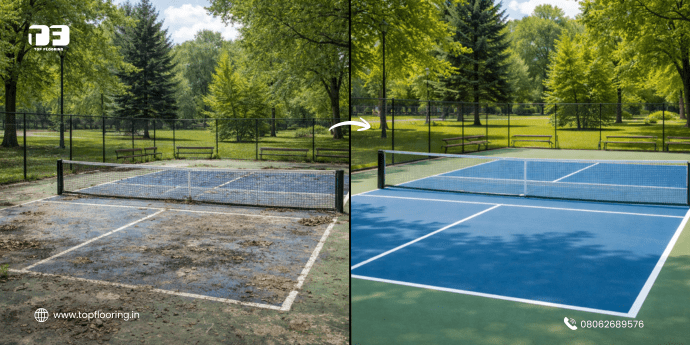
Courts in Mumbai, Chennai, and Kochi that experience high humidity and heavy monsoon rainfall require more frequent drainage maintenance and acrylic resurfacing compared to courts in drier regions like Jaipur or Ahmedabad. Partnering with the original construction contractor for an Annual Maintenance Contract (AMC) typically delivers 20% to 30% cost savings compared to reactive, ad-hoc repair engagements.
ROI and Revenue Potential: Is Building a Pickleball Court Worth It in 2026?
Pickleball court construction represents not just a sports infrastructure investment but a genuine revenue-generating business opportunity in India’s 2026 sports economy. Courts in high-footfall locations such as gated townships, corporate campuses, fitness centers, and sports clubs recover construction costs through multiple monetization channels that compound returns over time. Understanding the revenue model helps project owners calculate payback periods and justify capital expenditure to stakeholders and investors.
Revenue Channels for Pickleball Courts
Court rental fees generate the primary income stream. Urban clubs charge between ₹400 and ₹1,200 per hour per court during peak hours, with off-peak rates between ₹200 and ₹600. A well-utilized outdoor court operating 6 hours per day at ₹600 average hourly rate generates ₹1,08,000 per month or approximately ₹13,00,000 annually. Membership programs, coaching academies, tournament hosting, and branded equipment retail represent additional income layers. Corporate event bookings add premium revenue during weekday morning slots. With an outdoor court construction cost of ₹6,00,000 to ₹8,00,000, serious commercial operators achieve payback within 8 to 18 months.
Key Factors That Determine Your Final Pickleball Court Construction Cost
Multiple variables interact to determine your final project budget. Understanding each factor empowers you to make strategic trade-offs that optimize performance without exceeding your financial capacity. Contractors who provide quotes without site visits often underestimate these variables, leading to budget overruns. Always commission a detailed site assessment and request itemized quotes from at least three experienced pickleball court construction specialists before committing.
| Factor | Low-Cost Scenario | High-Cost Scenario |
|---|---|---|
| Location | Tier 2 city, flat terrain | Metro city, sloped/rocky site |
| Court Type | Outdoor, single court | Indoor, multi-court facility |
| Base Material | Asphalt (cost-effective) | Reinforced concrete (premium) |
| Surface System | 5-layer basic acrylic | 8-layer cushioned premium acrylic |
| Fencing | Basic chain-link, 8 ft | PVC-coated GI mesh, 10 ft, padded posts |
| Lighting | No lighting installed | Full LED floodlights, automated |
| Net System | Standard economy net | Tournament-grade aluminum posts |
| Site Complexity | Flat, clear, accessible | Rooftop, waterproofing required |
| Color & Branding | Standard colors | Custom colors, logo embedding |
Frequently Asked Questions (FAQs)
A standard outdoor pickleball court with acrylic flooring, fencing, and lighting costs between ₹5,00,000 and ₹12,00,000 in India in 2026.
Multi-layer synthetic acrylic flooring applied over a concrete or asphalt base delivers the best combination of durability, UV resistance, and consistent ball bounce for Indian climates.
Indoor pickleball court installation cost in India ranges from ₹10,00,000 to ₹25,00,000 or more, depending on roofing, air conditioning, and the quality of flooring selected.
M25 reinforced concrete base with an 8-layer cushioned acrylic surface system represents the most durable pickleball court material combination for high-traffic commercial and institutional courts.
An official pickleball court measures 20 feet wide by 44 feet long, and the total construction footprint including safety run-off zones requires 30 feet wide by 60 feet long.