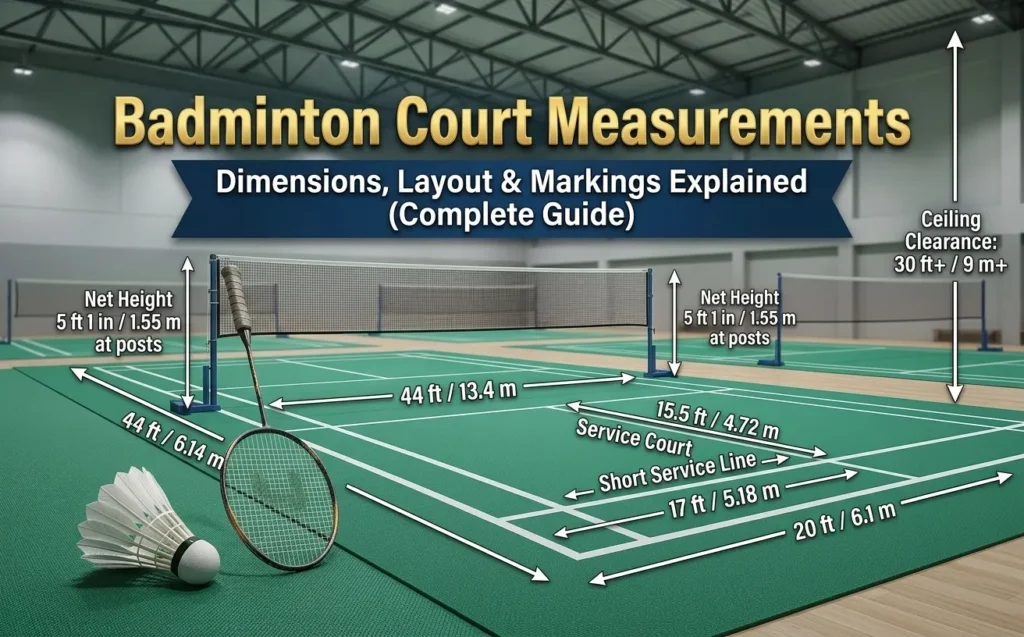
Badminton is a sport built on precision, speed, and control and all of that begins with a perfectly measured court. Every line, every inch of net height, and even the ceiling clearance plays a crucial role in how the game is played. Whether constructing a professional stadium, a school court, or a recreational facility, understanding official badminton measurements is essential.
All standards are governed by the Badminton World Federation (BWF), ensuring uniformity across the world.
Table of contents
- Standard Badminton Court Dimensions
- Detailed Court Layout & Markings
- Service Court Dimensions
- Net Height and Specifications
- Badminton Racket Dimensions
- Ceiling Height Requirements
- Singles vs Doubles: Complete Comparison
- Court Orientation and Spacing
- Badminton Court Construction & Flooring (Expert Guide)
- Acrylic Flooring System (Step-by-Step)
- Common Mistakes in Court Construction
- Why Accurate Measurements Matter
- Conclusion
- Frequently Asked Questions
Standard Badminton Court Dimensions
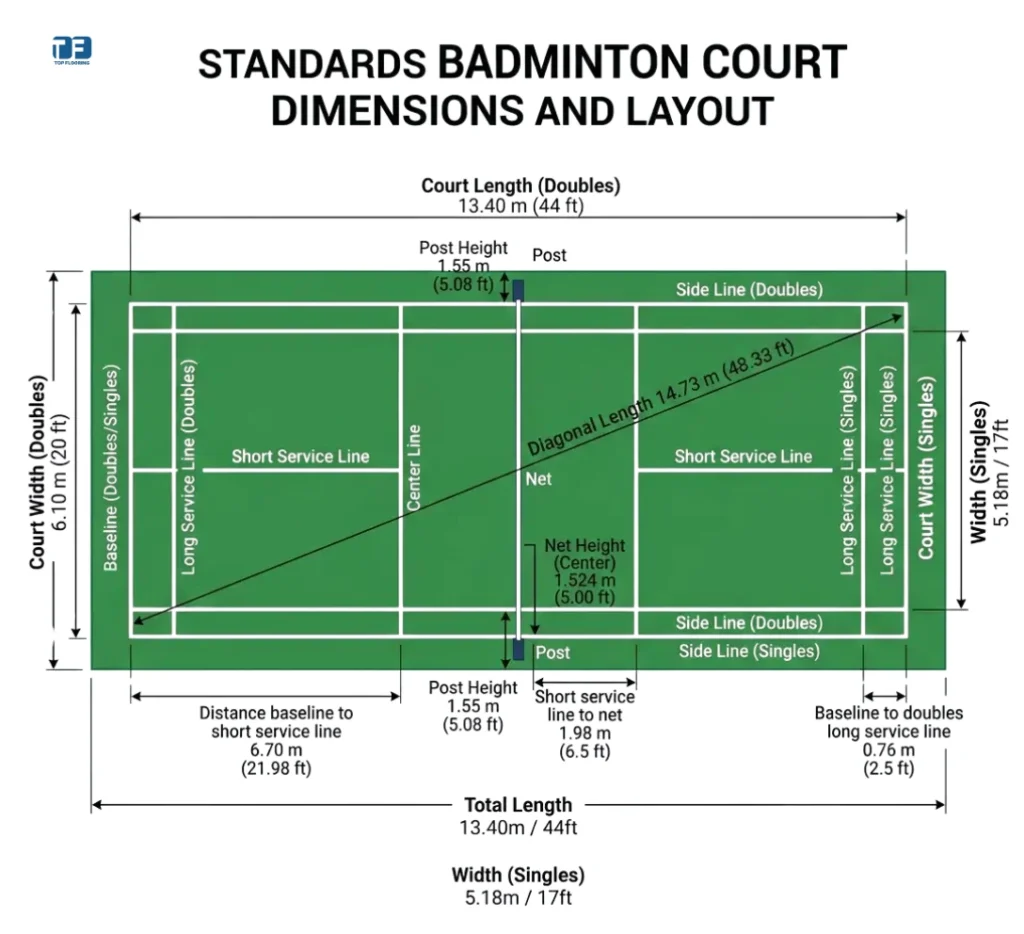
The badminton court is rectangular and divided into two equal halves by a net. The court dimensions vary slightly depending on whether the game is played in singles or doubles format.
Overall Court Size
| Type | Length (meters) | Width (meters) | Length (feet) | Width (feet) |
| Doubles | 13.4 m | 6.1 m | 44 ft | 20 ft |
| Singles | 13.4 m | 5.18 m | 44 ft | 17 ft |
Key Insights:
- The length remains constant in both formats.
- The width reduces in singles, using inner sidelines.
- Doubles play utilizes the full court width.
Court Area
| Type | Area (sq meters) | Area (sq feet) |
| Doubles | 81.74 m² | ~880 sq ft |
| Singles | 69.41 m² | ~748 sq ft |
This difference in area significantly affects gameplay strategy—singles focuses on endurance and precision, while doubles emphasizes speed and coordination.
Detailed Court Layout & Markings
Court markings define the boundaries and service areas. Each line has a specific purpose and must be drawn accurately.
Boundary Lines
Baseline (Back Boundary Line)
- Located at the extreme ends of the court
- Distance from opposite baseline: 13.4 m (44 ft)
Sidelines
- Outer sidelines: Used in doubles (6.1 m / 20 ft)
- Inner sidelines: Used in singles (5.18 m / 17 ft)
Service Lines
Short Service Line
- Distance from net: 1.98 m (6.5 ft)
Long Service Line (Doubles)
- Distance from baseline: 0.76 m (2.5 ft) inside
Long Service Line (Singles)
- Same as the baseline
Center Line
- Divides service courts into left and right
- Essential for serving rules
Line Thickness
- Standard width: 40 mm (1.57 inches)
- Lines must be clearly visible and in a contrasting color
Service Court Dimensions
Understanding service boxes is critical for gameplay accuracy.
| Type | Length | Width |
| Doubles | 3.96 m (13 ft) | 3.05 m (10 ft) |
| Singles | 4.72 m (15.5 ft) | 2.59 m (8.5 ft) |
Key Differences:
- Singles service area is longer but narrower
- Doubles service area is shorter but wider
Net Height and Specifications
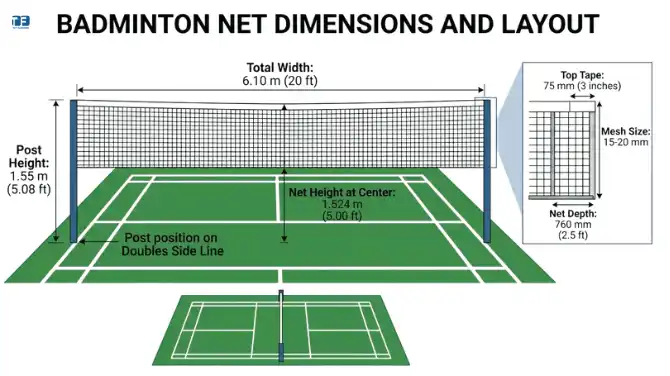
The net divides the court and determines the trajectory of shots.
Official Net Height
| Position | Height (meters) | Height (feet) |
| At posts | 1.55 m | 5 ft 1 in |
| At center | 1.524 m | 5 ft |
Net Dimensions
- Width: 6.1 m (20 ft)
- Depth: 760 mm (2.5 ft)
- Mesh size: 15–20 mm
Net Posts
- Positioned on doubles sidelines
- Height: 1.55 m (5 ft 1 in)
Shuttlecock Specifications
The shuttlecock is unique to badminton and plays a crucial role in gameplay.
Standard Measurements
| Feature | Measurement |
| Weight | 4.74–5.50 g |
| Feather count | 16 feathers |
| Feather length | 62–70 mm (2.44–2.75 in) |
| Cork diameter | 25–28 mm (0.98–1.10 in) |
| Total height | ~85 mm (3.35 in) |
Types of Shuttlecock
- Feather (professional use)
- Nylon (recreational use)
Badminton Racket Dimensions
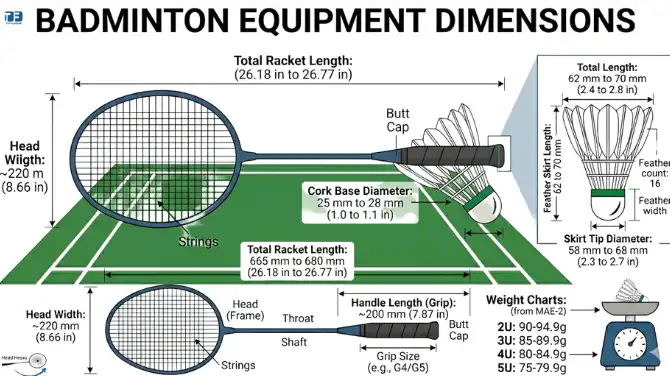
Rackets are designed for speed and control.
Standard Specifications
| Feature | Measurement |
| Max length | 680 mm (26.77 in) |
| Max width | 230 mm (9.05 in) |
| Weight | 70–95 g |
Ceiling Height Requirements
Ceiling height is often overlooked but extremely important.
Recommended Heights
| Level | Height (meters) | Height (feet) |
| Recreational | 7–9 m | 23–30 ft |
| Club Level | 9–12 m | 30–39 ft |
| International | 12–15 m | 39–49 ft |
Why It Matters:
- High clears require vertical space
- Prevents shuttle obstruction
- Improves visibility
Singles vs Doubles: Complete Comparison
| Feature | Singles | Doubles |
| Width | 5.18 m (17 ft) | 6.1 m (20 ft) |
| Boundary lines | Inner sidelines | Outer sidelines |
| Back boundary | Baseline | Long service line |
| Service area | Long & narrow | Short & wide |
| Gameplay style | Endurance-based | Fast-paced & aggressive |
Court Orientation and Spacing
Orientation
- Prefer north-south alignment
- Reduces sunlight glare
Surrounding Space
| Area | Space Required |
| Sides | 1.5–2 m (5–6.5 ft) |
| Back | 2–2.5 m (6.5–8 ft) |
Lighting Requirements
- Recreational: 300–500 lux
- Professional: 750–1000 lux
- LED lighting recommended
Badminton Court Construction & Flooring (Expert Guide)
Badminton Court Flooring plays a major role in performance, durability, and player safety.
Types of Flooring
Synthetic Acrylic Flooring (Highly Recommended)
- Synthetic Acrylic Flooring is best for India’s climate
- UV-resistant and weatherproof
- Cost-effective and long-lasting
Wooden Flooring
- Premium indoor courts
- Excellent shock absorption
- High maintenance cost
PVC / Vinyl Flooring
- Good cushioning
- Slip-resistant
- Common in indoor facilities
Acrylic Flooring System (Step-by-Step)
- Concrete/Asphalt base
- Surface leveling
- Primer coat
- Acrylic resurfacer
- Cushion layers (optional)
- Color coating
- Line marking
Benefits of Acrylic Flooring
- Consistent shuttle bounce
- Anti-skid surface
- Low maintenance
- Lifespan: 5–8 years
Additional Technical Specifications
Line Marking
- Width: 40 mm
Net Position
- Aligned with doubles sidelines
Surface Slope
- Outdoor courts: slight slope for drainage
Common Mistakes in Court Construction
- Incorrect line marking
- Low ceiling height
- Poor lighting placement
- Uneven flooring
- Wrong net height
Why Accurate Measurements Matter
- Ensures fair gameplay
- Meets tournament standards
- Enhances player performance
- Improves safety
Conclusion
Badminton is not just about skill it’s about precision in every aspect of the court. From court size and markings to net height, ceiling clearance, and flooring systems, every detail must align with standards set by the Badminton World Federation.
For modern badminton court construction, synthetic acrylic flooring stands out as the most practical and efficient solution especially in Indian conditions offering durability, performance, and cost-effectiveness.
Whether building a professional arena or a backyard court, following these measurements ensures a world-class playing experience.
Frequently Asked Questions
13.4 m × 6.1 m (44 ft × 20 ft) for doubles; width reduces to 5.18 m (17 ft) for singles.
1.55 m (5 ft 1 in) at posts and 1.524 m (5 ft) at center, as per Badminton World Federation.
1.5–2 m (5–6.5 ft) on sides and 2–2.5 m (6.5–8 ft) at the back.
Synthetic acrylic, wooden, or PVC flooring acrylic is most durable and cost-effective.
Standard line width is 40 mm (1.57 inches).