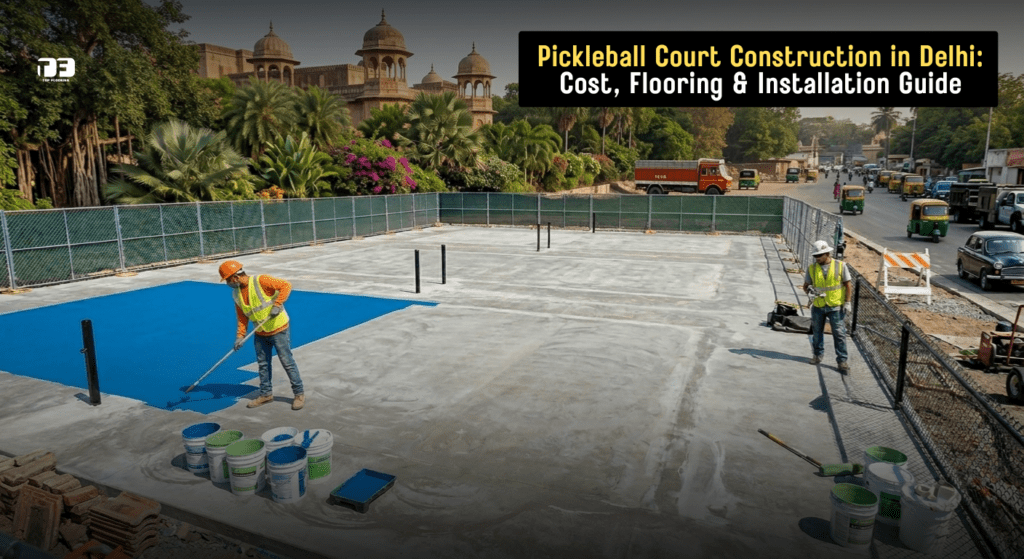
Pickleball is rapidly becoming one of the fastest-growing sports in India, and Delhi has emerged as a major hotspot for new pickleball court development. From residential societies and sports academies to clubs, schools, and commercial sports arenas, the demand for professional pickleball court construction is increasing every year.
The rise of the sport has created a strong need for durable, weather-resistant, and professional-grade pickleball court flooring solutions that can perform well in Delhi’s harsh climate conditions. Whether it is extreme summer heat, monsoon moisture, or heavy daily usage, the quality of construction directly impacts the court’s lifespan, player safety, bounce consistency, and maintenance costs.
This complete guide explains everything about pickleball court construction in Delhi, including court dimensions, flooring materials, construction process, installation stages, project costs, maintenance, expert recommendations, and real-world case studies.
Table of contents
- Why Pickleball is Growing Rapidly in Delhi
- Standard Pickleball Court Dimensions
- Best Flooring for Pickleball Courts in Delhi
- Types of Pickleball Court Flooring
- Importance of Surface Slope
- Pickleball Court Construction Cost in Delhi
- Common Mistakes in Pickleball Court Construction
- Maintenance Tips for Pickleball Courts
- Expert Advice for Long-Lasting Pickleball Courts
- Case Study 1: Residential Pickleball Court in Delhi NCR
- Case Study 2: Multi-Sport Facility Conversion
- Why Delhi Needs Weather-Resistant Pickleball Courts
- Future of Pickleball Court Construction in Delhi
- Conclusion
Why Pickleball is Growing Rapidly in Delhi
Several factors are driving the rapid expansion of pickleball infrastructure in Delhi NCR:
- Increasing interest in recreational sports
- Growing number of pickleball clubs and tournaments
- Space-efficient court dimensions
- Lower construction cost compared to tennis courts
- Easy conversion of existing badminton or tennis courts
- Demand from schools, housing societies, and fitness clubs
Unlike many traditional sports, pickleball appeals to all age groups. Young players enjoy its fast gameplay, while older players prefer it because it is easier on the joints compared to tennis.
As a result, many sports facility owners in Delhi are now investing in synthetic acrylic pickleball court construction.
Standard Pickleball Court Dimensions
Before starting construction, understanding official pickleball court measurements is essential.
Official Pickleball Court Size
A standard pickleball court measures:
- Court Size: 20 ft × 44 ft
- Total Recommended Playing Area: 30 ft × 60 ft
- Net Height:
- 36 inches at sidelines
- 34 inches at center
The additional surrounding space is important for safe player movement and tournament-level gameplay.
Court Layout Components
A professional pickleball court includes:
- Baseline
- Sidelines
- Non-volley zone (Kitchen)
- Service courts
- Centerline
- Net system
- Safety perimeter
Proper line marking accuracy is critical because even small dimensional errors affect gameplay.
Best Flooring for Pickleball Courts in Delhi
Choosing the right Pickleball Court flooring system is the most important part of court construction.
Why Synthetic Acrylic Flooring is Preferred
Synthetic acrylic flooring is considered one of the best surfaces for outdoor pickleball courts in Delhi because it offers:
- Excellent grip and traction
- Consistent ball bounce
- UV resistance
- Weather durability
- Anti-skid performance
- Long surface life
- Low maintenance requirements
Delhi’s climate includes intense UV exposure and seasonal rainfall, making acrylic systems more reliable than many alternative surfaces.
Types of Pickleball Court Flooring
1. Synthetic Acrylic Flooring
This is the most commonly used professional outdoor pickleball surface.
Advantages
- Smooth gameplay
- Cushioning options available
- Crack resistance
- Professional appearance
- Long-term durability
- Suitable for heavy usage
Best For
- Clubs
- Sports academies
- Schools
- Residential communities
- Tournament facilities
2. PP Interlocking Tiles
PP tiles are modular surfaces commonly used for temporary or semi-professional courts.
Advantages
- Faster installation
- Portable setup
- Lower initial preparation work
Limitations
- Less professional ball bounce
- Higher movement under extreme heat
- Joint gaps may affect gameplay
- Shorter lifespan in heavy commercial use
3. Concrete Surface with Paint
Some low-budget facilities use painted concrete without professional acrylic layering.
Limitations
- Poor grip
- Surface cracking
- Inconsistent bounce
- Faster wear and tear
- Higher injury risk
For long-term performance, professional synthetic acrylic flooring remains the preferred solution.
Step-by-Step Pickleball Court Construction Process
Professional pickleball court construction involves multiple technical stages.
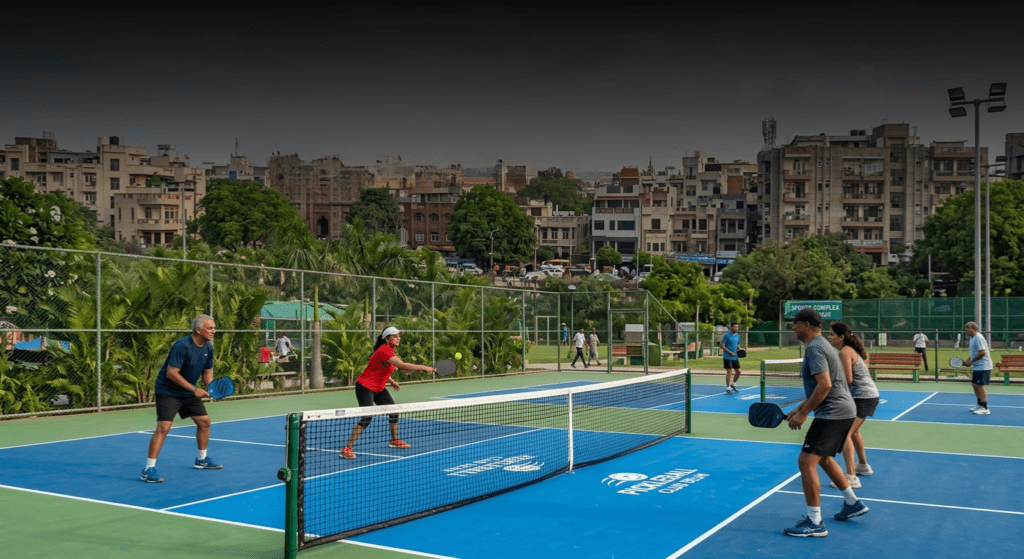
Step 1: Site Inspection & Planning
The process begins with site evaluation.
Important Factors Evaluated
- Ground condition
- Soil stability
- Water drainage
- Available space
- Surface slope
- Sun orientation
- Accessibility
In Delhi, drainage planning is especially important because monsoon water accumulation can damage poorly constructed courts.
Step 2: Ground Excavation & Base Preparation
After planning, excavation work starts.
Base Construction Includes
- Soil compaction
- Sub-base layering
- Aggregate filling
- Levelling
- Roller compaction
A strong base prevents future surface undulations and cracks.
Common Base Types
- Concrete base
- Asphalt base
Concrete is more common in Delhi due to durability and stability.
Importance of Surface Slope
Professional courts are never completely flat.
A slight slope is maintained for proper water drainage.
Recommended slope:
- Approximately 1%
Improper slope design causes:
- Water stagnation
- Surface peeling
- Faster acrylic damage
Step 3: Concrete or Asphalt Installation
The structural layer is then installed.
Concrete Base Advantages
- Stronger durability
- Better crack resistance
- Stable surface
- Longer lifespan
After installation, curing time is essential before acrylic coating begins.
Step 4: Surface Grinding & Crack Treatment
Before acrylic application, the base surface must be corrected.
This stage includes:
- Grinding uneven areas
- Filling cracks
- Deep patch repairs
- Surface levelling
Professional contractors use specialized patch systems to remove undulations and create a smooth playing surface.
Step 5: Acrylic Resurfacer Application
An acrylic resurfacer coat is applied to improve bonding and surface consistency.
Functions of Resurfacer
- Seals the concrete pores
- Improves adhesion
- Creates texture uniformity
- Enhances durability
Step 6: Cushion Layer (Optional)
High-performance courts may include cushioning layers.
Benefits
- Reduced joint stress
- Improved player comfort
- Better shock absorption
- Professional playing experience
Cushioned acrylic systems are ideal for clubs and tournament courts.
Step 7: Color Coating Application
Multiple acrylic color coats are applied.
Common Color Combinations
- Blue and green
- Red and green
- Grey and blue
Important Features
- UV-resistant pigments
- Anti-slip texture
- Weather resistance
Professional layering ensures even texture and consistent gameplay.
Step 8: Line Marking
Precision line marking is performed according to official pickleball dimensions.
High-quality acrylic line paint ensures:
- Sharp visibility
- Long-term durability
- Fade resistance
Step 9: Net System Installation
The final stage includes installation of:
- Net poles
- Center straps
- Net assembly
- Fencing (if required)
- Lighting systems
Pickleball Court Construction Cost in Delhi
Construction cost depends on several factors.
Major Cost Factors
- Court size
- Base type
- Acrylic system quality
- Cushion layers
- Site condition
- Drainage requirements
- Lighting installation
- Fencing
- Number of courts
Approximate Cost Range
Basic Recreational Court
- Lower-cost acrylic system
- Standard concrete base
- Minimal accessories
Professional Court
- Premium acrylic layers
- Cushion system
- Professional fencing
- Sports lighting
Tournament-Level Facility
- Multi-layer cushioning
- Premium surfacing
- Advanced drainage
- Spectator infrastructure
The final cost varies significantly based on project specifications and site conditions.
Common Mistakes in Pickleball Court Construction
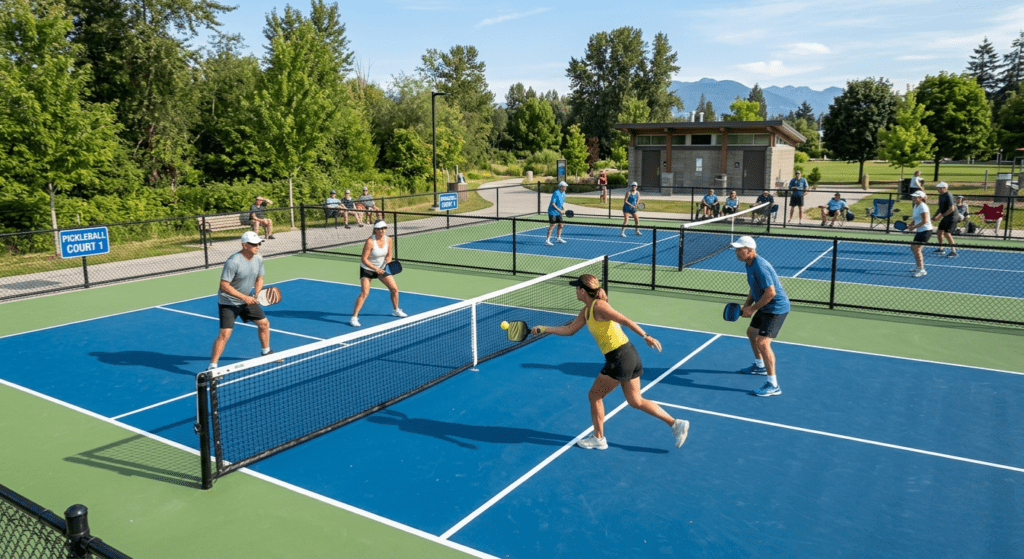
Many facilities face problems because of poor construction practices.
1. Weak Base Preparation
Poor compaction leads to:
- Surface cracks
- Settlement issues
- Uneven bounce
2. Low-Quality Acrylic Materials
Cheap coatings often result in:
- Peeling
- Color fading
- Reduced grip
3. Improper Drainage
Water accumulation is one of the biggest causes of court damage in Delhi.
4. Incorrect Surface Slope
Improper leveling creates gameplay issues and reduces surface life.
5. Inaccurate Court Dimensions
Incorrect measurements affect professional gameplay standards.
Maintenance Tips for Pickleball Courts
Proper maintenance increases surface lifespan significantly.
Weekly Maintenance
- Surface cleaning
- Dust removal
- Debris clearing
Monthly Maintenance
- Inspection for cracks
- Drainage checking
- Line visibility inspection
Annual Maintenance
- Surface inspection
- Acrylic touch-up
- Professional resurfacing assessment
Expert Advice for Long-Lasting Pickleball Courts
Sports flooring experts recommend the following:
Use Professional Acrylic Systems
Professional-grade acrylic materials provide:
- Better durability
- UV protection
- Consistent texture
- Longer lifespan
Prioritize Base Quality
A strong base determines overall court performance more than surface color or aesthetics.
Invest in Proper Drainage
Drainage systems significantly reduce long-term repair costs.
Avoid Low-Cost Shortcuts
Cheap construction often results in:
- Early resurfacing
- Frequent repairs
- Player dissatisfaction
Case Study 1: Residential Pickleball Court in Delhi NCR
A residential society in Delhi NCR wanted to convert an unused recreational area into a pickleball court.
Challenges
- Limited space
- Water drainage issues
- Existing uneven concrete
Solution
The contractor performed:
- Surface grinding
- Deep patch correction
- Acrylic resurfacing
- Professional line marking
Results
- Smooth gameplay surface
- Improved resident engagement
- Low maintenance requirements
- High daily usage durability
Case Study 2: Multi-Sport Facility Conversion
A sports academy converted an old badminton area into dual pickleball courts.
Requirements
- Multi-use compatibility
- Fast project completion
- Professional bounce quality
Construction Approach
- Existing base correction
- Acrylic cushioning system
- Anti-slip texture coating
- LED sports lighting installation
Outcome
The academy successfully hosted local pickleball events within months of installation.
Why Delhi Needs Weather-Resistant Pickleball Courts
Delhi experiences:
- Extreme summer temperatures
- Dust exposure
- Heavy seasonal rain
- High UV radiation
Because of this, professional synthetic acrylic systems are essential for long-term durability.
Weather-resistant courts offer:
- Better color stability
- Reduced surface damage
- Improved player safety
- Lower maintenance costs
Future of Pickleball Court Construction in Delhi
The future of pickleball infrastructure in Delhi looks extremely promising.
Expected trends include:
- More residential society courts
- Dedicated pickleball clubs
- Multi-court commercial facilities
- School and university installations
- Smart sports infrastructure integration
As awareness grows, the demand for professional pickleball court flooring and construction services is expected to increase significantly.
Conclusion
Pickleball court construction in Delhi requires proper planning, technical expertise, high-quality flooring materials, and professional installation methods. From base preparation and drainage design to acrylic surfacing and line marking, every stage directly affects court performance and lifespan.
Synthetic acrylic flooring continues to be one of the most reliable choices for outdoor pickleball courts because of its durability, weather resistance, anti-slip performance, and professional gameplay quality.
Whether the project involves a residential court, sports academy, club, or commercial sports facility, investing in quality construction ensures better player experience, lower maintenance costs, and long-term surface durability.