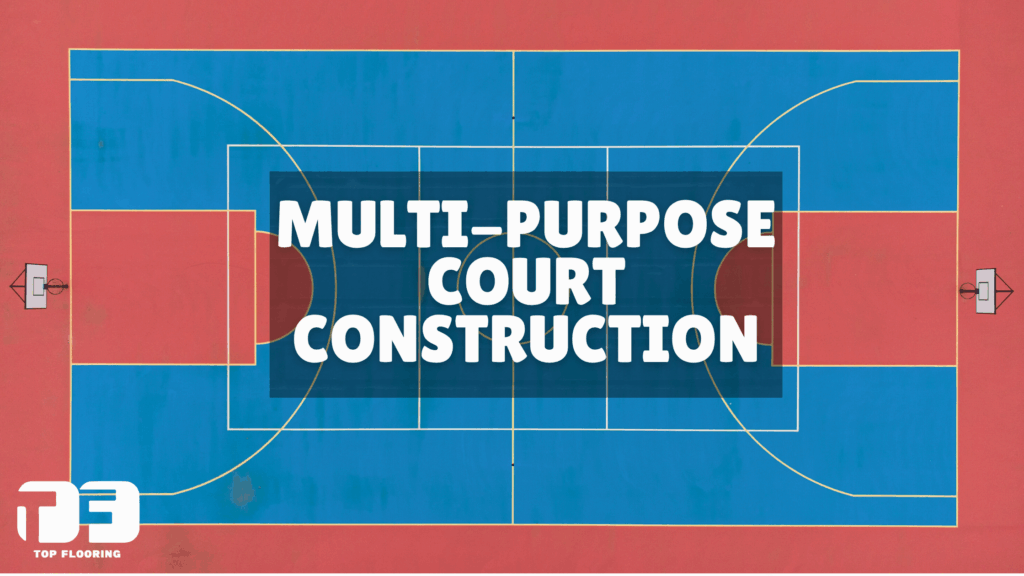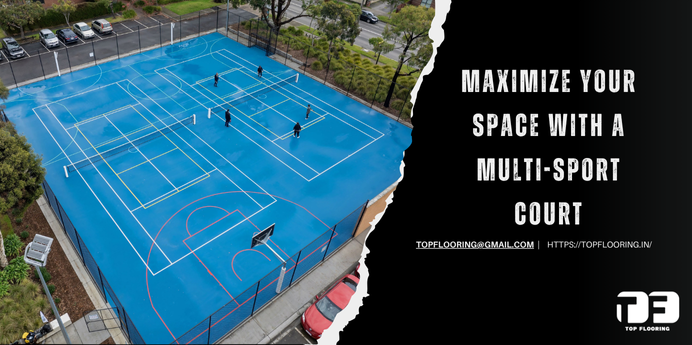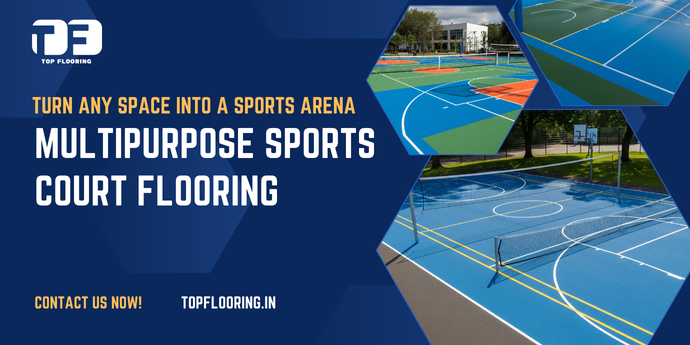
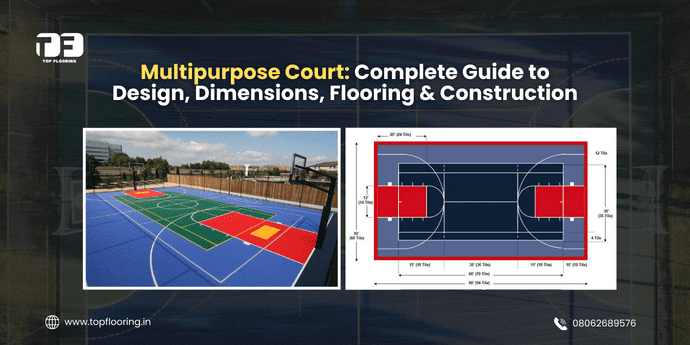
A multipurpose court is a sports playing surface designed to support multiple games—such as basketball, badminton, volleyball, tennis, and pickleball—on a single court. The most commonly recommended multipurpose court dimensions range from 28 m × 15 m to 34 m × 20 m, depending on the sports included in the layout. These courts typically use synthetic acrylic sports flooring, which provides durability, weather resistance, consistent ball bounce, and player safety.
Multipurpose courts are widely used in schools, sports academies, residential complexes, community parks, and sports clubs because they allow several sports to be played on one surface, saving both space and construction costs. A properly designed court includes accurate measurements, correct line markings, durable surface materials, proper drainage, and professional installation to ensure long-term performance.
What Is a Multipurpose Court?
A multipurpose sports court is a specially designed sports facility where multiple sports can be played on the same surface. Instead of constructing separate courts for each sport, a multipurpose court integrates different line markings and equipment within a single playing area.
These courts are especially beneficial in locations where space optimization and cost efficiency are important.
Sports Commonly Played on Multipurpose Courts
- Basketball
- Volleyball
- Badminton
- Tennis
- Pickleball
- Futsal or mini football
Many modern sports facilities also incorporate training drills, recreational games, and physical education activities on multipurpose courts.
Standard Multipurpose Court Dimensions
Multipurpose courts do not follow one universal dimension because they are designed based on the sports included. However, most courts are planned around basketball court dimensions, since basketball requires the largest playing area.
Typical Multipurpose Court Sizes
| Court Type | Length | Width | Sports Included |
| Community Multipurpose Court | 28 m | 15 m | Basketball, badminton |
| School Multipurpose Court | 30 m | 17 m | Basketball, volleyball |
| Large Multipurpose Sports Court | 34 m | 20 m | Basketball, tennis |
| Recreational Court | 26 m | 14 m | Volleyball, badminton |
These sizes allow proper placement of multiple sports line markings while maintaining adequate playing space.
Official Sports Court Dimensions Used in Multipurpose Design
To create a functional multipurpose sports court, designers consider official dimensions of individual sports.
Basketball Court Dimensions (FIBA Standard)
| Measurement | Size |
| Court Length | 28 m |
| Court Width | 15 m |
| Three-Point Line | 6.75 m |
| Free Throw Line Distance | 4.6 m |
Basketball typically forms the primary layout for multipurpose courts.
Badminton Court Dimensions (BWF Standard)
| Measurement | Singles | Doubles |
| Court Length | 13.4 m | 13.4 m |
| Court Width | 5.18 m | 6.1 m |
| Net Height | 1.55 m | 1.55 m |
Multiple badminton courts can fit within a basketball-sized playing area.
Volleyball Court Dimensions (FIVB Standard)
| Measurement | Size |
| Court Length | 18 m |
| Court Width | 9 m |
| Net Height (Men) | 2.43 m |
| Net Height (Women) | 2.24 m |
Volleyball courts easily integrate into multipurpose layouts.
Tennis Court Dimensions (ITF Standard)
| Measurement | Size |
| Court Length | 23.77 m |
| Singles Width | 8.23 m |
| Doubles Width | 10.97 m |
| Net Height | 0.914 m |
Tennis markings are usually included in larger multipurpose courts.
Multipurpose Court Layout and Line Markings
Proper line marking design is critical for a multipurpose court to avoid confusion during gameplay.
Recommended Line Colors
| Sport | Line Color |
| Basketball | White |
| Volleyball | Yellow |
| Badminton | Green |
| Tennis | Blue |
This color-coding system allows players to easily identify the correct playing lines for each sport.
Important Layout Considerations
- Minimum 2–3 m safety space around the court
- Non-overlapping key zones
- Clear placement of basketball poles and net posts
- Proper alignment for multiple sports
Sports infrastructure planners often use digital layout software and precise measurements during installation.
Indoor vs Outdoor Multipurpose Courts
Multipurpose courts can be constructed both indoors and outdoors depending on usage requirements.
Indoor vs Outdoor Court Comparison
| Feature | Indoor Court | Outdoor Court |
| Surface Material | Wood, PU flooring | Acrylic sports flooring |
| Weather Exposure | None | Rain, sunlight |
| Maintenance | Lower | Moderate |
| Construction Cost | Higher | More economical |
| Lighting | Artificial lighting | Natural + floodlights |
Outdoor multipurpose courts are more common in schools, parks, and residential societies because they require lower investment.
Materials Used in Multipurpose Sports Courts
Selecting the right flooring material significantly impacts court durability, player comfort, and sports performance.
Common Sports Court Flooring Materials
| Material | Key Features | Typical Application |
| Synthetic Acrylic Flooring | Durable, UV resistant | Outdoor sports courts |
| Polyurethane Flooring | Cushioning and shock absorption | Indoor sports arenas |
| EPDM Rubber | High elasticity | Playgrounds |
| Wooden Flooring | Premium performance | Professional indoor courts |
Among these materials, synthetic acrylic sports flooring is the most widely used option for multipurpose outdoor courts.
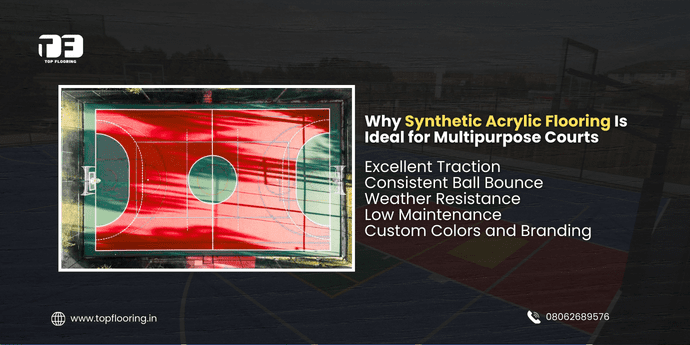
Why Synthetic Acrylic Flooring Is Ideal for Multipurpose Courts
Synthetic acrylic sports flooring has become the preferred surface for outdoor sports infrastructure.
Key Benefits of Acrylic Sports Flooring
1. Excellent Traction
Acrylic surfaces provide a textured finish that enhances player grip and safety.
2. Consistent Ball Bounce
The surface ensures uniform ball rebound, which is essential for sports like basketball and tennis.
3. Weather Resistance
Acrylic sports coatings can withstand:
- Heavy sunlight
- Rain and moisture
- Temperature fluctuations
This makes them ideal for tropical climates and outdoor sports environments.
4. Low Maintenance
Acrylic courts require only periodic cleaning and occasional resurfacing.
5. Custom Colors and Branding
Multipurpose courts can be designed with different color zones and school or club branding.
Multipurpose Court Construction Process
Building a high-quality multipurpose sports court requires proper planning and professional installation.
1. Site Preparation
The first stage includes:
- Soil testing
- Land leveling
- Drainage planning
A stable base prevents structural issues later.
2. Base Construction
The base layer usually consists of:
- Compacted soil
- Granular sub-base
- Reinforced concrete or asphalt layer
Proper base construction ensures surface stability and long-term durability.
3. Acrylic Sports Coating Application
The acrylic flooring system typically includes:
- Acrylic primer
- Resurfacer coat
- Cushion layers (optional)
- Color coating
- Line marking paint
This layered system creates a durable, slip-resistant sports surface.
4. Sports Equipment Installation
Final installations include:
- Basketball poles
- Volleyball net posts
- Badminton net systems
- Protective fencing
- Floodlighting systems
Multipurpose Court Construction Cost
The cost of building a multipurpose court depends on several factors.
Major Cost Factors
| Factor | Impact on Cost |
| Court size | Larger courts require more materials |
| Base type | Asphalt or concrete base |
| Surface material | Acrylic or PU flooring |
| Lighting system | Floodlights increase cost |
| Sports equipment | Poles, nets, fencing |
Estimated Multipurpose Court Construction Cost (India)
| Court Type | Estimated Cost |
| Basic Concrete Court | ₹4–₹6 lakh |
| Acrylic Multipurpose Court | ₹6–₹12 lakh |
| Professional Sports Facility | ₹12–₹25 lakh |
Costs vary based on site conditions, materials, and project scale.
Maintenance Tips for Multipurpose Courts
Proper maintenance significantly extends the life of sports courts.
Essential Maintenance Practices
- Regular cleaning of the surface
- Checking for cracks or surface damage
- Repainting line markings periodically
- Ensuring proper drainage
Well-maintained acrylic sports courts typically last 8–12 years before resurfacing.
Common Mistakes During Multipurpose Court Construction
Avoiding these mistakes ensures long-term court performance.
Frequent Errors
Poor Drainage Planning
Water accumulation can damage sports flooring.
Incorrect Court Orientation
Courts should ideally be oriented north–south to reduce sunlight glare.
Improper Surface Slope
A slope of about 1% helps proper drainage.
Overlapping Line Markings
Too many markings can confuse players if not planned properly.
Safety Considerations in Sports Court Design
Player safety is a critical factor in sports infrastructure planning.
Essential Safety Features
- Non-slip sports surface
- Shock absorption layers
- Adequate run-off area
- Protective fencing
- Proper lighting for night play
These features help reduce sports injuries and improve gameplay quality.
Future Trends in Multipurpose Sports Courts
Modern sports infrastructure is evolving with new technologies and materials.
Emerging Trends
Smart Sports Courts
Sensors integrated into courts can track player movement and performance metrics.
Sustainable Sports Flooring
Eco-friendly coatings and recycled materials are becoming popular.
Hybrid Sports Complexes
Modern facilities combine multipurpose courts, fitness zones, skating areas, and walking tracks within a single complex.
Conclusion
Multipurpose courts have become an essential element of modern sports infrastructure because they allow multiple sports to be played on a single surface while maximizing available space. Proper planning of court dimensions, line markings, construction methods, and surface materials ensures safe and durable sports facilities.
Among various surface options, synthetic acrylic sports flooring remains the most reliable and cost-effective solution for outdoor multipurpose courts. Its durability, weather resistance, consistent playing performance, and low maintenance requirements make it the preferred choice for schools, sports academies, residential communities, and recreational parks.
By investing in professional sports court design and high-quality flooring systems, facility planners and developers can create long-lasting sports environments that encourage participation, improve athletic performance, and support the growth of sports infrastructure.
Frequently Asked Questions (FAQs)
Most multipurpose courts measure 28 m × 15 m, which accommodates basketball while allowing other sports like badminton and volleyball.
Sports commonly played include basketball, volleyball, badminton, tennis, pickleball, and futsal.
Synthetic acrylic sports flooring is widely considered the best option because of its durability, traction, and weather resistance.
A professionally constructed acrylic court can last 10–15 years with proper maintenance.
Including safety margins, about 30 m × 18 m space is recommended.
Yes, multipurpose courts are very popular in residential complexes, schools, and community parks.