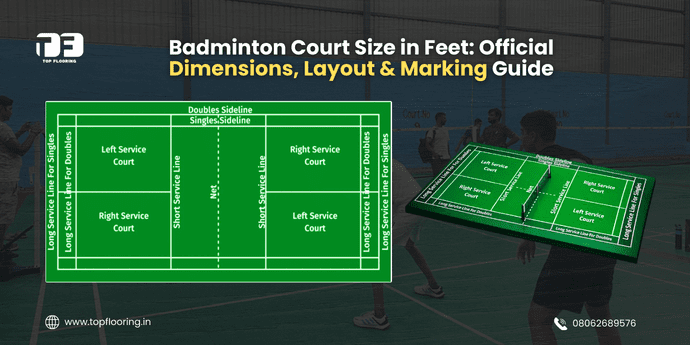
The official badminton court size in feet is 44 feet long and 20 feet wide for doubles matches, while the singles court width is 17 feet. These dimensions are defined by the Badminton World Federation (BWF) and are used in international tournaments, professional competitions, and standard badminton facilities worldwide.
A badminton court includes multiple markings such as the baseline, center line, short service line, and long service line, which divide the court into specific playing zones. The net height is 5 feet at the posts and 5 feet 1 inch at the center, ensuring consistent gameplay conditions.
Understanding the exact badminton court dimensions, layout, and markings in feet is essential for architects, sports infrastructure developers, schools, and sports facility planners designing professional badminton courts. Accurate measurements ensure fair gameplay, player safety, and compliance with global standards.
This guide explains badminton court size in feet, official measurements, layout, markings, construction planning, flooring materials, and modern sports court technologies.
Official Badminton Court Dimensions in Feet
Badminton court measurements are standardized globally by the Badminton World Federation (BWF) to maintain consistency across competitions.
Standard Badminton Court Measurement Table
| Court Component | Measurement (Feet) | Measurement (Meters) |
| Total Court Length | 44 ft | 13.4 m |
| Doubles Court Width | 20 ft | 6.1 m |
| Singles Court Width | 17 ft | 5.18 m |
| Net Height at Center | 5 ft 1 in | 1.55 m |
| Net Height at Posts | 5 ft | 1.524 m |
| Short Service Line Distance | 6 ft 6 in | 1.98 m |
| Long Service Line (Doubles) | 2 ft 6 in from baseline | 0.76 m |
| Court Line Width | 1.57 inches | 40 mm |
These measurements apply to professional tournaments, training facilities, school courts, and recreational badminton courts.
Badminton Court Area in Square Feet
Understanding the total playing area helps planners estimate construction space and flooring materials.
| Court Type | Size (Feet) | Total Area |
| Singles Court | 44 × 17 ft | 748 sq ft |
| Doubles Court | 44 × 20 ft | 880 sq ft |
However, when designing a sports facility, additional run-off space around the court is required for safe movement.
Badminton Court Layout Explained
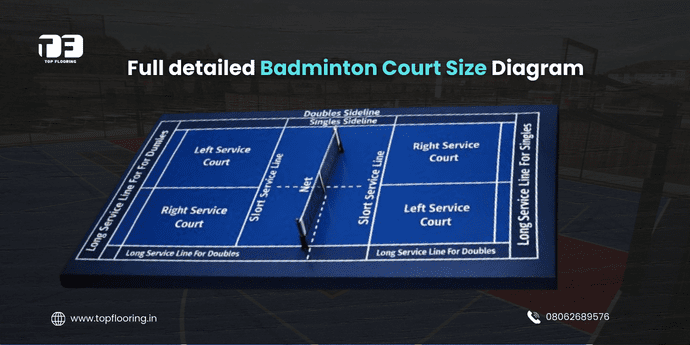
A badminton court layout includes several markings that divide the playing area into service zones and boundary lines.
Key Sections of a Badminton Court
Baseline
The back boundary line of the court. If the shuttlecock lands beyond this line, it is considered out.
Sidelines
The vertical boundary lines along the length of the court.
- Inner sidelines → used for singles matches
- Outer sidelines → used for doubles matches
Center Line
Divides the court into left and right service areas.
Short Service Line
Marks the minimum distance a serve must travel.
Long Service Line for Doubles
Defines the maximum depth allowed for a serve in doubles matches.
Badminton Court Markings and Measurement Rules
Precise court markings are essential because they determine whether a shuttlecock is in or out.
Standard Court Markings
| Line | Function |
| Baseline | Back boundary of the court |
| Sideline | Side boundary lines |
| Center Line | Divides service courts |
| Short Service Line | Minimum serve distance |
| Long Service Line (Doubles) | Maximum serve depth |
| Long Service Line (Singles) | Same as baseline |
All court lines are 1.57 inches (40 mm) wide and must be clearly visible.
Singles vs Doubles Badminton Court Dimensions
The length of the badminton court remains the same for both singles and doubles matches, but the width changes.
Comparison Table
| Feature | Singles Court | Doubles Court |
| Length | 44 ft | 44 ft |
| Width | 17 ft | 20 ft |
| Service Area | Narrow | Wider |
| Long Service Line | Baseline | Shorter service line |
| Gameplay Style | More precision | Faster rallies |
Singles matches require players to cover the full court length but a narrower width, emphasizing endurance and strategic placement.
Minimum Space Required for a Badminton Court
When constructing a badminton facility, additional space must be included for player safety and movement.
Recommended Facility Size
| Area | Recommended Measurement |
| Playing Court | 44 × 20 ft |
| Side Clearance | 4–6 ft |
| Back Clearance | 6–8 ft |
| Minimum Hall Height | 30 ft |
| Ideal Court Area | 60 × 30 ft |
Sports facility planners often allocate extra space to allow spectator seating and multiple courts in large indoor halls.
Indoor vs Outdoor Badminton Courts
Professional badminton is typically played indoors because environmental conditions can affect shuttle flight.
Comparison of Court Types
| Feature | Indoor Court | Outdoor Court |
| Wind Effect | None | Significant |
| Lighting | Artificial sports lighting | Natural light |
| Surface Type | PVC or wooden flooring | Acrylic or concrete |
| Tournament Use | Yes | Rare |
| Maintenance | Moderate | Higher due to weather |
Indoor courts provide better control, consistent gameplay, and improved player safety.
Construction Process of a Badminton Court
Constructing a professional badminton court requires careful planning and precise execution.
Step-by-Step Construction Process
1. Base Preparation
A stable base is created using concrete or asphalt to support the sports flooring system.
2. Surface Installation
Sports flooring such as synthetic acrylic coatings or PVC sports flooring is installed.
3. Line Marking
Court lines are painted according to official badminton measurements.
4. Net and Post Installation
Posts are installed at the sidelines, and the net is fixed at standard height.
5. Lighting System Installation
Indoor courts require uniform LED sports lighting to avoid glare.
6. Final Inspection
Measurements and surface quality are checked before the court becomes operational.
Materials Used in Modern Badminton Court Flooring
Different flooring systems are used depending on facility requirements and budget.
Common Sports Flooring Materials
| Flooring Type | Key Features |
| Wooden Flooring | Used in professional indoor arenas |
| PVC Sports Flooring | Good shock absorption |
| Synthetic Acrylic Flooring | Durable and weather resistant |
| Polyurethane Flooring | High elasticity and cushioning |
| Concrete Surface | Low-cost outdoor option |
Each surface type offers different levels of grip, durability, and maintenance requirements.
Why Synthetic Acrylic Flooring is Popular for Sports Courts
Synthetic acrylic flooring systems are widely used in modern sports infrastructure because of their performance and durability.
Advantages of Acrylic Sports Flooring
Durability
Acrylic surfaces withstand heavy sports activity and outdoor weather conditions.
Slip Resistance
Textured coatings improve traction and player safety.
UV Resistance
Surface colors remain vibrant under sunlight.
Low Maintenance
Requires minimal upkeep compared to wooden courts.
Multi-Sport Use
Suitable for badminton, tennis, basketball, and pickleball courts.
Because of these advantages, synthetic acrylic surfaces are commonly installed in schools, parks, sports academies, and recreational facilities.
Cost Factors in Badminton Court Construction
The total cost of building a badminton court varies depending on infrastructure and materials.
Major Cost Influencing Factors
| Factor | Description |
| Flooring Material | Acrylic, PVC, or wood |
| Base Construction | Concrete or asphalt foundation |
| Lighting System | LED sports lighting installation |
| Drainage System | Essential for outdoor courts |
| Labor Costs | Skilled installation team |
Proper planning ensures the facility delivers long-term durability and professional gameplay conditions.
Maintenance Tips for Badminton Courts
Regular maintenance ensures long life and consistent playing conditions.
Recommended Maintenance Practices
- Clean court surfaces regularly
- Inspect for cracks or damage
- Repaint faded court lines
- Avoid dragging heavy equipment across the surface
- Schedule periodic resurfacing for acrylic coatings
With proper care, sports court surfaces can last 10–15 years or longer.
Common Mistakes in Badminton Court Construction
Poor planning can lead to expensive corrections later.
Typical Construction Errors
- Incorrect court dimensions
- Poor base leveling
- Low-quality flooring materials
- Inadequate safety clearance areas
- Improper lighting design
Professional sports flooring contractors help ensure accurate measurements and long-lasting performance.
Safety Considerations in Court Design
Safety should be a priority when building sports infrastructure.
Key Safety Guidelines
- Use non-slip sports flooring surfaces
- Provide adequate run-off areas
- Maintain smooth, crack-free surfaces
- Install proper sports lighting
- Ensure correct net tension and height
These precautions help prevent injuries during high-speed rallies.
Future Trends in Badminton Court Construction
Sports infrastructure is evolving with modern materials and smart technologies.
Emerging Innovations
Smart Sports Courts
Sensors embedded in the surface track player performance and movement.
Sustainable Sports Flooring
Eco-friendly materials are being developed for sports surfaces.
Hybrid Multi-Sport Courts
Facilities designed for multiple sports using advanced acrylic coatings.
Improved Surface Technologies
Modern acrylic systems provide better grip, durability, and weather resistance.
These innovations are shaping the future of sports court construction and facility design.
Conclusion
Understanding the official badminton court size in feet, layout, and markings is essential for designing professional sports facilities. The standard dimensions of 44 feet by 20 feet for doubles matches and 44 feet by 17 feet for singles matches ensure consistency in gameplay across tournaments and training courts.
Beyond accurate measurements, successful badminton court construction depends on proper planning, high-quality sports flooring materials, precise line markings, and professional installation. Modern sports infrastructure increasingly uses synthetic acrylic sports flooring systems due to their durability, safety, and low maintenance requirements.
For schools, sports academies, and infrastructure developers, investing in well-constructed badminton courts helps create high-performance sports environments that support safe and competitive play for years to come.
Frequently Asked Questions (FAQ)
The official badminton court size is 44 feet long and 20 feet wide for doubles matches, while the singles court width is 17 feet.
A standard doubles badminton court covers approximately 880 square feet.
The badminton net height is 5 feet at the posts and 5 feet 1 inch at the center.
Standard badminton court lines are 40 mm (about 1.57 inches) wide.
Including safety clearance, a badminton facility typically requires around 60 ft × 30 ft of space.