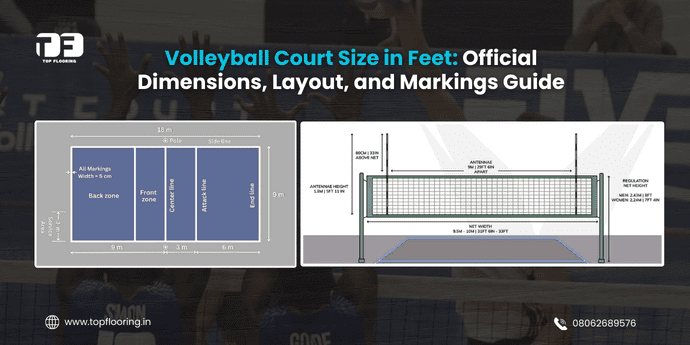
The official volleyball court size in feet is 59 feet long and 29.5 feet wide, which equals 18 meters × 9 meters according to the standards defined by the Fédération Internationale de Volleyball (FIVB). The court is divided into two equal halves of 29.5 ft × 29.5 ft, separated by a net placed at the center line. Each half also includes an attack line positioned 9 feet 10 inches (3 meters) from the net, creating front and back zones for gameplay.
In addition to the playing area, volleyball courts require a free zone around the court ranging from 10 to 16 feet to allow safe player movement. These measurements are followed worldwide in professional tournaments, schools, sports academies, and recreational facilities. Understanding volleyball court dimensions is essential for sports infrastructure planners, architects, facility developers, and sports flooring manufacturers who aim to build safe and regulation-compliant courts.
Official Volleyball Court Dimensions in Feet
The standard volleyball court has a rectangular layout with carefully defined measurements that ensure fairness and proper gameplay.
Volleyball Court Measurement Table
| Feature | Measurement (Feet) | Measurement (Meters) |
| Total court length | 59 ft | 18 m |
| Total court width | 29.5 ft | 9 m |
| Half court size | 29.5 × 29.5 ft | 9 × 9 m |
| Attack line distance from net | 9 ft 10 in | 3 m |
| Service zone width | 29.5 ft | 9 m |
| Minimum free zone | 9 ft 10 in | 3 m |
| Recommended free zone | 16 ft | 5 m |
| Indoor ceiling height | 23 ft minimum | 7 m |
These measurements are standardized by international governing bodies such as:
- Fédération Internationale de Volleyball
- International Olympic Committee
- National Collegiate Athletic Association
Maintaining these dimensions ensures that players experience consistent gameplay conditions across different facilities.
Volleyball Court Layout Explained
A volleyball court consists of multiple zones that regulate player positioning and gameplay strategies. Proper court layout is crucial when designing a sports facility.
Key Zones in a Volleyball Court
| Court Zone | Description |
| Front zone | Area between the net and attack line |
| Back zone | Area between attack line and end line |
| Service zone | Area behind the end line where players serve |
| Free zone | Clear space around the court |
| Substitution zone | Area where players enter or exit the game |
The attack line plays an important role in volleyball rules. Players positioned in the back row must jump from behind this line when performing an attacking shot.
Volleyball Court Markings and Line Measurements
Court markings define the boundaries of gameplay and guide player movement. All volleyball court lines are typically 2 inches (5 cm) wide and must contrast clearly with the playing surface.
Important Volleyball Court Lines
| Line | Function |
| Baselines (end lines) | Mark the back boundary of the court |
| Sidelines | Mark the side boundaries |
| Center line | Divides the court into two halves |
| Attack line | Separates front and back zones |
| Service line | Defines the serving area |
| Substitution line | Used during player substitutions |
Modern sports courts use high-durability acrylic sports paint for line markings to ensure clear visibility and long-term durability.
Volleyball Net Height Standards
The height of the volleyball net varies depending on the competition category.
Official Volleyball Net Height
| Category | Net Height (Feet) | Net Height (Meters) |
| Men’s volleyball | 7 ft 11 5/8 in | 2.43 m |
| Women’s volleyball | 7 ft 4 1/8 in | 2.24 m |
| Youth volleyball | 6.5 – 7.5 ft | Varies |
The net is supported by poles positioned approximately 3 feet outside the sidelines to avoid interfering with gameplay.
Indoor vs Outdoor Volleyball Court Dimensions
The playing area dimensions remain the same for both indoor and outdoor volleyball courts, but the construction materials and infrastructure vary.
Comparison of Indoor and Outdoor Volleyball Courts
| Feature | Indoor Court | Outdoor Court |
| Surface | Hardwood or PU flooring | Acrylic or sand |
| Weather protection | Controlled environment | Weather resistant design |
| Lighting | Indoor sports lighting | Floodlights |
| Drainage | Not required | Essential |
| Maintenance | Moderate | Low |
Outdoor volleyball courts require surfaces that can withstand rain, sunlight, and temperature variations.
Volleyball Court Construction Process
Building a professional volleyball court requires accurate measurements and proper installation techniques.
Step-by-Step Volleyball Court Construction
1. Site Preparation
The construction site is leveled and compacted to create a stable base.
2. Base Layer Construction
Concrete or asphalt is installed to form a strong structural foundation.
3. Surface Preparation
The base is smoothed and primed to ensure proper bonding of the sports flooring system.
4. Sports Surface Installation
Synthetic sports coatings or hardwood flooring systems are applied depending on indoor or outdoor usage.
5. Court Line Marking
Official volleyball court lines are marked using precision measurement tools.
6. Equipment Installation
Net posts, nets, and protective padding are installed according to official standards.
Professional installation ensures consistent ball bounce, proper traction, and long-term surface durability.
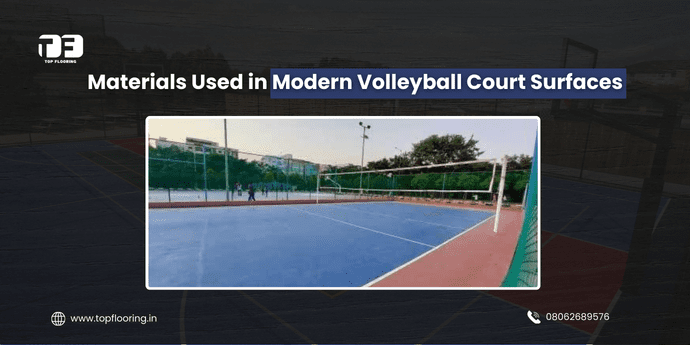
Materials Used in Modern Volleyball Court Surfaces
Several surface materials are used for volleyball courts depending on usage, climate, and budget.
Volleyball Court Flooring Materials
| Surface Material | Application |
| Hardwood flooring | Indoor professional arenas |
| Synthetic acrylic flooring | Outdoor courts |
| PU sports flooring | Indoor multipurpose halls |
| Sand | Beach volleyball |
| Modular sports tiles | Temporary courts |
Among these materials, synthetic acrylic sports flooring is widely used for outdoor sports infrastructure.
Why Synthetic Acrylic Flooring Is Popular for Volleyball Courts
Synthetic acrylic flooring has become the preferred choice for outdoor sports courts due to its performance and durability.
Key Benefits of Synthetic Acrylic Sports Flooring
Weather Resistance
Acrylic surfaces resist UV exposure, rain, and extreme temperatures, making them suitable for outdoor sports facilities.
Excellent Player Grip
The textured surface provides high traction, reducing the risk of slips and injuries.
Consistent Ball Bounce
Acrylic sports coatings maintain uniform ball response, improving gameplay quality.
Low Maintenance
These surfaces require minimal maintenance compared to traditional sports flooring systems.
Long Service Life
With proper installation, synthetic acrylic courts can last 8–12 years before resurfacing.
Because of these advantages, acrylic flooring is widely used for volleyball courts, basketball courts, tennis courts, and multipurpose sports facilities.
Cost Considerations for Volleyball Court Construction
The cost of building a volleyball court depends on several factors including surface material, site conditions, and infrastructure requirements.
Major Cost Factors
| Factor | Impact |
| Land preparation | Leveling and excavation |
| Base construction | Concrete or asphalt foundation |
| Sports flooring | Acrylic, PU, or hardwood |
| Lighting installation | Enables night play |
| Fencing and seating | Spectator facilities |
Outdoor acrylic volleyball courts are generally more cost-effective than indoor hardwood installations.
Maintenance Tips for Volleyball Courts
Proper maintenance ensures that sports courts remain safe and playable for many years.
Essential Maintenance Practices
- Regular cleaning to remove dust and debris
- Periodic inspection for surface cracks
- Repainting of court markings when needed
- Net tension adjustment
- Drainage inspection for outdoor courts
Routine maintenance helps maintain consistent surface performance and athlete safety.
Common Mistakes During Volleyball Court Construction
Several construction errors can negatively affect court performance.
Frequent Construction Mistakes
- Incorrect court dimensions
- Poor base construction
- Improper attack line placement
- Inadequate drainage system
- Use of non-sports grade flooring materials
Hiring experienced sports infrastructure professionals helps avoid these issues.
Safety Considerations in Volleyball Court Design
Player safety should always be a top priority in sports facility design.
Important safety measures include:
- Adequate free zone around the court
- Shock-absorbing sports surfaces
- Anti-slip coatings
- Proper lighting for visibility
- Protective padding around net posts
Modern sports infrastructure design focuses on injury prevention and optimal playing conditions.
Future Trends in Volleyball Court Design
Sports infrastructure continues to evolve with technological advancements.
Emerging Trends
Smart Sports Surfaces
Sensor-enabled courts can track player movement and performance data.
Sustainable Flooring Systems
Eco-friendly sports coatings with low environmental impact are becoming more popular.
Multipurpose Sports Courts
Facilities are increasingly designed to support multiple sports on a single surface.
Advanced Drainage Systems
Improved drainage technologies help maintain playable surfaces during heavy rainfall.
These innovations are shaping the future of modern sports infrastructure.
Conclusion
Understanding volleyball court size in feet, official dimensions, and proper layout is essential when designing professional sports facilities. The standard court measures 59 × 29.5 feet, with clearly defined zones, markings, and net height requirements that ensure fair gameplay.
For sports academies, schools, stadium developers, and infrastructure planners, proper construction methods and high-quality materials play a critical role in building durable sports courts. Modern facilities increasingly rely on synthetic acrylic sports flooring, which offers long-term durability, excellent grip, and low maintenance for outdoor sports infrastructure.
Investing in professional sports court design and high-quality sports flooring ensures safe gameplay, consistent performance, and long-lasting sports infrastructure for athletes and communities.
Frequently Asked Questions
The standard volleyball court measures 59 feet in length and 29.5 feet in width, according to international volleyball regulations.
The attack line is placed 9 feet 10 inches (3 meters) from the net on each side of the court.
A volleyball court requires a free zone of at least 10 feet around the court, though professional facilities often provide up to 16 feet.
The official net height is 7 ft 11 5/8 in for men and 7 ft 4 1/8 in for women.
Including free zones, a volleyball facility usually requires around 80 to 92 feet in length and 50 to 60 feet in width.