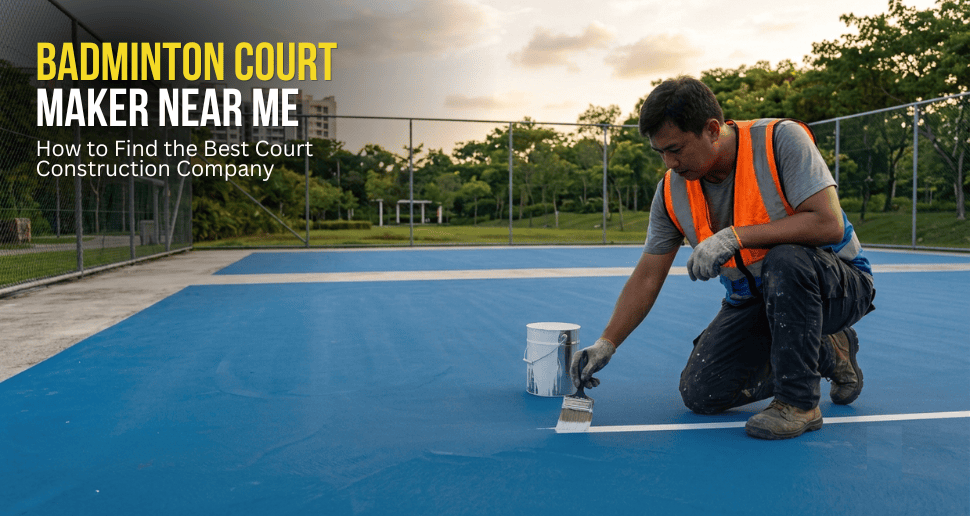
Searching “badminton court maker near me” into Google usually means one of two things: you’re building a new court and don’t know who to trust with the job, or your existing court has worn out and you need someone local to fix it properly. Either way, the decision matters more than most people realize. A badminton court isn’t just a painted rectangle – it’s a base, a drainage system, a cushioning layer, and a surface finish that all have to work together. Get any one of those wrong, and you’re looking at cracking, waterlogging, or a court that plays inconsistently within a year.
This guide walks through exactly how to evaluate a local badminton court maker, what separates a good construction company from a risky one, and what real installation projects actually look like from start to finish.
Table of contents
What a Badminton Court Maker Actually Does
The term “badminton court maker” gets used loosely, and that’s part of why the search results are confusing. In reality, there are two distinct roles in building a court:
| Role | What They Handle |
|---|---|
| Flooring Manufacturer | Produces the acrylic coating system, cushion layers, and line-marking paint sold to installers or directly to clients. |
| Court Construction / Installation Company | Handles the on-site work: base survey, slope correction, drainage, layer-by-layer surface application, and final line marking. |
Some companies do both. Most don’t. When you search “badminton court maker near me,” you’re almost always looking for the second category – the team that will physically show up, assess your site, and build the court. This distinction matters because a manufacturer three states away can sell you excellent material, but if the local installation crew doesn’t prepare the base correctly, the material’s quality won’t save the court. Top Flooring specializes in exactly this on-the-ground acrylic installation work.
Why “Near Me” Matters More Than You’d Think
Badminton court construction is not a one-visit job. It typically involves a site survey, base preparation, multiple coating layers with curing time between each, and a final inspection. A local installer can:
- Visit the site quickly for an accurate quote instead of estimating from photos
- Understand regional climate factors – monsoon drainage needs in coastal cities differ from heat and UV exposure concerns inland
- Respond faster if there’s a warranty issue or resurfacing need later
- Provide references from courts you can actually go see in person
This last point is the one people skip, and it’s the most useful. A photo on a website tells you nothing about how a court feels underfoot after 18 months of use. A local reference court does.
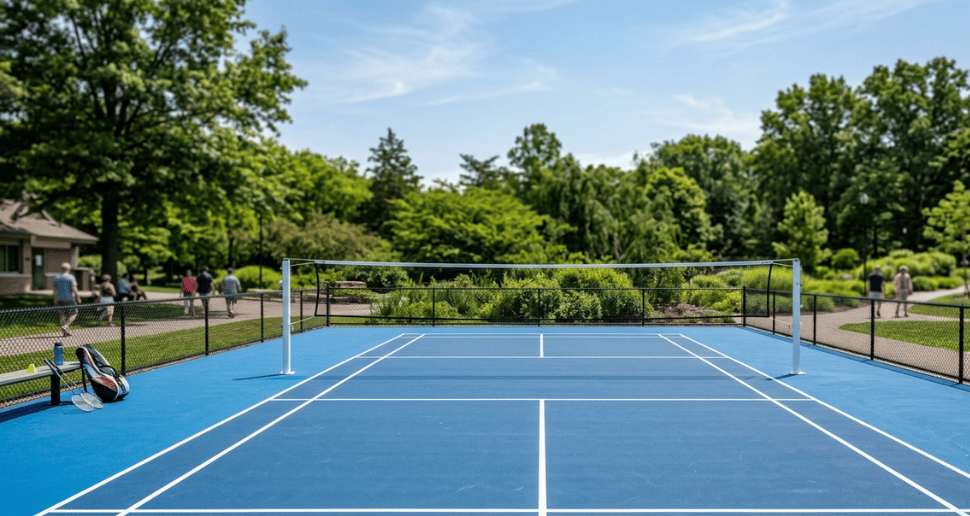
Expert Checklist: How to Vet a Court Construction Company
- Ask for a physical site visit before quoting. Any company willing to give you a firm price without seeing the ground is guessing – and you’ll pay for that guess later in change orders.
- Request to see 2–3 completed courts, ideally 1+ years old. New installations always look good. Ask specifically to see something that’s had a full monsoon season and a full summer on it.
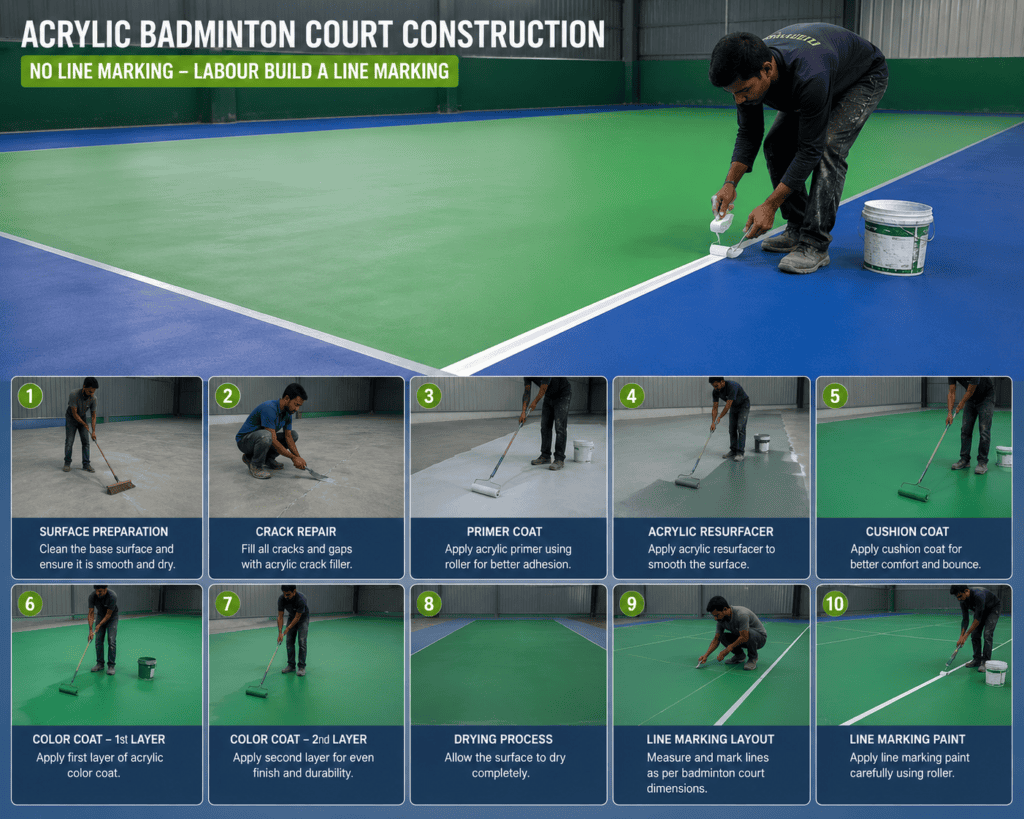
- Get a layer-by-layer breakdown in writing. A proper acrylic system includes base preparation, primer, cushion layer (if applicable), multiple acrylic coats, and line marking. If the quote just says “acrylic flooring – lump sum,” ask them to itemize it.
- Confirm who handles base and drainage work. This is where most long-term court failures start. Ask directly: who assesses slope and drainage, and is that included in the quote or subcontracted separately?
- Check the warranty terms, not just the warranty length. A 3-year warranty that only covers material defects (not installation errors) is very different from one that covers the full system.
- Ask about weather-specific formulation. If you’re in a high-UV or high-humidity region, confirm the coating system is suited to it – not a generic spec used everywhere.
- Compare at least two quotes. Not to chase the lowest price, but because the gaps between quotes usually reveal what one company is including that another isn’t.
Red Flags to Watch For
- Verbal-only quotes with no written scope of work
- Pressure to pay the full amount upfront before any work begins
- No willingness to show past project sites, only photos
- Unusually short timelines that skip curing time between coating layers
- No mention of base/drainage assessment as part of the process
Case Studies: Real Installation Projects
Case Study 1: Resurfacing a Waterlogged Outdoor Court, Coastal City
The problem: A sports academy’s outdoor badminton court had been resurfaced twice in five years but kept failing in the same way – standing water after monsoon rains, peeling paint near the baseline, and a surface that had gone slick and inconsistent underfoot. Players had started avoiding the court during and right after the rainy season.
The assessment: A site survey found the real issue wasn’t the acrylic coating at all – it was the base. The original slope had been laid nearly flat, so water had nowhere to run off. Every previous resurfacing had gone straight over the same flawed base, which is why the same problems kept coming back.
The solution: Rather than another surface-only resurfacing, the team recommended a full base correction: breaking up and regrading the existing base to the proper drainage slope, adding a perimeter drainage channel, then applying a fresh multi-layer acrylic system suited to high-humidity conditions.
The result: The court has gone through a full monsoon season without any standing water. Maintenance callouts dropped significantly, and the academy has been able to keep the court in consistent use year-round instead of losing weeks of bookings every rainy season.
Case Study 2: New Court Construction for a Residential Society, Tier-2 City
The problem: A residential society wanted to convert an underused paved area into a single outdoor badminton court for residents, working within a tight footprint and a fixed budget approved by the society committee.
The assessment: The site survey confirmed the existing concrete base was structurally sound but needed re-leveling and a proper slope correction before any coating could go down. Space constraints meant the run-off area around the court had to be planned carefully to keep the layout usable without compromising safety margins.
The solution: The team re-leveled and primed the base, applied a cushioned acrylic system for comfort during longer recreational play, and completed BWF-standard line marking within the available footprint. The full project – from base work to final marking – was completed within two weeks.
The result: The court has become one of the most-used amenities in the society, with residents organizing regular weekend matches. The committee has since asked about extending similar acrylic surfacing to an adjoining walking path.
What Affects the Cost
Cost isn’t the right first question – scope is. Two quotes for the “same” court can differ by 30–40% simply because one includes base repair and the other doesn’t. Factors that genuinely move the price:
- Condition of the existing base (repair vs. new construction)
- Drainage work required for the site
- Indoor vs. outdoor specification
- Number of acrylic coating layers and cushioning requirements
- Court size – single court vs. multi-court facility
- Line marking complexity (single-sport vs. multi-purpose court markings)
Rather than asking “what does a badminton court cost,” ask each company for an itemized quote against the same scope of work. That’s the only way to compare fairly.
Questions to Ask Before You Sign
- Can I visit a court you completed at least a year ago?
- Who is responsible for base and drainage assessment, and is it in this quote?
- What’s included in the warranty, and what voids it?
- What’s the expected timeline, including curing time between layers?
- What happens if weather delays the installation?
- Who do I contact for post-installation issues, and what’s the response time?
Frequently Asked Questions
Start by shortlisting local installers with a documented project portfolio, ask for site visits to completed courts, verify their experience with acrylic surfacing specifically, and compare written quotations that clearly break down base preparation, materials, and warranty terms.
A manufacturer produces the flooring material itself, while a court construction company handles on-site work: base preparation, surface application, line marking, and finishing. Some manufacturers also install directly, while others work through certified local installers.
Cost depends on court size, base condition, surface type, and location. It’s best to get itemized quotes from at least two or three local companies, since base repair and site preparation can significantly affect the final price.
A standard single-court acrylic installation typically takes 7 to 15 days from base preparation to final line marking, depending on weather conditions and the state of the existing surface.
Yes. Acrylic flooring is UV-resistant, weatherproof, and low-maintenance, which makes it a common choice for outdoor badminton courts across varying Indian climates.
Final Thoughts
The right badminton court maker isn’t necessarily the biggest name that shows up first in search results – it’s the one who assesses your specific site properly, gives you a written scope you understand, and can show you a court they built that’s still performing well years later. Take the time to visit a reference site before you sign anything. It’s the single best predictor of how your own court will hold up.
Planning a Badminton Court Installation?
Top Flooring specializes in premium synthetic acrylic flooring for indoor and outdoor badminton courts — built for durability, weather resistance, and consistent play in Indian conditions.
Get a Free Quote