India’s sports infrastructure is growing at a pace never seen before. Driven by the Khelo India initiative, rising health consciousness, and a booming recreational sports culture, demand for quality sports courts has skyrocketed across schools, residential societies, sports academies, clubs, and corporate campuses.
Yet, for most facility owners, the single biggest point of confusion remains the same: How much does sports court flooring actually cost in India?
The answer is not a single number. It depends on the sport, the surface material, your location, the quality of the base, who installs it, and a dozen other variables that most contractors conveniently leave out of their initial quotes.
This guide changes that. We break down every cost component – sport by sport, material by material, city by city – so you walk into any contractor conversation with complete clarity. Whether you are building a backyard basketball half-court for ₹3 lakh or a professional 8-court badminton academy for ₹3 crore, this is the only guide you need for 2026.
Table of contents
- Understanding What “Sports Court Flooring Cost” Actually Includes
- The 6 Most Popular Sports Flooring Types in India (2026 Prices)
- Sport-by-Sport Cost Breakdown: Complete 2026 Guide
- City-Wise Price Variation: What You’ll Pay in Different States
- Key Cost Factors That Every Buyer Must Understand
- Maintenance Cost: The Number Nobody Mentions Upfront
- Indoor vs. Outdoor Courts: Cost Comparison
- The Right Flooring for Each Use Case: A Decision Guide
- Common Mistakes to Avoid When Planning Sports Court Flooring
- How to Get Accurate Quotes from Contractors
- Government Schemes and Subsidies for Sports Courts in India
- Final Thoughts: Invest Smart in Sports Court Flooring
Understanding What “Sports Court Flooring Cost” Actually Includes
Before diving into numbers, it is critical to understand that sports court flooring cost in India is not just the price of the top surface. A properly quoted sports court project includes multiple layers of cost:
1. Base Preparation Cost This is the foundation – concrete or asphalt. It represents 30–50% of the total project cost and is the most frequently underquoted component. Poor base preparation leads to cracks, bubbling, and premature failure of the surface layer.
2. Surface Flooring Material Cost This is what most people call “the flooring” – acrylic, PU, wooden, PVC, or modular tiles. The price per square foot quoted by suppliers typically refers to this layer only.
3. Sub-base and Primer Layers Multi-coat systems include a resurfacer, cushion coat, color coat, and silica sand layers between the base and the top surface.
4. Line Marking Cost Professional sport-specific line marking in approved colors.
5. Installation and Labour Cost Labour typically adds 25–35% to material costs.
6. Accessories Fencing, nets, posts, lighting, and drainage add to the project total.
Understanding this breakdown prevents budget surprises and helps you compare contractor quotes accurately.
The 6 Most Popular Sports Flooring Types in India (2026 Prices)
1. Synthetic Acrylic Flooring
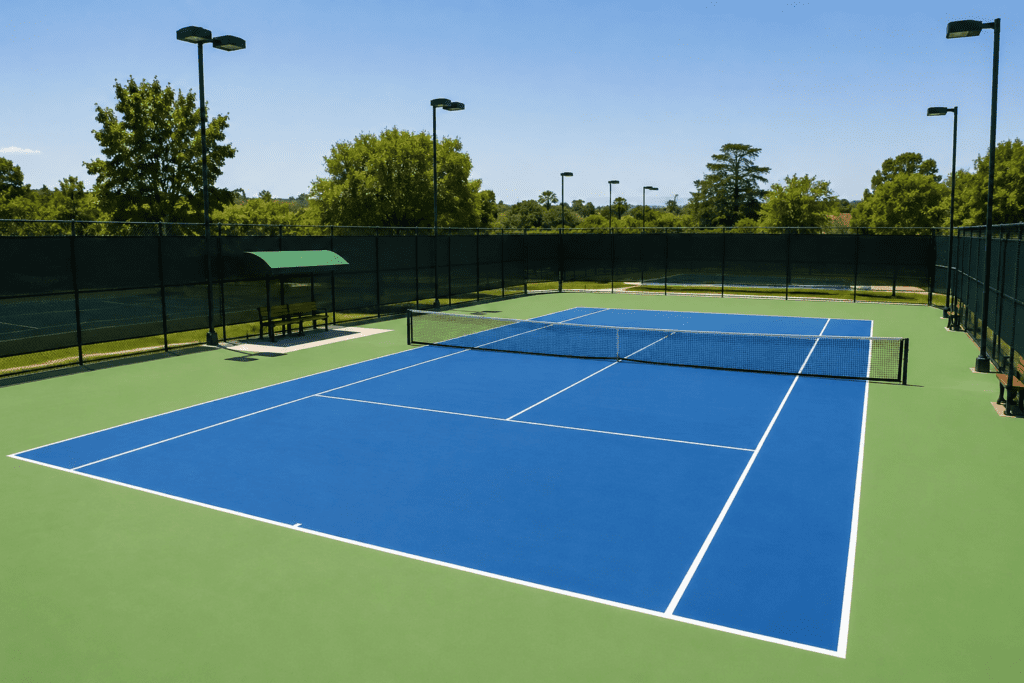
Acrylic flooring dominates the Indian sports court market in 2026. It is the most widely installed surface for tennis, basketball, badminton, volleyball, pickleball, and multi-sport courts across the country.
Why acrylic leads:
- UV resistant – performs well in India’s harsh sun
- Weather resistant – handles monsoon conditions without cracking
- ITF and BWF approved for professional play
- Available in custom colors and multi-sport configurations
- 5–10 year lifespan with minimal maintenance
2026 Pricing:
| System Type | Price Range per Sq. Ft. |
|---|---|
| Basic 2-coat acrylic | ₹70 – ₹120 |
| Standard 4-coat system | ₹120 – ₹180 |
| Cushioned acrylic (6-layer) | ₹180 – ₹280 |
| Premium cushioned system (8-layer) | ₹280 – ₹350+ |
The layered cushioned systems – with cushion coat between the base and color coat – reduce joint stress and knee impact by up to 40%, making them the preferred choice for sports academies and clubs.
2. Polyurethane (PU) Flooring
PU flooring is the gold standard for professional indoor sports courts. Widely used in national-level badminton and basketball facilities, PU systems offer superior shock absorption, consistent ball bounce, and long service life.
Best for: Professional indoor courts, high-budget academies, township sports complexes.
2026 Pricing:
| PU System | Price Range per Sq. Ft. |
|---|---|
| Basic PU (single layer) | ₹180 – ₹250 |
| Standard PU (multi-layer) | ₹250 – ₹400 |
| Professional PU system | ₹400 – ₹800 |
PU flooring costs significantly more than acrylic but delivers 70–80% better cushioning. For schools, housing societies, and local clubs, acrylic delivers comparable play quality at nearly half the cost of PU.
3. Maple Hardwood Flooring
Maple hardwood is the international benchmark for elite indoor badminton, basketball, and volleyball courts. BWF and BAI-recognised tournament venues mandate maple hardwood flooring.
Best for: National-level tournament venues, professional academies, five-star sports clubs.
2026 Pricing:
| Maple System | Price Range per Sq. Ft. |
|---|---|
| Standard maple hardwood | ₹800 – ₹1,100 |
| Sprung maple with sub-frame | ₹1,100 – ₹1,500 |
| Premium competition-grade maple | ₹1,500 – ₹2,200 |
Important: Maple flooring requires strict indoor climate control. Without proper HVAC and humidity management, wood expands, warps, and cracks – adding long-term maintenance costs.
4. PVC / Vinyl Flooring
PVC vinyl flooring in roll or tile form is popular for indoor multi-purpose courts. It is a go-to option for school gymnasiums and community halls where multiple sports are played on the same surface.
Best for: Multi-purpose indoor halls, school gymnasiums, training centers.
2026 Pricing:
| PVC / Vinyl Type | Price Range per Sq. Ft. |
|---|---|
| Basic PVC roll (3mm) | ₹35 – ₹80 |
| Sports-grade vinyl (4–6mm) | ₹80 – ₹160 |
| Professional PVC with backing | ₹160 – ₹250 |
5. Polypropylene (PP) Modular Tiles
Modular interlocking tiles made from polypropylene plastic are an emerging option for rooftop courts, temporary setups, and budget-conscious projects. They require no adhesive, no specialized civil work, and can be dismantled and relocated.
Best for: Rooftop courts, temporary courts, multi-sport conversions.
2026 Pricing:
| PP Tile System | Price Range per Sq. Ft. |
|---|---|
| Basic PP tiles | ₹35 – ₹80 |
| Standard sports PP tiles | ₹80 – ₹150 |
| Premium cushioned PP tiles | ₹150 – ₹250 |
Note: PP tiles provide less grip and bounce consistency than acrylic or PU systems, making them unsuitable for professional or competitive play.
Read Also – Acrylic vs PP Tiles vs Clay, which is best ?
6. Synthetic Grass / Astroturf
Primarily used for football and hockey, synthetic grass is growing in multi-sport applications for schools and community facilities.
2026 Pricing:
| Synthetic Grass Type | Price Range per Sq. Ft. |
|---|---|
| Basic synthetic grass (25mm) | ₹80 – ₹150 |
| Mid-range infill system | ₹150 – ₹280 |
| FIFA/FIH-grade artificial turf | ₹280 – ₹500+ |
Sport-by-Sport Cost Breakdown: Complete 2026 Guide
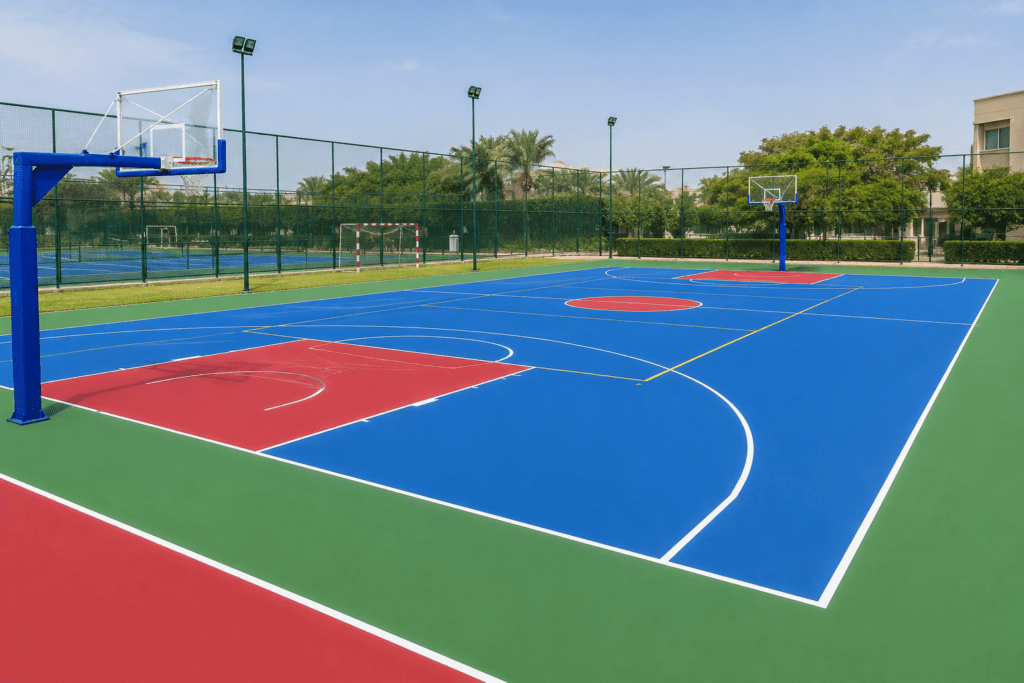
Basketball Court Flooring Cost in India
Basketball is one of the fastest-growing sports in India and demand for quality courts – from school playgrounds to township sports complexes – is rising steadily.
Standard Basketball Court Dimensions:
- Full court (NBA regulation): approximately 28m × 15m (~4,520 sq. ft.)
- Half-court (most popular for residential): approximately 14.3m × 15.2m (~2,340 sq. ft.)
2026 Cost by Surface Type:
| Surface Type | Cost per Sq. Ft. | Total Cost (Full Court) |
|---|---|---|
| Acrylic (basic 4-coat) | ₹120 – ₹180 | ₹5.4 lakh – ₹8.1 lakh |
| Cushioned Acrylic | ₹200 – ₹300 | ₹9 lakh – ₹13.5 lakh |
| PU Flooring | ₹350 – ₹600 | ₹15.8 lakh – ₹27 lakh |
| Maple Hardwood | ₹900 – ₹1,500 | ₹40.7 lakh – ₹67.8 lakh |
Total Project Cost (including base, installation, and accessories):
- Basic outdoor acrylic basketball court: ₹3 lakh – ₹10 lakh
- Standard outdoor with fencing and lighting: ₹10 lakh – ₹25 lakh
- Premium indoor with PU flooring: ₹30 lakh – ₹80 lakh
- Professional indoor with maple hardwood: ₹60 lakh – ₹1.26 crore
What impacts the cost most: The concrete base (M20 or M25 mix), number of acrylic coating layers, LED sports lighting (adds ₹2–5 lakh), and chain-link fencing (adds ₹1.5–3 lakh).
Badminton Court Flooring Cost in India
Badminton is India’s second most popular racket sport after cricket, and demand for professional courts is at an all-time high in 2026. The Badminton World Federation (BWF) and the Badminton Association of India (BAI) set strict surface standards for approved venues.
Standard Badminton Court Dimensions:
- Single court: 13.4m × 5.18m
- Doubles court: 13.4m × 6.1m (approximately 820 sq. ft.)
2026 Cost by Surface Type:
| Surface Type | Cost per Sq. Ft. | Total Cost per Court |
|---|---|---|
| Synthetic Acrylic (outdoor) | ₹80 – ₹160 | ₹65,600 – ₹1.31 lakh |
| PVC / PU (indoor) | ₹160 – ₹400 | ₹1.31 lakh – ₹3.28 lakh |
| PU Professional System | ₹400 – ₹600 | ₹3.28 lakh – ₹4.92 lakh |
| Maple Hardwood (tournament) | ₹900 – ₹1,500 | ₹7.38 lakh – ₹12.3 lakh |
Total Project Cost (complete facility):
- Outdoor acrylic single court: ₹3 lakh – ₹8 lakh
- Single indoor PU court: ₹15 lakh – ₹25 lakh
- 4-court indoor PU facility: ₹50 lakh – ₹80 lakh
- Professional maple hardwood court (tournament-grade): ₹60 lakh – ₹1.5 crore
Important note for indoor badminton: Court flooring is only one part of the investment. A proper indoor facility also requires a minimum ceiling height of 9 meters, non-glare LED lighting at 500+ lux, and wall treatment to prevent shuttlecock air disturbance. These structural components can equal or exceed the flooring cost.
Tennis Court Flooring Cost in India
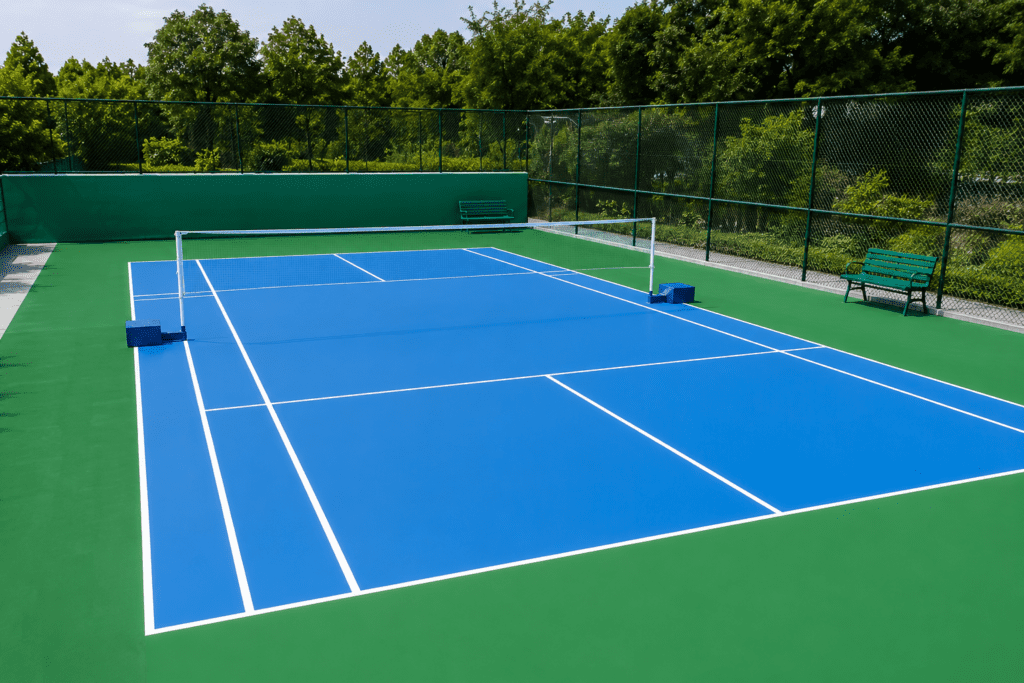
Tennis courts are the largest of all standard sports courts and therefore typically the most expensive to construct.
Standard Tennis Court Dimensions:
- Playing area (singles + doubles): 78 ft × 36 ft
- Recommended total area with run-off: 120 ft × 60 ft (~7,200 sq. ft.)
2026 Cost by Surface Type:
| Surface Type | Cost per Sq. Ft. | Total Cost (Full Court) |
|---|---|---|
| Basic Acrylic (4-layer) | ₹90 – ₹160 | ₹6.5 lakh – ₹11.5 lakh |
| Cushioned Acrylic (6-layer) | ₹180 – ₹280 | ₹13 lakh – ₹20 lakh |
| PU Flooring | ₹300 – ₹500 | ₹21.6 lakh – ₹36 lakh |
| Clay Court System | ₹200 – ₹400 | ₹14.4 lakh – ₹28.8 lakh |
| Synthetic Grass | ₹200 – ₹400 | ₹14.4 lakh – ₹28.8 lakh |
| Grass Court (natural) | ₹500 – ₹1,200 | ₹36 lakh – ₹86.4 lakh |
Total Project Cost:
- Basic outdoor acrylic tennis court: ₹8 lakh – ₹18 lakh
- Mid-range cushioned acrylic with fencing and lighting: ₹20 lakh – ₹35 lakh
- Premium indoor PU tennis court: ₹40 lakh – ₹80 lakh
- Multi-court tennis academy: ₹1 crore – ₹5 crore+
Base preparation for tennis courts: Expect to spend ₹150–₹250 per sq. ft. on base alone. The base is the single most critical investment – a poorly prepared base causes surface cracking within 2–3 years regardless of how premium the surface coating is.
Volleyball Court Flooring Cost in India
Volleyball is gaining traction in schools, colleges, parks, and residential communities across India. Both indoor (wooden or PU) and outdoor (acrylic) courts are in demand.
Standard Volleyball Court Dimensions:
- Court size: 18m × 9m (~1,722 sq. ft.)
- Recommended total area with free zones: approximately 800–1,000 sq. ft. extra on each side
2026 Cost by Surface Type:
| Surface Type | Cost per Sq. Ft. | Total Cost (Standard Court) |
|---|---|---|
| PP Tiles (basic) | ₹35 – ₹80 | ₹60,000 – ₹1.38 lakh |
| Synthetic Acrylic | ₹180 – ₹350 | ₹3.1 lakh – ₹6 lakh |
| PU Flooring (indoor) | ₹400 – ₹800 | ₹6.9 lakh – ₹13.8 lakh |
| Wooden Maple (indoor) | ₹800 – ₹1,500 | ₹13.8 lakh – ₹25.8 lakh |
Total Project Cost:
- Basic outdoor synthetic court: ₹2 lakh – ₹6 lakh
- Standard outdoor acrylic court with fencing: ₹5 lakh – ₹12 lakh
- Professional indoor PU court: ₹15 lakh – ₹30 lakh
- Elite indoor maple hardwood court: ₹25 lakh – ₹60 lakh+
Pickleball Court Flooring Cost in India
Pickleball is the fastest growing sport in India in 2026, blending elements of tennis, badminton, and table tennis into one highly accessible format. Residential societies, schools, and corporate campuses are installing pickleball courts at an accelerating pace.
Standard Pickleball Court Dimensions:
- Playing area: 20 ft × 44 ft
- Recommended total area with run-off: 30 ft × 60 ft (~1,800 sq. ft.)
2026 Cost by Surface Type:
| Surface Type | Cost per Sq. Ft. | Total Cost (per Court) |
|---|---|---|
| Basic Acrylic | ₹150 – ₹250 | ₹2.7 lakh – ₹4.5 lakh |
| Cushioned Acrylic (8-layer) | ₹280 – ₹400 | ₹5 lakh – ₹7.2 lakh |
| PP Modular Tiles | ₹150 – ₹280 | ₹2.7 lakh – ₹5 lakh |
| Indoor PU System | ₹350 – ₹600 | ₹6.3 lakh – ₹10.8 lakh |
Total Project Cost (outdoor standard acrylic court):
- Budget outdoor acrylic pickleball court: ₹4.5 lakh – ₹8 lakh
- Mid-range with fencing and LED lighting: ₹8 lakh – ₹12 lakh
- Premium indoor pickleball court: ₹10 lakh – ₹25 lakh
Pickleball ROI insight: With commercial courts in Tier-1 cities charging ₹500–₹1,200 per hour per court, a well-located facility can recover its investment within 12–24 months – making pickleball courts one of the highest-ROI sports infrastructure investments in India today.
City-Wise Price Variation: What You’ll Pay in Different States
Geography significantly impacts sports court construction cost in India. Metro cities carry premium labour and logistics costs that push project budgets 20–40% higher than Tier-2 cities.
| City / Region | Cost Multiplier vs. National Average |
|---|---|
| Mumbai | +25% to +40% |
| Delhi / NCR | +20% to +35% |
| Bangalore | +20% to +30% |
| Hyderabad | +10% to +20% |
| Chennai | +10% to +20% |
| Pune | +5% to +15% |
| Ahmedabad | 0% to +10% |
| Tier-2 cities (Lucknow, Nagpur, Bhopal) | -10% to -15% |
| Tier-3 cities and smaller towns | -15% to -25% |
What drives city-wise variation:
- Labour rates: Skilled sports flooring applicators are more available – and more expensive – in metros.
- Material logistics: Transportation from manufacturing hubs adds cost in remote areas.
- Competition: More licensed contractors in metros creates competitive pricing in some cases.
- Site challenges: Urban locations may have elevator-access restrictions, narrow entry points, or building society NOC requirements that add cost.
Key Cost Factors That Every Buyer Must Understand
1. Base Quality and Subfloor Preparation
The single biggest hidden cost in sports court construction is the base. A proper M25 reinforced concrete slab with correct drainage slope (1:100) is non-negotiable for any acrylic or PU surface. Cutting corners here leads to surface bubbling, cracking, and expensive rework within 3–5 years.
Base preparation cost ranges:
- Soil levelling and excavation: ₹40–80 per sq. ft.
- Concrete base (M20): ₹100–₹150 per sq. ft.
- Concrete base (M25 reinforced): ₹150–₹250 per sq. ft.
- Asphalt base: ₹80–₹120 per sq. ft.
2. Number of Coating Layers
More layers mean better performance and durability – and higher cost. Entry-level acrylic systems use 2–4 coats. Professional cushioned systems use 6–8 layers including resurfacer, cushion coat, colour coat, and silica sand.
3. Material Brand and Origin
Imported acrylic systems from European or American brands cost 30–50% more than quality Indian-manufactured systems. However, reputable Indian brands that meet ITF and BWF certifications – such as products from established manufacturers – deliver excellent performance at a fraction of the import cost.
4. Court Size and Shape
Larger courts obviously cost more in materials and labour, but larger projects also get better per-square-foot pricing due to economies of scale. Multi-court installations reduce the unit cost per court by 15–25% compared to single-court builds.
5. Add-on Features
| Feature | Estimated Cost |
|---|---|
| Chain-link fencing (per court) | ₹1.5 lakh – ₹4 lakh |
| LED floodlighting (per court) | ₹2 lakh – ₹6 lakh |
| Basketball hoops (pair) | ₹25,000 – ₹2 lakh |
| Tennis net and posts | ₹15,000 – ₹80,000 |
| Custom logo/branding on court | ₹15,000 – ₹60,000 |
| Drainage system | ₹50,000 – ₹2 lakh |
| Spectator seating | ₹1 lakh – ₹10 lakh+ |
Maintenance Cost: The Number Nobody Mentions Upfront
Sports court flooring is a long-term investment. Understanding annual maintenance cost prevents budget shocks and helps you plan total cost of ownership correctly.
Annual Maintenance Cost by Surface Type:
| Surface Type | Annual Maintenance Cost | Full Resurfacing (years) |
|---|---|---|
| Synthetic Acrylic | ₹15,000 – ₹50,000 | Every 5–8 years |
| PU Flooring | ₹20,000 – ₹60,000 | Every 7–10 years |
| Maple Hardwood | ₹50,000 – ₹2 lakh | Every 8–12 years |
| PVC / Vinyl | ₹10,000 – ₹30,000 | Every 5–7 years |
| PP Modular Tiles | ₹5,000 – ₹20,000 | Replace tiles as needed |
Maintenance tips to extend lifespan:
- Clean the court surface weekly with a soft broom or wet mop.
- Avoid dragging heavy equipment across the surface.
- Reapply line marking every 2–3 years.
- Inspect and patch any surface cracks promptly before water infiltrates the base.
- For acrylic courts, a full resurfacing coat every 5–7 years restores performance and extends life significantly.
A well-maintained acrylic court can last 8–12 years. Poorly maintained, the same surface may fail in 3–4 years.
Indoor vs. Outdoor Courts: Cost Comparison
| Parameter | Outdoor Court | Indoor Court |
|---|---|---|
| Base requirement | Concrete with drainage | Concrete with subfloor |
| Flooring type | Acrylic or PP tiles | PU, maple, or PVC |
| Structural cost | Lower | Significantly higher (roofing, walls, HVAC) |
| Lighting requirement | Optional (for day use) | Essential |
| Climate impact | High (UV, rain, heat) | Controlled |
| Maintenance cost | Lower | Moderate to high |
| Typical project cost | ₹3 lakh – ₹25 lakh | ₹15 lakh – ₹3 crore+ |
| Best suited for | Schools, parks, societies | Academies, clubs, commercial use |
Indoor courts offer superior playing conditions, climate control, and year-round usability – but cost 3–10x more than equivalent outdoor setups. A 4-court indoor badminton facility with PU flooring, proper lighting, and basic amenities typically requires ₹50–80 lakh in 2026.
The Right Flooring for Each Use Case: A Decision Guide
For residential societies and housing complexes: Outdoor cushioned acrylic flooring on an M25 concrete base is the optimal choice. It handles India’s weather extremes, requires minimal maintenance, and serves multiple sports on one surface. Budget ₹8–20 lakh for a well-specified multi-sport court.
For schools and educational institutions: Outdoor synthetic acrylic remains the most cost-effective choice. Schools benefit from its low maintenance, injury-reducing cushioning, and the ability to mark multiple sport lines on one surface. Government schools under Khelo India can access subsidised construction support.
For sports academies and training centres: PU flooring for indoor courts. The higher upfront investment pays back in player performance, injury prevention, and the ability to host competitive events. Budget ₹25,000–₹50,000 per sq. ft. for a full indoor academy setup.
For commercial club facilities: The ROI on commercial courts depends on occupancy rate and booking fee. Pickleball and badminton offer the fastest payback due to lower construction cost and high hourly booking rates. A 4-court badminton facility in a Tier-1 city typically breaks even in 3–5 years at 60%+ occupancy.
For professional and tournament-grade venues: Maple hardwood or competition-grade PU flooring meeting BWF, ITF, or FIBA standards. Budget significantly for HVAC, professional lighting (1,000+ lux), and facility amenities.
Common Mistakes to Avoid When Planning Sports Court Flooring
1. Skipping proper base preparation to save money The single biggest mistake. A poor concrete base creates surface failures within 2–3 years. A proper M25 base is 30–50% of project cost but determines 80% of the court’s lifespan.
2. Choosing the cheapest surface without checking certification Non-certified acrylic or PU systems may fail faster, fade unevenly, and create unsafe playing conditions. Always verify ITF, BWF, or FIBA certification for the intended sport.
3. Getting only one contractor quote Always get at least 3 detailed itemised quotes. Material, labour, and base preparation should each be quoted separately for accurate comparison.
4. Ignoring drainage slope A 1:100 slope is mandatory for outdoor courts to prevent waterlogging. Courts built without correct drainage develop cracks and surface failure within 2–3 monsoon cycles.
5. Underestimating lighting cost LED sports lighting for evening play adds ₹2–6 lakh per court but dramatically increases court utilisation and commercial viability. Many facilities underinvest here and lose significant revenue potential.
6. Not accounting for resurfacing in the 10-year plan A court built today will need resurfacing in 5–8 years. Plan for this in your financial model to avoid a future budget crisis.
How to Get Accurate Quotes from Contractors
Getting a reliable, comparable quote from a sports flooring contractor requires asking the right questions:
- What concrete mix is included in the base – M20 or M25?
- How many coating layers does the surface system include?
- Is the acrylic or PU system ITF/BWF certified?
- What is the warranty period and what does it cover?
- Does the quote include drainage slope work?
- Is line marking included in the price?
- Who manufactures the flooring material – Indian or imported?
- What is the payment schedule and expected completion timeline?
Request itemised quotations that separately list base preparation, surface material cost, labour, line marking, and accessories. A contractor who cannot provide this breakdown should be approached with caution.
Government Schemes and Subsidies for Sports Courts in India
India’s Khelo India initiative continues to subsidise sports infrastructure development across schools, universities, and community facilities. Key schemes include:
Khelo India Infrastructure Grant: Covers up to 60–70% of construction cost for approved sports courts in educational institutions and community centres.
Sports Authority of India (SAI) Schemes: SAI provides technical guidance and partial funding for multi-sport courts in training centres across the country.
State Sports Development Boards: Most states have their own sports infrastructure subsidy programmes. Maharashtra, Karnataka, Tamil Nadu, and Gujarat in particular have active programmes for school and college court development.
If you are a school, municipal body, or community organisation, exploring these schemes before beginning construction can significantly reduce your cost burden.
Final Thoughts: Invest Smart in Sports Court Flooring
Sports court flooring is not a commodity purchase – it is a long-term infrastructure investment that directly impacts player safety, game quality, and facility reputation. In 2026, India’s sports infrastructure market offers more options, more certified materials, and more experienced contractors than ever before.
The right approach is to start with the intended use case, choose a surface that matches your sport and budget, invest adequately in the base, and never sacrifice quality for an initial price saving that leads to far costlier repairs down the line.
Whether you are building one residential badminton court or a 10-court sports academy, the pricing data in this guide equips you to plan accurately, compare quotes intelligently, and build a facility that performs – season after season.
This guide reflects real-market pricing data as of June 2026. Prices may vary based on location, contractor, and material availability. Always obtain itemised quotations from at least three certified sports flooring contractors before finalising your project budget.