Volleyball is rapidly gaining popularity across India, from schools and colleges to residential societies and professional academies. A well constructed volleyball court is not just about aesthetics it directly impacts player safety, performance, and long-term durability. This detailed guide explains everything about volleyball court construction, including dimensions, materials, deep construction steps, and cost insights to help build a high-quality, Google-friendly sports facility.
Table of contents
- What is Volleyball Court Construction?
- Standard Volleyball Court Dimensions & Layout
- Types of Volleyball Court Surfaces
- Step-by-Step Volleyball Court Construction Process (Detailed)
- Volleyball Court Construction Cost in India
- Key Design Considerations
- Maintenance Tips
- Common Mistakes to Avoid
- Conclusion
- Frequently Asked Questions
What is Volleyball Court Construction?
Volleyball court construction is a structured process that includes site planning, base preparation, surface installation, and finishing with accurate markings and accessories. A professionally built court ensures:
- Consistent ball bounce
- Anti-slip surface for safety
- Resistance to weather conditions
- Long lifespan with minimal maintenance
Standard Volleyball Court Dimensions & Layout
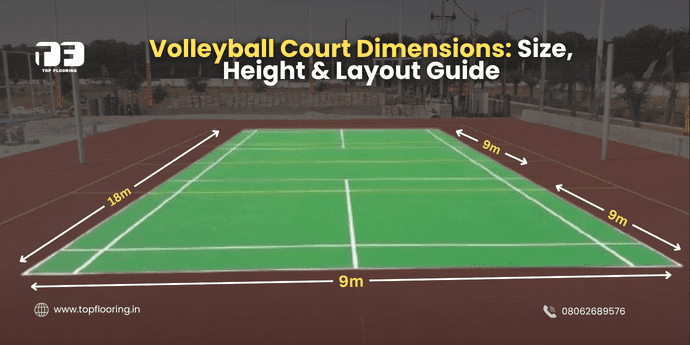
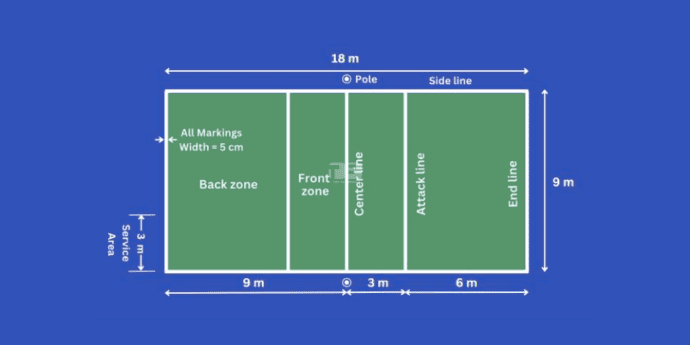
Following official Volleyball court dimensions is critical for proper gameplay:
- Court Size: 18 meters (length) × 9 meters (width)
- Free Zone: Minimum 3 meters on all sides (recommended 5 meters for professional use)
- Net Height:
- Men: 2.43 meters
- Women: 2.24 meters
- Attack Line: 3 meters from the center line
- Service Area: Behind the end line
- Line Width: Typically 5 cm
Incorrect dimensions can affect gameplay quality and may lead to non-compliance with tournament standards.
Types of Volleyball Court Surfaces
1. Synthetic Acrylic Flooring (Highly Recommended)
- Weather-resistant and UV-stable
- Anti-skid surface for player safety
- Consistent ball bounce
- Ideal for outdoor and multi-purpose courts
- Low maintenance and long-lasting
2. PU (Polyurethane) Flooring
- Cushioned surface for indoor courts
- Reduces player fatigue and injury risk
- Used in professional indoor stadiums
3. Cement/Concrete Surface
- Budget-friendly option
- Suitable for basic or rural setups
- Hard surface with higher injury risk
- Requires frequent repainting
Step-by-Step Volleyball Court Construction Process (Detailed)
This is the most critical part of the blog. Each stage must be executed with precision to ensure durability and performance.
1. Site Selection & Soil Analysis
The foundation of a long-lasting volleyball court begins with proper site selection.
Key Considerations:
- Choose a flat or slightly elevated land area
- Avoid waterlogging zones or low-lying areas
- Ensure easy accessibility for players and maintenance
- Prefer north-south orientation to reduce sun glare during gameplay
Soil Testing:
- Conduct basic soil testing to check load-bearing capacity
- Weak soil requires additional stabilization
- Soil with high moisture retention needs stronger drainage systems
Ignoring this step can lead to cracks, uneven surfaces, and structural failure over time.
2. Excavation & Ground Leveling
Once the site is finalized, excavation begins.
Process:
- Remove topsoil (usually 150mm–300mm depth)
- Clear debris, organic material, and loose soil
- Level the ground using grading equipment
Why It Matters:
- Ensures a stable base
- Prevents future sinking or unevenness
- Creates a uniform platform for base layers
Proper leveling directly affects the final surface quality.
3. Sub-Base Construction (WMM/PCC Layer)
This layer provides strength and load distribution.
Options:
- WMM (Wet Mix Macadam): Common for outdoor courts
- PCC (Plain Cement Concrete): Used for higher durability
Execution:
- Spread sub-base material evenly
- Compact using vibratory rollers
- Maintain thickness of 100mm–150mm
Key Focus:
- Achieve maximum compaction
- Avoid air gaps or loose sections
- Ensure uniform thickness
A poorly constructed sub-base leads to cracks and surface failure.
4. Drainage System & Slope Creation
Drainage is one of the most overlooked yet crucial elements.
Slope Design:
- Provide a slope of 1% (1:100 gradient)
- Direct water flow towards drains or edges
Drainage Solutions:
- Side drains around the court
- Perforated pipes for water discharge
- Proper outlet system to avoid water accumulation
Without proper drainage, water seepage can damage the surface layers and reduce lifespan.
5. Base Concrete Layer (if applicable)
For synthetic acrylic courts, a concrete or asphalt base is required.
Specifications:
- Thickness: 100mm–125mm
- Use reinforced concrete for added strength
- Allow proper curing (minimum 7–14 days)
Important Points:
- Surface must be smooth but not glossy
- No cracks or undulations
- Moisture content must be controlled before coating
This layer acts as the backbone of the Volleyball court flooring.
6. Surface Preparation Before Coating
Before applying the final surface, preparation is essential.
Steps:
- Clean dust, dirt, and loose particles
- Repair cracks or imperfections
- Grind uneven areas
- Apply primer for better adhesion
Skipping this step leads to peeling or uneven coating.
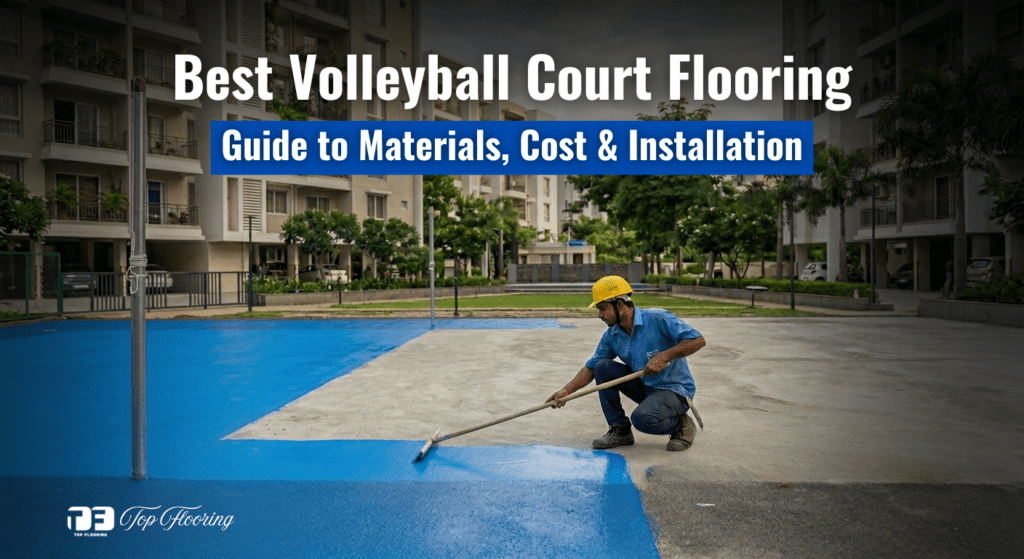
7. Application of Synthetic Acrylic Flooring System
This is the performance layer of the court.
Layering Process:
- Primer Coat: Improves bonding with base
- Resurfacer Layer: Smoothens surface
- Cushion Layers (optional): Adds comfort and shock absorption
- Acrylic Color Coats: Provides finish and durability
- Anti-Skid Texture Layer: Ensures grip
Drying Time:
- Each layer requires proper curing before the next is applied
Outcome:
- Uniform, durable, and high-performance surface
8. Line Marking
Accurate marking is essential for gameplay.
Process:
- Use high-quality acrylic line paint
- Follow official dimensions strictly
- Ensure straight, sharp, and visible lines
Poor marking affects gameplay and looks unprofessional.
9. Installation of Net Poles & Accessories
Final setup includes:
- Fixing durable net poles (usually steel with anti-rust coating)
- Installing adjustable net system
- Adding fencing (optional but recommended)
- Lighting setup for night play
10. Final Inspection & Quality Check
Before handing over the court:
- Check surface level and smoothness
- Verify dimensions and markings
- Test grip and ball bounce
- Inspect drainage flow
This ensures the court meets professional standards.
Volleyball Court Construction Cost in India
The total cost depends on multiple variables:
Estimated Cost Range:
- Basic Cement Court: ₹2 – ₹4 lakh
- Synthetic Acrylic Court: ₹5 – ₹12 lakh
- Indoor PU Court: ₹10 – ₹25 lakh
Cost Influencing Factors:
- Site condition and soil type
- Type of surface material
- Size and additional features
- Labor and location
- Accessories (lighting, fencing, seating)
Investing in quality construction reduces long-term repair and maintenance costs.
Key Design Considerations
- Proper drainage and slope
- High-quality base materials
- UV-resistant surface coatings
- Safety-focused anti-slip finish
- Space for spectators and movement
Maintenance Tips
- Regular cleaning to remove dust
- Immediate repair of cracks
- Periodic repainting of markings
- Ensure drainage system is functional
Common Mistakes to Avoid
- Poor base preparation
- Ignoring drainage planning
- Using low-quality materials
- Incorrect dimensions
- Unskilled installation
Conclusion
Volleyball court construction is a technical process that demands precision at every stage from site preparation to final coating. A well-built court enhances performance, ensures player safety, and delivers long-term value.
Among all surface options, synthetic acrylic flooring stands out as the most reliable choice for outdoor volleyball courts in India due to its durability, weather resistance, and low maintenance.
Frequently Asked Questions
The standard size is 18m × 9m with a minimum 3m free zone around it.
Synthetic acrylic flooring is the best due to its durability, grip, and weather resistance.
Typically 2 to 4 weeks, depending on site conditions and materials used.
It ranges from ₹2 lakh to ₹25 lakh depending on the surface and specifications.
Yes, synthetic acrylic flooring is ideal for multi-sport applications.