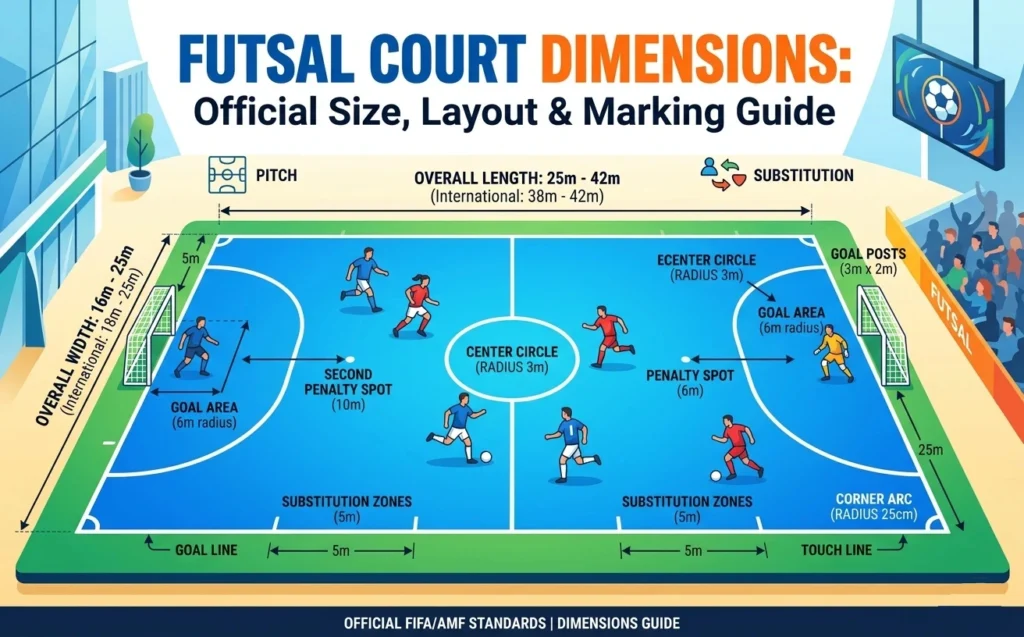
Futsal has rapidly become one of the most popular indoor and outdoor sports worldwide. Known for its fast gameplay, quick passing, close ball control, and compact playing area, futsal is widely played in schools, colleges, sports academies, residential societies, rooftop sports arenas, and professional indoor stadiums.
One of the most important aspects of building a high-quality futsal facility is understanding official futsal court dimensions. Proper court measurements directly affect gameplay speed, player movement, ball control, safety, and tournament standards.
Whether planning a professional futsal arena, training court, or multipurpose sports facility, knowing every dimension, including court length, width, goal size, penalty areas, line markings, and safety clearance, is essential for successful construction.
This complete guide explains futsal court dimensions in meters and feet, official FIFA standards, court layout details, flooring recommendations, and construction guidelines.
Table of contents
- What is a Futsal Court?
- Official Futsal Court Dimensions
- Complete Futsal Court Layout
- Futsal Court Boundary Lines
- Recommended Ceiling Height for Indoor Futsal Courts
- Futsal Court Flooring Types
- Outdoor Futsal Court Dimensions
- Indoor Futsal Court Dimensions
- Safety Clearance Around a Futsal Court
- Surface Slope for Outdoor Courts
- Futsal Court Base Construction
- Lighting Requirements for Futsal Courts
- Recommended Fence Height for Outdoor Futsal Courts
- Futsal Court Marking Colors
- Difference Between Futsal and Football Field Dimensions
- Best Futsal Court Size for Schools and Academies
- Common Mistakes in Futsal Court Construction
- Why Accurate Futsal Court Dimensions Matter
- Conclusion
What is a Futsal Court?
A futsal court is a hard-surface playing area designed for 5-a-side football. Unlike traditional football played on grass or turf, futsal is usually played on synthetic acrylic flooring, wooden flooring, PU flooring, or modular sports tiles.
The game focuses on:
- Speed
- Technique
- Ball control
- Fast passing
- Player movement
- Skill development
Because the playing area is smaller than a traditional football field, players are constantly involved in the game, making futsal highly engaging and physically demanding.
Official Futsal Court Dimensions
The dimensions of a futsal court vary slightly depending on whether the court is designed for recreational, training, national, or international matches.
According to FIFA futsal regulations, all measurements must remain within specified ranges.
Standard Futsal Court Size
Recreational and Training Court Dimensions
| Measurement | In Meters | In Feet |
| Minimum Court Length | 25 m | 82 ft |
| Maximum Court Length | 42 m | 138 ft |
| Minimum Court Width | 16 m | 52 ft |
| Maximum Court Width | 25 m | 82 ft |
These dimensions are commonly used for:
- Schools
- Sports academies
- Community centers
- Training facilities
- Recreational futsal arenas
International Futsal Court Dimensions
Professional and international tournaments require larger and more standardized court dimensions.
| Measurement | In Meters | In Feet |
| Court Length | 38–42 m | 125–138 ft |
| Court Width | 20–25 m | 65–82 ft |
The most commonly used international futsal court size is:
Professional FIFA Recommended Court Size
| Measurement | In Meters | In Feet |
| Length | 40 m | 131.2 ft |
| Width | 20 m | 65.6 ft |
This size provides ideal playing conditions for professional-level matches and tournaments.
Complete Futsal Court Layout
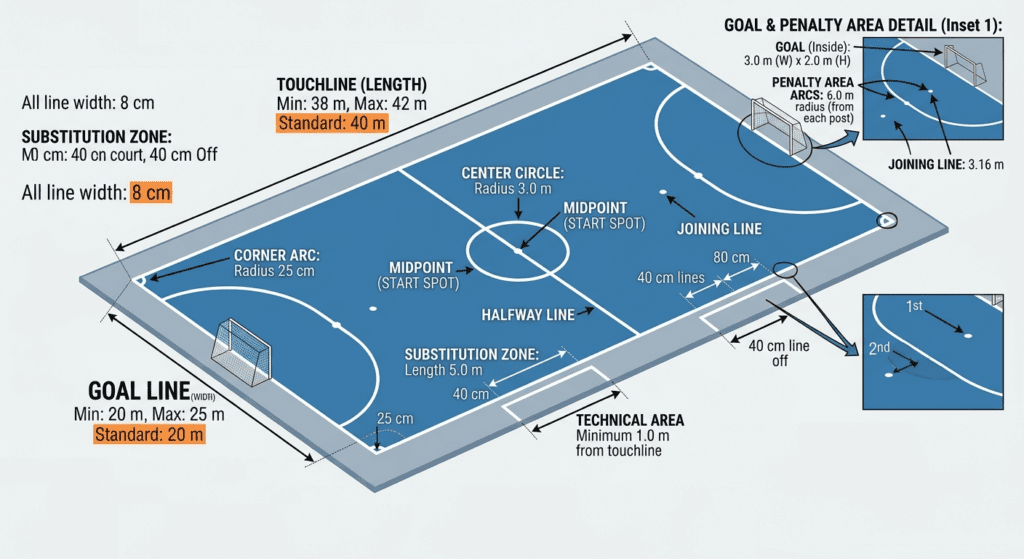
A futsal court includes several marked areas that define gameplay zones and player positioning.
The court layout includes:
- Boundary lines
- Touchlines
- Goal lines
- Halfway line
- Center circle
- Penalty areas
- Penalty marks
- Substitution zones
- Corner arcs
- Goals
- Team benches
Each area follows official measurements to maintain consistency in gameplay.
Futsal Court Boundary Lines
The futsal court boundary consists of two major lines:
Touchlines
These are the longer side lines running along the length of the court.
Goal Lines
These are shorter lines located behind each goalpost.
Futsal Court Line Thickness
All markings on the court must have uniform thickness.
| Measurement | In Meters | In Inches |
| Line Width | 0.08 m | 3.15 inches |
The lines are considered part of the playing area during matches.
Halfway Line Dimensions
The halfway line divides the court into two equal halves.
| Feature | Dimension |
| Halfway Line Length | Equal to court width |
This line passes through the center point of the court.
Center Circle Dimensions
The center circle is used during kick-off.
| Measurement | In Meters | In Feet |
| Radius | 3 m | 9.84 ft |
| Diameter | 6 m | 19.68 ft |
Opposing players must remain outside the circle during kick-off.
Futsal Penalty Area Dimensions
The penalty area in futsal differs significantly from traditional football.
Instead of a rectangular box, futsal uses arcs created from the goalposts.
Penalty Area Construction
- Two quarter circles are drawn from each goalpost.
- Each arc has a radius of 6 meters.
- The arcs are connected by a straight line parallel to the goal line.
| Measurement | In Meters | In Feet |
| Radius from Goalpost | 6 m | 19.7 ft |
This area defines where goalkeepers can use their hands.
First Penalty Mark Dimensions
The first penalty mark is used for standard penalties.
| Measurement | In Meters | In Feet |
| Distance from Goal Line | 6 m | 19.7 ft |
Second Penalty Mark Dimensions
The second penalty mark is used after accumulated fouls.
| Measurement | In Meters | In Feet |
| Distance from Goal Line | 10 m | 32.8 ft |
This encourages disciplined defending and reduces excessive fouls.
Corner Arc Dimensions
Each corner of the futsal court contains a quarter-circle arc for corner kicks.
| Measurement | In Meters | In Feet |
| Radius | 0.25 m | 0.82 ft |
Substitution Zone Dimensions
One of the unique features of futsal is rolling substitutions.
Substitution zones are marked in front of team benches.
| Measurement | In Meters | In Feet |
| Substitution Zone Length | 5 m | 16.4 ft |
Players must enter and leave the court through this area.
Team Bench Area Dimensions
The bench area is located near the substitution zone.
Recommended dimensions:
| Measurement | In Meters | In Feet |
| Bench Area Length | 5–8 m | 16–26 ft |
This space accommodates coaches, substitutes, and officials.
Futsal Goal Dimensions
The futsal goal is smaller than a traditional football goal.
| Measurement | In Meters | In Feet |
| Goal Width | 3 m | 9.84 ft |
| Goal Height | 2 m | 6.56 ft |
| Goal Depth (Top) | 0.8 m | 2.62 ft |
| Goal Depth (Bottom) | 1 m | 3.28 ft |
Goals are generally manufactured using:
- Powder-coated steel
- Aluminum
- Galvanized metal frames
Professional futsal goals also include durable weather-resistant nets.
Goalkeeper Area Rules
The goalkeeper can only handle the ball inside the penalty area.
The smaller penalty area increases the speed and intensity of the game while requiring quicker reactions from goalkeepers.
Recommended Ceiling Height for Indoor Futsal Courts
Indoor futsal facilities require proper vertical clearance.
| Measurement | In Meters | In Feet |
| Minimum Ceiling Height | 7 m | 23 ft |
| Recommended Ceiling Height | 9–12 m | 29–39 ft |
Higher ceilings improve gameplay and reduce interruptions caused by ceiling contact.
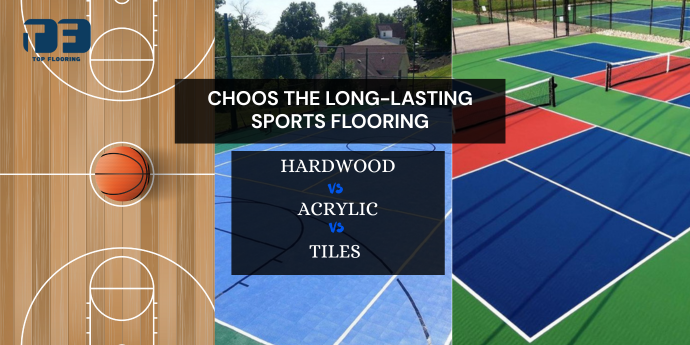
Futsal Court Flooring Types
Choosing the right flooring system is one of the most important decisions during futsal court construction.
The flooring affects:
- Ball bounce
- Player safety
- Grip
- Shock absorption
- Durability
- Maintenance
Synthetic Acrylic Futsal Flooring
Synthetic acrylic sports flooring is widely used for outdoor and multipurpose futsal courts.
Benefits of Acrylic Flooring
- UV resistant
- Weather resistant
- Slip resistant
- Durable surface
- Smooth ball movement
- Low maintenance
- Cost-effective
- Long lifespan
Synthetic acrylic flooring is commonly installed on asphalt or concrete bases.
PU Flooring for Indoor Futsal Courts
PU flooring provides:
- Better cushioning
- Shock absorption
- Joint protection
- Enhanced comfort
It is mostly used in indoor sports arenas and training centers.
Wooden Flooring for Professional Indoor Courts
Wooden flooring offers:
- Professional appearance
- Excellent ball response
- Smooth movement
- High comfort
However, it requires higher maintenance and controlled indoor conditions.
Modular Sports Tiles for Futsal
Interlocking sports tiles are ideal for:
- Rooftop courts
- Temporary futsal setups
- Multipurpose recreational areas
These tiles provide easy installation and portability.
Outdoor Futsal Court Dimensions
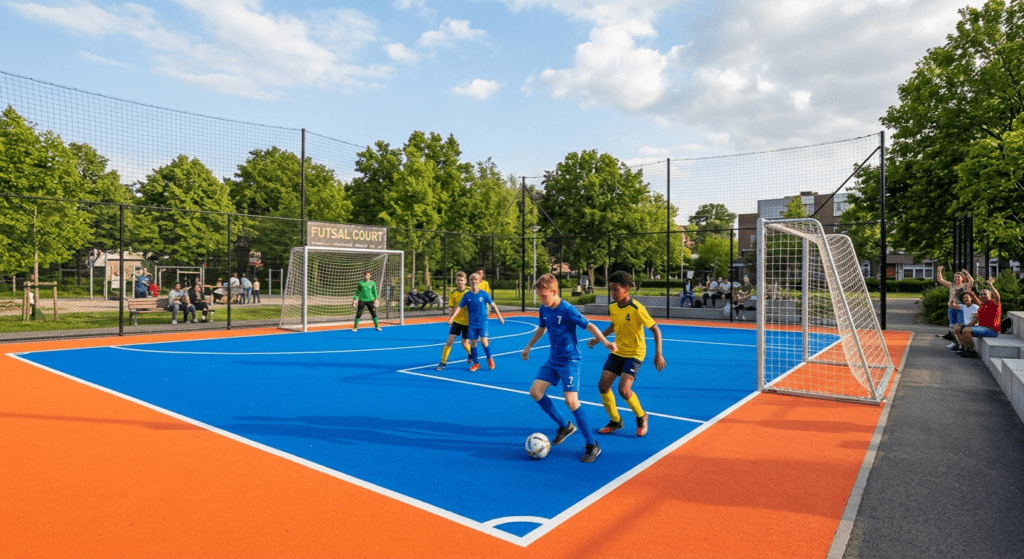
Outdoor futsal courts usually follow the standard 40 m × 20 m layout.
Common Outdoor Court Sizes
| Court Type | In Meters | In Feet |
| Training Court | 25 × 16 m | 82 × 52 ft |
| Standard Court | 40 × 20 m | 131 × 65.6 ft |
| Multipurpose Court | 30 × 18 m | 98 × 59 ft |
Outdoor courts generally use synthetic acrylic flooring because of its weather resistance and durability.
Indoor Futsal Court Dimensions
Indoor futsal facilities usually use professional dimensions to support tournaments and advanced training.
Standard Indoor Court Size
| Measurement | In Meters | In Feet |
| Length | 40 m | 131.2 ft |
| Width | 20 m | 65.6 ft |
Indoor courts often include:
- Spectator seating
- LED sports lighting
- Sound systems
- Scoreboards
- Air ventilation systems
Safety Clearance Around a Futsal Court
Additional free space around the playing area improves player safety.
| Area | Recommended Space |
| Side Clearance | 1–2 m |
| Goal End Clearance | 2–3 m |
This buffer zone prevents injuries during fast movement and collisions.
Surface Slope for Outdoor Courts
Outdoor futsal courts require proper drainage systems.
| Measurement | Recommended Slope |
| Surface Slope | 1% |
This slight slope prevents water accumulation after rainfall.
Futsal Court Base Construction
The quality of the base determines court durability and surface performance.
Common Base Types
Concrete Base
- Most common option
- Strong and durable
- Suitable for acrylic flooring
Asphalt Base
- Cost-effective
- Good drainage
- Popular for outdoor courts
Cushioned Sports Base
- Enhanced comfort
- Better shock absorption
- Premium sports experience
Lighting Requirements for Futsal Courts
Proper lighting improves visibility and gameplay quality.
| Court Type | Recommended Lux |
| Recreational Courts | 200–300 lux |
| Training Courts | 300–500 lux |
| Professional Courts | 500–750 lux |
LED sports floodlights are commonly used because of their energy efficiency and long lifespan.
Recommended Fence Height for Outdoor Futsal Courts
Fencing prevents the ball from leaving the court.
| Measurement | In Meters | In Feet |
| Recommended Fence Height | 4–6 m | 13–20 ft |
Chain-link fencing is widely used for outdoor facilities.
Futsal Court Marking Colors
Popular line marking colors include:
- White
- Yellow
- Blue
The markings should clearly contrast with the playing surface color.
Difference Between Futsal and Football Field Dimensions
| Feature | Futsal Court | Football Field |
| Playing Format | 5-a-side | 11-a-side |
| Average Length | 40 m | 100–110 m |
| Average Width | 20 m | 64–75 m |
| Surface Type | Hard Court | Grass/Turf |
| Goal Size | Smaller | Larger |
| Ball Type | Low bounce | Standard bounce |
Futsal promotes technical skill development and faster gameplay.
Best Futsal Court Size for Schools and Academies
Schools and training academies often use slightly smaller courts because of limited space.
Recommended Training Court Dimensions
| Measurement | In Meters | In Feet |
| Length | 30 m | 98 ft |
| Width | 18 m | 59 ft |
This size provides effective gameplay while reducing construction costs.
Common Mistakes in Futsal Court Construction
Many futsal courts fail because of improper planning and inaccurate dimensions.
Common Errors Include
- Incorrect court measurements
- Poor drainage systems
- Uneven base construction
- Low-quality flooring materials
- Improper line markings
- Inadequate lighting
- Insufficient safety clearance
Using official futsal dimensions helps avoid these issues.
Why Accurate Futsal Court Dimensions Matter
Proper dimensions provide:
- Better gameplay quality
- Professional standards
- Safer movement
- Balanced ball bounce
- Improved player experience
- Tournament compatibility
- Long-term durability
Incorrect dimensions can negatively affect passing, positioning, and overall game flow.
Conclusion
Understanding futsal court dimensions is essential for constructing a professional, safe, and durable playing facility. Every measurement, from court length and width to goal dimensions, penalty areas, center circles, and line markings , contributes to proper gameplay and player performance.
The most widely used professional futsal court size is 40 meters × 20 meters (131.2 ft × 65.6 ft), along with FIFA-standard markings and goal dimensions.
For both indoor and outdoor futsal court construction, synthetic acrylic sports flooring remains one of the best solutions because of its durability, weather resistance, slip resistance, and low maintenance requirements.
Whether building a futsal court for schools, sports academies, residential societies, clubs, rooftop arenas, or commercial sports complexes, following official futsal court dimensions ensures long-term performance, player safety, and professional gameplay standards.