Pickleball has become one of the fastest-growing sports worldwide, leading to increased demand for high-quality courts in schools, clubs, sports academies, residential communities, resorts, and public parks. While court dimensions and equipment are important, the most critical factor influencing gameplay, player safety, maintenance, and long-term value is the pickleball court material.
The right pickleball court surface provides consistent ball bounce, excellent traction, weather resistance, and long-term durability. Choosing the wrong material can result in uneven play, frequent repairs, increased maintenance costs, and player injuries.
This guide explores everything about pickleball court materials, including available surface options, performance characteristics, installation requirements, costs, maintenance needs, real-world case studies, and expert recommendations.
Table of contents
- Why Pickleball Court Material Matters
- Key Factors to Consider Before Selecting Pickleball Court Material
- Types of Pickleball Court Materials
- Performance Comparison of Popular Pickleball Court Materials
- Understanding Pickleball Court Construction Layers
- Cost of Pickleball Court Materials
- Real Case Study: Community Pickleball Court Upgrade
- Expert Advice from Sports Flooring Professionals
- Common Mistakes to Avoid
- Why Synthetic Acrylic Is Considered the Best Pickleball Court Material
- Future Trends in Pickleball Court Materials
- Conclusion
- Frequently Asked Questions
Why Pickleball Court Material Matters
A pickleball court experiences constant player movement, quick directional changes, varying weather conditions, and repeated ball impact. The surface material directly affects:
- Ball bounce consistency
- Player comfort
- Injury prevention
- Court lifespan
- Maintenance costs
- Weather resistance
- Visual appearance
- Return on investment
A well-constructed court can remain functional for many years while maintaining professional-level performance.
Key Factors to Consider Before Selecting Pickleball Court Material
1. Playing Performance
The surface should provide:
- Predictable ball bounce
- Good grip and traction
- Smooth player movement
- Consistent speed of play
Professional and recreational players alike benefit from a surface that supports accurate shot placement and safe footwork.
2. Climate Conditions
Outdoor courts must withstand:
- UV radiation
- Rainfall
- Temperature fluctuations
- Humidity
Surface materials that perform well in one region may not be suitable in another.
3. Maintenance Requirements
Some surfaces require frequent repairs and resurfacing, while others need only periodic cleaning.
4. Budget
The lowest initial cost does not always mean the lowest lifetime cost. Long-term maintenance expenses should also be considered.
5. Intended Usage
Different facilities have different requirements:
- Public parks
- Sports academies
- Residential communities
- Schools
- Professional training centers
The expected level of usage influences material selection.
Types of Pickleball Court Materials
1. Synthetic Acrylic Surface
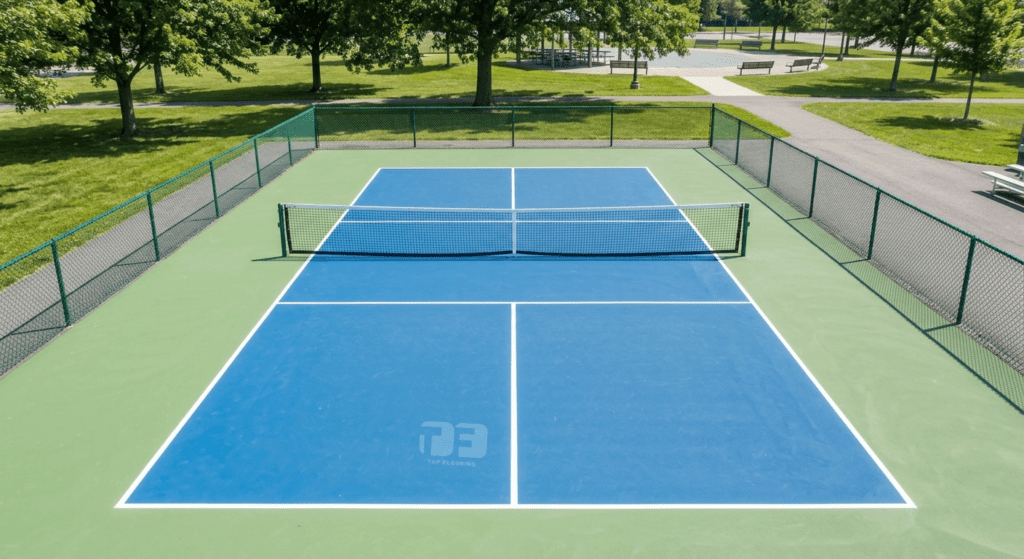
Synthetic acrylic flooring is widely recognized as the preferred pickleball court material for outdoor courts.
It consists of multiple acrylic coating layers applied over a properly prepared concrete or asphalt base.
Advantages
Consistent Ball Bounce
Acrylic surfaces create a smooth and uniform playing area that delivers predictable ball response.
Excellent Slip Resistance
Specialized texture systems improve traction without restricting movement.
UV Resistance
High-quality acrylic coatings maintain their appearance and performance under continuous sunlight exposure.
Low Maintenance
Routine cleaning and occasional resurfacing are usually sufficient.
Wide Color Options
Facilities can choose customized court colors that enhance aesthetics and visibility.
Cost-Effective Lifecycle
Although installation costs may be higher than basic concrete, lower maintenance costs often provide better long-term value.
Best For
- Outdoor pickleball courts
- Residential communities
- Sports clubs
- Schools
- Tournament venues
2. Concrete Surface
Concrete serves as both a court base and, in some cases, the playing surface itself.
Advantages
- Strong structural foundation
- Long lifespan
- Relatively low initial cost
Limitations
- Hard on joints
- Limited player comfort
- Poor aesthetics
- Can crack over time
- Reduced grip during wet conditions
Concrete is often used as the foundation beneath acrylic systems rather than as the final playing surface.
3. Asphalt Surface
Asphalt is another common base material.
Advantages
- Lower installation cost
- Faster installation
- Good surface smoothness
Limitations
- More vulnerable to heat
- Potential surface deformation
- Shorter lifespan compared to concrete
Most professional pickleball courts using asphalt bases are coated with acrylic surfacing systems.
4. Modular PP Tiles
Polypropylene (PP) modular tiles are increasingly used in temporary and multi-sport applications.
Advantages
- Quick installation
- Portable design
- Drainage capability
- Easy replacement of damaged sections
Limitations
- Different ball bounce characteristics
- Higher noise levels
- Movement between tiles over time
- Less preferred for competitive play
5. Cushioned Acrylic Systems
These systems combine acrylic coatings with cushion layers.
Benefits
- Enhanced shock absorption
- Reduced player fatigue
- Increased comfort
- Lower stress on knees and ankles
Ideal For
- Senior players
- Sports academies
- High-usage facilities
- Premium recreational centers
Performance Comparison of Popular Pickleball Court Materials
| Material | Ball Bounce | Grip | Durability | Maintenance | Comfort |
|---|---|---|---|---|---|
| Acrylic Surface | Excellent | Excellent | Excellent | Low | Good |
| Cushioned Acrylic | Excellent | Excellent | Excellent | Low | Excellent |
| Concrete | Good | Moderate | Excellent | Moderate | Poor |
| Asphalt | Good | Moderate | Good | Moderate | Moderate |
| PP Tiles | Moderate | Good | Good | Low | Good |
For overall performance, acrylic systems consistently outperform other options.
Understanding Pickleball Court Construction Layers
A professional court typically includes:
Subgrade
Compacted soil foundation.
Base Layer
Concrete or asphalt.
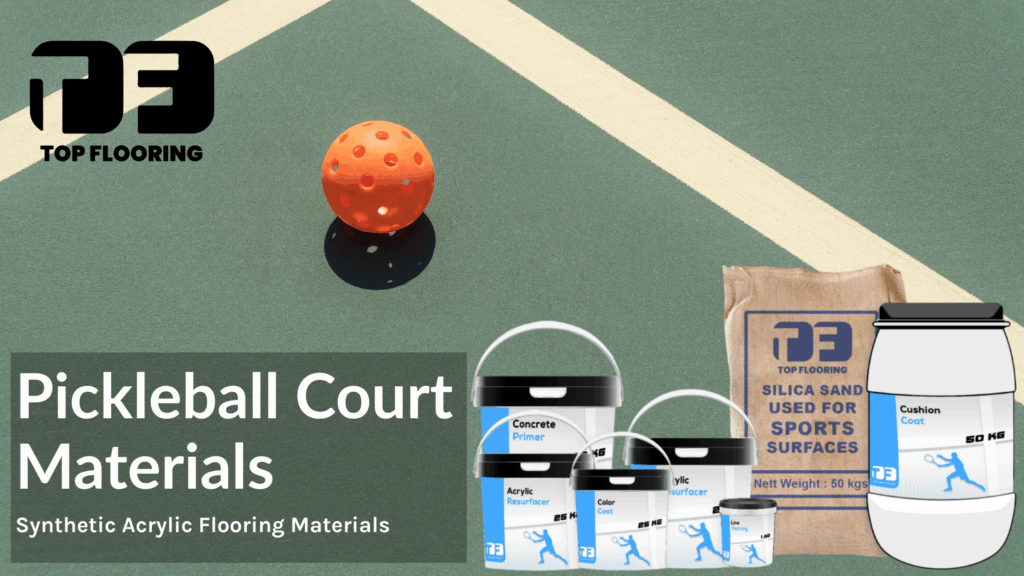
Acrylic Resurfacer
Acrylic Resurfacer provides smoothness and durability.
Texture Coats
Improve traction and playability.
Color Coats
Color Coats enhance aesthetics and visibility.
Court Markings
Court Markings precision game lines for professional play.
Each layer contributes to court performance and longevity.
Cost of Pickleball Court Materials
Several factors influence total project cost:
- Site preparation
- Base construction
- Surface material selection
- Drainage requirements
- Geographic location
- Labor costs
Relative Cost Ranking
- Concrete Surface (Lowest)
- Asphalt Surface
- Acrylic Surface
- Cushioned Acrylic Surface (Highest)
- Premium Modular Tile Systems
While acrylic systems may require higher initial investment, their superior durability and lower maintenance often result in better long-term value.
Real Case Study: Community Pickleball Court Upgrade
Project Overview
A residential community experienced growing demand for pickleball among residents.
Initial Situation
The community used a basic concrete court that presented several challenges:
- Surface cracking
- Poor grip
- Inconsistent bounce
- Frequent complaints from players
Solution
The facility upgraded to a synthetic acrylic pickleball court system over the existing concrete base.
Results After One Year
- Improved player satisfaction
- Better ball control
- Reduced maintenance requirements
- Enhanced court appearance
- Increased court bookings
The facility management reported significantly lower repair expenses compared to previous years.
Key Takeaway
Investing in quality surfacing materials often reduces overall ownership costs while improving user experience.
Expert Advice from Sports Flooring Professionals
Prioritize Surface Quality Over Initial Cost
Choosing the cheapest surface often leads to increased repair and maintenance expenses later.
Focus on Climate Compatibility
Materials should be selected according to local environmental conditions.
Invest in Proper Base Preparation
Even the highest-quality surface coatings cannot compensate for a poorly constructed foundation.
Choose UV-Resistant Systems
Outdoor courts require protection from sunlight exposure to maintain color and performance.
Plan for Future Maintenance
Every sports surface eventually requires resurfacing. Selecting systems with straightforward maintenance procedures simplifies long-term management.
Common Mistakes to Avoid
Ignoring Drainage Design
Poor drainage can shorten court lifespan significantly.
Using Low-Quality Coatings
Inferior materials often fade, crack, and wear prematurely.
Skipping Surface Texturing
Insufficient texture can affect traction and safety.
Poor Line Marking Accuracy
Incorrect markings compromise gameplay quality.
Hiring Inexperienced Contractors
Proper installation is as important as material selection.
Why Synthetic Acrylic Is Considered the Best Pickleball Court Material
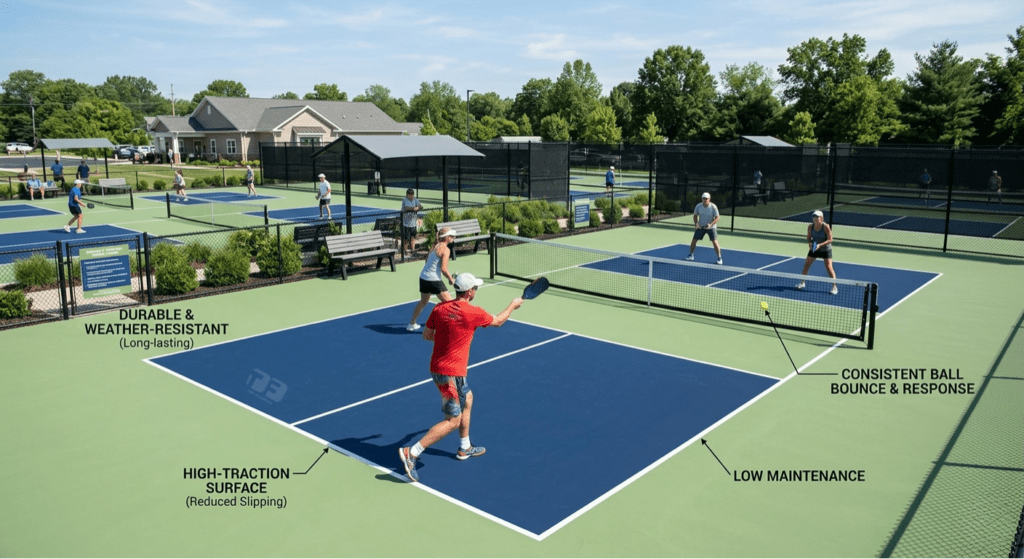
Synthetic acrylic systems continue to dominate modern pickleball court construction because they provide:
- Consistent ball bounce
- Excellent player traction
- UV resistance
- Attractive appearance
- Long service life
- Low maintenance
- Customizable colors
- Professional-level performance
These advantages make acrylic surfaces suitable for residential, recreational, and competitive environments.
Future Trends in Pickleball Court Materials
The industry is moving toward:
Cushioned Performance Systems
Improved player comfort and injury reduction.
Sustainable Materials
Environmentally responsible coating technologies.
Advanced UV Protection
Longer-lasting color stability.
Multi-Sport Surface Integration
Facilities seeking greater versatility and higher utilization.
Smart Court Technologies
Integrated performance tracking and maintenance monitoring systems.
Conclusion
Selecting the best pickleball court material is one of the most important decisions in any court construction project. While concrete, asphalt, and modular tile systems each have their place, synthetic acrylic surfaces consistently provide the best combination of performance, durability, aesthetics, and long-term value.
For schools, sports clubs, residential communities, parks, academies, and commercial facilities, professionally installed acrylic pickleball court systems deliver reliable gameplay, improved player safety, and lower lifecycle costs.
A well-designed pickleball court is more than just a playing surface—it is a long-term investment in player experience, facility reputation, and sporting excellence.
Frequently Asked Questions
Synthetic acrylic surface systems are generally considered the best option because they provide excellent ball bounce, traction, durability, and weather resistance.
Concrete is an excellent foundation material but performs best when covered with an acrylic sports surfacing system.
With proper maintenance and periodic resurfacing, an acrylic pickleball court can provide many years of reliable performance.
Yes. Cushioned systems reduce impact stress on players and are particularly beneficial for high-use facilities and older athletes.
High-quality acrylic systems generally offer one of the best combinations of low maintenance and long-term durability.