
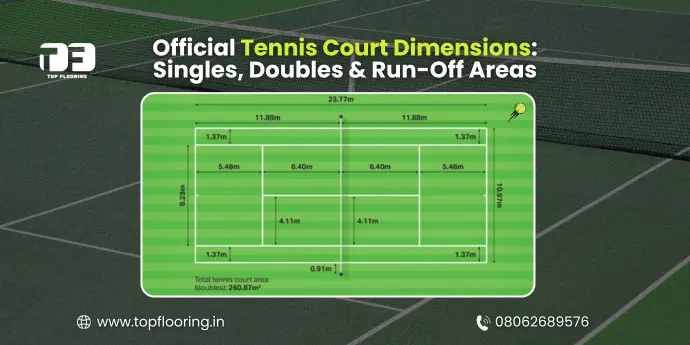
Understanding tennis court dimensions is essential whether planning a new court, renovating an existing one, or simply learning the rules of the game. From professional tournaments to school playgrounds, tennis courts follow standardized measurements that ensure fair play, consistent bounce, and proper movement space for players.
Why Official Tennis Court Dimensions Matter
Tennis is a precision sport where court measurements directly affect gameplay and safety. Incorrect dimensions can lead to:
- Inconsistent ball bounce
- Player movement restrictions
- Safety risks due to limited run-off space
- Non-compliance with official standards
- Increased maintenance and resurfacing issues
Following official tennis court dimensions ensures uniform play quality across all levels.
Standard Tennis Court Dimensions (Quick Overview)
A tennis court has a rectangular shape and is used for both singles and doubles matches.
Official Tennis Court Size
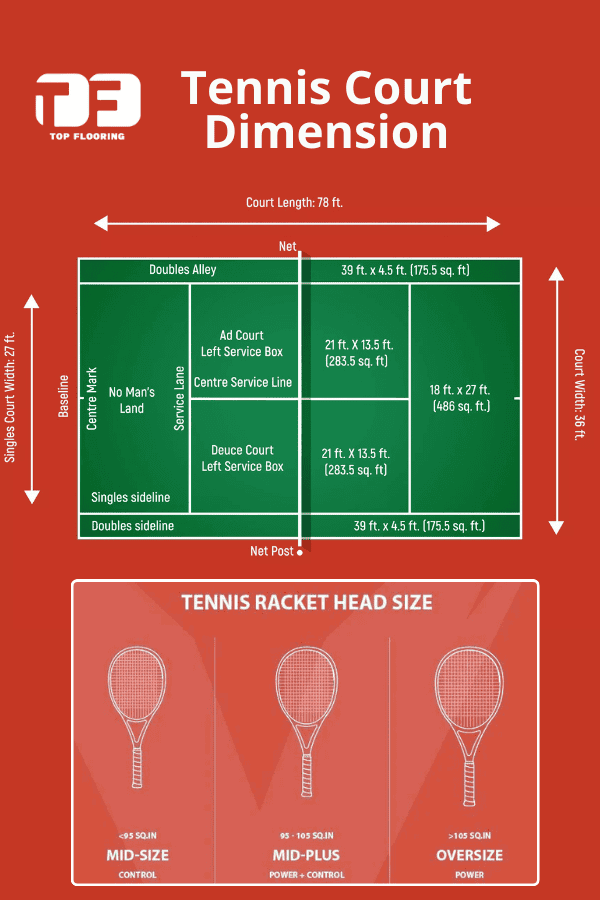
- Total length: 78 feet (23.77 meters)
- Width (Doubles): 36 feet (10.97 meters)
- Width (Singles): 27 feet (8.23 meters)
The length remains the same for singles and doubles; only the width changes.
Transform Your Sports Facility Today!
Contact us for high-quality synthetic sports flooring material and elevate your space!
Singles Tennis Court Dimensions
Single matches use the inner portion of the court.
- Length: 78 feet
- Width: 27 feet
- Total playing area: 2,106 sq ft (approx.)
Single sidelines are located inside the doubles sidelines, clearly marked with paint or tape.
Doubles Tennis Court Dimensions
Doubles matches use the full width of the court.
- Length: 78 feet
- Width: 36 feet
- Total playing area: 2,808 sq ft (approx.)
The double sidelines are the outermost boundary lines.
Tennis Court Layout Explained
Understanding the layout helps visualize how the court is divided.
Baseline
- Located at both ends of the court
- Marks the boundary behind the players
Singles & Doubles Sidelines
- Singles sidelines: inner vertical lines
- Doubles sidelines: outer vertical lines
Service Line
- Parallel to the net on both sides
- 21 feet away from the net
Center Service Line
- Divides the service boxes into left and right sections
Service Boxes
- Two on each side of the net
- Used during serves
Net Position
- Placed exactly at the center of the court
- Net height:
- 3 ft 6 in (1.07 m) at posts
- 3 ft (0.914 m) at the center
- 3 ft 6 in (1.07 m) at posts
Tennis Court Markings Dimensions
All court lines are part of the playing area.
- Line width: 1–2 inches (usually 2 inches)
- Baseline width: Up to 4 inches (for visibility)
- Color: White or contrasting shade for surface clarity
Clear, accurate markings are essential for umpiring and player judgment.
Total Space Required for a Tennis Court
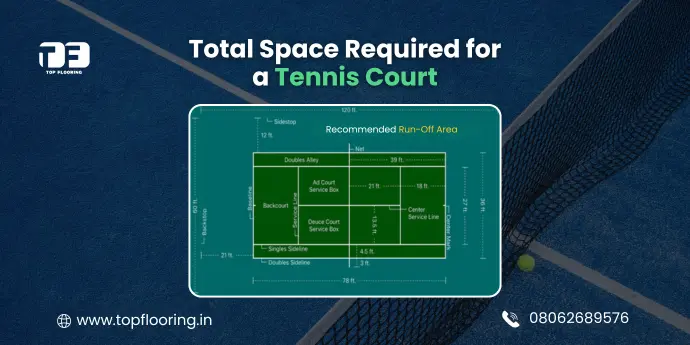
The playing area alone is not enough. Extra space is required for player movement and safety.
Recommended Run-Off Area
- Minimum total area:
- 120 ft × 60 ft (7,200 sq ft)
- 120 ft × 60 ft (7,200 sq ft)
- Preferred for tournaments:
- 120 ft × 64 ft or more
- 120 ft × 64 ft or more
This additional space allows players to chase shots without injury.
Indoor vs Outdoor Tennis Court Dimensions
The court size remains the same for indoor and outdoor courts. The difference lies in overhead clearance.
Indoor Tennis Court Requirements
- Minimum ceiling height: 20 feet
- Recommended height: 30–40 feet for competitive play
Adequate lighting and ventilation are also critical indoors.
Tennis Court Dimensions for Schools & Residential Projects
For non-professional use:
- Standard court dimensions are still recommended
- Run-off space may be slightly reduced if necessary
- Multi-sport layouts often share space
However, shrinking the actual playing area is not advised.
Common Mistakes in Tennis Court Dimensions
Many issues arise due to incorrect planning.
- Ignoring run-off space
- Incorrect singles or doubles width
- Improper net height
- Uneven or unclear markings
- Inadequate spacing for fencing or seating
Avoiding these mistakes ensures better play quality and lower maintenance costs.
Why Tennis Court Dimensions Matter in Construction Projects
Accurate tennis court dimensions are critical for:
- Proper installation of tennis court flooring systems
- Uniform ball bounce and player safety
- Efficient use of construction space
- Long-term durability of tennis court material
- Compliance with sports authority standards
Incorrect dimensions often lead to flooring failure, drainage issues, and costly rework.
Transform Your Sports Facility Today!
Contact us for high-quality synthetic sports flooring material and elevate your space!
Are Tennis Court Dimensions the Same Worldwide?
Yes. Tennis court dimensions are standardized globally, ensuring consistency across:
- Schools
- Clubs
- National tournaments
- International competitions
This uniformity allows players to compete anywhere without adjustment.
Final Thoughts
Understanding tennis court dimensions is the foundation of proper court planning and enjoyable gameplay. From court length and width to markings and run-off space, every measurement plays a role in performance, safety, and long-term usability.
Whether the goal is recreational play or professional competition, following standard tennis court dimensions ensures a high-quality playing experience that meets global standards.
FAQs
A standard tennis court measures 78 feet long and 36 feet wide for doubles, and 27 feet wide for singles.
The length is the same. Only the width changes—singles courts are narrower.
Including run-off areas, about 7,200 sq ft is recommended.
The net is 3 feet high at the center and 3 feet 6 inches at the posts.
The court size is the same, but indoor courts require sufficient ceiling height.