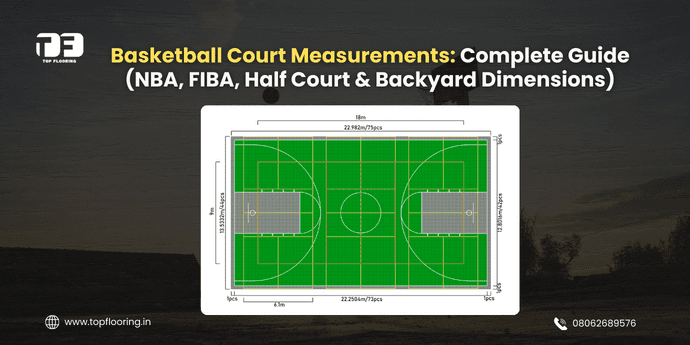
Basketball court measurements refer to the standard dimensions and markings used to design a playable court. A full-size court is 94 ft × 50 ft (28.65 m × 15.24 m) for NBA and 91.9 ft × 49.2 ft (28 m × 15 m) for FIBA. These measurements include boundary lines, key areas, and scoring zones.
Standard Basketball Court Measurements Overview
Basketball court measurements define how the game is played, ensuring consistency across professional, amateur, and recreational levels. These dimensions include not only the overall size but also key markings like the three-point line, free-throw lane, and center circle. For architects, contractors, and sports developers, accuracy in these measurements is critical. Even minor deviations can impact gameplay, safety, and compliance with governing standards.
Basketball courts are rectangular playing surfaces defined by governing bodies like National Basketball Association (NBA) and FIBA. While dimensions are similar, small differences affect gameplay and design.
The standard layout includes:
- Length and width
- Center circle
- Free throw lane (key)
- Three-point arc
- Restricted area
For architects and contractors, understanding these dimensions ensures compliance and performance.
Basketball Court Size Comparison (NBA vs FIBA vs Half Court)
| Court Type | Length (ft) | Width (ft) | Length (m) | Width (m) |
| NBA Court | 94 ft | 50 ft | 28.65 m | 15.24 m |
| FIBA Court | 91.9 ft | 49.2 ft | 28 m | 15 m |
| Half Court | 47 ft | 50 ft | 14.33 m | 15.24 m |
NBA Court Dimensions Explained
The NBA court is the most recognized standard globally. It is designed for professional-level performance, emphasizing speed and spacing.
Key Measurements:
- Court Size: 94 ft × 50 ft
- Three-point line: 23.75 ft
- Free throw distance: 15 ft
- Key width: 16 ft
The larger court size increases player spacing, making it ideal for high-performance play.
FIBA Basketball Court Measurements
FIBA courts are used in international competitions and are slightly smaller than NBA courts.
Key Measurements:
- Court Size: 28 m × 15 m
- Three-point line: 6.75 m
- Free throw distance: 4.6 m
- Key width: 4.9 m
Key Difference:
The shorter three-point line encourages more outside shooting in international play.
Half Court Basketball Size
Half courts are commonly used in schools, training facilities, and residential projects.
Standard Half Court Dimensions:
- Length: 47 ft
- Width: 50 ft
Half courts require less space and cost, making them practical for compact areas. Half court basketball size can be customized depending on available land without compromising essential gameplay features.
Backyard Basketball Court Size Guide
Backyard courts are customized based on available space.
Recommended Backyard Sizes
| Court Type | Size (ft) | Use Case |
| Small Court | 20 × 30 ft | Kids / casual play |
| Medium Court | 30 × 50 ft | Practice & shooting |
| Large Court | 50 × 84 ft | Semi-professional |
Proper planning ensures optimal playability even in limited areas.
Expert Tip:
For backyard courts, maintaining proper slope (1%) is crucial to prevent water accumulation and ensure long-term durability.
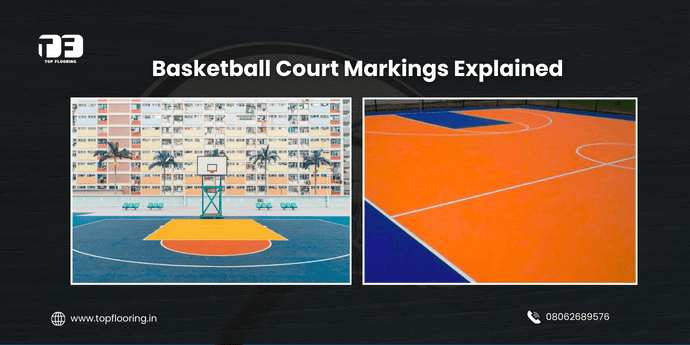
Basketball Court Markings Explained
Court Markings Measurement Table
| Marking | Distance |
| Free Throw Line | 15 ft from backboard |
| Three-Point Line (NBA) | 23.75 ft |
| Three-Point Line (FIBA) | 6.75 m |
| Key Width (NBA) | 16 ft |
| Center Circle Radius | 6 ft |
These markings define gameplay zones and must be accurately painted during construction.
Basketball Court Construction Process
Building a professional basketball court involves multiple stages:
1. Site Preparation
- Soil compaction
- Leveling
- Base preparation
2. Sub-base Installation
- Crushed stone layer
- Proper drainage system
3. Concrete or Asphalt Base
- Thickness: 100–150 mm
- Slope: 1% for water runoff
4. Surface Coating
- Acrylic layers
- Line marking
Materials Used in Basketball Court Flooring
Modern Basketball courts flooring use advanced materials for durability and performance:
- Concrete base
- Asphalt surface
- Synthetic acrylic coatings
- PU systems (indoor courts)
Among these, acrylic systems dominate outdoor courts.
Why Synthetic Acrylic Flooring is Ideal for Basketball Courts
Synthetic acrylic flooring has become the industry standard due to its performance and durability.
Key Advantages:
- Excellent grip and ball bounce
- UV resistance for outdoor use
- Low maintenance
- Anti-slip surface
- Cost-effective installation
It also allows customization of colors and markings, making it ideal for schools and stadiums.
Cost Estimation Factors
Basketball court cost depends on:
- Court size
- Base construction (concrete/asphalt)
- Acrylic coating system
- Location and labor
Approximate Cost Range (India):
- ₹250–₹450 per sq ft (acrylic courts)
Maintenance & Durability
Proper maintenance ensures long-term performance:
- Regular cleaning
- Crack repair
- Recoating every 4–6 years
Acrylic courts can last 8–10 years with proper care.
Common Mistakes in Court Construction
Avoid these errors:
- Incorrect slope → water stagnation
- Poor base compaction → cracks
- Wrong line markings
- Low-quality materials
These mistakes reduce court lifespan and performance.
Safety Considerations
Safety is critical in court design:
- Anti-slip surfaces
- Shock absorption
- Proper lighting
- Clear boundary markings
Well-designed courts reduce injury risks.
Future Trends in Basketball Court Design
The sports flooring industry is evolving rapidly:
- Smart courts with sensors
- Eco-friendly materials
- Modular court systems
- High-performance coatings
These innovations improve gameplay and sustainability.
Conclusion
Understanding basketball court measurements is essential for designing high-performance sports facilities. Whether it is an NBA-standard arena, a FIBA-compliant court, or a backyard setup, precise dimensions and proper construction play a crucial role.
From base preparation to surface coating, every step impacts durability, safety, and gameplay quality. Synthetic acrylic flooring continues to be the preferred choice due to its performance, weather resistance, and cost efficiency.
For architects, contractors, and sports infrastructure developers, investing in accurate design and high-quality materials ensures long-term success and optimal playing conditions.
Frequently Asked Questions
A standard basketball court measures 94 ft × 50 ft (28.65 m × 15.24 m) in the NBA and 28 m × 15 m in FIBA. These dimensions include all markings like the three-point line, free throw line, and key area.
A half basketball court typically measures 47 ft × 50 ft (14.33 m × 15.24 m). It is commonly used in schools, training facilities, and residential spaces due to lower space requirements.
NBA courts are slightly larger at 94 ft × 50 ft, while FIBA courts measure 28 m × 15 m. The three-point line distance and key dimensions also differ, affecting gameplay style.
The minimum backyard court size is around 20 ft × 30 ft, suitable for casual play. For better gameplay, a 30 ft × 50 ft court is recommended.
Synthetic acrylic flooring is considered the best for outdoor basketball courts due to its durability, anti-slip properties, UV resistance, and consistent ball bounce.
The cost varies depending on size and materials, but typically ranges between ₹250–₹450 per sq ft for acrylic basketball courts in India.