Designing a basketball court requires accuracy, planning, and a clear understanding of measurements. Whether the goal is to build a professional arena, school court, or residential play area, correct basketball court dimensions and layout are essential for performance, safety, and durability.
This guide explains everything in a simple and practical way, including basketball court measurements in feet and metres, half court size, backboard dimensions, and construction essentials.
Table of contents
- Why Basketball Court Dimensions Are So Important
- Standard Basketball Court Dimensions
- Basketball Court Measurement in Feet
- Basketball Court Dimensions in Metres
- Half Basketball Court Size (Feet & Metres)
- Basketball Court Size in Square Feet
- Length and Width of a Basketball Court
- Basketball Backboard Dimensions and Size
- Basketball Court Diagram Measurements Explained
- Line Markings and Line Thickness
- Ceiling Height for Indoor Basketball Courts
- Basketball Ground Size (Including Safety Area)
- Role of Flooring in Basketball Court Construction
- Common Basketball Court Measurement Mistakes
- Maintenance and Rechecking Measurements
- Final Thoughts
- Frequently Asked Questions (FAQs)
Why Basketball Court Dimensions Are So Important
Accurate basketball court measurements are not just technical; they directly influence how the game is played. Even small deviations can impact shooting distance, player positioning, and overall gameplay experience.
Proper dimensions ensure consistency across courts, allowing players to perform confidently whether they are practicing or competing. They also help maintain safety by providing adequate spacing and movement areas.
Standard Basketball Court Dimensions
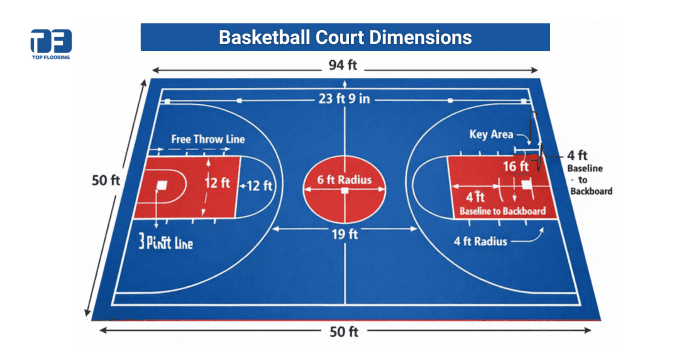
Basketball courts follow two major standards: NBA (USA) and FIBA (International). In India, FIBA standards are commonly used.
| Standard | Length | Width |
| NBA | 94 ft (28.65 m) | 50 ft (15.24 m) |
| FIBA | 28 m | 15 m |
Both layouts are similar, with minor variations in markings and arc distances.
Basketball Court Measurement in Feet
Understanding court dimensions in feet is essential for construction planning in many regions.
Key Measurements (Feet)
- Court Length: 94 ft
- Court Width: 50 ft
- Free Throw Line Distance: 15 ft
- Center Circle Diameter: 12 ft
- Rim Height: 10 ft
- Three-Point Line: 22–23.75 ft (depending on standard)
These measurements define the structure of the court and influence gameplay strategies.
Basketball Court Dimensions in Metres
Metric measurements are widely used in international projects and modern construction.
Key Measurements (Metres)
- Court Length: 28 m
- Court Width: 15 m
- Free Throw Line: 4.6 m
- Three-Point Line: 6.75 m
- Rim Height: 3.05 m
Using metres ensures compatibility with global standards like FIBA.
Half Basketball Court Size (Feet & Metres)
A Half courts are a practical solution for limited space and budget.
| Measurement Type | Size |
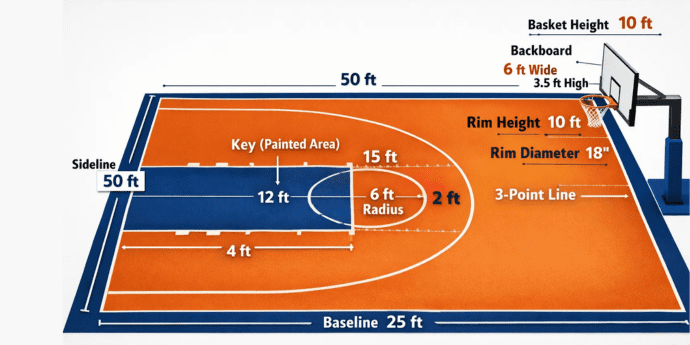
| Feet | 47 ft × 50 ft |
| Metres | 14.3 m × 15 m |
Half courts are ideal for training, practice drills, and recreational use. They provide sufficient space for shooting and skill development while reducing construction costs.
Basketball Court Size in Square Feet
Knowing the total area helps estimate materials and budget.
| Court Type | Area |
| Full Court | Approx. 4,700 sq ft |
| Half Court | Approx. 2,350 sq ft |
This calculation is especially useful when planning flooring and base construction.
Length and Width of a Basketball Court
The standard proportions of a basketball court are carefully designed to balance offense and defense.
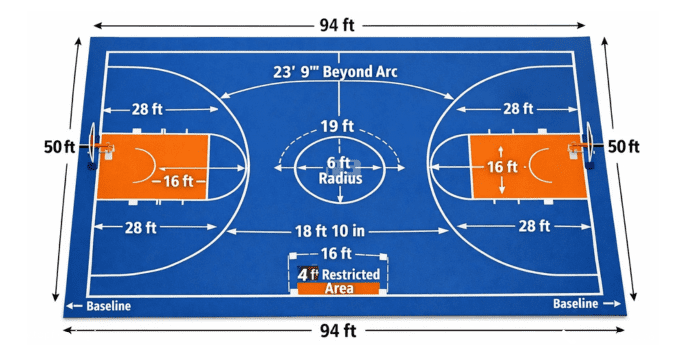
- Length: 94 ft / 28 m
- Width: 50 ft / 15 m
These dimensions create enough space for fast-paced movement while maintaining competitive balance.
Basketball Backboard Dimensions and Size
The backboard is a key component that affects shooting accuracy and rebounds.
| Component | Measurement |
| Backboard Width | 6 ft (1.83 m) |
| Backboard Height | 3.5 ft (1.07 m) |
| Rim Height | 10 ft (3.05 m) |
| Rim Diameter | 18 inches (45 cm) |
The rectangular marking on the backboard helps players aim bank shots effectively.
Basketball Court Diagram Measurements Explained
A basketball court includes several marked zones that define gameplay.
- Center Circle: Used for tip-off at the start of the game
- Free Throw Lane (Key): Player positioning during free throws
- Three-Point Arc: Defines long-range scoring area
- Baselines and Sidelines: Outer boundaries of the court
- Restricted Area: Zone under the basket to prevent charging fouls
Each marking must be precise to ensure fair play and rule compliance.
Line Markings and Line Thickness
Court markings must be clear, durable, and accurate.
- Standard thickness: 2 inches (5 cm)
- Lines should be highly visible against the surface
- Acrylic line paint is commonly used for long-lasting performance
Incorrect or faded lines can affect gameplay decisions and officiating.
Ceiling Height for Indoor Basketball Courts
Indoor courts require sufficient vertical clearance to allow high shots and passes.
| Level | Recommended Height |
| Recreational | Minimum 7 metres |
| Professional | Up to 12 metres |
Adequate ceiling height ensures uninterrupted gameplay.
Basketball Ground Size (Including Safety Area)
In addition to the playing area, extra space is required around the court.
- Recommended safety margin: 3 to 5 feet on all sides
- Total space for full court: Approx. 110 ft × 60 ft
This buffer zone prevents injuries and allows free movement beyond boundaries.
Role of Flooring in Basketball Court Construction
The quality of flooring plays a major role in performance and durability.
Synthetic acrylic flooring is widely preferred for Basketball court flooring because it offers:
- Consistent ball bounce
- Slip resistance for player safety
- Weather resistance for outdoor courts
- Low maintenance requirements
This makes it an ideal choice for schools, clubs, and residential courts in India.
Common Basketball Court Measurement Mistakes
Errors in measurement can reduce the usability of a court.
Common mistakes include:
- Incorrect three-point line placement
- Improper rim height
- Uneven court surface
- Lack of safety space
- Inaccurate line markings
Avoiding these issues ensures a professional-quality court.
Maintenance and Rechecking Measurements
Regular maintenance keeps the court in optimal condition.
- Repaint markings when they fade
- Check rim height and alignment periodically
- Inspect surface for cracks or wear
- Maintain proper drainage for outdoor courts
Consistent upkeep extends the life of the court and maintains playing quality.
Final Thoughts
Basketball court construction is a combination of accurate measurements, proper layout, and quality materials. From full court dimensions to half court size and backboard specifications, every detail contributes to a better playing experience.
For long-term performance, using synthetic acrylic sports flooring ensures durability, safety, and consistent gameplay across different weather conditions.
Frequently Asked Questions (FAQs)
A standard court measures 94 ft × 50 ft (28 m × 15 m).
Half court dimensions are 47 ft × 50 ft (14.3 m × 15 m).
The standard height is 10 feet (3.05 metres).
The backboard measures 6 ft × 3.5 ft (1.83 m × 1.07 m).
Synthetic acrylic flooring is considered the best due to its durability, grip, and low maintenance.