Volleyball is one of the most popular indoor and outdoor sports played in schools, sports academies, clubs, colleges, resorts, and professional stadiums. Whether planning a professional sports facility, a school playground, or a beach volleyball setup, understanding the correct volleyball court size is essential for performance, safety, and compliance with official standards.
From volleyball court dimensions and volleyball net dimensions to beach volleyball court size and construction requirements, every measurement plays a crucial role in creating a high-quality playing surface. Proper court planning ensures accurate gameplay, player safety, durability, and long-term performance.
This detailed guide explains official volleyball court size in feet, layout, markings, net measurements, construction standards, flooring options, and all dimensions required for indoor and outdoor volleyball court construction.
Table of contents
- Official Volleyball Court Size
- Volleyball Court Size in Feet
- Volleyball Court Layout Explained
- Volleyball Net Dimensions
- Volleyball Pole Dimensions
- Beach Volleyball Court Size
- Beach Volleyball Net Dimensions
- Beach Volleyball Sand Depth
- Recommended Free Zone Around Volleyball Court
- Indoor Volleyball Court Height Clearance
- Volleyball Court Flooring Options
- Volleyball Court Construction Process
- Volleyball Court Slope & Drainage
- Lighting Requirements for Volleyball Courts
- Volleyball Court Construction Cost Factors
- Difference Between Indoor and Beach Volleyball Court Size
- Common Mistakes During Volleyball Court Construction
- Why Accurate Volleyball Court Dimensions Matter
- Conclusion
- Frequently Asked Questions
Official Volleyball Court Size
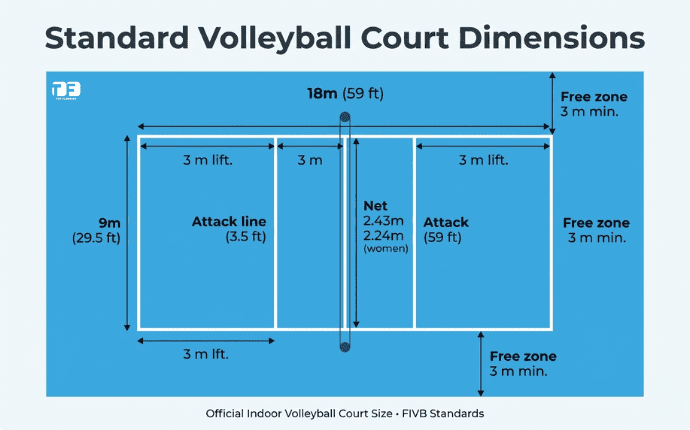
The standard volleyball court size approved by international organizations such as the FIVB (Fédération Internationale de Volleyball) is:
| Measurement | In Meters | In Feet |
| Court Length | 18 meters | 59 feet |
| Court Width | 9 meters | 29.5 feet |
| Total Playing Area | 162 sq. meters | 1,743 sq. feet |
The volleyball court is rectangular and divided equally into two playing zones by the center line and net.
Each side of the court measures:
- 9 meters × 9 meters
- Approximately 29.5 feet × 29.5 feet
These official volleyball court dimensions are used for professional indoor matches, tournaments, training facilities, schools, and sports complexes.
Volleyball Court Size in Feet
Many builders and sports contractors search specifically for volleyball court size in feet while planning court layouts. Here are the standard dimensions:
| Court Area | Size in Feet |
| Full Court Length | 59 feet |
| Full Court Width | 29.5 feet |
| Half Court | 29.5 ft × 29.5 ft |
| Attack Line Distance | 10 feet from center line |
| Free Zone Recommended | 10–16 feet around court |
The total recommended construction area becomes much larger after including safety clearance zones around the court.
Volleyball Court Layout Explained
A standard volleyball court layout consists of several important sections:
1. Boundary Lines
The boundary lines define the playing area.
Sidelines
- Length: 59 feet
- Positioned along the longer sides
End Lines
- Width: 29.5 feet
- Positioned at the shorter ends
All court lines are usually:
- 5 cm wide (2 inches)
- Marked using durable acrylic line paint
2. Center Line
The center line divides the court into two equal halves beneath the net.
- Width: 2 inches
- Runs directly under the volleyball net
3. Attack Line (3-Meter Line)
The attack line separates front-row and back-row playing areas.
Official Measurement:
- 3 meters from center line
- Approximately 9 feet 10 inches
This line is critical in professional volleyball gameplay.
Volleyball Net Dimensions
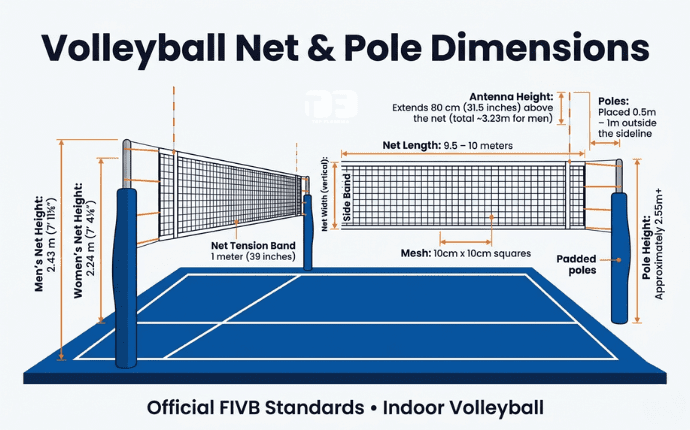
Understanding volleyball net dimensions is equally important during court construction.
Standard Volleyball Net Size
| Specification | Measurement |
| Net Width | 1 meter (3.3 feet) |
| Net Length | 9.5 to 10 meters |
| Net Height (Men) | 2.43 meters (7 ft 11 ⅝ in) |
| Net Height (Women) | 2.24 meters (7 ft 4 ⅛ in) |
The volleyball net extends slightly beyond both sidelines for proper tension support.
Volleyball Pole Dimensions
The volleyball poles support the net and must be installed securely.
| Specification | Measurement |
| Distance from Sidelines | 0.5–1 meter |
| Pole Height | Around 8 feet 4 inches |
| Pole Material | Steel or aluminum |
Professional installations often use padded poles for player safety.
Beach Volleyball Court Size
Beach volleyball has different dimensions compared to indoor volleyball.
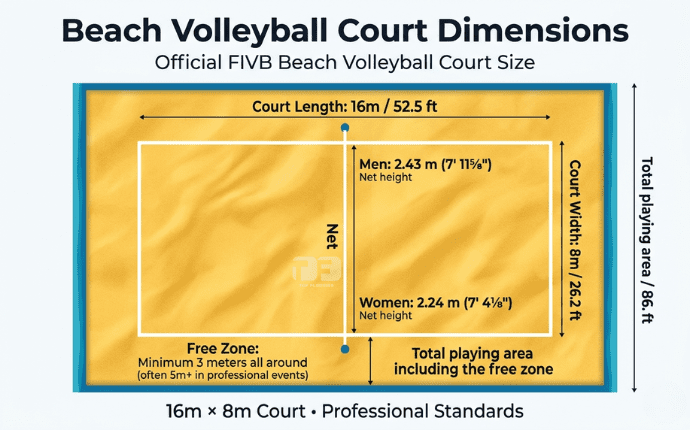
Official Beach Volleyball Court Size
| Measurement | In Meters | In Feet |
| Length | 16 meters | 52.5 feet |
| Width | 8 meters | 26.2 feet |
The beach volley ball court size is smaller because only two players compete on each side.
Beach Volleyball Net Dimensions
| Category | Net Height |
| Men | 2.43 meters |
| Women | 2.24 meters |
These measurements are similar to indoor volleyball standards.
Beach Volleyball Sand Depth
The sand layer is one of the most important factors in beach volleyball court construction.
Recommended Sand Depth
| Layer | Recommended Depth |
| Playing Sand | 12–18 inches |
| Base Layer | Compacted drainage base |
The sand should be:
- Soft
- Rounded
- Dust-free
- Properly drained
Recommended Free Zone Around Volleyball Court
Professional volleyball courts require additional free space for player movement and safety.
Indoor Volleyball Free Zone
| Area | Recommended Clearance |
| Sidelines | 3–5 meters |
| End Lines | 5–8 meters |
Total Recommended Indoor Area
Including safety space:
- Around 24 m × 15 m
- Approximately 78 ft × 49 ft
This larger playing environment is necessary for competitive volleyball matches.
Indoor Volleyball Court Height Clearance
Indoor facilities require adequate ceiling clearance.
| Competition Level | Minimum Height |
| School Level | 23 feet |
| Professional Level | 40 feet or more |
Low ceilings can affect gameplay and ball movement.
Volleyball Court Flooring Options
Choosing the correct volleyball court flooring improves:
- Ball bounce
- Player grip
- Shock absorption
- Durability
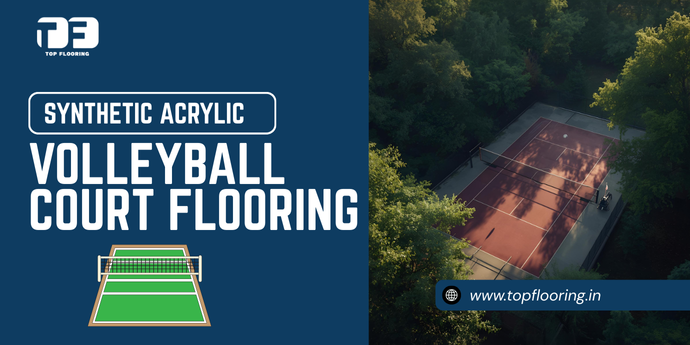
1. Synthetic Acrylic Flooring
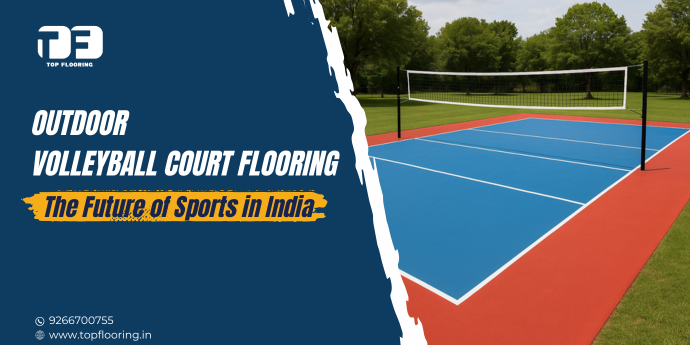
Synthetic acrylic sports flooring is one of the most popular solutions for outdoor volleyball courts.
Benefits:
- UV resistant
- Anti-slip surface
- Weather resistant
- Long-lasting color
- Easy maintenance
It is commonly used for:
- Outdoor volleyball courts
- Multi-purpose courts
- School sports grounds
2. PU Flooring
PU flooring offers:
- Better cushioning
- Joint protection
- Professional indoor finish
Mostly preferred for indoor stadiums and academies.
3. Wooden Volleyball Flooring
Professional indoor volleyball tournaments often use hardwood flooring because it provides:
- Excellent ball response
- Premium appearance
- Smooth movement
However, maintenance costs are higher.
Volleyball Court Construction Process
Proper volleyball court construction involves multiple stages.
Step 1: Site Preparation
The area is:
- Excavated
- Leveled
- Compacted
Proper slope and drainage are essential.
Step 2: Base Construction
Typical base layers include:
- Compacted soil
- WMM layer
- Concrete or asphalt base
A strong base improves court durability.
Step 3: Surface Coating
Depending on project requirements:
- Acrylic coating
- PU coating
- Sports tiles
- Wooden flooring
may be installed.
Step 4: Court Marking
Court lines are marked using:
- Acrylic line paint
- UV-resistant sports coatings
Measurements must follow official volleyball court dimensions.
Step 5: Net & Pole Installation
The final stage includes:
- Pole anchoring
- Net fitting
- Tension adjustment
- Safety padding installation
Volleyball Court Slope & Drainage
Outdoor volleyball courts require proper drainage systems.
Recommended Slope
| Surface Type | Recommended Slope |
| Acrylic Court | 1% |
| Concrete Base | 1:100 |
Proper drainage prevents:
- Water accumulation
- Surface damage
- Cracks
- Slippery conditions
Lighting Requirements for Volleyball Courts
For evening matches and tournaments, sports lighting is essential.
Recommended Lux Levels
| Usage Type | Lux Level |
| Recreational Play | 200 lux |
| Training | 300–500 lux |
| Professional Matches | 1000+ lux |
LED sports lighting is commonly used due to energy efficiency.
Volleyball Court Construction Cost Factors
Several factors influence volleyball court construction cost:
- Court size
- Flooring material
- Base thickness
- Indoor or outdoor installation
- Drainage system
- Lighting setup
- Seating area
- Fencing requirements
Outdoor synthetic acrylic volleyball courts flooring are generally more cost-effective and easier to maintain than indoor wooden courts.
Difference Between Indoor and Beach Volleyball Court Size
| Feature | Indoor Volleyball | Beach Volleyball |
| Court Size | 18m × 9m | 16m × 8m |
| Players | 6 per side | 2 per side |
| Surface | Acrylic/Wood/PU | Sand |
| Court Area | Larger | Smaller |
| Movement Speed | Faster | Slower |
Common Mistakes During Volleyball Court Construction
Many facilities face issues due to incorrect planning.
Common Problems:
- Wrong volleyball court dimensions
- Improper net height
- Poor drainage
- Uneven flooring
- Low-quality coatings
- Incorrect slope
- Inadequate safety clearance
Using official measurements and professional sports flooring materials helps avoid these issues.
Why Accurate Volleyball Court Dimensions Matter
Correct volleyball court size and layout ensure:
- Fair gameplay
- Professional standards
- Better player movement
- Reduced injury risk
- Improved tournament eligibility
Incorrect dimensions can affect both recreational and professional matches.
Conclusion
Understanding official volleyball court size, volleyball net dimensions, beach volley ball court size, and construction standards is essential for building a professional sports facility. Whether developing an indoor volleyball arena, school sports ground, outdoor acrylic court, or beach volleyball setup, every measurement must follow official standards for performance and safety.
A properly designed volleyball court with high-quality synthetic acrylic flooring, accurate markings, proper drainage, and correct net installation delivers long-term durability and a better playing experience. Careful planning of volleyball court dimensions in feet, free zones, lighting, and flooring materials ensures the court meets modern sports infrastructure requirements while providing excellent gameplay conditions for athletes of all levels.
Frequently Asked Questions
The official volleyball court size is 59 feet long and 29.5 feet wide.
The standard volleyball net height is 7 ft 11⅝ in for men and 7 ft 4⅛ in for women.
The official beach volley ball court size is 52.5 feet × 26.2 feet.
Synthetic acrylic flooring is widely used because it is durable, anti-slip, UV-resistant, and weatherproof.
A minimum safety clearance of 10–16 feet around the court is recommended for safe gameplay.
Indoor volleyball courts are larger with hard surfaces, while beach volleyball courts are smaller and made with sand.