Whether you’re planning to build a professional tennis court, renovate an existing one, or simply understand the sport better, knowing the official tennis court measurements is essential. Every line, dimension, and marking on a tennis court is standardized to ensure fair play and consistent performance across recreational, club, and professional tournaments.
From the size of a tennis court in meters to the tennis court measurement in feet, every specification follows international standards established by the International Tennis Federation (ITF). These measurements not only affect gameplay but also influence court construction, material estimation, fencing, lighting, drainage, and player safety.
In this comprehensive guide, we’ll explain the official tennis court dimensions, the complete tennis court layout, singles and doubles court sizes, net height, line markings, and everything you need to know before building or designing a tennis court.
Table of contents
- Quick Answer: What Are the Official Tennis Court Measurements?
- Why Tennis Court Measurements Matter
- Official Tennis Court Dimensions
- Tennis Court Measurement in Feet
- Tennis Court Layout Explained
- Singles vs Doubles Tennis Court Dimensions
- Tennis Court Lines and Their Measurements
- Tennis Net Height and Pole Placement
- Key Takeaways
- Total Space Required for a Tennis Court
- Dimensions of Lawn Tennis Court
- ITF Official Standards for Tennis Courts
- Tennis Court Construction Tips
- Common Mistakes While Measuring a Tennis Court
- Complete Tennis Court Measurement Table
- Final Thoughts
- Frequently Asked Questions
Quick Answer: What Are the Official Tennis Court Measurements?
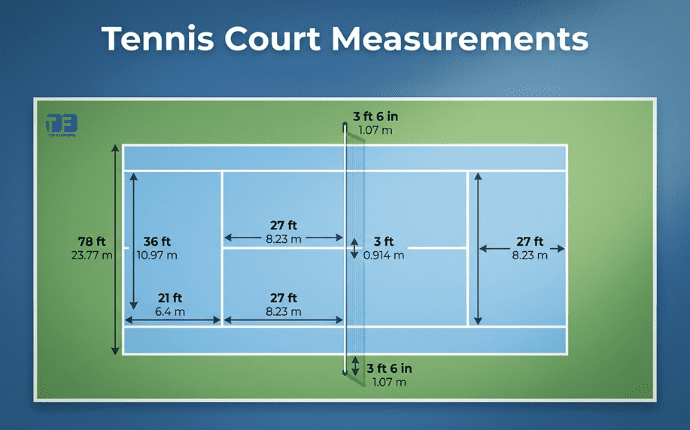
If you’re looking for a quick answer, here are the official dimensions of a standard tennis court.
| Measurement | Metric | Imperial |
| Court Length | 23.77 meters | 78 feet |
| Singles Court Width | 8.23 meters | 27 feet |
| Doubles Court Width | 10.97 meters | 36 feet |
| Service Line Distance from Net | 6.40 meters | 21 feet |
| Net Height (Center) | 0.914 meters | 3 feet |
| Net Height (Posts) | 1.07 meters | 3 ft 6 in |
These are the internationally recognized official tennis court dimensions used for recreational play, clubs, schools, academies, and professional tournaments.
Why Tennis Court Measurements Matter
Many people assume that building a tennis court simply requires enough open space. In reality, accurate tennis court measurements determine how enjoyable, safe, and professional the playing experience will be.
Proper court dimensions ensure:
- Consistent ball bounce
- Fair competition
- Better player movement
- Compliance with ITF standards
- Accurate court construction
- Efficient use of construction materials
- Proper fencing and lighting placement
Even a few inches of error can affect gameplay and make the court unsuitable for tournaments or competitive practice.
Official Tennis Court Dimensions
The International Tennis Federation has established precise standards that define the official tennis court dimensions used around the world.
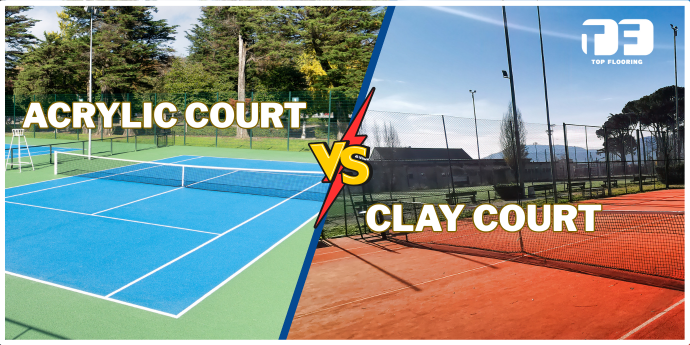
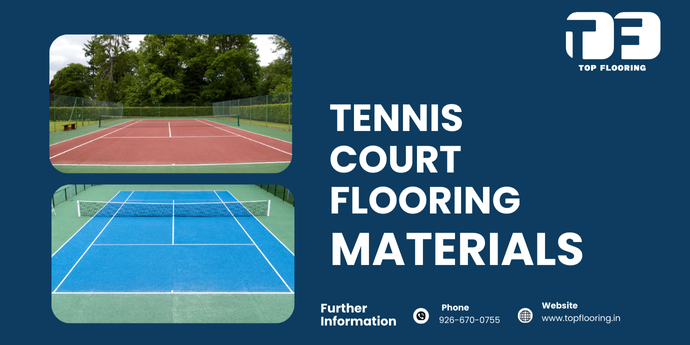
The playing surface remains the same regardless of whether the court is made using acrylic flooring, clay, grass, synthetic turf, or hard court materials.
Standard Tennis Court Dimensions
| Court Component | Size (Meters) | Size (Feet) |
| Overall Length | 23.77 m | 78 ft |
| Singles Width | 8.23 m | 27 ft |
| Doubles Width | 10.97 m | 36 ft |
| Distance from Net to Baseline | 11.885 m | 39 ft |
| Service Box Length | 6.40 m | 21 ft |
| Center Service Line | Divides Service Boxes | — |
These tennis court dimensions remain identical across professional Grand Slam venues, community courts, schools, sports academies, and residential installations.
Tennis Court Size in Meters
One of the most searched questions is:
What is the size of a tennis court in meters?
The official size of a tennis court in meters is:
- Length: 23.77 meters
- Singles Width: 8.23 meters
- Doubles Width: 10.97 meters
Although the doubles court is wider than the singles court, both formats use the same court length.
When constructing a new court, additional clearance around the playing area is recommended for safe movement and tournament compliance. This extra space accommodates player run-off, umpire chairs, fencing, and maintenance access.
Tennis Court Measurement in Feet
In countries like the United States and parts of Asia, dimensions are often referenced in imperial units. Understanding the tennis court measurement in feet is especially useful when reading construction plans or purchasing sports flooring materials.
Here are the standard measurements:
- Court Length – 78 feet
- Singles Court Width – 27 feet
- Doubles Court Width – 36 feet
- Distance from Baseline to Net – 39 feet
- Service Line Distance – 21 feet
- Net Height at Center – 3 feet
- Net Height at Posts – 3 feet 6 inches
Whether you work in metric or imperial units, both systems represent the same official specifications.
Tennis Court Layout Explained
Understanding the tennis court layout is just as important as knowing the dimensions. Each section of the court serves a specific purpose during play.
A standard tennis court consists of:
Baselines
Located at each end of the court, the baselines define the rear boundary. Players typically serve from behind the baseline and often rally close to it during baseline exchanges.
Singles Sidelines
These mark the playable width for singles matches.
Doubles Sidelines
The outer sidelines expand the court width for doubles matches, allowing four players to compete with additional lateral space.
Service Boxes
The area between the service line and the net is divided into four service boxes by the center service line. A legal serve must land diagonally in the opponent’s service box.
Center Service Line
This line divides the service area into left and right service courts.
Center Mark
A short mark at the center of each baseline helps players position themselves correctly while serving.
Every line plays an essential role in maintaining fair play and accurate officiating.
Singles vs Doubles Tennis Court Dimensions
Although both formats share the same court length, the width changes depending on the type of match being played.
| Feature | Singles | Doubles |
| Length | 23.77 m (78 ft) | 23.77 m (78 ft) |
| Width | 8.23 m (27 ft) | 10.97 m (36 ft) |
| Alley Width | Not Used | 1.37 m (4.5 ft) Each Side |
The additional space in doubles comes from the doubles alleys located on either side of the singles court.
These alleys increase the court width by approximately 2.74 meters (9 feet) overall.
Tennis Court Lines and Their Measurements
Accurate line markings are essential for gameplay and officiating. They determine whether a ball is in or out and guide player positioning throughout the match.
Baseline
- Width: Up to 10 cm (4 inches)
- Located at each end of the court
Sidelines
- Singles Sideline
- Doubles Sideline
These define the court boundaries depending on the format being played.
Service Line
Positioned:
- 6.40 meters (21 feet) from the net
This creates the service boxes used during serves.
Center Service Line
Runs perpendicular from the net to the service line and divides the service courts equally.
Center Mark
A short line measuring approximately 10 cm (4 inches) extends from the baseline toward the net, helping players align correctly before serving.
Proper line marking is especially important when using acrylic or synthetic sports flooring, as high-quality coatings improve visibility and durability.
Tennis Net Height and Pole Placement
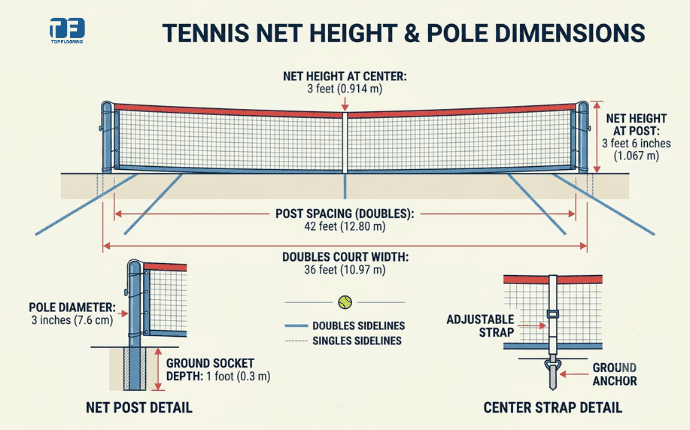
The tennis net is one of the most important components of the court and must meet official standards.
Official Net Height
| Location | Height |
| Center | 0.914 meters (3 feet) |
| Net Posts | 1.07 meters (3 feet 6 inches) |
The center strap keeps the net lower in the middle, ensuring consistent gameplay.
Pole Placement
- Singles matches may use singles sticks when playing on a doubles court.
- Net posts are positioned just outside the doubles sidelines.
- Proper post installation ensures the net remains correctly tensioned throughout play.
Key Takeaways
Understanding tennis court measurements is the foundation of proper court design and construction. Whether you’re measuring a recreational court or planning a professional facility, following the official tennis court dimensions ensures accurate gameplay, compliance with ITF standards, and long-term performance.
In this first part, we’ve covered:
- Official tennis court dimensions
- Tennis court size in meters and feet
- Complete tennis court layout
- Singles and doubles court measurements
- Line markings and their purpose
- Official net height and pole placement
In the next part, we’ll explore the total land area required for a tennis court, run-off space, dimensions of lawn tennis court, ITF construction guidelines, common measurement mistakes, FAQs, and expert tips for building a professional tennis court.
Total Space Required for a Tennis Court
While the official playing area measures 23.77 × 10.97 meters (78 × 36 feet) for doubles, this isn’t the total land required to build a tennis court. Players need additional space around the court to move safely, retrieve balls, and avoid collisions with fences or walls.
Recommended Total Tennis Court Area
| Court Type | Total Size (Meters) | Total Size (Feet) |
| Recreational Court | 34.75 × 17.07 m | 114 × 56 ft |
| Club & Tournament Court | 36.58 × 18.29 m | 120 × 60 ft |
This additional area is known as the run-off area or clearance zone and is an essential part of professional court construction.
Recommended Run-Off Space
- Behind each baseline: 6.40 meters (21 feet)
- Along each sideline: 3.66 meters (12 feet)
Adequate run-off space improves player safety and allows uninterrupted movement during fast-paced rallies.
Dimensions of Lawn Tennis Court
The dimensions of a lawn tennis court are exactly the same as those of any other standard tennis court. Whether the surface is natural grass, acrylic, clay, synthetic turf, or cushioned hard court, the playing dimensions remain unchanged.
Official Dimensions of Lawn Tennis Court
| Measurement | Meters | Feet |
| Length | 23.77 m | 78 ft |
| Singles Width | 8.23 m | 27 ft |
| Doubles Width | 10.97 m | 36 ft |
| Net Height (Center) | 0.914 m | 3 ft |
The primary difference lies in the playing surface rather than the dimensions. Grass courts offer faster ball speed and lower bounce, while acrylic hard courts provide consistent bounce with lower maintenance.
ITF Official Standards for Tennis Courts
The International Tennis Federation (ITF) establishes the standards used for tennis courts worldwide. Following these guidelines ensures that courts are suitable for recreational play, coaching, national competitions, and international tournaments.
Key ITF requirements include:
- Court Length: 23.77 meters (78 feet)
- Singles Width: 8.23 meters (27 feet)
- Doubles Width: 10.97 meters (36 feet)
- Net Height at Center: 0.914 meters
- Net Height at Posts: 1.07 meters
- Clearly visible white court markings
- Uniform surface with consistent ball bounce
- Proper court slope for water drainage
- Safe run-off areas surrounding the court
If you’re building a new court, following ITF standards helps ensure professional performance and future tournament compatibility.
Tennis Court Construction Tips
Correct tennis court measurements are only one part of a successful installation. The quality of Tennis Court construction, foundation, drainage, and surface materials also play a major role in court performance and durability.
1. Start with a Stable Base
A strong concrete or asphalt base prevents cracks and ensures a level playing surface.
2. Ensure Proper Drainage
Standing water can damage the court and reduce its lifespan. A slight surface slope and effective drainage system are essential.
3. Choose the Right Surface
Popular tennis court surfaces include:
- Acrylic hard courts
- Synthetic acrylic flooring
- Clay courts
- Natural grass
- Artificial grass
- Cushioned acrylic systems
The choice depends on budget, climate, maintenance requirements, and playing style.
4. Use High-Quality Sports Coatings
Premium acrylic coatings provide:
- UV resistance
- Anti-slip performance
- Consistent ball bounce
- Long-lasting color
- Low maintenance
5. Hire Experienced Tennis Court Builders
Professional contractors ensure accurate official tennis court dimensions, proper line markings, correct net installation, and long-term durability.

Common Mistakes While Measuring a Tennis Court
Many construction errors occur because measurements are taken incorrectly or important standards are overlooked.
Avoid these common mistakes:
- Measuring from the outside instead of the inside edge of the lines
- Forgetting to include run-off areas
- Incorrect service box dimensions
- Uneven court surface
- Improper net height
- Misaligned baselines or sidelines
- Poor drainage planning
- Using low-quality line marking paint
Taking accurate measurements before construction helps avoid costly repairs later.
Complete Tennis Court Measurement Table
For quick reference, here’s a summary of the official tennis court measurements.
| Component | Metric | Imperial |
| Court Length | 23.77 m | 78 ft |
| Singles Width | 8.23 m | 27 ft |
| Doubles Width | 10.97 m | 36 ft |
| Distance from Net to Baseline | 11.885 m | 39 ft |
| Service Line Distance | 6.40 m | 21 ft |
| Alley Width | 1.37 m | 4.5 ft |
| Net Height (Center) | 0.914 m | 3 ft |
| Net Height (Posts) | 1.07 m | 3 ft 6 in |
| Recommended Total Court Area | 36.58 × 18.29 m | 120 × 60 ft |
Final Thoughts
Understanding the official tennis court measurements is essential for anyone involved in tennis court construction, renovation, coaching, or facility management. From the tennis court size and tennis court layout to the size of a tennis court in meters, every measurement plays an important role in ensuring safe, fair, and professional gameplay.
Whether you’re building a residential court, a school sports facility, a club, or a tournament venue, following the official tennis court dimensions guarantees compliance with international standards and enhances the overall playing experience.
By combining accurate measurements with high-quality construction materials and proper installation techniques, you can create a tennis court that delivers excellent performance for many years.
Frequently Asked Questions
The official tennis court measures 23.77 meters (78 feet) in length. The width is 8.23 meters (27 feet) for singles and 10.97 meters (36 feet) for doubles.
The standard size of a tennis court in meters is:
Length: 23.77 meters
Singles Width: 8.23 meters
Doubles Width: 10.97 meters
A standard tennis court measures:
Length: 78 feet
Singles Width: 27 feet
Doubles Width: 36 feet
No. The dimensions of a lawn tennis court are identical to those of hard, clay, or synthetic courts. Only the surface material changes.
The tennis net is 3 feet (0.914 meters) high at the center and 3 feet 6 inches (1.07 meters) at the posts.